

On the night of July 30, 2026, the border fence at Ceuta stopped meaning anything. Spain’s Interior Ministry counted roughly 50,000 people crossing from Morocco into eight square miles of Spanish territory in about a day and a half.
At least 67 people died in the water and the crush. Madrid answered with a 500-metre floating barrier, an emergency EU appeal, and a phrase you rarely hear a European prime minister aim at a strategic partner: “a violation of Spain’s territorial sovereignty.”
Five weeks later, the crisis stopped being about migration at all. A leaked police report suggested Moroccan authorities planned and steered the crossing; a police note dated July 29 had warned of an “extreme risk” of a “coordinated” arrival a full day before the border collapsed.
The government insists there is no evidence “whatsoever” of Moroccan orchestration. The opposition says the government “knew it — and covered it up.” Crowds filled Spanish cities on September 2, and a former Socialist justice minister broke ranks with his own party on live television.
Here is what almost no one in Madrid is saying out loud: the border did exactly what the system was configured to let it do. Spain runs the euro area’s growth-leading large economy on top of a political core that stopped performing sovereignty functions in-house, and Ceuta is where the invoice landed. Call it the Rented-Border Trap.
⚡ Speed Run Notes
- Spain scores 7/10 on every economic engine variable (V15-V18) and grows at three times the euro-area pace, yet has not passed a new budget since 2023. The engine room outperforms the bridge.
- The Rented-Border Trap: Spain outsourced border enforcement to Morocco, energy goodwill to Algeria, and deterrence to EU frameworks. Each crisis raises the landlord’s rent.
- Morocco has now opened the migration valve twice: roughly 9,000 crossings in 2021, about 50,000 in 36 hours in 2026. The price of calm goes up every cycle.
- V10=5 tribalism is the pivot variable. The Ceuta crisis became a cover-up fight between blocs within days, which is exactly how a paralyzed system metabolizes external coercion.
- Eight famous reform packets fail Spain’s V-vector. The three worth studying include Spain’s own 1977 Moncloa playbook, Ireland’s Tallaght Strategy, and Finland’s dependency pivot.
Table of Contents
- About Yu-kai Chou
- Understanding Spain’s Governance Landscape Through Nationcraft
- What Is the Nationcraft Framework?
- Why This Spain Variables Analysis Matters
- The 18 Spain Nation Variables
- The Rented-Border Trap
- Detailed Justifications: Reading Spain Variable by Variable
- Strategic Implications
- Best-Match Historical Packets
- Governance Strategy Recommendations
- Comparative Context
- What This Means Practically for Spain Reform
- The Nationcraft Framework in Practice
- Frequently Asked Questions
About Yu-kai Chou

Yu-kai Chou is a Human-Systems Architect & Behavioral Designer and the creator of the Nationcraft Framework — an 18-variable diagnostic for matching a country’s structural profile to the reform packets that have historically worked under similar conditions. He has consulted for governments in eight nations, including Ukraine, the United Kingdom, the Kingdom of Bahrain, Singapore, Taiwan, the Netherlands, Kazakhstan, and South Korea, and has worked directly with President Zelenskyy’s team on post-war reconstruction priorities for Ukraine.
Chou’s prior framework — the Octalysis Framework — has been applied by LEGO, Microsoft, Porsche, Coca-Cola, Salesforce, and MrBeast, impacting over 1.5 Billion Users. He has taught the methodology at Harvard, Stanford, Yale, Tesla, Google, BCG, and IDEO.
His work has been cited by Harvard, Stanford, MIT, Forbes, Wall Street Journal, Wired, US Department of Energy, NIST, NSF, NCBI, US Department of Education, ClinicalTrials.gov, and Google Scholar — with 3,700+ more academic publications. Explore his books here.

This Spain analysis was written as the Ceuta crisis moved from border emergency to constitutional stress test. It applies the same 18-variable Nationcraft diagnostic used in advisory work for the Netherlands and the United Kingdom (two parliamentary systems whose fragmentation dynamics Spain increasingly shares) to a narrower question: which reform packets survive contact with a polity that grows at three times the euro-area pace but has stopped being able to pass a budget.
Understanding Spain’s Governance Landscape Through Nationcraft
Most coverage of Spain in September 2026 is asking who knew what on July 29. That is the right question for a parliamentary commission and the wrong question for anyone trying to understand why Spain keeps ending up here.
The Nationcraft Framework asks a different question: what kind of machine is Spain, and what happens when you feed this specific machine an external shock?
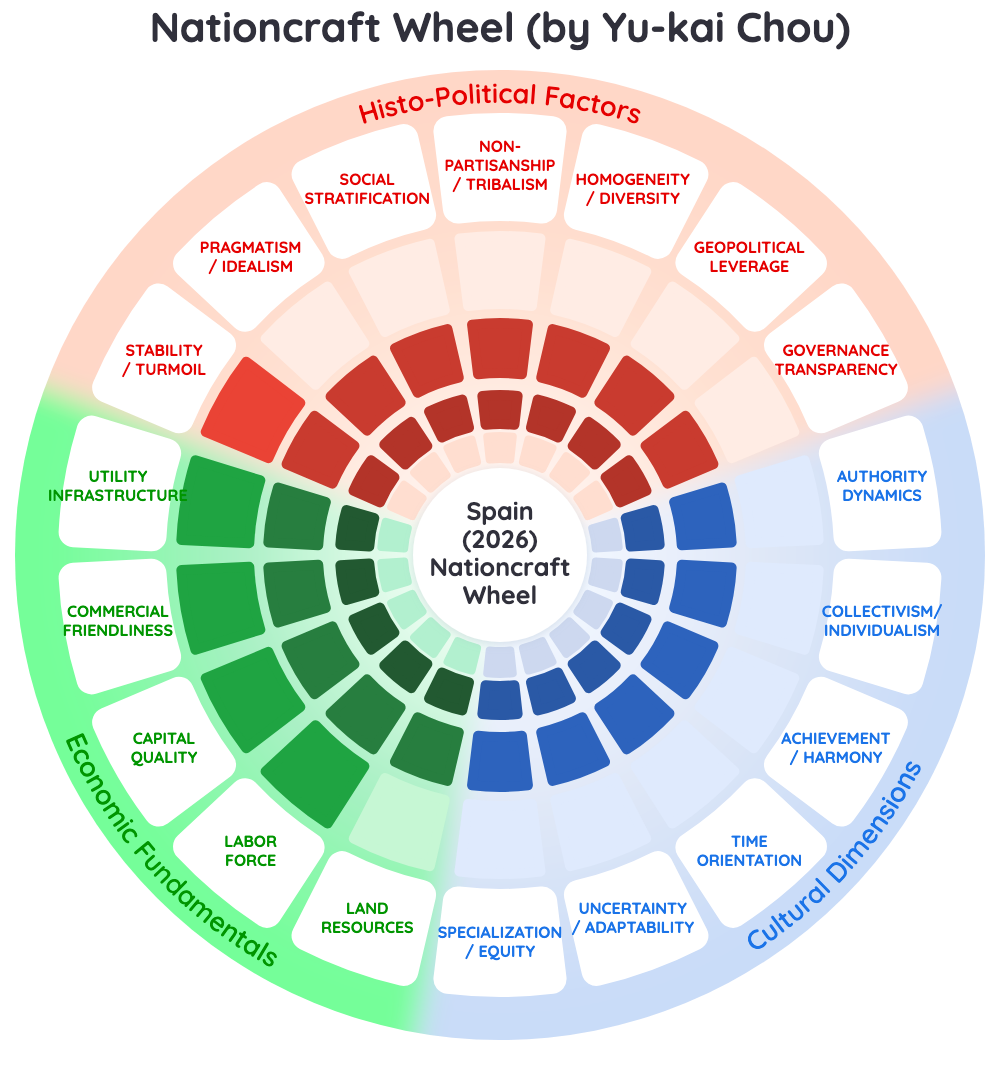
Spain’s machine has a strange shape. The economic deck runs hot: V15 (Labor Force Quality) at 7, V16 (Capital Quality) at 7, V17 (Commercial Friendliness) at 7, V18 (Utility Infrastructure) at 7.
Growth forecasts for 2026 sit between 2.2% and 2.6% depending on whether you ask the OECD, the Bank of Spain, or the government — roughly three times the euro-area pace. Tourism keeps breaking records, the AVE network is the longest high-speed rail system in Europe, and EU recovery funds are still landing.
Then you look at the political deck. V10 (Non-Partisanship vs Tribalism) sits at 5 and behaves worse. V11 (Homogeneity vs Diversity) at 5 encodes a state whose own territorial story is permanently contested. V1 (Authority Dynamics) at 6 describes intact state institutions above a government that commands no majority.
A country with this profile does not fail loudly. It fails quietly, by renting out the functions its politics cannot fund — and the Nationcraft ledger says the rent is compounding.
What Is the Nationcraft Framework?
The Nationcraft Framework is a diagnostic system that scores every country on 18 Nation Variables: six cultural (V1-V6), seven historical-political (V7-V13), and five economic (V14-V18), each on a 1-10 scale.
The scores are never averaged. Configuration is the strategy: a V1=8 society can run reform packets that a V1=4 society will spit out, regardless of how good the policy looks on paper.
Against that profile, Nationcraft matches Success Packets: documented historical reform programs, from Meiji Japan to the Celtic Tiger, each tagged with the variable preconditions that made it work. The method grew out of how Octalysis applies to nation-building, because a nation is ultimately a motivation system at scale.
Behavioral mechanics matter more here than most policy analysts admit. The same 8 Core Drives that power the Octalysis Framework in products govern whether 48 million people cooperate with a reform, ignore it, or burn it down.
The packet was real, the execution was competent, and the country still rejected it, because three variables in the profile said it would. Nationcraft starts from that observation.
Why This Spain Variables Analysis Matters
Spain is the fourth-largest economy in the euro area and the canon’s most cited proof that pacted transitions work. The 1975-1986 sequence (Political Reform Law, legalized opposition, the Moncloa Pacts, the 1978 Constitution) is filed in the Nationcraft corpus as SP-017, and half the democratization literature runs on it.
That is precisely why the 2026 stress test matters beyond Spain. If the country that wrote the pacted-transition packet can no longer execute a pact, every mid-V10 democracy should want to know which variable broke.
The stakes are also directly material. Three consecutive years without a new national budget means Spain is governing a 2026 economy on re-tabled 2023 spending priorities, while unemployment holds around 10% and the deficit still runs at 2.4% of GDP for 2025.
And the timing is unforgiving. Spain spent early 2026 refusing Washington the use of the Rota and Morón bases during the Iran war and closing its airspace to US operations, which bought moral clarity at the price of alliance capital — months before it needed friends on the Ceuta file.
Readers of the United States variable analysis will recognize the pattern of strong fundamentals leaking through a polarized political core. Spain runs the same leak at higher pressure, with a foreign landlord holding the valve.
The 18 Spain Nation Variables
Here is Spain’s full Nationcraft V-vector for 2026, drawn from the framework’s 147-country corpus and sanity-checked against current Freedom House, Transparency International, and IMF/OECD data.
| Variable | Name | Score | 2026 Reading |
|---|---|---|---|
| V1 | Authority Dynamics | 6/10 | Intact state authority (courts, monarchy, civil service) above a minority government with no chamber majority |
| V2 | Collectivism vs Individualism | 4/10 | Individualist-leaning society; strong family and regional sub-collectivism, weak national mobilization |
| V3 | Achievement vs Harmony | 5/10 | Balance culture with fiercely competitive niches: tourism, renewables, agro-export |
| V4 | Time Orientation | 6/10 | Long-cycle infrastructure delivery coexisting with quarter-to-quarter political survival |
| V5 | Uncertainty & Adaptability | 6/10 | Absorbed COVID, the 2024 floods, and the 2025 blackout without institutional rupture |
| V6 | Specialization vs Equity | 5/10 | Welfare-state equity default alongside strong specialized clusters |
| V7 | Stability vs Turmoil | 7/10 | Deep institutional stability under loud political noise; three budget-less years without breakdown |
| V8 | Pragmatism vs Idealism | 6/10 | The pacted-transition inheritance, increasingly overridden by bloc ideology |
| V9 | Social Stratification | 6/10 | Mid-band EU inequality; youth precarity and housing stress as the live fault line |
| V10 | Non-Partisanship vs Tribalism | 5/10 | Bloc-vs-bloc politics; every external shock becomes an internal legitimacy fight |
| V11 | Homogeneity vs Diversity | 5/10 | Plurinational state; territorial identity is permanently contested political terrain |
| V12 | Geopolitical Leverage | 5/10 | EU/NATO floor eroding at the margins: US rift over Iran-war basing, Morocco border pressure, Algeria treaty frozen |
| V13 | Governance Transparency | 6/10 | Mid-tier EU transparency; prosecutors jailing the PM’s inner circle cuts both ways |
| V14 | Land Resources | 5/10 | Heavy solar/wind endowment and agriculture against structural water stress |
| V15 | Labor Force Quality | 7/10 | Skilled, educated workforce carrying a structural-unemployment overhang near 10% |
| V16 | Capital Quality | 7/10 | Deep banking system, EU funds inflow, functioning capital markets |
| V17 | Commercial Friendliness | 7/10 | Open EU market economy; 17-region regulatory layering is the drag |
| V18 | Utility Infrastructure | 7/10 | Europe’s longest high-speed rail network, top-tier ports, aggressive renewables build-out |
Read the vector as two decks. The economic deck runs V15=7, V16=7, V17=7, and V18=7, with V14=5 as the drag.
A full band lower sits the political core (V1=6, V10=5, V11=5, V12=5), the deck that decides whether a state can perform sovereignty under pressure.
The Rented-Border Trap
Every named Nationcraft paradox is a specific variable interaction, and Spain’s is one of the cleanest in the corpus. The Rented-Border Trap: a state whose engine room (V15-V18 at 7) generates enough prosperity to paper over a political core (V10=5, V11=5, V1=6) that cannot pay the domestic cost of hard sovereignty functions, so it rents them from outside.
Border enforcement is rented from Morocco, which has policed the approaches to Ceuta and Melilla under cooperation arrangements Spain pays for in money, trade positioning, and diplomatic concessions. Energy goodwill was rented from Algeria until the 2022 Western Sahara pivot froze the friendship treaty. Strategic deterrence is rented from EU and NATO frameworks that Spain publicly split from during the 2026 Iran war.
Renting is rational for a fragmented polity. Doing these functions in-house means defense budgets, border infrastructure, energy diversification, and migration frameworks that all require parliamentary majorities Spain has stopped producing.
The trap sits in the pricing: a landlord who knows you cannot move raises the rent, and the record shows exactly that curve.
| Year | Event | The rent goes up |
|---|---|---|
| 2021 | Spain hosts Polisario leader Brahim Ghali for medical treatment; roughly 9,000 people cross into Ceuta in days, including over 1,200 unaccompanied minors | Madrid learns the border opens when Rabat is displeased; a Spanish minister calls it “blackmail” |
| 2022 | Sánchez reverses decades of neutrality and endorses Morocco’s autonomy plan for Western Sahara | Calm is repurchased at the price of Algeria suspending its friendship treaty with Spain |
| 2022 | Mass fence attempt at the Melilla perimeter ends in dozens of deaths | The enclaves stay Europe’s deadliest land border while cooperation deepens |
| 2026 | July 30-31: the Ceuta border effectively collapses; ~50,000 cross in about 36 hours, at least 67 die | A July 29 police note warned of a “coordinated” arrival; leaked papers show Moroccan security officers present as the crossing unfolded |
| 2026 | September: leak crisis, street protests, parliamentary siege of the government | The bill is now paid in regime legitimacy rather than policy concessions |
The calm Spain buys from Rabat is purely extrinsic — paid-for compliance with none of the internalized alignment that makes cooperation durable, the exact fragility described in intrinsic and extrinsic motivation research. Withdraw the payment, or let the payer look weak, and the behavior reverts instantly.
And the political core cannot respond, because V10=5 guarantees that any external coercion is immediately reprocessed as domestic ammunition. Within 72 hours of the leak, the story in Madrid was no longer “Morocco coerced Spain.” It was “the government lied,” versus “the right is weaponizing a tragedy” — which is precisely the reflex the landlord is counting on.
Detailed Justifications: Reading Spain Variable by Variable
The cultural deck (V1-V6): a society that cooperates locally and fragments nationally
V1 (Authority Dynamics) at 6 carries a distinction most readings skip. The Spanish state retains real authority: courts convict sitting attorneys general, the monarchy anchors continuity, the civil service delivers.
What V1=6 will not deliver is deference to a weak executive. A minority government borrowing votes from six parties cannot convert state authority into governing authority, and 2026 is the proof.
V2 (Collectivism vs Individualism) at 4 explains why Spain mobilizes fast at the local and regional scale (see the volunteer response to the 2024 Valencia floods) while national-level collective projects stall. Loyalty pools in the family, the city, the autonomous community, and only then, weakly, in Madrid.
V3 (Achievement vs Harmony) at 5 and V6 (Specialization vs Equity) at 5 describe a balance culture: Spain protects weekends and pensions while running globally competitive tourism, renewables, and agro-export clusters.
V4 (Time Orientation) at 6 shows up in the AVE map, a 30-year infrastructure commitment no single government could have delivered. V5 (Uncertainty & Adaptability) at 6 was earned the hard way: pandemic, blackout, floods, all absorbed without rupture.
The historical-political deck (V7-V10): stability without capacity
V7 (Stability vs Turmoil) at 7 looks paradoxical under headlines about jailed aides and besieged ministers. It is accurate: elections and transfers of power run on schedule, and the debt gets serviced.
Spain has turned stability into a substitute for capacity. The system is stable enough to survive not deciding anything, which removes the forcing function that turmoil provides in lower-V7 states.
V8 (Pragmatism vs Idealism) at 6 is the fading signature of the transition generation. The Moncloa Pacts were pragmatism under existential pressure; the 2026 bloc system increasingly treats every negotiation as identity betrayal.
V9 (Social Stratification) at 6 hides the generational cliff. Youth unemployment and housing costs have produced a cohort with weak ownership stakes in the system, the classic precondition for the resignation loop described in learned helplessness research: repeated demonstrations that your input does not change outcomes teach you to stop inputting.
Everything in this diagnosis routes through V10 (Non-Partisanship vs Tribalism) at 5. Spain has not passed a fresh budget since 2023 because the blocs will not lend each other legitimacy even at zero policy cost.
For calibration, the Nationcraft corpus flags full Governance Paralysis (pattern ST-003) at V10≤3. Spain at V10=5 is above the threshold and drifting toward it, which is the correct way to read September 2026: a warning shot from the pattern, taken while there is still time to reverse.
The sovereignty deck (V11-V13): the contested self
V11 (Homogeneity vs Diversity) at 5 encodes Spain’s plurinational reality: Catalonia, the Basque Country, Galicia, and a foreign-born population near a fifth of the total. Diversity is a genuine asset in Spain’s labor market and culture.
It is a liability in exactly one place: sovereignty narration. A state whose own territorial story is contested at home defends distant enclaves with a divided voice, and adversaries can hear the division.
V12 (Geopolitical Leverage) at 5 enables the trap. Spain holds real cards (EU membership, NATO geography, the Rota base, gas interconnections), yet 2026 found it simultaneously estranged from Washington over Iran-war basing, from Algiers over Western Sahara, and from Rabat over the border itself.
Spain let three leverage positions expire in the same year. When the Ceuta valve opened, the EU response Sánchez himself called “selfish” was the sound of leverage that had not been maintained.
V13 (Governance Transparency) at 6 is genuinely two-sided in 2026. The state’s accountability machinery works: the PM’s former organization secretary sits in pre-trial detention and the attorney general was convicted by the Supreme Court.
Aimed at the inner circle of a sitting government, that same machinery converts every institutional act into bloc warfare fuel — transparency without trust amplifies V10 damage instead of repairing it.
The economic deck (V14-V18): the engine that hides the leak
V15 (Labor Force Quality) at 7, V16 (Capital Quality) at 7, V17 (Commercial Friendliness) at 7, and V18 (Utility Infrastructure) at 7 are why Spain leads euro-area growth at 2.2-2.6% for 2026 while its politics burns.
V14 (Land Resources) at 5 nets exceptional renewables endowment against water stress that climate pressure keeps tightening.
The engine deck camouflages the trap. Because tourists keep arriving, EU funds keep flowing, and Santander keeps lending, there is no economic pain signal forcing the political core to reform — the leak only becomes visible when a landlord yanks the border, and by then the response window is measured in days.
Strategic Implications
Three strategic conclusions fall straight out of the vector.
First, Spain’s binding constraint is political throughput, measured in majorities per year. Any reform program that requires more than one or two parliamentary majorities to sequence is dead on arrival under V10=5, no matter how sound the economics.
Second, the external dependencies are now the primary attack surface. Morocco has demonstrated twice that Spain’s border is a dial it can turn, and V12=5 means Spain currently lacks the alliance capital to make turning it expensive.
Third, the economic engine buys time and nothing else. V15-V18 at 7 can fund a sovereignty rebuild; the 2.2-2.6% growth differential is exactly the fiscal space a serious government would spend on de-renting the border, the energy portfolio, and the alliance ledger.
Time bought and not spent is how the Nationcraft corpus describes every slow-motion trap in the library, and Spain’s clock is running against its own drift toward the ST-003 signature.
Best-Match Historical Packets
The Nationcraft corpus stores reform programs as Success Packets with explicit variable preconditions. Run Spain’s 2026 vector against the library and the sorting is brutal: the packets everyone reaches for fail on the political core, and the ones that fit point somewhere uncomfortable.
| Packet | Program (country, years) | Key preconditions | Spain 2026 fit |
|---|---|---|---|
| SP-001 | Meiji Open Reform (Japan, 1868-1912) | V1=10, V11=9 | REJECT: top-down homogeneous modernization |
| SP-002 | Lee Kuan Yew Industrialization (Singapore, 1965-1990) | V1 authority, city-state scale | REJECT: non-replicable control surface |
| SP-003 | Deng Xiaoping Open Reform (China, 1978-2000) | V1=10, single-party sequencing | REJECT: political system unavailable |
| SP-078 | Carnation Revolution & EU Integration (Portugal, 1974-1986) | EU accession as external anchor | REJECT: the accession card is already spent |
| SP-089 | Baltic Tiger Transformation (Lithuania, 1990s-2000s) | Young state, blank institutional slate | REJECT: Spain is a consolidated welfare state |
| SP-108 | Rogernomics Radical Liberalization (New Zealand, 1984-1993) | Cabinet unity, majoritarian system, V13=9 | REJECT: minority coalition cannot blitz |
| SP-109 | 1990s Banking Crisis Consolidation (Sweden, 1990-1996) | V10=9, V13=9 cross-party trust | REJECT: assumes the one variable Spain lacks |
| SP-112 | Wassenaar Consensus Labor Packet (Netherlands, 1982-1995) | V10=8, V2=7 corporatist machinery | REJECT: tripartite trust infrastructure absent |
| SP-017 | Post-Franco Transition (Spain, 1975-1986) | Existential pressure, pact discipline, EU anchor | STUDY: Spain’s own packet, mechanism intact |
| SP-016 | Celtic Tiger (Ireland, 1987-2007) | Tallaght opposition compact, V8=8 pragmatism | STUDY: the gridlock-breaking mechanism transfers |
| SP-110 | Post-Soviet Nokia Miracle (Finland, 1991-2000) | V15=9, V4=8, invest-through-crisis nerve | STUDY: the dependency-pivot mechanism transfers |
Eight reformer playbooks Spain should reject
The rejections matter as much as the fits, because each one is a policy fantasy currently circulating in Madrid in some costume.
SP-001 Meiji: the strong-hand fantasy
Meiji Japan ran V1=10 authority acceptance and V11=9 homogeneity; reformers could impose modernization top-down and society absorbed it. Spain’s V1=6 above V11=5 plurality means any strong-hand program triggers territorial resistance before it triggers modernization — the fantasy of “a government that finally decides” fails at the first Basque or Catalan veto point.
SP-002 Lee Kuan Yew: the technocrat fantasy
The LKY packet is the most requested item in the library and the least transferable. Singapore paired exceptional governance with a control surface no 48-million-person plurinational democracy possesses, as the Singapore LKY Packet stress test documents even for Singapore’s own next decade. Spain cannot hire its way into V1=7 authority.
SP-003 Deng: the gradualist-command fantasy
Deng’s sequencing genius (agriculture before industry, coastal before inland) ran on single-party continuity across decades. Spain’s median government now survives on borrowed votes with a 2027 election clock; no Spanish executive can promise year 12 of anything.
SP-078 Carnation Revolution: the spent anchor
Portugal’s packet worked because EU accession functioned as an external disciplining anchor that every domestic faction wanted. Spain already used that anchor in 1986. You cannot join Europe twice, and no substitute anchor of equal gravity currently exists on offer.
SP-089 Baltic Tiger: the blank-slate fantasy
Lithuania and its neighbors rebuilt institutions from scratch with nothing to defend. Spain’s consolidated welfare state means every reform touches an entrenched beneficiary with lawyers; the Baltic speed run is unavailable to a state with this much accumulated structure.
SP-108 Rogernomics: the blitz fantasy
New Zealand’s 1984 liberalization moved at shock speed through a unified cabinet in a majoritarian system with V13=9 transparency. Spain’s minority coalition cannot sustain a blitz for a single legislative week — the partners would harvest the backlash before the benefits landed.
SP-109 Swedish consolidation: the consensus fantasy
Sweden’s 1990s bank rescue and fiscal repair is the packet Spanish technocrats cite most, and its preconditions are the exact inversion of Spain’s political core: V10=9 non-partisanship and V13=9 transparency made cross-bloc guarantees credible. Prescribing Swedish-style consensus to a V10=5 system means prescribing the missing precondition as if it were the plan.
SP-112 Wassenaar: the corporatist fantasy
The Dutch tripartite pact traded wage restraint for work-time innovation and ended Dutch Disease unemployment. It required standing corporatist machinery — unions, employers, and government inside one negotiating institution with V10=8 trust. Spain’s social partners can sign individual deals, and have, yet the standing trust infrastructure that made Wassenaar compound over 13 years does not exist at V10=5.
Three playbooks Spain should actually study
SP-017 Post-Franco Transition: Spain’s own packet, read correctly
Spain’s highest-fit packet sits under its own name in the library. The 1977 Moncloa Pacts brought communists, conservatives, and everyone between them to one table under existential pressure and produced wage moderation, tax reform, and a constitutional settlement inside 24 months.
Read correctly, SP-017 is a mechanism: pressure made legible. Every faction understood that the alternative to a pact was losing the whole game.
The 2026 application writes itself. A hostile power steering 50,000 people through your border in 36 hours is exactly the caliber of existential pressure that priced the original pacts — a Moncloa II scoped to sovereignty functions (border, energy, alliance posture, and a budget to fund them) is the single highest-fit reform program available to Spain, because it is the one program Spain has already proven it can run.
SP-016 Celtic Tiger: the Tallaght mechanism
Ireland 1987 faced debt at 120% of GDP and 17% unemployment with adversarial two-bloc politics. The unlock was the Tallaght Strategy: the opposition leader announced his party would support the government’s stabilization program from the opposition benches, without joining the government.
That single move broke the legitimacy-lending deadlock that V10-constrained systems cannot otherwise escape, and everything else (social partnership, the FDI machine) compounded from it. The transferable piece for Spain is not the corporate tax rate; it is a Spanish Tallaght on three named files, offered publicly so defection carries a price.
SP-110 Finland’s Nokia Miracle: the dependency pivot
Finland 1991 lost a quarter of its trade overnight when the Soviet market vanished; GDP fell 13% and unemployment ran from 3% to 20%. The response was the opposite of austerity instinct: R&D spending pushed to 3.5% of GDP through the worst of the crisis, and a decade later Finland was a knowledge economy.
Spain’s dependency profile is milder and the lesson transfers cleanly: when a single external counterparty can shock your system, you spend through the pain to build alternatives. For Spain that means border capacity, energy interconnection, and Sahel diplomacy funded now, at 7-tier V16 capital quality, while the growth differential lasts.
Governance Strategy Recommendations
Nationcraft recommendations are sequenced against the vector, never against the wish list. Spain’s sequence has to respect one constraint above all: at V10=5, majorities are the scarcest resource in the country, so every recommendation is designed to need as few of them as possible.
| Priority | Move | Variables engaged | Packet source |
|---|---|---|---|
| 1 | Publish the full Ceuta evidence file to a cross-party commission with a fixed 90-day mandate. Truth established jointly is the only antidote to a leak war. | V13, V10 | SP-017 (pact preconditions) |
| 2 | A “Tallaght offer” on three named files: border capacity, energy interconnection, defense posture. Opposition support from the benches, publicly announced, no coalition entry. | V10, V1 | SP-016 |
| 3 | Moncloa II scoped to sovereignty only: one pact covering border infrastructure, Sahel diplomacy, alliance repair, and the budget line that funds all three. | V10, V12, V8 | SP-017 |
| 4 | Spend the growth differential on de-renting: Frontex-plus arrangements, LNG and interconnector build-out, restored working relations with Washington and Algiers. | V12, V16, V18 | SP-110 |
| 5 | Give the under-35 cohort a visible ownership stake (housing supply acceleration, contribution-linked benefits) before resignation hardens into exit. | V9, V2 | SP-110 (invest-through-crisis logic) |
No grand constitutional reform, no federal redesign, no ideological program of either bloc: at this V-vector those are decade-long fights Spain cannot schedule, and the trap compounds on a shorter clock.
Comparative Context
Spain’s configuration is common enough in 2026 Europe that the corpus reads like a support group. The France Fragmentation Trap analysis shows the same pattern one notch worse: a hung assembly converting every reform into a survival vote.
The Germany Consensus Trap analysis is the inverted case, a machine built so completely around consensus that it cannot move fast even when unified. Spain fails at the earlier step: it cannot form the consensus at all.
The Greece Discipline Window analysis shows what an external anchor does to a Mediterranean V-vector when the anchor holds, and what leaks back when it lifts. The Hungary Two-Thirds Trap analysis demonstrates the opposite resolution of fragmentation: eliminating it by capturing the state, at ruinous cost to V13.
And the Bosnia Dayton Deadlock analysis is the terminal case study: a constitution that institutionalized its blocs so thoroughly that governance paralysis became the operating system. Spain is many notches above Bosnia on every variable, and the direction of drift is the same, which is the point of reading them side by side.
What This Means Practically for Spain Reform
For officials, the practical translation of this Nationcraft read is about behavioral design as much as policy design. A sovereignty pact needs an epic frame to survive bloc politics: the 1977 negotiators sold the transition as founding a nation, a Core Drive far stronger than budget line items, and the mechanics of that appeal are mapped in Core Drive 1: Epic Meaning & Calling.
Loss already frames the moment. Nothing concentrates a polarized parliament like the demonstrated ability of an outside power to open your border on demand; the design task is keeping attention on the shared loss rather than the partisan one, the dynamic detailed in Core Drive 8: Loss & Avoidance.
And any pact must be socially expensive to defect from. Tallaght worked because the commitment was public: walking it back meant visible betrayal, the mechanism described in Core Drive 5: Social Influence & Relatedness. Private understandings between Spanish party leaders will not survive the first news cycle.
For investors and analysts, the practical read is simpler. Spain’s economic deck (V15-V18 at 7) is real and durable; the tail risk lives entirely in the political core, and its leading indicator is whether any cross-bloc instrument appears on the sovereignty files by mid-2027.
Watch for a budget. Spain’s first new budget since 2023 will say more about trap escape than any speech.
The Nationcraft Framework in Practice
This analysis ran the standard Nationcraft sequence: profile the 18 variables, name the paradox the configuration produces, then filter the Success Packet library against the preconditions the vector actually satisfies.
The Spain case shows the framework’s core discipline better than most, because the seductive packets (Swedish consensus, Dutch corporatism, technocratic blitz) all fail on a single variable, and the highest-fit packet was sitting in Spain’s own history the whole time.
That is the Nationcraft bet in one sentence: countries do not need better policies nearly as often as they need policies matched to their variables.
Spain wrote one of the canon’s founding packets in 1977. The question September 2026 asks is whether the machinery that wrote SP-017 still runs, and the honest answer is that the mechanism survives while its precondition, legible shared pressure, is being actively dissolved by the bloc reflex.
Ceuta made the pressure legible again.
Closing
The Rented-Border Trap has a defined exit, and Spain has walked it before: convert external coercion into pact pressure, buy back the outsourced functions with the growth dividend, and let the engine deck fund the political repair instead of masking its absence.
Every month the leak war continues, the rent goes up. The landlord is watching the blocs fight, and the meter is running.
Explore More Nationcraft Analyses
The full Nation Variables Library holds every published country diagnostic in this series. For adjacent stress tests of strong-fundamentals states, read the Taiwan Silicon Shield analysis, the South Korea Post-Martial Trap analysis, and the UK Reform Surge analysis.
Related Reading
- The Nationcraft Framework: 18 Variables, 8 Goals, 100+ Proven Reform Packets
- Nationcraft Nation Variables Library
- Nationcraft Analysis: Sweden Trust Overdraft 2026
- Nationcraft Analysis: Bulgaria Euro Anchor Trap 2026
- Nationcraft Analysis: Poland Liberum Veto Trap 2026
Frequently Asked Questions
What is the Rented-Border Trap in Spain’s Nationcraft analysis?
The Rented-Border Trap is the named paradox in Spain’s 2026 Nationcraft profile: a state with 7-tier economic variables (V15-V18) and a mid-tier political core (V10=5, V11=5, V1=6) that outsources hard sovereignty functions, principally border enforcement to Morocco, because its fragmented politics cannot fund them domestically. Each crisis lets the external partner raise the price, and the polarized system pays in legitimacy rather than policy.
Why does Nationcraft rate Spain’s political core so much lower than its economy?
Spain’s economic variables reflect measurable performance: euro-area-leading growth, deep capital markets, Europe’s longest high-speed rail network. The political core scores reflect equally measurable dysfunction: no new national budget since 2023, a governing coalition that lost its parliamentary partner in October 2025, and a party system that converts every external shock into a bloc-versus-bloc legitimacy fight within days.
Did Morocco deliberately cause the 2026 Ceuta crisis?
That is contested and formally uninvestigated territory. A leaked police report and a July 29 police note warning of a “coordinated” arrival suggest orchestration; Spain’s National Police leadership says there is no evidence “whatsoever,” and the government blames smuggler networks. The Nationcraft point stands either way: Morocco demonstrated in 2021 that the border responds to bilateral displeasure, and a state that rents its border security has structurally invited the ambiguity.
Which reform packets fit Spain’s 2026 V-vector?
Three from the Success Packet library: SP-017, Spain’s own Post-Franco Transition packet, whose Moncloa Pact mechanism converts existential pressure into cross-party settlement; SP-016, Ireland’s Celtic Tiger packet, whose Tallaght Strategy shows how an opposition can lend legitimacy without entering government; and SP-110, Finland’s post-Soviet pivot, which models spending through a dependency shock to build alternatives. Eight celebrated packets, including Swedish 1990s consolidation and the Dutch Wassenaar pact, fail Spain’s preconditions.
Is Spain heading toward full governance paralysis?
Not yet by the corpus definition. The Governance Paralysis pattern (ST-003) triggers at V10≤3 with ideological rigidity at V8≤3; Spain sits at V10=5 and V8=6. The 2026 reading is drift toward the signature rather than arrival, which is exactly when the Tallaght and Moncloa mechanisms still work. Waiting until the thresholds are met is how the window closes.
Footnotes
- Euronews, “Spanish government in turmoil as Ceuta crisis deepens,” September 3, 2026. euronews.com
- Euronews, “Spain government in disarray as conflicting reports swirl over Morocco’s role in Ceuta,” September 2, 2026. euronews.com
- Al Jazeera, “Spain installs floating barrier off Ceuta after deadly migrant crossings,” August 1, 2026. aljazeera.com
- Al Jazeera, “At least 18 die as thousands cross from Morocco into enclave of Ceuta,” July 30, 2026. aljazeera.com
- NPR, “At least 18 die after breach of border between Morocco and Spanish territory of Ceuta,” July 31, 2026. npr.org
- CNN, “Spanish leader slams ‘selfish’ EU response as death toll from Ceuta crossings climbs,” July 31, 2026. cnn.com
- The Conversation, “Ceuta’s border crisis is about geopolitics, not just migration,” August 2026. theconversation.com
- Al Jazeera, “Ceuta and Melilla: Why Europe’s African border remains a flashpoint,” August 5, 2026. aljazeera.com
- Wikipedia, “2021 Morocco–Spain border incident.” en.wikipedia.org
- Il Sole 24 Ore, “Spain weathering global crises: GDP set to grow by 2.6% in 2026.” ilsole24ore.com
- Catalan News, “Spain raises 2026 GDP growth forecast to 2.6% despite war uncertainty.” catalannews.com
- Goldman Sachs Insights, “Why Spain’s economy is growing three times faster than the euro area.” goldmansachs.com
- GBC News, “Junts withdraws support for PSOE government,” October 2025. gbc.gi
- Anadolu Agency, “Spanish prime minister’s ex-right-hand man jailed on corruption charges,” June 2025. aa.com.tr
- Spain in English, “Spain’s Attorney General suspended for 2 years, after being found guilty of leak in tax fraud case,” November 20, 2025. spainenglish.com
- Al Jazeera, “Spain refuses to let US use bases for Iran attacks,” March 2, 2026. aljazeera.com
- Al Jazeera, “Spain closes airspace to US planes involved in war on Iran,” March 30, 2026. aljazeera.com