

On September 6, 2026, two American envoys walked into Kyiv for the first time since the full-scale invasion began, one day after spending three hours with Vladimir Putin in Moscow. For 72 hours, the missiles mostly stopped.
Then the envoys left, and the strikes on Kyiv resumed within a day.[1]
That one week compresses the entire Ukrainian predicament. Everything Ukraine needs to rebuild — $524 billion in assessed recovery needs, €210 billion in frozen Russian central bank assets, a reparations loan the size of a mid-tier European economy — sits in escrow behind a settlement whose terms are being drafted in rooms Ukraine only sometimes occupies.[2][3]
I call this configuration the Escrowed Recovery Trap. Reconstruction capital usually arrives after wars end; Ukraine’s is being negotiated, itemized, and legally contested while the war is still killing people every week.
The variables that would let Ukraine absorb Marshall-Plan-scale capital at Marshall-Plan-level efficiency (the V2=8 cohesion and V5=8 adaptability the scorecard below documents) are partly products of the war itself.
The money arrives, if it arrives, at the exact moment the configuration that could deploy it starts to decay.
This analysis runs Ukraine’s September 2026 profile through all 18 Nation Variables, names what the vector permits and what it forbids, and tests nine historical reform packets against it. Five famous ones fail, four fit, and the difference decides whether $524 billion ends up looking more like West Germany in 1955 or Afghanistan in 2021.
⚡ Speed Run Notes
- Ukraine’s rebuild is being negotiated before its war has ended: $524B in assessed needs, €210B in frozen Russian assets, and a live peace process deciding which unlocks first.
- The Escrowed Recovery Trap: capital arrives only at peace, but the cohesion that would absorb it (V2=8, V5=8) is partly a product of the war. The asset starts decaying as the check clears.
- SP-117 already proved deep reform survives invasion: Ukraine’s own 2014-2022 packet moved transparency from the low 2s to today’s 4. The open question is whether it survives armistice politics.
- Packet math: Wirtschaftswunder, Israel 1948, Estonia digital, and Croatia’s war-to-EU path fit Ukraine’s vector. Shock therapy, CPA Iraq, Afghan aid saturation, Dayton, and garrison stabilization fail it.
- One tell prices everything: do the anti-corruption agencies keep reaching upward while the money waits in escrow? Funders read each case as a live quote on absorption capacity.
Table of Contents
- Understanding Ukraine’s Governance Landscape Through Nationcraft
- What Is the Nationcraft Framework?
- The 18 Ukraine Nation Variables
- The Escrowed Recovery Trap
- Detailed Justifications: The Variables Doing the Work
- Best-Match Historical Packets for Ukraine’s Rebuild
- Governance Strategy Recommendations
- Strategic Implications
- Comparative Context: Ukraine Among Its Analogs
- The Nationcraft Framework in Practice
- Frequently Asked Questions
About Yu-kai Chou

Yu-kai Chou is a Human-Systems Architect & Behavioral Designer and the creator of the Nationcraft Framework — an 18-variable diagnostic for matching a country’s structural profile to the reform packets that have historically worked under similar conditions. He has consulted for governments in eight nations, including Ukraine, the United Kingdom, the Kingdom of Bahrain, Singapore, Taiwan, the Netherlands, Kazakhstan, and South Korea, and has worked directly with President Zelenskyy’s team on post-war reconstruction priorities for Ukraine.
Chou’s prior framework — the Octalysis Framework — has been applied by LEGO, Microsoft, Porsche, Coca-Cola, Salesforce, and MrBeast, impacting over 1.5 Billion Users. He has taught the methodology at Harvard, Stanford, Yale, Tesla, Google, BCG, and IDEO.
His work has been cited by Harvard, Stanford, MIT, Forbes, Wall Street Journal, Wired, US Department of Energy, NIST, NSF, NCBI, US Department of Education, ClinicalTrials.gov, and Google Scholar — with 3,700+ more academic publications. Explore his books here.

This Ukraine analysis is the one in the series closest to Chou’s own desk: alongside the advisory work named above, he co-founded reSTATE, a venture dedicated to rebuilding Ukraine — the vantage point this analysis is written from.
Understanding Ukraine’s Governance Landscape Through Nationcraft
Start with what actually happened in the first week of September 2026, because the details matter more than the headlines.
Jared Kushner and Steve Witkoff met Putin in Moscow on September 5 for over three hours. The next day they were in Kyiv, their first wartime visit, for three rounds of talks with President Zelenskyy, with the national security advisers of the UK, France, and Germany joining the final session.[1][4]
Zelenskyy came out of the talks repeating the two conditions he has held since the 28-point plan of November 2025 was cut down to 19 points in Geneva: security guarantees, and what he calls a dignified peace.[5][6]
Meanwhile the machinery of state grinds on under rules no other European country operates under. Martial law has been extended for the 20th time, through October 31, 2026.
National elections remain constitutionally barred while it holds, and the parties in the Rada have agreed the first post-war vote comes no earlier than six months after it lifts.
A new prime minister, Serhii Koretskyi, took office in July 2026. The parliament elected in 2019 is still seated.
This is a government running a war, a reform program, and an EU accession bid simultaneously, on an extended mandate.
The standing Nation Variable Analysis: Ukraine (2026) page scored all 18 variables and named the country’s core configuration the Spartan Paradox: socially anti-fragile, materially terminal.
This post is the September 2026 sequel to that scorecard. The configuration has not changed.
What changed is that the money is now on the table, and the table has lawyers around it.
What Is the Nationcraft Framework?
For readers arriving from the policy world rather than the gamification world: the Nationcraft Framework is an 18-variable diagnostic for matching a country’s structural profile to the historical reform packets that worked under similar conditions.
The central claim is that policy effectiveness is decided by context-fit, and only secondarily by policy quality. A reform that transformed one nation can be inert or destructive in another, because the receiving configuration is different.
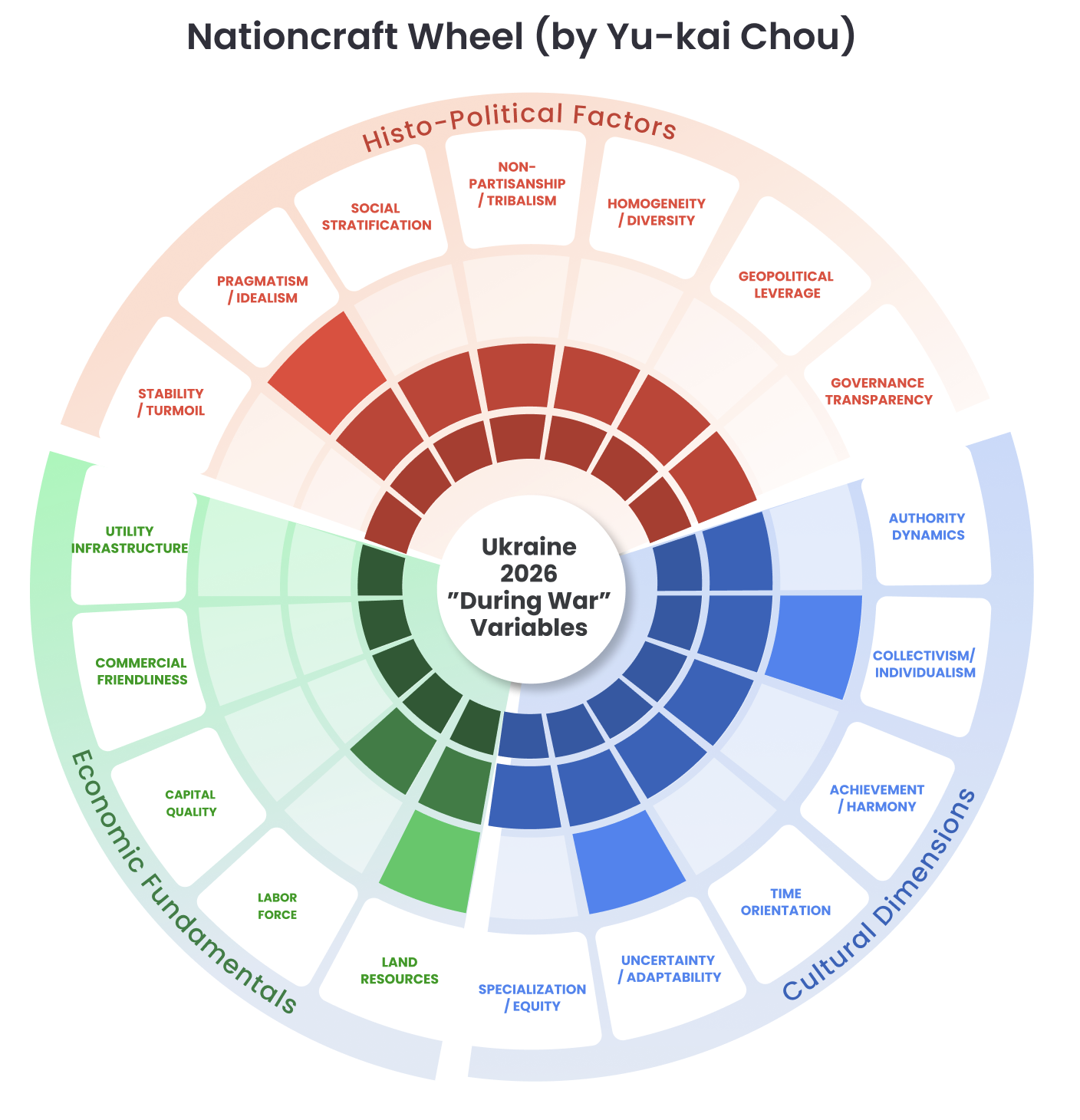
The 18 Nation Variables split into three clusters. Cultural (V1-V6): Authority Dynamics, Collectivism, Achievement Orientation, Time Orientation, Uncertainty Adaptability, and Specialization versus Equity.
Histo-political (V7-V13): Stability, Pragmatism, Social Stratification, Non-Partisanship versus Tribalism, Homogeneity, Geopolitical Leverage, and Governance Transparency. Economic (V14-V18): Land Resources, Labor Force Quality, Capital Quality, Commercial Friendliness, and Utility Infrastructure.
Each variable is scored 1-9. The scores are never averaged, because configuration is strategy: a nation with V2=8 and V16=1 is a different animal from a nation with V2=4 and V16=5, even if the totals match.
Against a country’s vector, Nationcraft tests over 140 documented Success Packets and Failure Packets: Meiji Japan, the Wirtschaftswunder, Botswana’s diamonds, Yeltsin’s shock therapy. Each carries its own variable preconditions.
(The derivation from behavioral design to statecraft is written up in how the Octalysis Framework applies to nation-building.)
Why This Ukraine Analysis Matters in September 2026
Here is the escrow ledger as it stands this month, custodians and court dates included.
| Stream | Size | Gate holding it | Status, September 2026 |
|---|---|---|---|
| Assessed recovery and reconstruction needs (RDNA4, World Bank / EU / UN / Ukraine) | $524B over ten years | Settlement, security, and donor sequencing | Standing estimate since February 2025; roughly 2.8x Ukraine’s projected 2024 nominal GDP[2] |
| Frozen Russian central bank assets in the EU | ~€210B | EU unanimity, Belgian legal exposure | European Commission says use “remains on the table”; needs assessment underway with the IMF[3] |
| Of which held at Euroclear, Brussels | €193B | Russia’s lawsuit against Euroclear; Belgium’s demand for EU-wide risk sharing | Belgium has stopped blocking in principle; legal concerns unresolved[7] |
| Proposed reparations loan against those assets | €140B | Same Belgian and legal gates | Structure debated since late 2025; Netherlands, Poland, Spain, and Sweden pushing to reopen[3][7] |
| Additional 2026 defense financing need | ~€27B | Donor decisions in real time | Named by the Commission as the immediate gap[3] |
| 2025 recovery financing gap | $9.96B | Annual budget cycles | Against $7.37B allocated with donor support[2] |
Nearly every meaningful number in that table is conditional on an event Ukraine does not fully control.
This is why absorption capacity, more than any funding total, decides the decade. Money that arrives into a configuration that cannot deploy it does not just underperform.
It actively corrodes, as the packet evidence below shows in brutal detail.
The method: run the country’s vector against the historical packets first, and only then argue policy (the Venezuela reform playbooks analysis runs the same test on a different vector). Most of the usual prescriptions fail the match test before the policy debate even begins.
The 18 Ukraine Nation Variables
These scores carry forward the 2026 wartime vector from the standing Ukraine page, cross-checked this month against current reporting. Where the war moved a score away from its pre-war baseline, the delta is noted.
| Variable | Score | September 2026 reading |
|---|---|---|
| V1 Authority Dynamics | 4/9 | Conditional legitimacy. Two Maidan revolutions prove Ukrainians reject unearned authority; wartime command is accepted because it is earned. Leaders hold power on performance. |
| V2 Collectivism | 8/9 | Wartime solidarity, volunteer networks, territorial defense coordination. Pre-war baseline was 6; the war forged this upward. |
| V3 Achievement vs Harmony | 6/9 | Entrepreneurial culture persists under survival focus. |
| V4 Time Orientation | 5/9 | Ten-year reconstruction planning coexists with day-by-day survival. EU accession forces long-horizon commitments. |
| V5 Uncertainty & Adaptability | 8/9 | Three decades of upheaval, then wartime innovation at scale: drones, procurement reform, digital services under fire. |
| V6 Specialization vs Equity | 6/9 | Soviet-legacy STEM depth; equity expectations remain influential. |
| V7 Stability vs Turmoil | 1/9 | Active warfare. Over 612 strikes on energy infrastructure in 2025 alone; missiles on Kyiv resumed the day after the US envoys left. Pre-war: 4. |
| V8 Pragmatism vs Idealism | 8/9 | Wartime pragmatism: ProZorro procurement, battlefield-driven iteration. Pre-war: 7. |
| V9 Social Stratification | 5/9 | Oligarch power diminished further in 2025-26; sacrifice democratized through service. |
| V10 Non-Partisanship vs Tribalism | 5/9 | Rally-around-the-flag unity masks live factional divisions. July 2025 proved both halves at once; see below. |
| V11 Homogeneity vs Diversity | 6/9 | National identity consolidated by the war; regional and linguistic diversity reduced. |
| V12 Geopolitical Leverage | 6/9 | Ukraine shapes Western policy and sits at the negotiating table, but the first meeting of each round happens in Moscow. Pre-war: 3. |
| V13 Governance Transparency | 4/9 | NABU, SAPO, ProZorro, and Diia lifted this from roughly 2-3 pre-Euromaidan. July 2025 showed the ceiling is contested from above. Trajectory disputed, level holding. |
| V14 Land Resources | 7/9 | Black-earth breadbasket and significant minerals; roughly 20% of territory occupied, extensive mine contamination. |
| V15 Labor Force Quality | 6/9 | Strong STEM base cut by 6-8 million refugees and mobilization. Pre-war: 8. The single most reversible loss on this table. |
| V16 Capital Quality | 1/9 | Aid-dependent public finances, debt above 90% of GDP, recovery capital escrowed abroad. Pre-war: 5. |
| V17 Commercial Friendliness | 3/9 | Wartime constraints on business; EU accession keeps reform pressure alive. |
| V18 Utility Infrastructure | 1/9 | Around 55 GW of installed generation before 2022; roughly 11.5 GW available by February 2026. Up to 80% of combined heat and power plants hit. Pre-war: 6.[8][9] |
Sixteen of eighteen scores carry forward from the standing scorecard unchanged. The two annotated ones, V10 and V13, did not move in level, but 2025-26 gave us decisive new evidence about what sits underneath them, which the justifications section unpacks.
The Escrowed Recovery Trap
Every named pattern in this series is a specific interaction of three to five variables. Here is this one.
The need: V16=1 and V18=1. Capital quality and utility infrastructure sit at the floor of the scale.
Ukraine cannot self-finance a $524 billion rebuild, and the grid running at a fifth of its pre-war capacity puts a hard ceiling on everything else.
The gate: V7=1. Active warfare makes insurance impossible, keeps private capital out, and leaves the big public money (the frozen assets, the reparations loan) legally and politically escrowed until some settlement threshold is crossed.
The asset: V2=8 and V5=8. Social cohesion and adaptability at eight out of nine each, in a country of forty million.
This is the configuration that absorbed three winters of grid attacks without state collapse.
The decay clause: V10=5. That cohesion is partly war-generated.
Rally-around-the-flag unity suppresses factional politics; it does not dissolve them. When the existential threat recedes, the suppressed conflicts (over mobilization, over veterans, over who governed the war economy and how) come back with interest.
Put those together and you get the trap in one sentence: the peace that unlocks Ukraine’s money also unwinds the social configuration that would spend it well.
The motivational mechanics underneath that clause set the decay rate. Wartime cohesion runs on threat fused with cause, and armistice retires the threat overnight while the cause fades slowly.
The design question is which institutions convert that motivational surplus into durable systems before it drains. The practice section near the end of this analysis takes that question apart.
The Spartan Paradox from the standing Ukraine scorecard already carries the structural half of this argument with its instruction to invest in networks before concrete, and the Escrowed Recovery Trap adds the clock to it.
Detailed Justifications: The Variables Doing the Work
Five variable clusters carry this Nationcraft analysis. Each one below cites what changed, or decisively failed to change, since the war began.
V2=8 + V5=8: The Absorption Assets
The case for Ukrainian adaptability stopped being theoretical years ago. A country that entered the war with a conventional army now runs a drone-production complex whose feedback loops between front line and factory are measured in weeks (the full loop is documented in Ukraine’s drone warfare game loop).
For reconstruction, V2 and V5 set the absorption rate, which decides whether the same aid ends up as housing or as invoices.
The civic side of that rate is just as documented. Diia, the state services app, reached 19 million users in a country of roughly 40 million, and the volunteer logistics networks that formed in 2022 still route materiel, medicine, and money around bottlenecks formal procurement cannot clear.
V7=1 + V16=1 + V18=1: The Terminal Triad
Three variables at or near the floor define what Ukraine cannot currently do. With over 612 documented strikes on energy infrastructure in 2025 and roughly 8.5 GW of generation disabled since October 2025 alone, the grid entered 2026 with about 11.5 GW available against a pre-war installed base near 55 GW.[8][9]
Up to 80% of combined heat and power plants have been hit. Repair crews rebuild under fire, and the constraint has shifted from courage to equipment: extra-high-voltage substation transformers are scarce, slow to manufacture, and impossible to hide.[8]
The fiscal floor is just as hard. Public debt above 90% of GDP, a $9.96 billion recovery financing gap in 2025, and a Commission-named €27 billion defense gap for 2026 mean every reconstruction dollar is somebody else’s political decision first.[2][3]
V7=1 gates even those decisions, since no insurance market prices active missile risk at rates a rebuild can carry.
V13=4 + V10=5: The Contested Ceiling
2025-26 delivered decisive new evidence here, and it cuts both ways.
In July 2025, the Rada passed and Zelenskyy signed a law subordinating NABU and SAPO (the anti-corruption bureau and its specialized prosecutor) to the prosecutor general. Within hours, Ukrainians were in the streets of Kyiv, Lviv, Dnipro, and Odesa in the first nationwide protests of the entire war.[10]
Nine days later, a restoration law passed 331 to 0, and the agencies’ independence was back.[10] Read as a V13 event, the episode is a draw: the executive tested the ceiling, and civil society held it.
Then November 2025 removed all doubt about whether those agencies have teeth. Operation Midas, a 15-month NABU-SAPO investigation, raided Energoatom, the state nuclear operator, and implicated a kickback scheme running 10-15% of contract value, roughly $100 million.
Among the accused: Timur Mindich, a former business partner of the president, who fled the country a day before the raids. The justice minister was suspended; the company’s supervisory board was dismissed.[11]
An anti-corruption apparatus prosecuting into the head of state’s own circle, during a war, is close to the strongest institutional evidence a V13=4 country can produce. It is also, simultaneously, evidence of how much corruption remains to prosecute.
Both facts are true, and funders in Brussels read both.
V10=5 sits underneath this. The protests, the scandal, the mobilization debates: these are the suppressed factional politics that armistice will release, and July 2025 previewed exactly how fast they can surface.
V12=6: Leverage That Peaks at the Table
Ukraine transformed its geopolitical position from pre-war buffer state (V12=3) to a nation that shapes NATO posture, EU budgets, and global food markets. That is real, and it holds at 6.
But September 2026 also showed the boundary of it. The envoys’ itinerary ran Moscow first, Kyiv second.
The frozen-assets decision runs through Belgian courts and EU unanimity rules. Ukraine’s leverage is substantial and borrowed at the same time, which is what a 6 on a 9-point scale records.
V15=6: The Most Reversible Loss
Between six and eight million Ukrainians left, disproportionately educated, disproportionately women with children. Mobilization absorbs a large share of prime-age men who remain.
The official unemployment indicator for 2025 stood at 17.7% even so.
Unlike destroyed transformers, this loss can reverse itself, and quickly. Refugee return is a function of three things the settlement directly controls: security credibility, housing, and jobs.
That responsiveness to the settlement text is why V15 sits at the center of the reconstruction math.
Best-Match Historical Packets for Ukraine’s Rebuild
Each packet in the Nationcraft corpus carries variable preconditions extracted from the historical record. Running Ukraine’s vector against the reconstruction-relevant set produces a clean split.
| Packet | Case | Core precondition | Ukraine’s vector says | Verdict |
|---|---|---|---|---|
| FP-016 Yeltsin Shock Therapy | Russia, 1991-1999 | Institutions before liberalization; failed without them | V13=4 is triple Russia’s 1990s level, but still below the safe threshold for speed-first privatization | Reject |
| FP-003 Coalition Provisional Authority | Iraq, 2003-2011 | External administrator replacing domestic legitimacy | V1=4 conditional legitimacy rejects imposed authority; two Maidans prove it | Reject |
| SP-077 Karzai-Ghani Development Attempt | Afghanistan, 2001-2021 | Aid saturation without security or legitimacy | V7=1 without a settlement replicates the precondition that consumed $2.3 trillion | Reject |
| SP-093 Dayton Peace Implementation | Bosnia, 1995-2020 | Peace structure that freezes divisions into the constitution | V11=6 and V2=8 do not need ethnic vetoes; a Dayton-shaped settlement would manufacture paralysis | Reject |
| SP-065 Sisi Stabilization | Egypt, 2013-2023 | Strongman consolidation plus IMF stabilization | V1=4 makes consolidation combustible; the EU anchor forbids it anyway | Reject |
| SP-015 Wirtschaftswunder | West Germany, 1948-1963 | Requires V15≥6, V5≥6, V8≥7 before capital arrives | Ukraine reads 6 / 8 / 8. Qualifies; the only current European case that does | Fit |
| SP-027 Nation-Building Packet | Israel, 1948-1973 | Building institutions while the threat persists; diaspora as capital | V2=8 cohesion and a 6-8 million diaspora mirror the packet’s engine | Fit |
| SP-007 Estonia Digital Revolution | Estonia, 1991-2020 | Requires V5≥7, V8≥8, technical literacy | Ukraine already runs it at 30x Estonia’s scale: Diia, ProZorro | Fit |
| SP-068 Homeland War & EU Accession | Croatia, 1995-2013 | War’s end converted into accession conditionality | The closest structural analog in the corpus, warnings included | Fit |
Now the arguments, packet by packet. Rejections first, because the rejected ones are the loudest voices in the current policy conversation.
Rejected: FP-016 Yeltsin Shock Therapy (Russia, 1991-1999)
The packet: rapid price liberalization, mass voucher privatization, and austerity to force a market economy into existence in the shortest possible time.
The recorded failure mode is precise. Extremely low rule-of-law and corruption-control scores interacted catastrophically with high-speed privatization, enabling oligarch capture and asset stripping.
The corpus files it as the institutions-first lesson: liberalize before courts work, and the assets flow to whoever can enforce claims privately.
Ukraine will face this temptation in its most seductive form. A reconstruction boom privatizes assets at enormous scale (land, energy, rebuilt industry), and speed will be framed as patriotic necessity.
Ukraine’s V13=4 is a different starting point from Russia’s 1990s floor, and its civil society has proven it can check the executive within days. But 4 is not 7, and the July 2025 episode showed how fast the oversight architecture can be attacked from inside.
The deeper irony: the state that ran this failure packet now runs Russia’s fortress economy, a configuration built in part on the oligarch structures shock therapy created. That history is the strongest available argument for keeping speed-first privatization off Ukraine’s menu.
Rejected: FP-003 Coalition Provisional Authority (Iraq, 2003-2011)
The packet: an external authority administers reconstruction directly, on the theory that local institutions are too weak or too corrupt to trust.
Iraq’s version disbanded the army, purged the civil service, and ran decisions through a 14-month foreign administration that alienated the population it was rebuilding. Roughly $2 trillion later, the corpus verdict is blunt: post-conflict reconstruction run over the head of domestic legitimacy produces insurgency instead of institutions.
Why it matters here: as the escrow negotiations mature, donor-side voices will push for an internationally administered reconstruction agency holding the purse, with Ukrainian ministries as subcontractors. The instinct is understandable given the corruption headlines, and it is wrong for this vector.
Ukraine’s V1=4 reads as conditional legitimacy: authority is accepted when earned, overthrown when imposed. A population that ran two revolutions against its own captured governments will not accept a foreign proconsul, however well-intentioned.
The fit-preserving alternative is conditionality without administration: external audit, milestone-gated disbursement, Ukrainian execution. Those two models diverge into Iraq on one side and the packet that rebuilt Western Europe on the other.
Iraq’s longer arc, the rentier dynamics that followed, is mapped in the Iraq rentier sovereignty analysis.
Rejected: SP-077 Karzai-Ghani Development Attempt (Afghanistan, 2001-2021)
The packet: saturate a country with development money while the security question stays unresolved. $2.3 trillion in total US spending, $145 billion of it development aid, produced schools, clinics, and media — and then eleven days in August 2021 erased the state.
The corpus insight applies to every Ukraine donor directly: unlimited money cannot build a state without security, legitimacy, and regional buy-in. Aid at that volume, into an unsettled conflict, becomes the economy itself, and an economy of aid contracts corrodes the legitimacy it was meant to fund.
Ukraine is not Afghanistan on legitimacy: it has a fought-for national identity, functioning (if strained) elections history, and V2=8 civic density Afghanistan never had. The packet’s warning attaches to the sequencing, and specifically to the temptation to start spending the $524 billion before V7 moves off 1.
Reconstruction-while-fighting is survivable at repair scale: Ukraine proves it every winter. At transformation scale, with no settlement, it reproduces the Afghan shape of donor money chasing security that does not yet exist, at far larger scale.
Rejected: SP-093 Dayton Peace Implementation (Bosnia, 1995-2020)
The packet: end the war by constitutionalizing the division. Dayton stopped the killing and then froze the conflict into a two-entity, three-peoples structure where every reform requires consent that never comes.
Twenty-five years of evidence: peace held, governance never arrived, half the population left. The corpus files it as the proof that a settlement’s text can prevent the state it creates from ever functioning.
I analyzed the current end-state of that structure in Bosnia’s Dayton deadlock.
The relevance to Ukraine is direct and immediate, because the settlement text is being drafted now. Any peace architecture that hardwires occupied-territory ambiguity into Ukraine’s constitutional order, or gives external guarantors veto points inside domestic institutions, imports the Dayton failure at 10x scale.
Ukraine’s variables argue against any need for such scaffolding: V11=6 homogeneity (consolidated further by the war) and V2=8 cohesion are the opposite of Bosnia’s fragmentation. The danger is a negotiation optimized for signature speed producing that structure anyway.
Rejected: SP-065 Sisi Stabilization (Egypt, 2013-2023)
The packet: restore order through strongman consolidation, stabilize the macro numbers with IMF support, and trade political freedom for predictability.
Set aside every value judgment and it still fails on pure variable math. Egypt’s configuration could sustain it; Ukraine’s cannot.
V1=4 means Ukrainian authority is conditional: earned through performance, revoked through the street. The two Maidans are the empirical record of what happens when consolidation is attempted against this vector.
A wartime president with extended mandates, a barred election calendar, and emergency powers will face real pressure to hold the wartime concentration after armistice, framed as reconstruction efficiency. Ukraine already ran this experiment in miniature: one move against the anti-corruption agencies in July 2025, and the largest protests of the war materialized in hours.
The comparison case is worth studying because its costs are so visible: Egypt’s garrison economy shows where stabilization-by-consolidation settles: order purchased at the price of every dynamic variable. For a country whose recovery depends on V5=8 adaptability and diaspora trust, that trade surrenders the exact variables the rebuild runs on.
Fit: SP-015 Wirtschaftswunder (West Germany, 1948-1963)
The packet everyone cites, and for once the variable math agrees. West Germany 1948: cities flattened, currency worthless, millions displaced — and a skills base, an adaptability reflex, and a pragmatism culture that turned Marshall Plan capital into the fastest recovery in modern history.
The corpus is specific about preconditions: V15≥6 skills, V5≥6 adaptability, V8≥7 pragmatism. Ukraine reads 6, 8, 8.
It qualifies, and it is currently the only large European case that does.
Three mechanisms transfer. First, the currency-and-incentives reform came before the capital: Erhard’s 1948 currency reform restored price signals, then the $1.4 billion of Marshall money arrived into an economy that could allocate it.
Ukraine’s equivalent list reads: insurance mechanisms, land-registry integrity, and contract enforcement, all in place before the €140 billion moves.
Second, integration provided the market: the European Coal and Steel Community turned a rebuilt industrial base into an export engine. Ukraine’s EU accession track repeats that mechanism with a bigger treaty.
Third, labor peace was designed, through codetermination, rather than assumed. Ukraine’s postwar version is veteran reintegration, the single most predictable V10 stress point.
What does not transfer: the scale of external protection. West Germany rebuilt under NATO’s shield, which is precisely the security-guarantee question sitting unresolved in the current talks.
Germany’s own present-day configuration (examined in Germany’s consensus machine) is what seven decades of compounding on that foundation looks like, sclerosis included.
Fit: SP-027 Nation-Building Packet (Israel, 1948-1973)
The only packet in the corpus for building a state while the war is still live, which makes it the only packet matching Ukraine’s actual sequencing problem rather than the one donors wish it had.
Israel 1948-1973: institutions built under existential threat, population doubled in three years through immigration absorption, diaspora functioning as capital source and talent pipeline, military service as the great social integrator. The corpus notes existential threat (V7=2) created unity and sacrifice, and diaspora human capital was the decisive asset.
The Ukraine mapping is nearly line-for-line. Six to eight million abroad reads as a loss on the scorecard; managed deliberately, it becomes one of the largest diaspora-capital reserves any rebuilding state has held.
Absorption infrastructure (housing, credential recognition, jobs) is the reconstruction priority that converts V15=6 back toward its pre-war 8.
The military as integrating institution already operates: service has scrambled Ukraine’s class and regional lines the way the IDF scrambled immigrant origins. The design task is converting that into postwar civic architecture instead of letting it curdle into a veterans-versus-everyone cleavage.
The packet’s warnings are on the record too: the socialist economy stagnated until reformed, and integration tensions persisted for generations. How the model’s descendants perform under 2026 conditions is a separate live question (one I examined in Israel’s startup-nation trap), but the 1948-1973 packet itself remains the corpus’s cleanest proof that V7=1 does not forbid institution-building, only that the building happens in a different order than peacetime states use.
Fit: SP-007 Estonia Digital Revolution (Estonia, 1991-2020)
The corpus lists hard preconditions: V5≥7 adaptability, V8≥8 pragmatism, strong technical literacy. Ukraine passes the first two outright and carries the Soviet-legacy STEM base for the third.
Calling this one a recommendation undersells it: Ukraine already runs this packet, at thirty times the population Estonia proved it on. Diia’s 19 million users make it one of the most-adopted state digital platforms on earth.
ProZorro made procurement legible enough that journalists routinely mine it for the scandals NABU then prosecutes.
That is the packet’s anti-corruption mechanism working as designed: digital rails do not eliminate corruption, they make it visible, prosecutable, and expensive. Operation Midas exists partly because the data trails exist.
For reconstruction, the implication is concrete. Every escrowed euro should flow through rails as transparent as ProZorro from day one (a DiiaBuild, in effect), because the digital audit trail is what lets external funders accept Ukrainian execution instead of demanding the Iraq-shaped external administration the vector rejects.
Estonia’s caveats (small-country rollout speed, brain drain) read differently at Ukraine’s scale, and the packet requires V15≥7 that Ukraine currently misses by one point. Which is one more reason the diaspora-return machinery of the Israel packet matters here as well, since each packet depends on the others’ outputs.
Fit: SP-068 Homeland War & EU Accession (Croatia, 1995-2013)
The closest structural analog the corpus holds: a European country that fought an existential independence war on its own soil, won survival, and then converted war’s end into EU accession within eighteen years.
The transferable core is the conditionality engine. Croatia’s accession required things domestic politics alone would never have delivered: war-crimes tribunal cooperation, judiciary reform, privatization completion.
The corpus insight: EU conditionality can drive reforms that internal coalitions cannot, because the prize is external, visible, and binary.
Ukraine’s version is already running hotter than Croatia’s ever did. NABU, SAPO, ProZorro, and the entire transparency architecture exist substantially because EU and IMF conditionality demanded them, and candidate-status politics kept them alive through July 2025.
The packet ships a warning label too. Croatia’s post-accession growth disappointed; brain drain accelerated after membership, because free movement out of a weak domestic economy pulls the young first.
Accession anchors the reform decade. Prosperity at the end of it still has to be earned domestically.
For Ukraine that means the accession track’s value is highest before membership, as the external spine holding V13 upward pressure through armistice politics; the domestic-economy variables, V16 and V17, decide what membership is eventually worth.
The Packet Ukraine Already Runs: SP-117 Post-Euromaidan Reform (Ukraine, 2014-2022)
The corpus contains one packet whose country column reads Ukraine, and it reframes the entire reconstruction debate.
SP-117 documents 2014-2022: external anchors (EU and IMF conditionality) plus civil-society pressure plus digital tools, bypassing captured institutions to lift governance transparency from roughly V13=2 toward 4-5, during a live conflict in the east. The packet’s recorded insight is that deep governance reform is possible even during active warfare, when those three forces align.
Its recorded limitation: judicial reform stayed incomplete, and oligarch influence diminished without disappearing.
Every 2025-26 data point in this analysis is that packet still executing. The July 2025 reversal was the civil-society leg holding.
Operation Midas was the institutional leg biting. The EU accession clusters are the external-anchor leg pulling.
So the strategic question for the escrow era becomes whether SP-117 (the country’s own, proven, still-running packet) survives contact with peace: with demobilized factional politics, with reconstruction rents worth fighting over, and with an executive that tested the ceiling once already.
Framed that way, the trap carries its own exit: to absorb $524 billion well, Ukraine has to remain what the war years built.
Governance Strategy Recommendations
What follows is sequencing logic for anyone with a stake in Ukraine’s reform decade: Ukrainian policymakers, diaspora institutions, donor governments, and the analysts scoring them. The packets above compress into four moves, in order.
| Phase | Move | Variables it defends | Packet source |
|---|---|---|---|
| Now, pre-settlement | Harden the transparency architecture against armistice politics: statutory independence for NABU and SAPO with supermajority repeal thresholds, and reconstruction rails built ProZorro-style before the big money moves | V13 up, protects V12 | SP-117, SP-007 |
| At settlement | Reject Dayton-shaped constitutional freezes and Iraq-shaped external administration; take conditionality-with-audit, keep execution Ukrainian | V1, V11, V2 | SP-093, FP-003 (negative), SP-015 |
| First 24 months post-settlement | Run the absorption play: insurance and land-registry integrity first, then capital; diaspora-return machinery (housing, credential recognition, jobs) as the flagship program | V16 up, V15 up, V18 up | SP-015, SP-027 |
| The reform decade | Ride EU accession conditionality as the external spine; design veteran reintegration before the V10 bill arrives; finish the judicial reform SP-117 left incomplete | V13, V10, V17 | SP-068, SP-117 |
Two of these deserve a sentence more.
Take insurance-before-capital first. Private reconstruction capital (the multiple of public money that turns $524 billion of needs into an actual economy) moves only when war-risk insurance, enforceable contracts, and clean land registries exist.
Erhard’s currency reform is remembered because it fixed incentives before the Marshall money landed; Ukraine gets the same effect through legal plumbing.
And the veteran-reintegration point is where the Escrowed Recovery Trap will actually be fought. Hundreds of thousands of people who carried the war will demobilize into a society deciding how to spend the largest capital inflow in its history.
Design their landing (employment pipelines, status, a stake in the rebuild) and V2=8 carries into peacetime. The alternative is watching the suppressed V10 divisions resurface inside the reconstruction budget itself.
Strategic Implications
For Ukrainian institutions, the implication is a single priority: treat the transparency architecture as critical infrastructure, on par with the grid, because it collateralizes the entire escrow.
Every Midas-style prosecution raises the absorption rate Brussels will underwrite; every July-2025-style move against the agencies lowers it.
For donor governments, the packet evidence argues for conditionality without administration. The Iraq model fails this vector; the Marshall model fits it.
Milestone-gated disbursement through transparent Ukrainian rails is both the fastest and the safest path the variables permit.
For the diaspora, the math is unsentimental: return decisions aggregate into the difference between V15=6 and V15=8, which compounds into whether the rebuild has the people to run it. The state can make return rational, while safety waits on what gets signed.
For investors watching the escrow, the prosecution docket leads and the peace headlines lag.
Disclosure: through reSTATE, the venture I co-founded to support Ukraine’s rebuild, these sequencing questions are working constraints.
Comparative Context: Ukraine Among Its Analogs
Nationcraft scores mean most when read against neighbors and analogs. Four comparisons locate Ukraine’s 2026 position.
| Configuration | Key variables | What it shows Ukraine |
|---|---|---|
| Ukraine 2026 | V2=8, V5=8, V7=1, V13=4, V16=1, V18=1 | Anti-fragile society, terminal material base, contested transparency ceiling |
| Russia 2026 | Fortress configuration: coerced stability, sanctions adaptation, hollowing capital | The aggressor’s V-vector is optimized for endurance, which is why settlement timing shapes both recoveries |
| Poland 2026 | EU-anchored transformation success now fighting internal veto politics | The accession prize is real and it does not end politics; see Poland’s liberum veto trap |
| West Germany 1948 / Israel 1948 / Croatia 1995 | The three fit packets at their starting lines | Each began with worse material scores than Ukraine’s and better security horizons; the guarantee question is the whole difference |
The two recoveries are coupled. A settlement that lets the fortress configuration claim victory finances the next war; one that converts Ukrainian survival into membership-anchored prosperity is the strongest non-military deterrent Europe can buy, and the variables on both sides of the border argue for the same settlement design.
The Nationcraft Framework in Practice
Everything above is the Nationcraft variable layer at work. There is also a street layer, and reconstruction lives or dies on it.
A nation absorbing reconstruction capital is, at street level, millions of individual decisions to stay, return, build, and comply. Those decisions run on motivation, and Ukraine’s wartime motivation has a specific shape: threat fused with cause, or Core Drive 8: Loss & Avoidance fused with Core Drive 1: Epic Meaning & Calling.
Armistice retires the threat overnight and dims the cause, and no country keeps wartime motivation at peacetime prices. The reform decade therefore has to engineer replacements before the vacuum opens: civic versions of Core Drive 1, meaning a rebuild ordinary people can see their own fingerprints on, and institutional versions of the accountability pressure Core Drive 8 supplied for free during the war.
The veteran pipeline is the concrete test case. Service gave hundreds of thousands of people meaning, status, and a team; a reintegration program that offers a paycheck but no role in the national story trades Epic Meaning for wages, and the transition from wartime Black Hat urgency to White Hat design fails at exactly that seam.
This is what the Nationcraft Framework adds in practice beyond the scorecard: the variable layer says what policy can attempt, and the motivational layer says whether forty million people will carry it.
Closing: What to Watch Between Now and the Next Round
Three signals, in order of information value.
First, whether NABU and SAPO’s independence survives the next twelve months structurally intact, and whether Midas-class prosecutions continue reaching upward.
Second, what the settlement text says about guarantees and constitutional structure. The moment draft language surfaces resembling Dayton’s frozen vetoes or an external administration of reconstruction funds, the packet math above says the decade just got harder.
Third, the Belgian legal track on the €140 billion reparations loan, which moves slowly and binds hard: whichever way Euroclear’s risk gets mutualized sets the real timetable on the largest single funding stream Ukraine’s rebuild has.
The war decided whether Ukraine survives. The escrow decides what surviving buys.
Frequently Asked Questions
What is the Escrowed Recovery Trap?
It is the interaction of five Ukrainian Nation Variables in 2026: recovery capital gated behind a settlement (V7=1, V16=1), while the social cohesion and adaptability that would absorb that capital well (V2=8, V5=8) are partly products of the war itself and begin to decay at armistice (V10=5). The money and the capacity to spend it move in opposite directions.
How large are Ukraine’s reconstruction needs as of 2026?
The RDNA4 assessment (World Bank, European Commission, UN, and the Government of Ukraine, February 2025) puts recovery and reconstruction needs at $524 billion over ten years, roughly 2.8 times Ukraine’s projected 2024 nominal GDP. Direct damage was assessed at $176 billion, with housing, transport, and energy the most affected sectors.
What happens to the €210 billion in frozen Russian assets?
As of September 2026, undecided. About €193 billion sits at Euroclear in Belgium.
The European Commission says using the assets for Ukraine remains on the table and is assessing financing needs with the IMF, while a proposed €140 billion reparations loan works through Belgian legal objections and a Russian central bank lawsuit. Netherlands, Poland, Spain, and Sweden are pushing to reopen the decision.
Which historical reform packets fit Ukraine’s configuration?
Four fit with conditions: West Germany’s Wirtschaftswunder (SP-015), Israel’s 1948-1973 nation-building packet (SP-027), Estonia’s digital revolution (SP-007), and Croatia’s war-to-EU-accession path (SP-068), plus SP-117, Ukraine’s own post-Euromaidan reform packet, which is still running. Five fail the variable test: Yeltsin-era shock therapy, the Iraq CPA model, Afghanistan-style aid saturation, Dayton-style frozen settlements, and Egypt-style stabilization through consolidation.
Is Ukraine’s anti-corruption system actually working?
The 2025-26 record shows an infrastructure with real teeth and a contested ceiling. Operation Midas saw NABU and SAPO prosecute a roughly $100 million kickback scheme at the state nuclear operator, reaching into the president’s own circle, during the war.
In July 2025, a law subordinating those agencies was reversed within nine days after the first nationwide protests of the war. Both facts price into V13=4: institutions strong enough to bite, an executive still tempted to test them.
Explore More Nationcraft Analyses
The full Nationcraft country series lives in the Nation Variables Library, which indexes every published scorecard and analysis.
For adjacent configurations, start with Kazakhstan’s steppes pivot (a post-Soviet state running its balancing act without a war) and Singapore’s LKY packet stress test, a study of what disciplined sequencing compounds into.
Related Reading
- The Nationcraft Framework: 18 Variables, 8 Goals, 100+ Proven Reform Packets
- Nationcraft Nation Variables Library
- Nation Variable Analysis: United States (2026)
- Nationcraft Analysis: Yemen Frozen War Trap 2026
- Nationcraft Analysis: Taiwan Silicon Shield Paradox 2026
Footnotes
- Al Jazeera, “US envoys hold ‘substantive’ talks with Zelenskyy in first visit to Kyiv,” September 6, 2026. aljazeera.com
- World Bank / Government of Ukraine / European Commission / UN, “Updated Ukraine Recovery and Reconstruction Needs Assessment (RDNA4),” February 25, 2025. worldbank.org
- Anadolu Agency, “EU says use of frozen Russian assets for Ukraine remains ‘on the table’,” September 11, 2026. aa.com.tr
- Deutsche Welle, “US envoys Witkoff and Kushner hold Ukraine talks after meeting Putin,” September 6, 2026. dw.com
- NPR, “Witkoff and Kushner call Kyiv talks ‘substantive’ after Moscow Putin meeting,” September 6, 2026. knpr.org
- BBC News, “Ukraine says leaked 28-point plan ‘no longer exists’ after Geneva talks,” November 2025. bbc.com
- The Moscow Times, “Belgium’s ‘Golden Goose’ Is Keeping Billions From Ukraine,” September 10, 2026. themoscowtimes.com
- UN Human Rights Monitoring Mission in Ukraine, “Attacks against Ukraine’s energy infrastructure and update on the human rights situation in Ukraine, 1 December 2025 – 31 May 2026.” ukraine.un.org
- The Ukrainian Review, “Power Outages as the New Reality: The State and Prospects of Ukraine’s Energy System.” theukrainianreview.info
- Kyiv Independent, “Following street protests, Zelensky signs law restoring independence of anti-graft bodies,” July 31, 2025. kyivindependent.com
- OSW Centre for Eastern Studies, “Operation Midas: the largest corruption scandal within Zelensky’s inner circle,” November 13, 2025. osw.waw.pl
- CNN, “Russia resumes attacks on Kyiv after US envoys depart,” September 7, 2026. cnn.com