
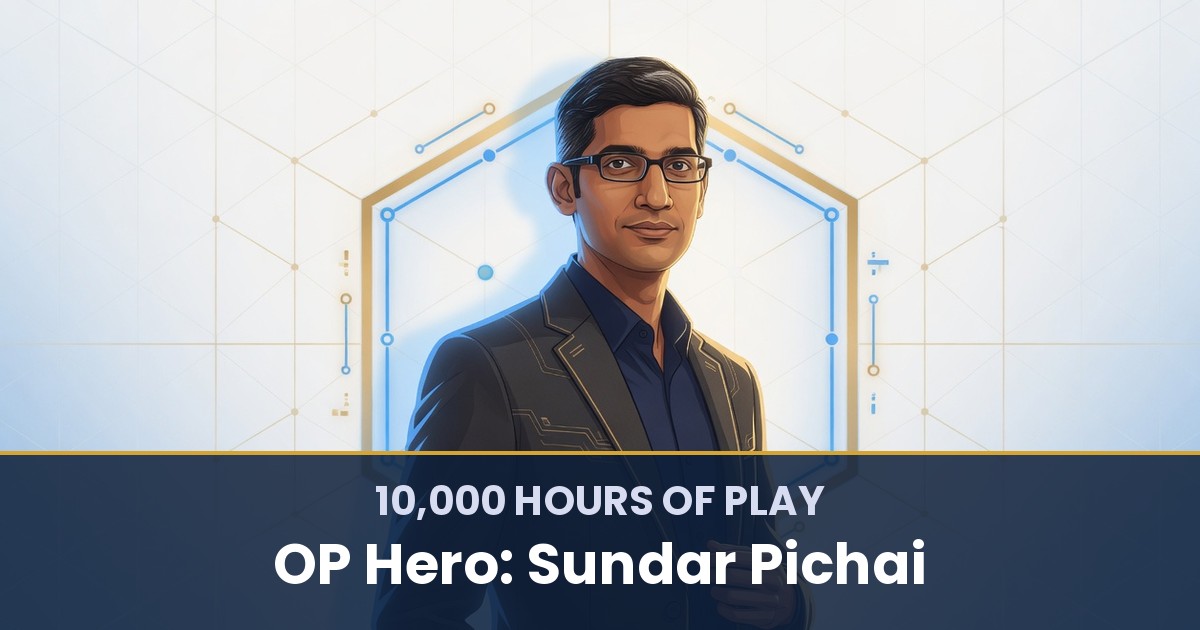
10,000 Hours of Play by OP Hero: Sundar Pichai
Sundar Pichai went from IIT Kharagpur to Alphabet CEO by owning the layer underneath: Toolbar, Chrome, Android, then the AI reset.


On 8 February 2023, Alphabet shares fell roughly 7 to 8 percent in a single trading day.
The trigger was one answer in a promotional demo. Google’s new chatbot, Bard, made an incorrect claim about the James Webb Space Telescope, and the market wiped out an estimated $100 billion in value.
The man running Alphabet that morning was Sundar Pichai. He had grown up in Chennai, in a family that got its first telephone when he was about twelve.
His father, an electrical engineer, spent roughly a year’s salary on the plane ticket that took him to Stanford in 1993.
Thirty years later, Pichai was answerable for one of the most closely watched AI races in the world, and his first big public move in it had just gone wrong in public.
Within three months he had merged Google’s two AI research labs into one unit. The twenty years before that morning explain why the company let him make that call.
⚡ Speed Run Notes
- Pichai’s game: turn complicated computing into products ordinary people use every day, at the scale of billions.
- He trained as a metallurgical engineer at IIT Kharagpur, then stacked Stanford, Applied Materials, Wharton and McKinsey before joining Google in 2004.
- His first Google product, the Toolbar, lived inside other companies’ browsers. Chrome, launched in 2008, gave Google a browser of its own.
- He climbed by absorbing more products: Android, Chrome and Apps in 2013, all Google products in 2014, Google CEO in 2015, Alphabet CEO in 2019.
- The Bard demo miss in 2023 cost an estimated $100 billion in market value. He answered by merging Google’s two AI labs under Demis Hassabis.
Table of Contents
About Yu-kai Chou

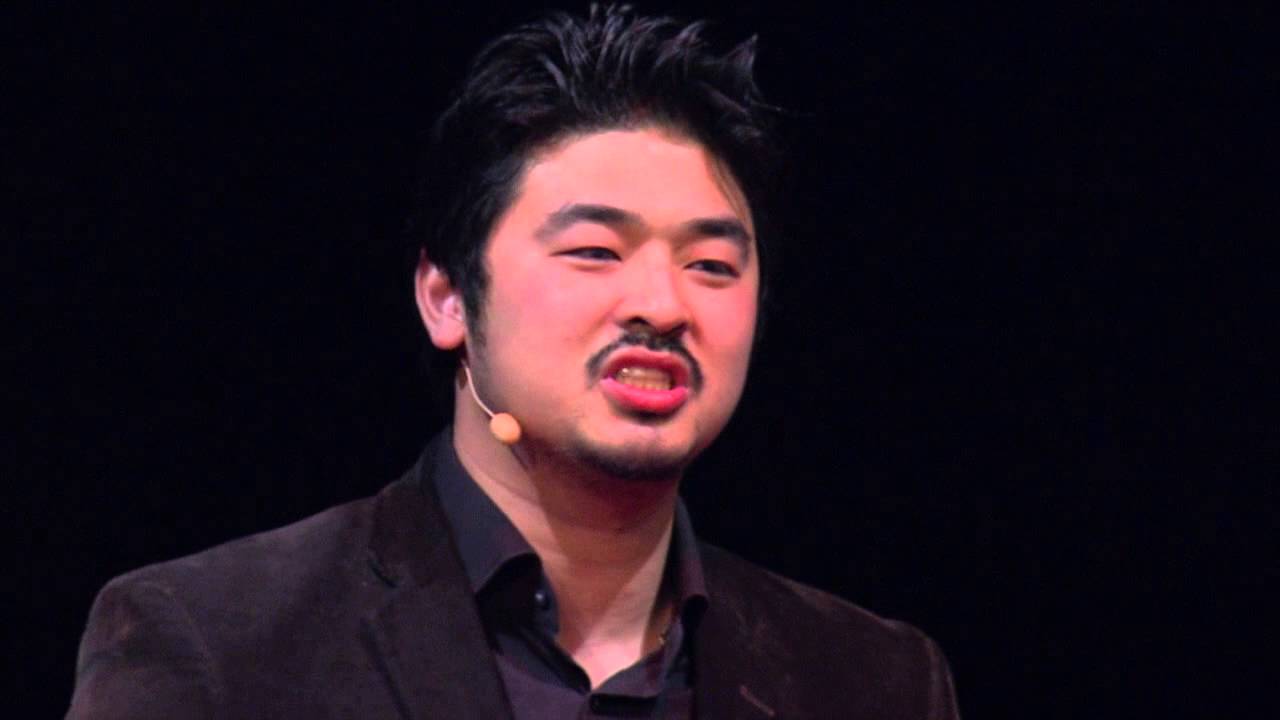
Yu-kai Chou is the author of 10,000 Hours of Play — the book that treats your life as the most important game you’ll ever build a character in, and gives you the 6-Step framework (Game · Attributes · Role · Skills · Allies · Quests) to play it on purpose. He has spent two decades developing the system through which this post analyzes its OP Hero, and applies it to his own life and to the lives of the people he advises around the world.
Chou’s other framework, the Octalysis Framework, has been applied by LEGO, Microsoft, Porsche, Coca-Cola, Salesforce, and MrBeast, impacting over 1.5 Billion Users. He has taught the methodology at Harvard, Stanford, Yale, Tesla, Google, BCG, and IDEO, and has advised governments in eight nations including Ukraine, the United Kingdom, the Kingdom of Bahrain, Singapore, Taiwan, the Netherlands, Kazakhstan, and South Korea.
His work has been cited by Harvard, Stanford, MIT, Forbes, Wall Street Journal, Wired, US Department of Energy, NIST, NSF, NCBI, US Department of Education, ClinicalTrials.gov, and Google Scholar — with 3,700+ more academic publications. Explore his books here.
Pichai spent more than a decade in Roles far from consumer software: metallurgy, semiconductor manufacturing, consulting. None of them looks like preparation for running Google. The lesson I would lift is about Step 3: a Role that seems off your path can still supply the vocabulary a later Role depends on.
Step 1: The Game — What Sundar Pichai Was Actually Playing
In the 10K HP framework, your Game is whatever you keep chasing across decades, and choosing your game starts with naming it.
Pichai has never published a mission statement for his own life. His career choices show what he kept chasing anyway.
Again and again, he picked work that turned complicated technology into something simple enough for a very large number of people to use.
You can see it in the products he led. Toolbar put search inside the browser people already had, while Chrome gave them a faster browser and Android carried Google’s services onto phones sold by other companies.
By 2014 he was responsible for Search, Maps, Play, Android, Chrome, Gmail and Google Apps at once.
All of them are distribution layers that other products run on.
Some players chase a signature invention. Pichai chased reach: the number of people a piece of infrastructure could serve once someone made it dependable.
In 2016 he started describing Google’s direction as a move from a “mobile-first” world to an “AI-first” one.
Step 2: Attributes — The Innate Stats
Attributes are the stats you bring into the game before training. With a living executive, they have to be read from repeated behavior, so treat these as inferences.
Reading his build through the OP Talent Triangle Method, four stats stand out.
Technical pattern recognition. He earned a B.Tech in metallurgical engineering at IIT Kharagpur with an Institute Silver Medal, then a master’s in materials science and engineering at Stanford.
Materials science studies how structures behave under load. It is a useful training ground for someone who later spent his career on platforms.
Memory for detail. Profiles of his childhood repeat one story: once the family had a telephone, young Sundar could recall the numbers he dialed.
Domain range. Engineering, then semiconductors at Applied Materials, then a Wharton MBA as a Siebel Scholar and Palmer Scholar, then consulting at McKinsey. He crossed four fields before his first day at Google.
Composure. In January 2023 he said he took responsibility for the decisions behind roughly 12,000 layoffs. In February 2024 he called Gemini’s image errors “completely unacceptable” in a memo to staff.
Step 3: Role(s) — The Character Class Across Chapters
Pichai changed Roles often, and almost every change widened the scope of what he connected.
Engineer-scholar (to the mid-1990s). IIT Kharagpur, then Stanford from 1993. Metallurgy first, then materials science.
Semiconductor industry (Applied Materials). His first industry job put him inside semiconductor manufacturing, far from consumer software.
Analyst and consultant (Wharton, McKinsey). The MBA and consulting years added a business vocabulary to the engineering one.
Product manager (Google, from 2004). He joined Google in 2004 and helped lead Google Toolbar, then Chrome, which launched on 2 September 2008.
Platform leader (March 2013 to October 2014). In March 2013 he took over Android from Andy Rubin and ran Android, Chrome and Apps together.
Head of products (October 2014). He became Senior Vice President of Products, over most of Google’s consumer lineup.
CEO (August 2015, then December 2019). On 10 August 2015, Larry Page announced Alphabet and named Pichai CEO of Google. On 3 December 2019, Page and Sergey Brin handed him the Alphabet CEO role as well.
Step 4: Skills — The Real-Life Game Skills Sundar Pichai Mastered
Track Treasure (Ranger): identifying hidden opportunities others don’t see. Toolbar brought Google search into other companies’ browsers, which meant Google’s front door belonged to someone else. Pichai was among the advocates for building Google’s own browser, and Chrome gave the company its own access point to the web.
StatCounter’s global data showed Chrome overtaking Internet Explorer around 2012.
Tactical Command (Ranger): making people of different talents work together. From 2013 he ran Android, Chrome and Apps, three organizations with different cultures and one shared user.
In April 2023 he used the same Skill at a larger scale, merging Google Brain and DeepMind into a single unit, Google DeepMind, led by Demis Hassabis.
Foresight (Ranger): projecting future trends and risks. His 2016 framing of the shift from “mobile-first” to “AI-first” came six years before chatbots became a mass-market product.
Reflect Damage (Paladin): using negative feedback and setbacks as fuel for growth. After the Bard demo error in February 2023, Google kept shipping, and Bard was later renamed Gemini. When Gemini’s image generator produced inaccurate pictures of people in February 2024, Google paused the feature and Pichai told staff the responses were “completely unacceptable.”
Look at where those Skills sit on the Skills Spectrum. Three of the four are Ranger Skills.
Step 5: Allies — The People Who Multiplied Sundar Pichai
His father, Regunatha Pichai. An electrical engineer at GEC in Chennai, he paid for his son’s 1993 flight to Stanford.
Larry Page and Sergey Brin. The founders kept widening his remit, first to Android, then to all products, then to Google, then to Alphabet itself.
In 2011, press reports said Twitter was trying to recruit him and that Google responded with a retention package reported at about $50 million. The figure was never confirmed by Google, but the founders’ behavior over the following years was.
Bill Campbell. The executive coach behind the book Trillion Dollar Coach worked with many Google leaders, and Pichai has publicly spoken about Campbell’s influence on him.
The Toolbar, Chrome and Android teams. Pichai’s documented contribution was leadership. Chrome’s later run as the world’s most-used browser was their work as much as his.
Demis Hassabis. The co-founder of DeepMind, which Google acquired in 2014, became head of the merged Google DeepMind in 2023.
Step 6: Quests — The Milestones That Shaped the Saga
Quest 1: The ticket (1993). A year of his father’s pay bought the flight to Stanford and access to Silicon Valley.
Quest 2: The browser (2004 to 2008). He joined Google in 2004, worked on Toolbar, and helped lead Chrome to its 2 September 2008 launch.
Quest 3: The platform merge (2013). Taking over Android in March 2013 put the phone operating system, the browser and the apps under one leader.
Quest 4: The CEO chair (2015 and 2019). He became Google CEO in August 2015 and joined Alphabet’s board in July 2017, and the Alphabet CEO role followed in December 2019. India awarded him the Padma Bhushan in 2022.
Quest 5 (setback): The hard year (2023). On 20 January 2023, Alphabet announced about 12,000 job cuts, roughly 6 percent of its workforce, and Pichai said he took responsibility for the decisions that led there.
Three weeks later came the Bard demo error.
Quest 6: The reset (2023 onward). In April 2023 he merged Brain and DeepMind under Demis Hassabis. Bard became Gemini, and Gemini went into Search and Google’s other products.
On 5 August 2024, Judge Amit Mehta ruled that Google had illegally maintained monopolies in general search services and search text advertising.
What You Can Steal From Sundar Pichai’s Build
Find out who owns your front door. Toolbar depended on other companies’ browsers. Chrome gave Google an access point it controlled.
Ask for the adjacent product. Each of his promotions added a neighboring product line to the ones he already ran: Android next to Chrome, then Search and Maps next to both.
Name your mistakes out loud. Pichai used the words “completely unacceptable” in a memo to staff about a product his own company had shipped.
Play the long Quest. The flight in 1993 and the Alphabet chair in 2019 are twenty-six years apart, with Toolbar, Chrome and Android in between.
Where this framework comes from

Want the full system this profile is built on?
Every OP Hero piece runs through the same 6-Step framework from 10,000 Hours of Play: Unlock Your Real-Life Legendary Success. The book covers the full system, walks through Yu-kai’s own life run as the first applied case study, and gives you the worksheets to audit your own build.
Related Reading
- All OP Hero Profiles: the complete library
- 10,000 Hours of Play by OP Hero: Satya Nadella
- 10,000 Hours of Play by OP Hero: Tim Berners-Lee
- 10,000 Hours of Play by OP Hero: Morris Chang
- 10,000 Hours of Play by OP Hero: A.P.J. Abdul Kalam