
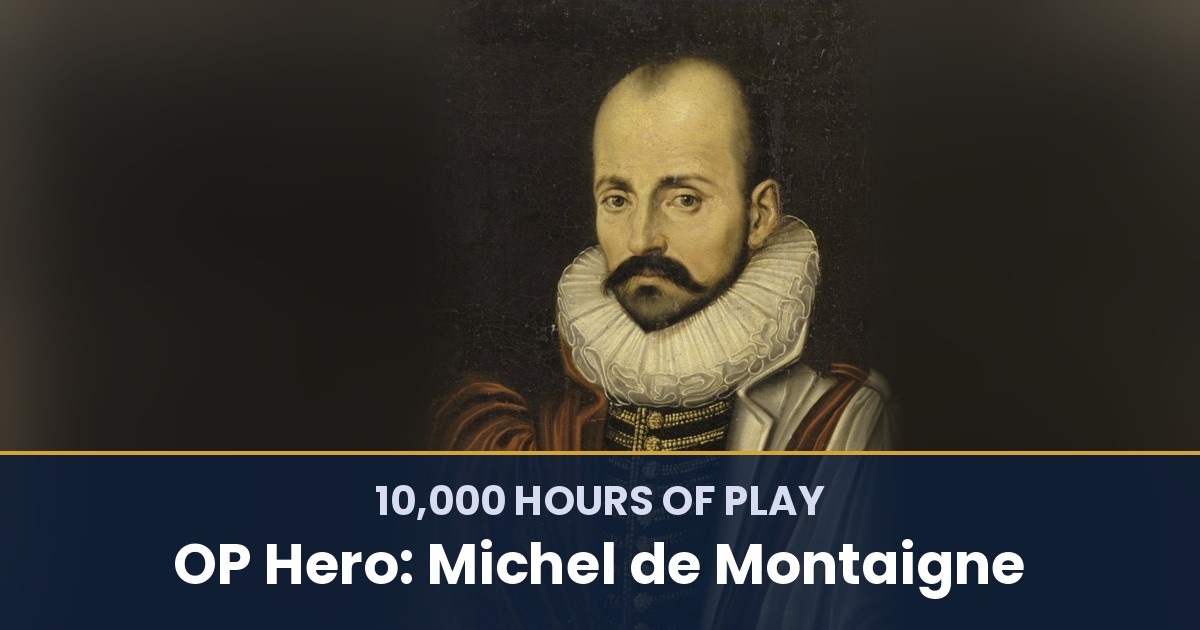


On 28 February 1571, his thirty-eighth birthday, Michel de Montaigne stepped away from public life and moved his working days into the library at the top of a tower on his family estate in Périgord.
He marked the day with a Latin inscription. It said that he had long been weary of the servitude of the law courts and public offices, and that he meant to spend the rest of his life there in calm and freedom.
That plan for a quiet retirement did not last long. Within seventeen years he had been mayor of Bordeaux, a go-between for the kings of France and Navarre, and, for part of one day, a prisoner in the Bastille.
What did last was the book he started in that tower. The Essais first appeared in 1580, he kept adding to them until he died in 1592, and they gave a whole literary form its name.
The six Steps below follow his run from a boy raised to speak Latin before French to the magistrate who retired at thirty-eight and wrote the Essais.
⚡ Speed Run Notes
- Montaigne played a long game of testing ordinary questions about how to live against books, history and his own experience.
- His signature move was using himself as the evidence, a method he announced in the note to the reader at the front of the 1580 edition and kept using for twelve more years.
- His canon Skills: Self Mastery (Rogue), Lich Grind (Warlock), Vision of the Wild (Druid), Concord of Elements (Druid) and Reflect Damage (Paladin).
- His Allies included a father who designed his education, a friend whose early death shaped his best-known essay, and a young editor who carried his final text into print.
- His setbacks were real ones: the death of La Boétie in 1563, years of kidney stones, a papal review of his book in Rome in 1581 and a mayoral term that ended in a plague year.
Table of Contents
About Yu-kai Chou

Yu-kai Chou is the author of 10,000 Hours of Play — the book that treats your life as the most important game you’ll ever build a character in, and gives you the 6-Step framework (Game · Attributes · Role · Skills · Allies · Quests) to play it on purpose. He has spent two decades developing the system through which this post analyzes its OP Hero, and applies it to his own life and to the lives of the people he advises around the world.
Chou’s other framework, the Octalysis Framework, has been applied by LEGO, Microsoft, Porsche, Coca-Cola, Salesforce, and MrBeast, impacting over 1.5 Billion Users. He has taught the methodology at Harvard, Stanford, Yale, Tesla, Google, BCG, and IDEO, and has advised governments in eight nations including Ukraine, the United Kingdom, the Kingdom of Bahrain, Singapore, Taiwan, the Netherlands, Kazakhstan, and South Korea.
His work has been cited by Harvard, Stanford, MIT, Forbes, Wall Street Journal, Wired, US Department of Energy, NIST, NSF, NCBI, US Department of Education, ClinicalTrials.gov, and Google Scholar — with 3,700+ more academic publications. Explore his books here.

Michel de Montaigne belongs in this series because his build shows how a private, bookish player can still earn the trust of both sides in a civil war. If I could lift one move from his character sheet, it would be his willingness to leave the library for the go-between Role, working as an intermediary between a Catholic king and a Protestant leader while the country around him was at war.
Step 1: The Game — What Michel de Montaigne Was Actually Playing
Montaigne’s Game was judgment. He wanted to work out how to think well about ordinary things like friendship, fear, illness and death, while staying honest about how little anyone can know for certain.
His motto put that limit into three words: “Que sais-je?”, which means “What do I know?”
He used the question as a working rule. Every time a conclusion started to feel settled, the motto pushed him to test it one more time.
The title of his book describes the method. Essais means attempts or trials, and each chapter tests a question against classical authors, history and his own experience, often ending without a final verdict.
In the note to the reader at the front of the first edition, dated 1 March 1580, he said plainly what he was doing: “I am myself the matter of my book.”
That line set the rules of his Game. The evidence would be one man’s habits, moods, illnesses and opinions, examined in close and candid detail.
The Game grew to three books and 107 chapters. He kept adjusting it until his death, adding a third book and hundreds of new passages for the 1588 edition, then filling the margins of his own printed copy with further changes.
He kept that inquiry going for twenty-one years after he first moved into the tower.
Step 2: Attributes — The Innate Stats
Attributes are the stats a player brings before any training, and Montaigne’s childhood makes several of his visible early.
His father, Pierre Eyquem, ran an unusual experiment on him. The baby was sent to be nursed by a peasant family in a nearby village, and back at home he was placed with a German tutor who spoke no French, so that Latin became his first language.
Montaigne later wrote that he was six years old before he understood French. His father also had him woken in the mornings by the sound of a musical instrument, because he believed sudden waking upset a child’s mind.
The first attribute that shows up in his writing is observational acuity. He noticed small things in himself and in others, such as a change of mood, a bodily sensation or an odd local custom, and he treated them as evidence about human nature.
The second attribute is a high tolerance for ambiguity, and he could keep two opposing possibilities open for pages at a time without forcing a conclusion, which is why so many of his essays argue with themselves.
The third attribute is candour about himself: he wrote about his poor memory, his daily habits and his kidney stones with the same steady attention he gave to the great figures of Greek and Roman history.
The OP Talent Triangle Method asks you to find your edge strength, the ability that sets your build apart from the people around you.
For Montaigne that edge was self-observation, a patient attention to his own mind that he turned into the subject of an entire book.
Step 3: Role(s) — The Character Class Across Chapters
Montaigne changed Roles at least five times, and what actually transferred across every change was the habit of weighing evidence before deciding, which he first practised for years as a judge.
His first Role was the magistrate, serving at the Cour des Aides in Périgueux and then, from 1557, in the Parlement of Bordeaux, where he spent about thirteen years before he gave up the office in 1570.
His second Role was the translator: at his father’s request he translated Raymond Sebond’s Theologia naturalis into French, and it was published in 1569, the year after his father died.
His third Role was the retired writer. From 1571 he worked in the tower library, where Greek and Latin sayings were inscribed on the ceiling beams, and in 1580 he published the first two books of the Essais in Bordeaux.
His fourth Role was the public official. He was elected mayor of Bordeaux in 1581 while he was travelling in Italy, took the office after pressure from King Henry III, and was re-elected in 1583.
His fifth Role was the go-between, and during the French Wars of Religion he worked as an intermediary between the Catholic king, Henry III, and the Protestant leader Henry of Navarre.
Step 4: Skills — The Real-Life Game Skills Michel de Montaigne Mastered
Skills are what a player trains on top of the starting stats, and five canon Skills explain most of Montaigne’s run.
The first is Self Mastery (Rogue): building a high level of self-awareness. Montaigne made himself the subject of his book and recorded his moods, habits and contradictions in close detail, chapter after chapter, across three books.
A similar discipline appears in Marcus Aurelius, who wrote his Meditations as private notes to himself. Montaigne took the same inward attention and published it.
The second is Lich Grind (Warlock): intense, secluded work. The nine years between his retirement in 1571 and the first edition in 1580 produced two books and more than ninety chapters.
The third is Vision of the Wild (Druid): seeing things from several perspectives with empathy. In “Of Cannibals” he wrote about the Tupinambá people of Brazil, mentioned meeting some who had been brought to Rouen in the time of King Charles IX, and argued that people call barbarism whatever is not their own custom.
The fourth is Concord of Elements (Druid): bringing parties with opposed interests together. In a civil war between Catholics and Protestants, both Henry III and Henry of Navarre used him as an intermediary, and Navarre stayed at the Château de Montaigne in 1584.
The fifth is Reflect Damage (Paladin): using setbacks as material for growth. A near-fatal fall from his horse became the subject of the essay “Of Practice,” and years of kidney stones fed “Of Experience,” the essay that closes his third book.
On the Skills Spectrum, Montaigne reads as a Master whose core craft was reflective prose, with a magistrate’s training in evidence and a go-between’s experience with two rival courts stacked on top of it.
Step 5: Allies — The People Who Multiplied Michel de Montaigne
Montaigne had only a handful of Allies, and each of them changed what his book became.
The first was his father, Pierre Eyquem. The Latin-first education he designed gave his son easy access to the classical authors, Plutarch and Seneca above all, whom the essays quote and argue with on page after page.
The second was Étienne de La Boétie, a fellow member of the Parlement of Bordeaux. La Boétie died on 18 August 1563, and the loss stayed with Montaigne for the rest of his life.
In “Of Friendship” he explained the bond with a line that is still quoted: “because it was he, because it was I.”
The third was Marie de Gournay, who had read the Essais as a young woman, met Montaigne in Paris in 1588, and became what he called his “fille d’alliance,” his adopted daughter.
After his death she prepared the 1595 edition, which carried his late additions into print.
The fourth Ally arrived after he was gone. John Florio’s English translation of 1603 brought the essays to English readers, and Shakespeare drew on “Of Cannibals” for Gonzalo’s speech about an ideal commonwealth in The Tempest.
Step 6: Quests — The Milestones That Shaped the Saga
Montaigne’s Quests run from a private loss to a book that kept growing after his death, and several of them are setbacks.
Quest 1 was grief: La Boétie died in August 1563, and Montaigne spent years working out in writing what the friendship had meant.
Quest 2 was the tower: he retired on 28 February 1571, and the first edition of the Essais, Books I and II, came out in Bordeaux in 1580.
Quest 3 was the road, and it carried a setback. From 1580 to 1581 he travelled through Switzerland, Germany and Italy, partly in search of relief for his kidney stones, and in Rome the Master of the Sacred Palace examined the Essais and asked for corrections.
Quest 4 was the mayor’s office in Bordeaux. He was elected mayor in his absence in 1581 and re-elected in 1583, and when plague broke out in 1585 at the end of his second term he stayed outside the city and did not return for the handover.
Quest 5 was the crowded year of 1588. The Paris edition added a third book, he was held in the Bastille for part of a day in July until Catherine de’ Medici had him released, and he met Marie de Gournay.
Quest 6 was the revision that never stopped. He kept writing in the margins of his own copy until he died at the Château de Montaigne in September 1592, and that annotated copy survives in Bordeaux.
Readers kept finding him long after his death, and in 1874 Friedrich Nietzsche wrote that the fact that such a man had written increased the joy of living on this earth.
What You Can Steal From Michel de Montaigne’s Build
First, make yourself the test case. Montaigne built whole essays out of watching his own reactions to fear, pain and friendship, and anyone can start that experiment with a notebook this week.
Second, protect a room where you can do deep work without interruption. The tower gave him nine years of reading and writing before the first edition appeared, and the first two books of the Essais were written there.
Third, publish the attempt and keep revising it. He released the essays in 1580, expanded them in 1588 and was still changing them in 1592, so his readers could watch a mind change across three editions.
Fourth, let your setbacks do some work for you. The fall from his horse and the kidney stones each became material for an essay, so even the hardest stretches of his life added pages to the book.
Where this framework comes from

Want the full system this profile is built on?
Every OP Hero piece runs through the same 6-Step framework from 10,000 Hours of Play: Unlock Your Real-Life Legendary Success. The book covers the full system, walks through Yu-kai’s own life run as the first applied case study, and gives you the worksheets to audit your own build.
Related Reading
- All OP Hero Profiles — the full hub
- 10,000 Hours of Play by OP Hero: Socrates
- 10,000 Hours of Play by OP Hero: René Descartes
- 10,000 Hours of Play by OP Hero: Baruch Spinoza
- 10,000 Hours of Play by OP Hero: Hannah Arendt