

In September 2024, Senegal’s new government did something almost no indebted state ever does voluntarily: it announced that the national books were wrong, and that the real debt was far larger than anyone had been told.
By the time the IMF finished re-checking the numbers, public debt stood at 132% of GDP at the end of 2024, against the roughly 74% the previous administration had reported. It is one of the largest debt-misreporting cases the Fund has ever processed.
Two years later, the government that told the truth is the one paying for it. Eurobonds slid through October 2026 while a $2.2 billion IMF rescue sat waiting on a budget vote, and the party that exposed the hidden ledger rejected that very budget in committee.
Here is the piece most coverage misses: the market penalty Senegal is paying right now attaches to the disclosure itself, and the political coalition that performed the disclosure is splitting over who should carry the cost.
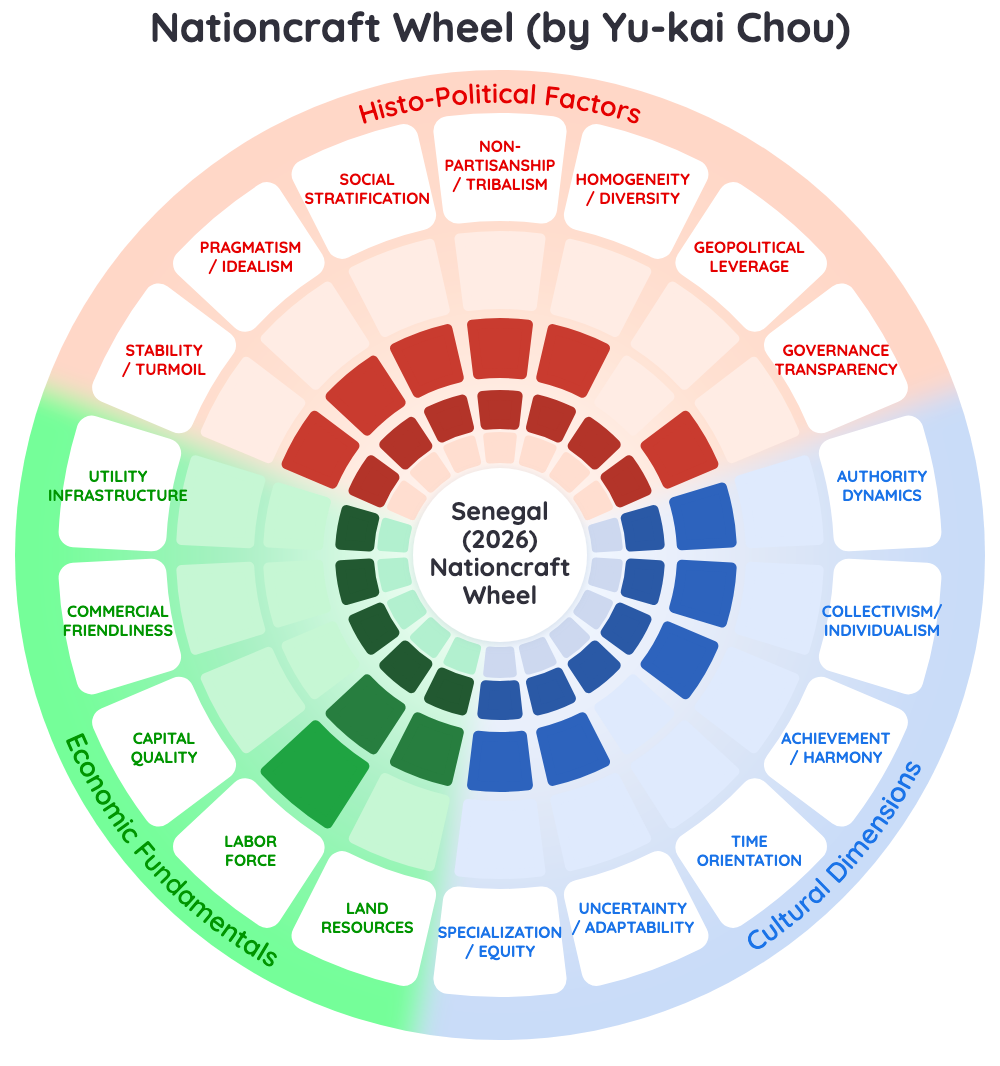
The Nationcraft reading of Senegal in October 2026 is a case study in what I call the Truth Tax Trap, and in why fiscal honesty is a sequencing problem before it is a virtue. Walk through the 18 variables and the trap becomes legible, along with the narrow path that converts a truth tax into a trust dividend.
⚡ Speed Run Notes
- Senegal did the one thing debt-hiders never do: it told the truth. The audited figure, public debt at 132% of GDP by end-2024, tripled the visible crisis and handed the new government the bill for sins it exposed.
- The Truth Tax Trap in V-vector terms: V13 Governance Transparency rising while V16 Capital Quality sits at 2 means honesty gets priced by markets years before it gets rewarded by institutions.
- A $2.2 billion, 36-month IMF deal reached staff-level agreement on September 1, 2026. It is gated on a misreporting waiver, financing assurances, and a budget that the ruling party itself rejected in committee in late October.
- Six celebrated reform playbooks misfit Senegal’s variables, including Georgia’s anti-corruption blitz and Argentina’s currency anchor. Jamaica 2010, Iceland 2008, and Canada 1994 are the packets actually worth studying.
- Reform that opens the system — statutory debt disclosure, a cross-party fiscal oversight body, oil revenue under published rules: this is the only route that turns the truth tax into cheaper borrowing and public trust.
Table of Contents
- Understanding Senegal’s Governance Landscape Through Nationcraft
- What Is the Nationcraft Framework?
- Why This Senegal Variables Analysis Matters
- The Crisis in Dates: From Hidden Ledger to Budget Standoff
- The 18 Senegal Nation Variables
- The Truth Tax Trap
- Detailed Justifications: Reading Each Variable
- Six Reformer Playbooks Senegal Reform Should Reject
- Best-Match Historical Packets: Three Playbooks Worth Studying
- Governance Strategy Recommendations
- Frequently Asked Questions
About Yu-kai Chou

Yu-kai Chou is a Human-Systems Architect & Behavioral Designer and the creator of the Nationcraft Framework — an 18-variable diagnostic for matching a country’s structural profile to the reform packets that have historically worked under similar conditions. He has consulted for governments in eight nations, including Ukraine, the United Kingdom, the Kingdom of Bahrain, Singapore, Taiwan, the Netherlands, Kazakhstan, and South Korea, and has worked directly with President Zelenskyy’s team on post-war reconstruction priorities for Ukraine.
Chou’s prior framework — the Octalysis Framework — has been applied by LEGO, Microsoft, Porsche, Coca-Cola, Salesforce, and MrBeast, impacting over 1.5 Billion Users. He has taught the methodology at Harvard, Stanford, Yale, Tesla, Google, BCG, and IDEO.
His work has been cited by Harvard, Stanford, MIT, Forbes, Wall Street Journal, Wired, US Department of Energy, NIST, NSF, NCBI, US Department of Education, ClinicalTrials.gov, and Google Scholar — with 3,700+ more academic publications. Explore his books here.

This Senegal analysis is the second Nationcraft reading of the country in 2026: July’s Tandem Trap piece diagnosed the Faye-Sonko dual-executive structure, while this one tracks what happened when that structure met the audited ledger — the hidden-debt disclosure, the $2.2 billion IMF staff-level agreement, and the October budget standoff. Chou’s advisory work on reform sequencing in eight nations is precisely about this problem class: how a government spends scarce public trust while repairing the institutions that generate it.
Understanding Senegal’s Governance Landscape Through Nationcraft
Senegal enters this analysis carrying two reputations at once. It is West Africa’s institutional exception (no successful coup since independence in 1960, with peaceful transfers of power in 2000, 2012, and 2024), and it is now also the state attached to one of the largest debt-misreporting scandals in IMF history.
Both reputations are true, and the tension between them is the analysis. The canon Senghor-Wade Stability Packet (SP-040, 1960-2012) records how Senegal built durable civilian rule out of a Sufi brotherhood alliance, negotiated politics, and gradual democratization, while its critical insight cuts the other way: stability without prosperity eventually breeds frustration, particularly among youth.
The 2024 election was that frustration arriving at the ballot box. Bassirou Diomaye Faye won the presidency within days of leaving prison, on an anti-corruption and sovereignty platform built by Ousmane Sonko, and their Tandem Trap configuration, president and movement-leader sharing one mandate, was the subject of July’s Nationcraft reading.
What changed since July is that the tandem formally split, and the split now has a price printed on it. The budget that unlocks a $2.2 billion IMF program sits hostage between a president’s government and a speaker’s party that were, eighteen months ago, the same project.
In Nationcraft terms this is a configuration problem, and configuration is exactly what the Nationcraft Framework was built to diagnose. Scores are never averaged; the interaction between a nation’s variables IS the strategy.
What Is the Nationcraft Framework?
The Nationcraft Framework is an 18-variable diagnostic I developed for matching a country’s structural profile to the historical reform packets that worked under similar conditions. The 18 Nation Variables split into three clusters: Cultural (V1-V6), Histo-Political (V7-V13), and Economic (V14-V18).
The central claim of Nationcraft is that policy effectiveness is decided by context-fit rather than policy quality. A reform that transformed one country can wreck another, because the receiving configuration (authority dynamics, trust reserves, capital depth, time horizons) determines what the policy becomes on contact.
Each variable is scored 1-9 from behavioral evidence. The framework then matches the profile against a corpus of over 100 Success Packets and failure packets: documented reform sequences with their preconditions, sequencing logic, outcome trajectories, and limits.
For Senegal, the Nationcraft question is narrow and urgent. Which debt-crisis playbooks fit a low-leverage, consensus-culture democracy with new oil, a currency it does not control, and a freshly audited ledger? And which celebrated playbooks would break it?
Why This Senegal Variables Analysis Matters
Senegal in late 2026 is the live test of a question every indebted government quietly asks: what actually happens if we stop lying about the numbers?
The empirical answer so far is uncomfortable. Disclosure cost Senegal its IMF program, its credit standing, and eventually the unity of its ruling movement, while the sanctioned reward, a new Fund arrangement and a debt treatment, remains gated on votes and waivers that have not yet happened.
If the disclosure path visibly fails here, every finance ministry watching learns the lesson that Mozambique’s pre-spent windfall and its tuna-bond scandal taught negatively: hiding debt is cheaper, right up until it is catastrophic. If the path works, Senegal becomes the reference case for honest-ledger recovery in a region full of opaque balance sheets.
There is also a second stake, on a timer. Senegal’s first full year of oil production was 2025, when the economy grew 6.7% on the strength of it. That means the revenue stream that could either fund recovery or dissolve into patronage is arriving at the exact moment the fiscal institutions are being rebuilt.
Readers of Ghana’s bailout cycle analysis will recognize the stakes: West African IMF programs have a habit of becoming recurring subscriptions. Whether Senegal’s becomes its last depends on variable interactions, and that is what the next sections map.
The Crisis in Dates: From Hidden Ledger to Budget Standoff
The Truth Tax Trap is easiest to see as a sequence. Every row below is load-bearing for the diagnosis that follows.
| Date | Event | Why it matters |
|---|---|---|
| Mar-Apr 2024 | Faye wins the presidency on the Pastef anti-corruption platform; Sonko becomes prime minister | The reform mandate is a shared asset of two men and one movement |
| Sep 2024 | The new government announces that deficits and debt were materially understated under the previous administration | The disclosure decision — the moment the truth tax starts accruing |
| Feb 2025 | Senegal’s Court of Auditors (Cour des comptes) confirms the misreporting | An independent institution, not a party, now owns the finding (V13) |
| Oct 2025 | Discussions on a new IMF-supported program begin at the IMF-World Bank Annual Meetings | Re-engagement starts only after the audit trail exists |
| May 22, 2026 | President Faye dismisses Prime Minister Sonko by decree, dissolving the government amid the debt crisis and stalled IMF talks | The tandem breaks on the question of the cleanup’s cost |
| May 25-26, 2026 | Economist Ahmadou Al Aminou Lô appointed prime minister; Sonko elected speaker of the National Assembly | Technocratic executive, movement-controlled legislature: the standoff geometry is set |
| Jun-Jul 2026 | Pastef declines to join the new government; Faye launches his own party | One mandate becomes two competing legitimacies (V10 pressure) |
| Sep 1, 2026 | IMF staff-level agreement: a 36-month, ~$2.2 billion Extended Credit Facility (SDR 1,537.1 million, 475% of quota) | The reward for disclosure, gated on corrective actions, a misreporting waiver, and financing assurances |
| Oct 20-26, 2026 | Eurobonds fall as the budget standoff threatens IMF approval; Semafor reports a “$13 billion budget deadlock”; a three-day general strike hits amid a cost-of-living squeeze | The truth tax compounding in real time |
| Oct 23, 2026 | Pastef, with 130 of 165 Assembly seats, rejects the revised budget in the finance committee | The ruling party blocks its own government’s cleanup budget |
| Oct 27, 2026 | Finance Minister Cheikh Diba asks that the draft return to committee “to seek a constructive outcome” and avoid a shutdown; Speaker Sonko agrees to set dates for committee proceedings and the next plenary | The vote that decides whether disclosure pays is pending as this analysis publishes |
Prime Minister Lô has publicly raised a constitutional fallback for passing the budget if the Assembly blocks it. That option exists on paper; its use would convert a fiscal standoff into an institutional one, which is precisely the V7 stability reserve Senegal cannot afford to spend.
The 18 Senegal Nation Variables
The scores below are the corpus values from the Nationcraft Nation Variables dataset (October 2026), consistent with July’s reading. Evidence is updated for the budget standoff.
| Variable | Score (1-9) | 2026 evidence |
|---|---|---|
| V1 Authority Dynamics | 6 | Semi-presidential authority now split three ways: President Faye, PM Lô’s technocratic cabinet, Speaker Sonko’s Assembly majority |
| V2 Collectivism vs Individualism | 6 | Sufi brotherhood networks (Mouride, Tijaniyya), teranga hospitality culture, strong family solidarity |
| V3 Achievement vs Harmony | 4 | Harmony-leaning; consensus and accommodation prized over open contest |
| V4 Time Orientation | 3 | Short political horizons; the hidden debt was short-termism made literal |
| V5 Uncertainty & Adaptability | 5 | Society absorbs shocks (strikes, price spikes) without rupture; institutions react late |
| V6 Specialization vs Equity | 4 | Equity-leaning; subsidies and distribution politics dominate allocation |
| V7 Stability vs Turmoil | 6 | No successful coup since 1960; peaceful alternations; 2021-24 unrest stressed but did not break the system |
| V8 Pragmatism vs Idealism | 4 | The split embodied: Faye and Lô pragmatic toward the IMF, Sonko’s wing sovereigntist-idealist |
| V9 Social Stratification | 5 | Moderate; caste legacies, a coastal-interior divide, urban youth locked out |
| V10 Non-Partisanship vs Tribalism | 4 | Partisanship hardening fast: Pastef vs Faye’s new party, one movement become two camps |
| V11 Homogeneity vs Diversity | 4 | Religiously cohesive (about 94% Muslim, largely Sufi), ethnically plural with Wolof plurality |
| V12 Geopolitical Leverage | 1 | Small economy, limited strategic weight; leverage rising slightly with gas and Sahel-gateway position |
| V13 Governance Transparency | 5 | The decisive mid-score: historic opacity produced the scandal, yet the audit and disclosure are transparency in action |
| V14 Land Resources | 6 | Agriculture, phosphates, fisheries, plus Sangomar oil and Greater Tortue Ahmeyim gas now producing |
| V15 Labor Force Quality | 7 | Carried by a French-educated administrative class and a strong diaspora; eroded by brain drain and weak average schooling |
| V16 Capital Quality | 2 | Junk-rated debt at 132% of GDP, thin domestic financial system, CFA franc peg removes monetary discretion |
| V17 Commercial Friendliness | 3 | Heavy state footprint, large informal economy, regulatory friction |
| V18 Utility Infrastructure | 3 | Improving electricity access; real gaps in power reliability, water, and transport beyond Dakar |
Read the shape before the details: social variables mid-to-strong (V2=6, V7=6, V15=7), economic variables weak (V16=2, V17=3, V18=3), and the political cluster split down the middle. Nationcraft treats that shape as a specific disease with specific contraindications.
The Truth Tax Trap
Here is the paradox in one sentence: the transparency that should be Senegal’s way out of the debt crisis is, in the short run, the thing deepening it.
Disclosure repriced the entire stock of Senegal’s obligations at once. A 74%-of-GDP country with suspicious numbers borrowed more cheaply than a 132% country with honest ones, so the act of telling the truth transferred years of concealed risk onto the balance sheet of the government that did the telling.
The trap has a political floor beneath the financial one. The consolidation the IMF program requires lands on the exact constituency (urban, young, cost-of-living-squeezed) that elected the disclosers, which is why a three-day general strike and a ruling-party budget revolt arrived in the same October.
In variable terms, the Truth Tax Trap is a V13-V16-V4 interaction. V13 Governance Transparency at 5 and climbing generates the audit, the restated ledger, and the Cour des comptes finding; V16 Capital Quality at 2 means there is no domestic capital cushion to absorb the repricing; V4 Time Orientation at 3 means the political system discounts the long-run trust dividend to nearly zero.
Add V10 at 4 and the trap closes. The truth tax needs to be carried by a united coalition for roughly a political generation before it converts, and Senegal’s coalition split fourteen months after the disclosure.
The trap teaches sequencing, never opacity: disclosure is Phase One of a sequence, and that a government which performs Phase One without pre-building the carrying structure — oversight bodies, protected household transfers, a budget process that survives party splits — pays the tax without collecting the dividend.
Detailed Justifications: Reading Each Variable
V1 Authority Dynamics: 6
Senegalese authority is strong but negotiated: presidents govern through marabout networks, unions, and party coalitions rather than over them. The 2026 configuration splits formal authority across Faye, Lô, and Sonko, which makes every fiscal decision a three-key lock.
V2 Collectivism vs Individualism: 6
The Sufi brotherhoods remain the deepest solidarity infrastructure in the country, able to stabilize or veto national projects. Any consolidation plan that ignores brotherhood-mediated consent misreads how Senegalese collectivism actually transmits.
V3 Achievement vs Harmony: 4
Senegal’s political culture prizes accommodation; even the 2024 rupture election produced a negotiated, peaceful transfer. Harmony-leaning cultures absorb austerity better when it is framed as shared sacrifice with visible elite participation.
V4 Time Orientation: 3
The hidden debt itself is the V4 evidence: obligations pushed past the reporting horizon for short-run political quiet. A 36-month IMF program with a 2027 revenue strategy asks a V4=3 system to hold a multi-year promise, which is the program’s quiet structural risk.
V5 Uncertainty & Adaptability: 5
Price shocks, strikes, and political whiplash have not produced institutional rupture, which argues for real adaptive capacity. The adaptation is social rather than institutional; ministries react slowly while households and brotherhoods absorb fast.
V6 Specialization vs Equity: 4
Allocation politics lean toward spreading resources: subsidies, public employment, regional balance. Consolidation that reads as equity-violating (cuts for the many, protection for the connected) will fail socially even if it passes arithmetically.
V7 Stability vs Turmoil: 6
Six decades without a successful coup is a regional outlier, and that reserve is the collateral the whole recovery borrows against. The constitutional-fallback budget option would spend V7 to solve a V10 problem, which is the wrong account to draw on.
V8 Pragmatism vs Idealism: 4
The ruling movement contains both poles: a pragmatic wing negotiating with the Fund and a sovereigntist wing for whom the IMF is the problem being treated. The budget vote is where those two theories of the state collide.
V9 Social Stratification: 5
Caste legacies and a widening urban-youth exclusion sit beneath formal equality. The strike wave shows stratification translating into organized wage pressure exactly when the ledger has no room for it.
V10 Non-Partisanship vs Tribalism: 4
Senegal’s partisanship is organizational rather than ethnic, and it is hardening: Pastef against Faye’s new party is a factional split inside what was one mandate. V10 at 4 is the variable moving fastest, and in the wrong direction for a multi-year program.
V11 Homogeneity vs Diversity: 4
Religious cohesion around Sufi Islam coexists with ethnic plurality and the long-running Casamance question. Unlike Côte d’Ivoire’s exclusionary spiral, Senegalese identity politics has historically stayed inclusive, an asset the current factional fight has not yet damaged.
V12 Geopolitical Leverage: 1
Senegal cannot make creditors need it the way larger or strategically placed debtors can. Gas exports and the Sahel-gateway position add some weight, but the recovery must be earned on credibility rather than extracted through leverage.
V13 Governance Transparency: 5
The most dynamic variable in the profile. The scandal proves the historic 3-4; the self-initiated audit, the Cour des comptes confirmation, and publication of the restated numbers are 6-7 behavior. Which of those two trajectories sticks will decide most of Senegal’s coming decade.
V14 Land Resources: 6
Phosphates, fisheries, and agriculture now sit alongside Sangomar crude and Greater Tortue Ahmeyim LNG. Resource arrival during institutional repair is historically the most dangerous timing, which is why the Chad packet appears in the rejection list below.
V15 Labor Force Quality: 7
The administrative and professional class is genuinely strong, and the diaspora is a capital and skills reservoir most peers lack. The score overstates average schooling, and brain drain is the standing threat to it.
V16 Capital Quality: 2
Debt at 132% of GDP, junk ratings, a thin banking system, and a currency board-like peg mean Senegal has almost no domestic shock absorbers. Every stabilization packet that assumed deep local capital markets is disqualified on this score alone.
V17 Commercial Friendliness: 3
The state’s economic footprint is heavy and the informal sector is where most Senegalese actually work. Formalization-by-force would tax the trap-carrying population; formalization-by-service (cheaper registration, functioning courts) is the V17 path consistent with the rest of the profile.
V18 Utility Infrastructure: 3
Power, water, and transport outside Dakar remain thin. Infrastructure is also where hidden liabilities often hid, so every new project now carries a disclosure test as well as an engineering one.
Six Reformer Playbooks Senegal Reform Should Reject
Nationcraft’s contrarian half: the packets below are celebrated, documented in the corpus, and wrong for this configuration. The table summarizes; the subsections give the variable mechanics.
| Packet | Years | Celebrated for | Why it misfits Senegal |
|---|---|---|---|
| SP-051 Saakashvili Reform Packet (Georgia) | 2004-2012 | Radical anti-corruption blitz | Requires concentrated executive power Senegal neither has (V1=6 negotiated) nor should want |
| SP-050 Convertibility & Crisis Packet (Argentina) | 1991-2003 | Killing hyperinflation with a currency anchor | Senegal already has the anchor; the packet’s failure mode (rigidity + fiscal indiscipline) is the live risk |
| SP-034 Plano Real & Stabilization Packet (Brazil) | 1994-2002 | Breaking inflationary psychology | Wrong disease: Senegal’s inflation was 1.4% in 2025; the ledger, not the price level, is broken |
| SP-099 Oil Discovery & Conflict Packet (Chad) | 1990-2020 | World Bank-conditioned oil revenue management | The cautionary case: conditions a ruler can renegotiate are not institutions (V13 test) |
| SP-079 EU Accession & Crisis Packet (Greece) | 1974-2015 | Integration-funded convergence | Hidden-deficit twin; externally administered austerity without domestic ownership cost a generation |
| FP-007 Economic Collapse Packet (Sri Lanka) | 2019-2022 | Nothing — a failure packet | The road Senegal stepped off: concealment, reserve depletion, then default and queues |
SP-051 Georgia: the blitz that needs a hand Senegal shouldn’t play
Georgia’s Saakashvili packet fired the entire traffic police, rebuilt customs, and jumped the country 50+ places in corruption rankings within five years. Its preconditions are the problem: a revolutionary mandate, V1 concentration around one leader, and a willingness to run reform through executive force.
Senegal’s V1=6 is negotiated authority in a system whose core asset is six coup-free decades, and the packet’s own record notes the authoritarian turn that followed concentration. The full mechanics are in the Saakashvili anti-corruption packet deep-dive; the transferable piece for Senegal is the service simplification; the power model stays in Georgia.
SP-050 Argentina: the anchor Senegal already wears
Argentina’s convertibility regime crushed 3,000% inflation and then, lacking fiscal truth underneath it, became the straitjacket that produced the largest sovereign default of its era. The packet’s critical insight: without fiscal discipline, the cure becomes the trap.
Senegal’s CFA franc peg delivers anchor-grade price stability — and removes devaluation as an adjustment valve, exactly as convertibility did. That is why Argentina’s anchor trap reads as a warning label here: with V16=2 and no monetary discretion, the honest budget is Senegal’s only shock absorber.
SP-034 Brazil: a brilliant answer to a question Senegal isn’t asking
The Plano Real broke a 30-year inflationary psychology with the URV transition currency and earned its place in the canon. Senegal’s inflation ran 1.4% in 2025 inside the franc zone.
Importing a stabilization packet aimed at price expectations would spend scarce reform bandwidth on a solved problem. The piece of the Real worth keeping is its 2000 Fiscal Responsibility Law (hard, published budget constraints), which belongs in the study list’s spirit rather than the stabilization machinery.
SP-099 Chad: conditions are not institutions
Chad’s World Bank pipeline experiment attached unprecedented revenue-management conditions to oil money, and the packet records the result: terms renegotiated within three years, revenues to the military and patronage, $10B+ extracted with HDI unchanged.
The lesson for a Senegal whose oil arrived in 2024-25 is exact. Rules imposed from outside, or adopted as conditions rather than as domestic law with court-enforceable publication requirements, do not survive contact with a determined executive, under any government, present or future.
SP-079 Greece: the other hidden-deficit country
Greece entered the euro on manipulated statistics, and when the truth surfaced in 2009-10 the correction was administered from outside: troika programs, 25% GDP loss, a generation’s social devastation. The packet’s critical insight is that external funds are no substitute for institutional reform.
Senegal’s divergence point from Greece is the ownership of the correction. Greece’s discipline window analysis shows what happens when consolidation is experienced as foreign command; Senegal disclosed its own books via its own Court of Auditors, and keeping the program domestically owned is the single biggest Greece-avoidance move available.
FP-007 Sri Lanka: the counterfactual Senegal avoided
Sri Lanka 2019-22 is the concealment endgame: tax cuts into a revenue collapse, reserves burned defending the currency, then the region’s worst crisis: default on $51B, fuel queues, a president in flight. The failure packet’s variable note is blunt: debt-financed development requires V16≥5, and Sri Lanka ran it at 3.
Senegal at V16=2 was running the same gradient until September 2024. Sri Lanka’s compliance paradox shows the after-state: years of IMF compliance from a position of rubble. Disclosure before default, for all its taxes, is the cheaper branch. That comparison is the Truth Tax Trap’s strongest defense.
Best-Match Historical Packets: Three Playbooks Worth Studying
The affirmative half. None of these transfers whole; each matches Senegal on the variables that gate success.
| Packet | Core move | Variable fit to Senegal |
|---|---|---|
| SP-083 Tourism & Diaspora Development Packet (Jamaica, 1962-2010) | 2010 domestic debt exchange + sustained cross-party fiscal discipline under an IMF program | Democracy-preserving debt workout; V2=6 consensus culture; two-party machine politics made to carry a long program |
| SP-114 Banking Collapse Response Packet (Iceland, 2008-2012) | Let losses surface, protect ordinary households, prosecute wrongdoing through courts, put key burdens to referendum | Accountability-first recovery; V2/V13 lesson maps to Senegal’s audit moment; fastest recovery among its crisis peers |
| SP-111 Chrétien-Martin Deficit Elimination Packet (Canada, 1993-1998) | Program Review: every program against six published tests; under-promise, over-deliver budgeting | Consolidation through transparent method rather than across-the-board pain; narrative framed as saving programs |
SP-083 Jamaica: debt honesty carried by consensus, for years
Jamaica spent decades in the middle-income debt trap the packet documents, then executed the 2010 Jamaica Debt Exchange and an IMF program that finally created fiscal space, with democratic stability maintained throughout. The durable mechanism was social: a standing cross-party and civil-society consensus that outlived individual governments.
That is the exact structure Senegal’s October standoff lacks. A Jamaica-shaped fiscal oversight compact (opposition, unions, employers, and brotherhood representatives holding the program jointly, with public minutes) would let the truth tax be carried by the society rather than by one faction’s political capital. V2=6 and V3=4 say Senegal can build this; V10=4 says it must.
SP-114 Iceland: make the truth expensive for the right people
Iceland let banks worth ten times GDP fail, protected domestic depositors, appointed a special prosecutor who convicted 36 bankers, and put the Icesave repayment question to citizens twice. The packet’s variable lesson credits V2 solidarity and V13 transparency for a recovery rated the fastest among crisis-hit nations.
Senegal’s analog is scale-adjusted but structurally parallel: the misreporting has authors, and routing accountability through courts with published findings, rather than through factional purge, is what converts a scandal into institutional capital. Angola’s prosecution dividend analysis maps the degraded version where anti-corruption doubles as politics; the Iceland packet is the clean version where judges, not parties, hold the pen.
SP-111 Canada: consolidation as a published method
Canada 1993 faced a 67% federal debt ratio and a deficit at 5.6% of GDP, then eliminated the deficit in five years through Program Review (six public tests applied to every program) and conservative revenue projections that let the government over-deliver. The packet’s political lesson: framing the cuts as saving social programs held public support.
Senegal cannot copy the trust level (Canada ran V13=9; Senegal is at 5), and that gap defines the adaptation. Each consolidation choice needs its test and rationale published, so the method itself manufactures the transparency the starting point lacks: consolidation as V13-building exercise rather than V13-consuming one.
Governance Strategy Recommendations
What would reform require, if someone were to pursue it? Written for the reformer, the analyst, and the citizen scoring the government’s choices. Each move names the mechanism that makes it real and the public that gains.
| Reform move | Mechanism that makes it real | Who gains | V-interaction |
|---|---|---|---|
| Statutory debt disclosure | A quarterly public debt bulletin required by law, audited by the Cour des comptes, published in full | Citizens and lenders get the same numbers at the same time; concealment becomes a legal violation, not a political option | V13 5→6; repairs V4 by making short-termism visible |
| A budget process that survives party splits | A standing fiscal oversight council (Jamaica EPOC shape) seating opposition, unions, employers, and civil society, with public minutes and a published scorecard | The program stops depending on any one faction’s survival; households see who signed what | Compensates V10=4 with institutionalized V2=6 |
| Oil and gas revenue under published rules before volumes scale | A transfer rule voted by the Assembly as law (share saved, share budgeted) with quarterly published flows, enforceable in court | The population owns the windfall trajectory; the Chad renegotiation path is closed by statute | V14=6 routed around V16=2; the Norway Oil Fund packet (SP-106) shows the preconditions being built here |
| Protect households inside consolidation | Targeted cash transfers with published eligibility criteria and an independent audit trail, expanded before subsidy reform lands | The cost-of-living constituency that struck in October carries less of the adjustment | V6=4 and V9=5 respected; consolidation survives socially |
| Accountability through courts, with published findings | Judicial process for the misreporting case, findings published whatever they conclude, no exemptions and no purge lists | Rule of law applying to elites — the Iceland dividend; future officials price concealment at its real cost | V13 compounding; V7 preserved because process, not faction, delivers the verdict |
The sequencing of these moves matters more than the selection of them. Disclosure already happened; the oversight compact and household protection are the overdue middle moves; the revenue rule must land before oil money scales, because the Chad packet shows rules adopted after the money flows are rules written by the money.
The common thread is that every move opens the system: it publishes, seats more parties at the table, and makes courts the referee. The pattern is deliberate, because opening the system is what separates reform from capacity optimization. A consolidation that merely collects better and controls tighter would pass the arithmetic and fail the country.
Strategic Implications
For the IMF program: the staff-level agreement’s own conditions (corrective actions on misreporting, a waiver, financing assurances) mean the program is purchasable only with the political goods Senegal is currently fighting over. The Fund’s pillars (consolidation, revenue strategy in 2027, arrears monitoring, SOE oversight) will hold only as domestic law, per the Chad lesson.
For the region: Senegal is running the honest-ledger experiment with everyone watching. Zambia’s model-debtor trap tested whether cooperative debtors get rewarded; Senegal tests whether honest ones do, and the G20 Common Framework treatment it has signaled will be the scoreboard.
For markets: the October Eurobond slide prices the standoff, and it will reprice on a single vote. Low V12 means Senegal cannot threaten its way to better terms; the only lever it holds is making its disclosures boringly reliable.
For the windfall: 6.7% growth in the first full oil year is the honeymoon number. Ireland’s windfall trap and Bolivia’s gas dividend trap bracket the outcomes: windfalls institutionalized versus windfalls politically consumed. Senegal chooses its bracket in roughly the next two budgets.
Comparative Context
Against its own packet: SP-040’s Senegal built stability without prosperity; the 2026 state is attempting prosperity without spending the stability. The packet’s warning, youth frustration as the bill for stagnation, is now the strike on the street.
Against the neighborhood: Côte d’Ivoire’s failure packet (FP-006) documents how an elite split hardened into exclusionary identity politics and then war. Senegal’s Faye-Sonko split remains programmatic rather than ethnic, and keeping it that way is worth more than any single budget.
Against the debt cohort: Ghana is on its latest Fund program and its bailout count is the cautionary metronome; Mozambique’s tuna-bond decade shows the concealment branch fully played out. Senegal’s differentiator in this cohort is that its scandal was self-reported: no creditor, court, or leak forced the September 2024 announcement.
That self-report is the asset the entire recovery should be built around, because it is the one thing in this story no peer can claim.
The Nationcraft Framework in Practice
This analysis ran the standard Nationcraft sequence: profile the 18 variables from behavioral evidence, name the paradox the interactions produce, then match against the packet corpus for fits and misfits — the same method as the Venezuela reform playbooks analysis that anchors this series.
The motivational layer underneath is the same one I map in products: a population’s willingness to carry reform is a design problem. The Octalysis lens on nation-building explains how the eight Core Drives translate to public policy, and Senegal’s case is nearly all Core Drive 8 (Loss & Avoidance) right now: a nation asked to sacrifice to avoid a worse path it never saw coming.
Sustainable versions of this story migrate to Core Drive 1 (Epic Meaning) and Core Drive 2 (Accomplishment): the country that told the truth and won. The recommendations above are, in motivational terms, that migration path.
Explore More Nationcraft Analyses
The full country series lives in the Nation Variables Library, with every published 18-variable analysis and its wheel.
Adjacent reads for this one: the Ghana, Zambia, and Mozambique analyses linked above for the debt cohort, and July’s Senegal Tandem Trap for the political architecture this piece builds on.
Frequently Asked Questions
What is the Truth Tax Trap in Senegal’s 2026 Nationcraft analysis?
The Truth Tax Trap names the interaction where rising transparency (V13) meets weak capital quality (V16=2) and short time horizons (V4=3): disclosing hidden debt repriced Senegal’s entire balance sheet immediately, while the rewards of honesty (cheaper borrowing, institutional trust) pay out on a delay the political system struggles to survive.
Why did Senegal’s debt jump to 132% of GDP?
The reported series jumped because the measurement finally caught up with the stock. After the 2024 transition, the new government announced that deficits and debt had been materially understated, Senegal’s Court of Auditors confirmed the misreporting in February 2025, and the IMF subsequently put public debt at 132% of GDP at end-2024 once the audited data replaced the reported series.
What does the $2.2 billion IMF agreement require from Senegal?
The September 1, 2026 staff-level agreement is a 36-month Extended Credit Facility of about US$2.2 billion (SDR 1,537.1 million, 475% of quota) whose Board approval is gated on corrective actions for the misreporting case, a waiver decision, and financing assurances. Its pillars include fiscal consolidation, stronger social safety nets, improved debt management, arrears monitoring, and oversight of state-owned enterprises.
Which reform playbooks fit Senegal’s Nation Variables?
The Nationcraft matches are Jamaica’s 2010 debt workout carried by cross-party consensus (SP-083), Iceland’s accountability-first crisis response (SP-114), and Canada’s transparent Program Review consolidation (SP-111). High-force packets like Georgia’s Saakashvili blitz (SP-051) misfit Senegal’s negotiated authority structure, and stabilization packets like Brazil’s Plano Real (SP-034) target a disease Senegal does not have.
Does Senegal’s oil and gas change the Nationcraft diagnosis?
It raises the stakes rather than changing the shape. Sangomar oil and Greater Tortue Ahmeyim gas lifted growth to 6.7% in 2025, but V16=2 and a mid-level V13 mean the windfall arrives before the institutions that would protect it; the Chad packet (SP-099) and the Norway fund packet (SP-106) mark the two endpoints of where that timing can lead.
Related Reading
- The Nationcraft Framework: 18 Variables, 8 Goals, 100+ Proven Reform Packets
- Nationcraft Nation Variables Library
- Nationcraft Analysis: Pakistan Borrower’s Gavel 2026
- Nationcraft Analysis: Kenya Concession Trap 2026
- Nationcraft Analysis: Tunisia Sovereignty Trap 2026
- Nationcraft Analysis: Nigeria Reform Dividend 2026
Footnotes
- IMF Press Release No. 26/282, “IMF Reaches Staff-Level Agreement with Senegal on an Extended Credit Facility Arrangement,” September 1, 2026: imf.org
- IMF, “Senegal: Questions and Answers”: imf.org
- IMF Press Briefing Transcript, September 10, 2026: imf.org
- Africanews, “Senegal’s finance committee to review revised budget key to IMF deal,” October 28, 2026: africanews.com
- Bloomberg, “Senegal Premier Raises Constitutional Option in Budget Standoff,” October 25, 2026: bloomberg.com
- Bloomberg, “Senegal Eurobonds Fall as Budget Standoff Puts IMF Deal at Risk,” October 20, 2026: bloomberg.com
- Semafor, “Senegal grapples with $13B budget deadlock,” October 26, 2026: semafor.com
- Wikipedia, “2026 in Senegal” (government change timeline: May 22-26, June 1, July 26, 2026): en.wikipedia.org
- Wikipedia, “Senegal hidden debt scandal”: en.wikipedia.org