
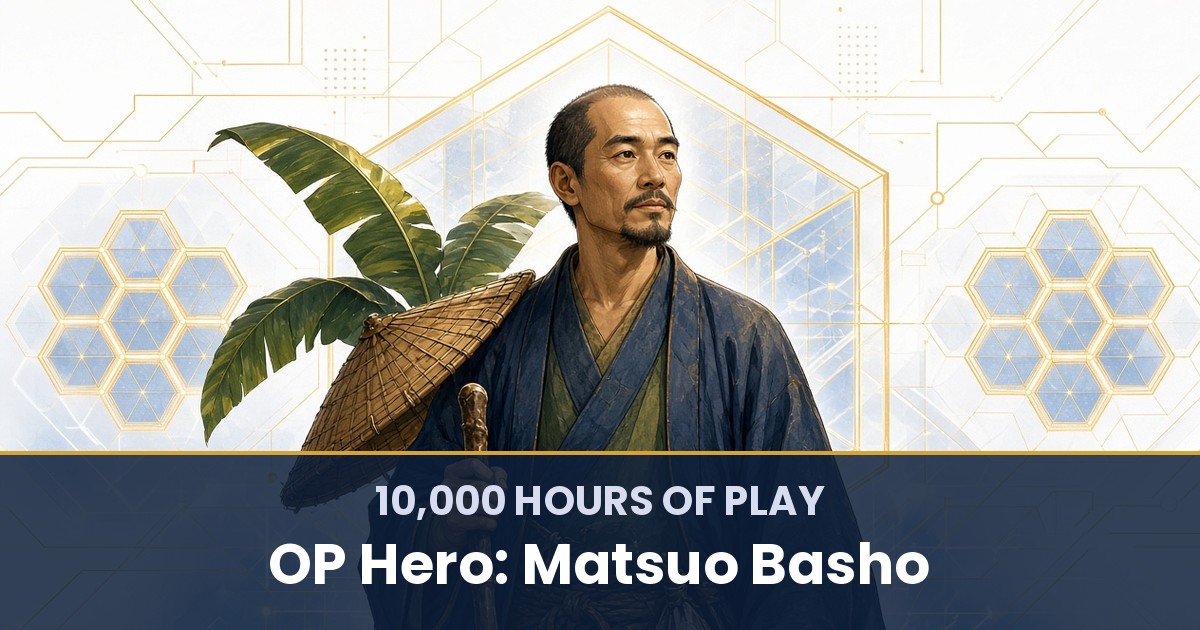


In December 1682, fire swept through Edo and took Matsuo Bashō’s hut with it.
He was in his late thirties, and the small riverside retreat was more than shelter. The banana plant by its door, a bashō, had given the rising haikai master the pen name the world now knows him by.
Watch what he did after the ash cooled: the hut was rebuilt by 1683, and then he started walking. Over the next twelve years he turned travel, poverty, and seventeen syllables into a single lifelong practice, and he kept refining it until the week he died.
His life maps cleanly onto the 6-Step framework, so let’s run the build.
⚡ Speed Run Notes
- Bashō’s real Game was turning poetry from urban entertainment into a way of living. Travel, poverty, and fellowship were his training methods for it.
- His Attributes showed early: he sensed poetic charge in ordinary sensory events other poets walked past, and he traded security for uncertainty on purpose, repeatedly.
- The famous frog poem of 1686 was an edit. His student Kikaku proposed decorative yellow roses for the opening; Bashō chose the ancient pond. Subtraction carried the poem.
- He scaled through Allies: a patron funded the hut, Sora ran logistics on the road, and disciples like Kikaku and Kyorai carried the school past his death.
- He died mid-journey in 1694 before his masterpiece was in print. Oku no Hosomichi was published in 1702 and made his five-month walk permanent.
Table of Contents
About Yu-kai Chou

Yu-kai Chou is the author of 10,000 Hours of Play — the book that treats your life as the most important game you’ll ever build a character in, and gives you the 6-Step framework (Game · Attributes · Role · Skills · Allies · Quests) to play it on purpose. He has spent two decades developing the system through which this post analyzes its OP Hero, and applies it to his own life and to the lives of the people he advises around the world.
Chou’s other framework, the Octalysis Framework, has been applied by LEGO, Microsoft, Porsche, Coca-Cola, Salesforce, and MrBeast, impacting over 1.5 Billion Users. He has taught the methodology at Harvard, Stanford, Yale, Tesla, Google, BCG, and IDEO, and has advised governments in eight nations including Ukraine, the United Kingdom, the Kingdom of Bahrain, Singapore, Taiwan, the Netherlands, Kazakhstan, and South Korea.
His work has been cited by Harvard, Stanford, MIT, Forbes, Wall Street Journal, Wired, US Department of Energy, NIST, NSF, NCBI, US Department of Education, ClinicalTrials.gov, and Google Scholar — with 3,700+ more academic publications. Explore his books here.

The move I would steal from Bashō’s sheet is the frog-pond edit: with a flashier opening on the table, he picked the quieter image that let the whole poem land. When I review my own work now, I hunt for the decorative line that is crowding out the real point, and I cut it.
Step 1: The Game — What Matsuo Bashō Was Actually Playing
On paper, Bashō’s Game looks like a poetry career: win students, publish collections, run a school.
His actual behavior keeps breaking that story. He built a growing teaching practice in Edo, and in 1680 he moved away from it, out to a hut in Fukagawa across the river from the commercial center.
By the mid-1680s he had standing and comfort again, and he repeatedly left both behind to walk hundreds of miles with almost nothing.
The Game that explains those choices is bigger than publishing. Bashō was trying to fuse literary mastery, austere conduct, nature, travel, and fellowship into one path, so that the way he lived and the way he wrote became the same discipline.
Haikai in his youth was largely a parlor game of wit and wordplay. He spent his adult life raising it into an art that could hold classical depth and ordinary experience in the same breath.
That is the work of choosing your Game: he defined a win condition nobody else was scoring yet, then let it reorganize everything, including where he slept.
Step 2: Attributes — The Innate Stats
Strip away the training and a few raw stats stand out on Bashō’s sheet.
The first is pattern recognition. He could detect poetic charge in events most people filter out entirely. The sound of a frog entering still water is the famous example, and his travel diaries run on the same perception: season, weather, ruins, and aging all read as signal.
The second is risk tolerance. Once he had earned recognition in Edo, security kept arriving, and he kept trading it away: for the hut, for poverty, for roads that were hard and sometimes unsafe in the 1680s.
The third is social intelligence. Haikai was collaborative art, composed live in a room of poets, and Bashō could read a session, teach mid-game, and keep strong personalities in one flow.
The fourth is identity flexibility. Samurai’s companion, urban professional, teacher, hermit, pilgrim: he changed social costume over and over without losing the underlying mission.
In 10K HP, this is exactly what the Talent Triangle Method is built to surface: the innate stats you were already running before any deliberate training got layered on top.
Bashō did not choose these stats. He chose a Game where all four of them compounded.
Step 3: Role(s) — The Character Class Across Chapters
Bashō’s build shows a clean sequence of class changes, each one serving the same Game.
Chapter one: samurai’s companion and apprentice poet in Iga, where he was born in 1644. Service to the young Tōdō Yoshitada came bundled with his first haikai training, and when Yoshitada died young, the respectable path closed. Bashō walked toward poetry instead of toward another lord.
Chapter two: urban haikai professional. He had announced himself with Kai Ōi, a poetry-contest anthology he produced in 1672, and through the 1670s he worked inside Edo’s commercial poetry world, building a reputation verse by verse.
Chapter three: master and teacher. From 1680 he ran his school from the Fukagawa hut, with students and patrons orbiting a man who had deliberately stepped outside the commercial center.
Chapter four: traveler-pilgrim. From 1684 until his death the road became his studio, and the travel journal became his signature form.
Each change of class in this Role selection moved him closer to the version of the art only he could do, and each one cost him something a careful planner would have kept.
Step 4: Skills — The Real-Life Game Skills Matsuo Bashō Mastered
Attributes are the raw stats. What made Bashō legendary was the trained layer on top, and in 10K HP terms his sheet shows five canon Real-Life Game Skills.
Devour (Warlock) — reduce a composition to the fewest components that still carry it. The frog poem of spring 1686 is the training record: his student Kikaku proposed opening with yellow roses, and Bashō chose the ancient pond, cutting the decoration so the splash could do the work. His late ideal of karumi, or lightness, is this Skill matured into a whole style.
Loremaster (Druid) — weave compelling, inspiring stories. His travel diaries are constructed narratives: prose, poems, history, and encounters arranged for effect, then revised at length. Oku no Hosomichi took about five months to walk and roughly five more years to finish writing.
Tactical Command (Ranger) — make people of different talents work harmoniously. Leading a renku session meant managing syllable counts, seasonal progression, tone shifts, and a roomful of poets, while making the result read as one work.
Courageous Heart (Paladin) — charge into uncharted and sometimes hostile territory. On 16 May 1689 he left Edo with his companion Sora for the deep north, a walk conventionally reckoned at about 1,500 miles through regions where travel was slow and rough.
Phoenix Rebirth (Paladin) — recover from devastating loss and come back stronger. The 1682 fire erased his home; by 1683 the hut was rebuilt, and by autumn 1684 he had converted catastrophe into method, opening his first great journey by styling himself a weather-beaten skeleton.
Where do you train something like Devour? Start by locating yourself on the Skills Spectrum. Bashō sat at the deep Specialist end: one art form, one lifetime, depth over breadth every single time.
Step 5: Allies — The People Who Multiplied Matsuo Bashō
Bashō reads as a solitary figure, a lone man on a road. His career says otherwise.
Tōdō Yoshitada gave him his entry point: haikai arrived as part of serving a young lord who loved it. Kitamura Kigin, the Kyoto authority, then connected that practice to the classical tradition Bashō would spend his life reworking.
Sugiyama Sampū, a wealthy Edo patron, supported the Fukagawa years. The hut, the teaching base, the distance from commercial judging: patronage made the hermit possible.
Kawai Sora made the great journey possible. He handled the practical load on the road north and kept his own travel record, which is why scholars today can compare what happened with what Bashō later crafted on the page.
And the disciples made it permanent. Takarai Kikaku, Hattori Ransetsu, and Mukai Kyorai developed distinct voices inside the school; Kyorai helped produce Sarumino, one of the principal records of Bashō-school linked verse.
This is Alliance building at the master tier. Bashō supplied standards, taste, and editing. The network supplied money, logistics, preservation, and reach, and it kept supplying them long after his death.
Step 6: Quests — The Milestones That Shaped the Saga
Quest one: Kai Ōi, 1672. The shell-game anthology was his first public project, and it put his poetic judgment in print while he was still in his twenties.
Quest two: the Fukagawa hut, 1680. Moving across the river turned him from one poet among many into the center of a school, and the banana plant outside gave him his name.
Then the setback. In December 1682 the Great Tenna fire burned the hut to the ground. A lesser build loses the saga here; Bashō’s circle rebuilt the hut within a year, and the loss seems to have loosened his grip on settled life altogether.
Quest three: the Nozarashi Kikō, 1684 to 1685. He left Edo in autumn 1684 and walked the Tōkaidō through Nagoya and Ise to his birthplace in Iga, then on through Nara and Kyoto, framing the trip as the journey of a weather-exposed skeleton who had priced in the road’s risks before taking the first step.
Quest four: the big one. The 1689 walk to the deep north ran roughly 150 days and ended at Ōgaki. Like Xuanzang, Bashō then discovered that the journey was the shorter half of the Quest: the finished Oku no Hosomichi took years more of revision and reached print in 1702, after his death.
Quest five: the last style. In his final years he pushed karumi against every ornamental habit his own school had learned. He died in Osaka on 28 November 1694, still traveling, and his death poem is conventionally transmitted as: stricken on a journey, my dreams go wandering over withered fields.
What You Can Steal From Matsuo Bashō’s Build
Define your Game so sharply that comfort registers as a detour. Bashō could walk away from a successful teaching practice because fusing art and life was the win condition, and staying put scored no points toward it.
Then train Devour. Your work almost certainly has a yellow-roses line in it right now: the flashy element you are proudest of, which the whole piece would be stronger without; cutting it is a Skill that improves with reps.
Structure your losses, too. The fire, the rough roads, and the years of poverty were all converted into material, framing, and style. Bashō processed setbacks in public, on the page, until they became assets.
And build the Alliance that outlives you. His disciples carried the school, his companion’s diary protected the record, and his patron funded the base. If your Quest matters, staff it the way Bashō did.
Where this framework comes from

Want the full system this profile is built on?
Every OP Hero piece runs through the same 6-Step framework from 10,000 Hours of Play: Unlock Your Real-Life Legendary Success. The book covers the full system, walks through Yu-kai’s own life run as the first applied case study, and gives you the worksheets to audit your own build.
Related Reading
- The Full OP Hero Profiles Hub
- 10,000 Hours of Play by OP Hero: Katsushika Hokusai
- 10,000 Hours of Play by OP Hero: Zhuangzi
- 10,000 Hours of Play by OP Hero: Rabindranath Tagore
- 10,000 Hours of Play by OP Hero: Hans Christian Andersen