
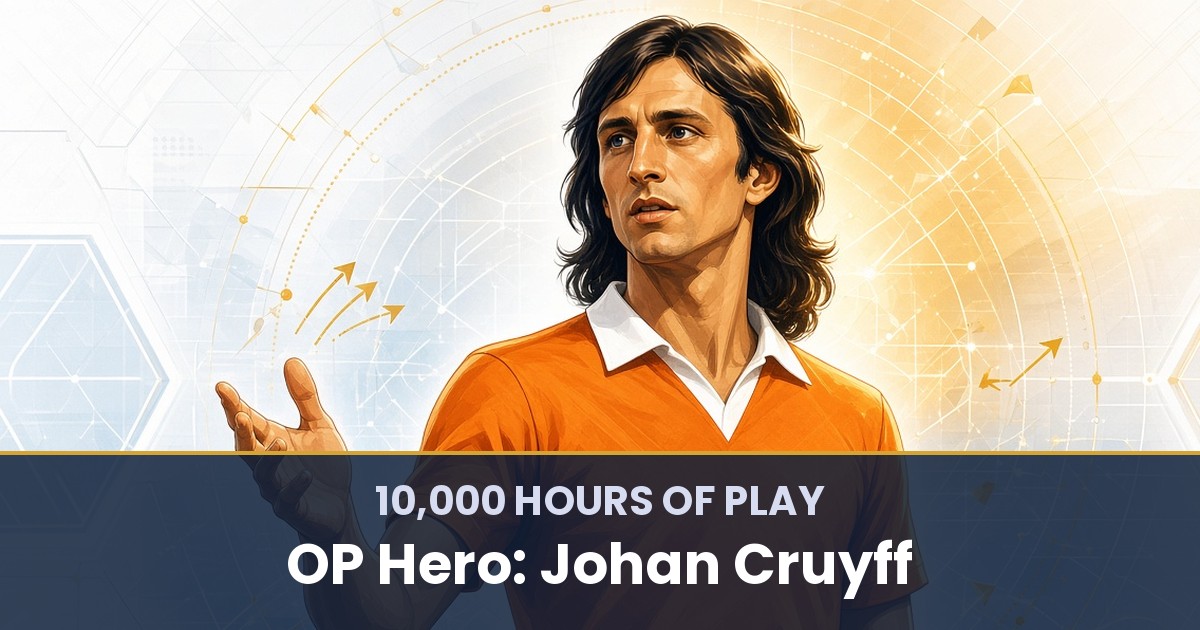


In the second minute of the 1974 World Cup final, Johan Cruyff collected the ball near the center circle, ran straight through the West German midfield, and was brought down by Uli Hoeneß for a penalty before a single West German player had touched the ball.
Johan Neeskens scored the penalty. The Netherlands still lost 2–1.
That afternoon in Munich is the Cruyff build in miniature: Total Football on full display, and a scoreboard that did not care. He then spent the next four decades making sure the intelligence outlived the result, first as a player, then as a coach, and finally as the designer of an entire club.
His life maps cleanly onto the 6-Step framework, so let’s run the build.
⚡ Speed Run Notes
- Cruyff’s real Game was making football more intelligent, as a player, a coach, and a club architect, and the trophies arrived as a by-product of the idea.
- His Attributes showed up on Amsterdam streets: spatial pattern recognition, a taste for visible risk, and a mouth that would not stop coaching everyone around him.
- He changed Role four times, from street kid to Ajax playmaker to Barcelona signing to coach, and each class change served the same mission.
- Rinus Michels supplied the structure, the 1974 squad put Total Football on a global stage, and Pep Guardiola kept the system alive as a coach.
- His biggest setbacks, losing a fortune in the late 1970s and heart surgery in 1991, both came right before his most important second acts.
Table of Contents
About Yu-kai Chou

Yu-kai Chou is the author of 10,000 Hours of Play — the book that treats your life as the most important game you’ll ever build a character in, and gives you the 6-Step framework (Game · Attributes · Role · Skills · Allies · Quests) to play it on purpose. He has spent two decades developing the system through which this post analyzes its OP Hero, and applies it to his own life and to the lives of the people he advises around the world.
Chou’s other framework, the Octalysis Framework, has been applied by LEGO, Microsoft, Porsche, Coca-Cola, Salesforce, and MrBeast, impacting over 1.5 Billion Users. He has taught the methodology at Harvard, Stanford, Yale, Tesla, Google, BCG, and IDEO, and has advised governments in eight nations including Ukraine, the United Kingdom, the Kingdom of Bahrain, Singapore, Taiwan, the Netherlands, Kazakhstan, and South Korea.
His work has been cited by Harvard, Stanford, MIT, Forbes, Wall Street Journal, Wired, US Department of Energy, NIST, NSF, NCBI, US Department of Education, ClinicalTrials.gov, and Google Scholar — with 3,700+ more academic publications. Explore his books here.

The move I would steal from Cruyff’s sheet is treating Step 3 and Step 4 as one project: he kept adding Skills only in service of a Role he had already chosen, so nothing he learned was wasted. When I audit my own build, the question I borrow from him is whether a new Skill makes the whole team around me play better, or only makes me look better.
Step 1: The Game — What Johan Cruyff Was Actually Playing
On paper, Cruyff’s Game looks like a footballer’s career: win titles, collect awards, retire, coach.
His behavior keeps breaking that story. He left Ajax in 1973, two years after his first Ballon d’Or, declined to play in the 1978 World Cup, and as a coach kept telling anyone who asked that results without quality were boring.
The Game that explains all of it is bigger than trophies. Cruyff was trying to make football more intelligent: to turn space, movement, and collective understanding into a competitive advantage that any team, at any level, could learn.
In the framework, that is the work of choosing your Game: he defined a win condition the people around him were not yet scoring, and then let it reorganize every decision underneath it.
He described street football in Amsterdam as the school that taught him this. Small spaces, uneven numbers, and bigger opponents forced him to find solutions, and his lifelong line that every disadvantage has its advantage came out of those games.
He was fond of saying he would rather win 5–4 than 1–0, which is a strange way for a professional to think.
Step 2: Attributes — The Innate Stats
Strip away the training and a few raw stats stand out on Cruyff’s sheet.
The first is spatial pattern recognition. Before he had any coaching, he was already seeing where space would appear two passes later, and he named Alfredo Di Stéfano’s ability to open space as the thing that caught his eye as a boy.
In 10K HP, this is exactly what the Talent Triangle Method is built to surface: the stats you were already running before any deliberate training got layered on top.
Risk tolerance comes next. His signature moves, the disguised pass, the feint, the sudden switch of position, could all fail in public, and he kept choosing them anyway because they broke defensive structures when they worked.
Then there is verbal assertiveness. Contemporary accounts describe a young star who talked constantly on the pitch, instructing, arguing, and directing teammates who were often older than him.
The last one is competitive self-belief. His stated ambition from early on was simply to be at the top, and he treated playing and coaching as the same destination.
Step 3: Role(s) — The Character Class Across Chapters
Cruyff’s build shows a clean sequence of class changes, a Role selection that kept serving the same Game at every chapter.
Chapter one: street player in Amsterdam. He joined Ajax’s youth system at ten and made his senior debut in 1964, carrying the improvisation of small-space football into a professional club.
Chapter two: system-defining playmaker. He became the central player of the Ajax side Rinus Michels built, which won three straight European Cups from 1971 to 1973 (the first under Michels, the next two under his successor Ștefan Kovács), and the captain of the Netherlands team that reached the 1974 World Cup final.
Chapter three: cultural catalyst. He joined Barcelona in 1973, played 231 games and scored 86 goals there by the club’s own count, and in his first season helped the club win its first Spanish league title in 14 years.
Chapter four: veteran organizer. After spells in the United States and at Levante, he returned to Ajax in 1981, moved to Feyenoord, and kept playing until May 1984, directing games with his head after his legs slowed.
Chapter five: coach and institutional architect. From 1985 at Ajax and from 1988 at Barcelona, he turned his playing principles into youth development, recruitment, and a positional system the club still teaches.
Step 4: Skills — The Real-Life Game Skills Johan Cruyff Mastered
Attributes are the raw stats. The trained layer on top is where the career was actually built, and his sheet shows five canon Real-Life Game Skills.
Track Treasure (Ranger) — identify hidden opportunities others don’t see. His whole playing style was built on receiving the ball already knowing where the next gap would open, and the Cruyff Turn against Sweden on 19 June 1974 is the famous proof: a pass sold one way, the ball dragged behind the standing leg, and a defender left facing nothing.
Elemental Transposition (Mage) — reframe every problem as a puzzle. Limited space, uneven numbers, stronger opponents: he treated each one as a solvable puzzle, and his stated method was to make a mistake, analyze it, and learn from it, which kept frustration out of the loop.
Heroic Strike (Warrior) — bold, confident statements that earn respect or force a binary choice. Cruyff spoke in blunt one-liners that forced teammates, boards, and journalists to pick a side, and the one-liners were blunt enough that the Dutch gave them a name of their own, Cruijffiaans.
Floral Blossom (Druid) — educate and mentor others. As Barcelona coach he promoted Pep Guardiola from the reserves into the pivot role at the base of his midfield, and Guardiola went on to build title-winning teams of his own as a coach.
Phoenix Rebirth (Paladin) — recover from devastating failure and come back stronger. He lost most of his money in a failed pig-farming business in the late 1970s, went to the United States to rebuild, came home to win two more league titles with Ajax, and then won the league and cup double with Feyenoord at 37.
Where do you train something like Track Treasure? Start by locating yourself on the Skills Spectrum, where Cruyff sat at the deep Specialist end: one sport and one idea for a lifetime, with every Skill pointed at it.
Step 5: Allies — The People Who Multiplied Johan Cruyff
Cruyff reads as a lone genius, the player who argued with everyone. His career says otherwise: the Alliance building started at home.
His father, Manus, started the football conversations early, and after Manus died in 1959 the family stayed inside Ajax’s orbit, with his mother working as a cleaner at the club. The street-football peers of Amsterdam supplied thousands of unstructured reps in tight spaces.
Rinus Michels gave him the structure. Michels built the training system at Ajax in which Cruyff’s intelligence could become a collective method, and the pair won the 1971 European Cup together before reuniting at Barcelona for the 1973–74 league title.
The Ajax teammates turned one man’s decisions into a model, winning six Dutch league titles, four national cups, and three European Cups in his first spell at the club. The 1974 national team then put that model in front of the whole world.
Later, his own players became the multiplier. Ronald Koeman scored the free kick that won Barcelona’s first European Cup at Wembley in 1992, and Guardiola, as a coach, kept the system alive long after Cruyff left the dugout.
Step 6: Quests — The Milestones That Shaped the Saga
Quest one: the Ajax breakthrough, 1964. Making the senior team at seventeen converted an informal, improvisational intelligence into a professional job.
Quest two: the European Cup run, 1971 to 1973. Three consecutive European titles made positional interchange a recognizable system that other teams could study, and the 1971, 1973, and 1974 Ballon d’Or awards followed.
Quest three: the 1974 World Cup. The Netherlands reached the final and lost 2–1 to West Germany, the setback that showed him a side could set the style of a whole tournament and still lose its last match.
Then the second setback. The business losses of the late 1970s forced him back onto the pitch for money, and the 1981 return to Ajax and the 1984 Feyenoord double were the recovery arc.
Quest four: Barcelona as a coach, 1988 to 1996. The Dream Team won four consecutive league titles from 1991 to 1994 and the club’s first European Cup in 1992, little more than a year after he recovered from heart bypass surgery in February 1991 and swapped cigarettes for lollipops on the touchline.
Quest five: the institution. The youth system he reshaped at Barcelona later produced Lionel Messi, and the Johan Cruyff Foundation and Cruyff Institute, which carry his name into children’s sport and sports education, outlived him when he died in Barcelona on 24 March 2016, aged 68.
What You Can Steal From Johan Cruyff’s Build
Define your Game so clearly that a win which betrays it feels like a loss. Cruyff’s measure was the quality of the idea, and a measure like that does not depend on who holds the trophy.
Then train Track Treasure on purpose. Spend time learning to see where the opening will appear two moves from now, in your industry or your team, because most people only see where the ball is right now.
Treat your worst setback as the setup for a second act. The financial collapse sent him back to the pitch, and the heart surgery came the year before the Dream Team’s European Cup, so the recovery arc in your own story is probably not finished yet.
And build the Alliance that can play without you. Barcelona was still teaching his positional ideas to its youth players when he died, so ask what in your own build would keep running if you stepped away for a year.
Where this framework comes from

Want the full system this profile is built on?
Every OP Hero piece runs through the same 6-Step framework from 10,000 Hours of Play: Unlock Your Real-Life Legendary Success. The book covers the full system, walks through Yu-kai’s own life run as the first applied case study, and gives you the worksheets to audit your own build.
Related Reading
- The Full OP Hero Profiles Hub
- 10,000 Hours of Play by OP Hero: Pelé
- 10,000 Hours of Play by OP Hero: Diego Maradona
- 10,000 Hours of Play by OP Hero: Joris Beerda
- 10,000 Hours of Play by OP Hero: Eliud Kipchoge