

Bulgarians are voting for a president today, October 25, 2026, and for the first time in five years the outcome will not decide who governs. That question was settled in April, when Rumen Radev’s Progressive Bulgaria took 131 of 240 seats — the first outright majority any party or alliance has won since 1997.
What today’s vote decides is something subtler and, in the Nationcraft reading, more dangerous to get wrong: whether the last constitutional counterweight to that majority joins it.
Seven snap elections between April 2021 and April 2026 taught Bulgarians to treat governments as weather. Then a former president resigned his own office in January, built a movement on the promise of sweeping the oligarchs out, and won the kind of mandate his country had stopped believing was possible.
Here is the trap inside that triumph. Call it the Clean-Sweep Trap: a political system exhausted by fragmentation hands one movement every lever at once, so the mandate that ended the revolving door also removes the checks that were supposed to catch whoever walked through it. Bulgaria’s 18-variable profile (V10=2 tribalism, V13=5 transparency, V7=4 stability) says this configuration punishes concentrated power faster than most, because the informal networks that captured the fragmented state do not disappear when the state consolidates. They re-apply for the job.
This analysis reads today’s presidential vote, the Radev government’s first six months, and 30 years of Bulgarian reform history through the Nationcraft Framework, and then tests which historical reform packets actually fit this configuration, and which celebrated playbooks would make the trap snap shut.
⚡ Speed Run Notes
- Bulgaria elects a president today: the one national office Radev’s movement does not yet hold. Incumbent Iliana Yotova (41-47% in late-October polls) faces opposition-backed Andrey Gyurov (25-31%); a November 1 runoff is likely.
- The Clean-Sweep Trap: after seven snap elections in five years, the 131-seat majority that restored governability can also retire the last institutional check — V10=2 tribalism makes that a capture risk.
- Bulgaria’s own Success Packet (SP-081) is unfinished: the 1997 currency board and 2007 EU accession fixed money and membership, while courts, prosecutors, and media ownership were never reformed.
- The tempting playbooks fail Bulgaria’s variable profile: Bukele’s mandate-to-emergency conversion (SP-064), Saakashvili’s fire-everyone blitz (SP-051), and Orbán’s majority-to-capture path (SP-059).
- The fits: finish SP-081’s unfinished institutional phase, study Slovakia’s post-Mečiar catch-up (SP-090) and Ukraine’s independent-institution build (SP-117). Each opens the system no matter who governs.
Table of Contents
- Understanding Bulgaria’s Governance Landscape Through Nationcraft
- What Is the Nationcraft Framework?
- Why This Bulgaria Variables Analysis Matters Today
- What Bulgaria Actually Looks Like in Numbers: The 18 Nation Variables
- The Clean-Sweep Trap
- Detailed Justifications: Bulgaria Variable by Variable
- Five Reformer Playbooks Bulgaria Should Reject
- Best-Match Historical Packets: Three Playbooks Worth Studying
- The Presidency as the Last Veto Point
- Governance Strategy Recommendations
- Strategic Implications and Comparative Context
About Yu-kai Chou

Yu-kai Chou is a Human-Systems Architect & Behavioral Designer and the creator of the Nationcraft Framework — an 18-variable diagnostic for matching a country’s structural profile to the reform packets that have historically worked under similar conditions. He has consulted for governments in eight nations, including Ukraine, the United Kingdom, the Kingdom of Bahrain, Singapore, Taiwan, the Netherlands, Kazakhstan, and South Korea, and has worked directly with President Zelenskyy’s team on post-war reconstruction priorities for Ukraine.
Chou’s prior framework — the Octalysis Framework — has been applied by LEGO, Microsoft, Porsche, Coca-Cola, Salesforce, and MrBeast, impacting over 1.5 Billion Users. He has taught the methodology at Harvard, Stanford, Yale, Tesla, Google, BCG, and IDEO.
His work has been cited by Harvard, Stanford, MIT, Forbes, Wall Street Journal, Wired, US Department of Energy, NIST, NSF, NCBI, US Department of Education, ClinicalTrials.gov, and Google Scholar — with 3,700+ more academic publications. Explore his books here.

This Bulgaria analysis is Chou’s second Nationcraft reading of the country in 2026, written on the day of the October 25 presidential vote. It draws on his advisory work with EU-member and EU-aligned governments — including the Netherlands, the United Kingdom, and Kazakhstan — and applies the framework to the question Sofia’s clean sweep now poses: whether a majority elected to end capture can be structured so the system opens instead of changing hands.
Understanding Bulgaria’s Governance Landscape Through Nationcraft
Most election-day coverage of Bulgaria will tell you who is ahead. The wire services already have: incumbent Iliana Yotova, backed by Prime Minister Rumen Radev’s Progressive Bulgaria, led every late-October poll, running between 41% and 47% against roughly 25-31% for Andrey Gyurov, the former caretaker prime minister running with the backing of the pro-European opposition.[1]
What that coverage cannot tell you is whether Bulgaria’s configuration can metabolize the outcome. That is a systems question, and it is the question the Nationcraft Framework was built to answer.
Bulgaria enters this vote as the European Union’s poorest member, a eurozone country as of January 1, 2026, and a state that has spent 17 years under some form of EU rule-of-law monitoring since joining in 2007.[8] Inflation ran at 5.1% in August, the loudest anxiety in the campaign, and drone strikes have hit four merchant ships in Bulgaria’s Black Sea maritime zones in recent weeks.[1]
Against that backdrop, the Nationcraft question is specific. A country whose defining weakness has been fragmented, captured, short-horizon governance just acquired concentrated, popular, long-horizon governance. The variables say that is the same disease in a different posture unless the institutions underneath change.
What Is the Nationcraft Framework?
The Nationcraft Framework treats a nation the way a systems designer treats any complex motivational environment: diagnose the configuration first, prescribe second.
It scores 18 Nation Variables across three clusters (cultural V1-V6, historical-political V7-V13, economic V14-V18) and then matches that profile against a library of 140 historical Success Packets and failure packets: documented reform programs, from the Meiji Restoration to Botswana’s diamond governance, each recorded with the variable preconditions under which it worked or broke.
The core claim of Nationcraft is that context-fit decides policy effectiveness. A reform that transformed one country fails in another when the receiving configuration differs on the variables that packet depends on.
I have written up the method in the Nation Variables Library, where Bulgaria now joins more than 80 country analyses, and in the applied piece on nation-building and public policy, which connects Nationcraft to the Octalysis Framework it grew out of. The short version: nations, like products, run on motivation, and motivation follows structure.
Why This Bulgaria Variables Analysis Matters Today
Three reasons this reading is dated October 25, 2026, and would be a different essay a week from now.
First, the ballot. Today’s presidential vote is the first national election since Progressive Bulgaria took its majority, and the presidency is the one national office the movement does not hold. Analysts quoted going into the weekend called the vote a referendum on Radev’s grip: EUobserver’s election-eve interview framed it as “a test of Rumen Radev’s grip on power,” and the Gyurov campaign’s closing argument warned against putting “all the eggs in one basket.”[2]
Second, the pivot. Since June, the Radev government has halted army-stock military donations to Ukraine after 13 prior aid packages, declined to join the Coalition of the Willing, and threatened to veto the EU’s 21st sanctions package before standing down once named listings were removed.[1] For a NATO frontline state whose V12 Geopolitical Leverage already scores 2/9, foreign-policy distance from its own alliance converts a thin asset into a liability while the war literally reaches Bulgarian waters.
Third, the window. This is my second Nationcraft reading of Bulgaria in 2026. The July analysis, the Euro Anchor Trap, examined what euro adoption does to a country that borrowed its monetary discipline from Frankfurt for 29 years. This one examines the political layer that July’s piece could only gesture at, because the clean sweep had not yet reached for the presidency. The two traps compound: a country that outsourced its monetary checks is now deciding whether to retire its constitutional ones.
What Bulgaria Actually Looks Like in Numbers: The 18 Nation Variables
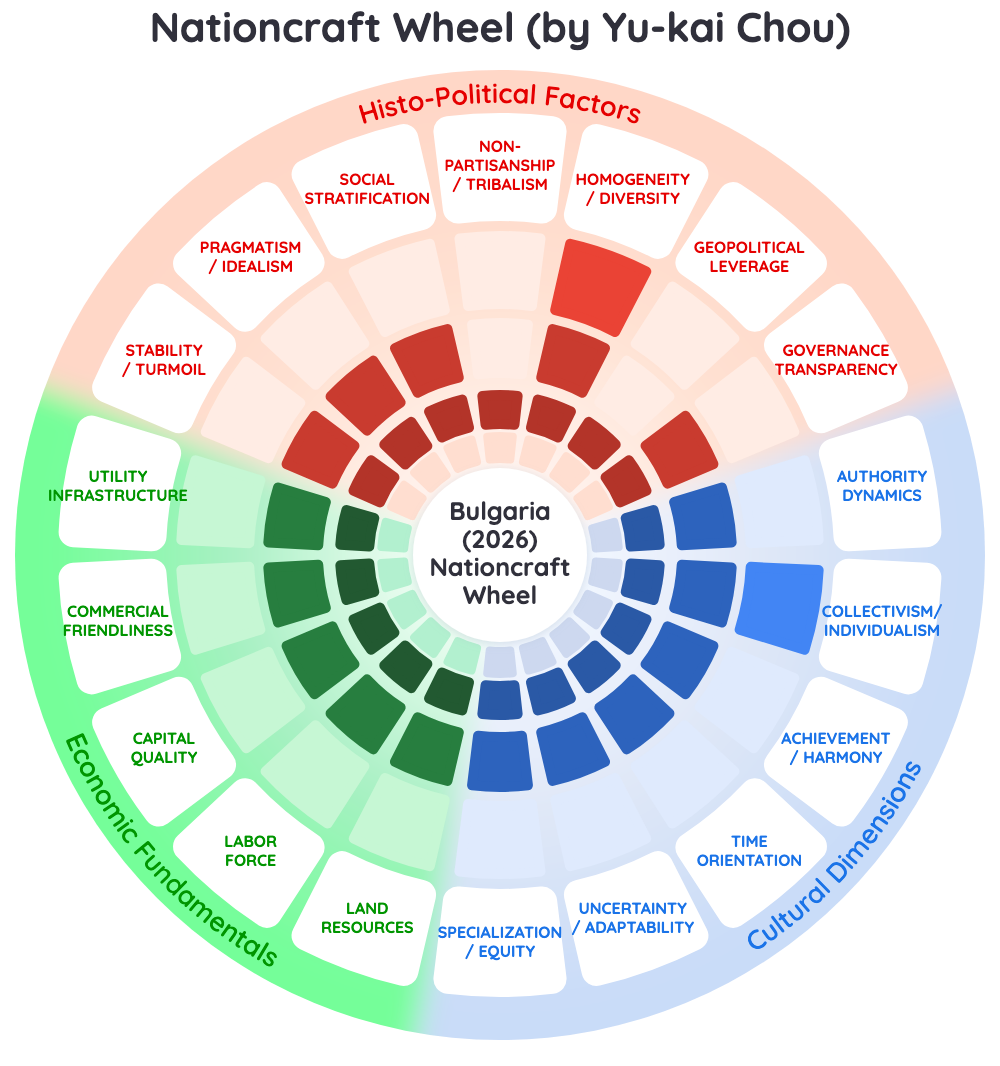
The table below is Bulgaria’s full Nationcraft V-vector as of October 2026, sanity-checked this week against current indicators. Scores run 1-9, and they describe governance dynamics only: a high score is a statement about how the system behaves, never a compliment.
| Variable | Score | Reading |
|---|---|---|
| V1 Authority Dynamics | 6 | Parliamentary system with recurring strongman gravity: Borisov for a decade, Radev now, each with a personal movement. |
| V2 Collectivism vs Individualism | 7 | Orthodox solidarity, family and village networks; communism atomized civic trust while leaving kin trust strong. |
| V3 Achievement vs Harmony | 4 | Achievement-oriented strivers exist in volume, many of them now in Munich, Rotterdam, and London. |
| V4 Time Orientation | 4 | Political horizon measured in months across 2021-2025; the EU anchor is the one long-horizon commitment that held. |
| V5 Uncertainty & Adaptability | 5 | Households adapted to three decades of shocks; institutions did not. |
| V6 Specialization vs Equity | 5 | A genuine IT and outsourcing niche sits on top of a state-legacy economy. |
| V7 Stability vs Turmoil | 4 | Seven snap elections in five years; a government fell in December 2025 to anti-corruption protests. |
| V8 Pragmatism vs Idealism | 4 | Grievance and identity politics dominate; the 1997 currency board remains the great pragmatic exception. |
| V9 Social Stratification | 6 | The EU’s highest income inequality, read here as a measure of governance strain. |
| V10 Non-Partisanship vs Tribalism | 2 | The anchor weakness. Vote-buying reports in April alone: 631 tied to DPS, 318 to GERB-SDS.[3] |
| V11 Homogeneity vs Diversity | 7 | Largely homogeneous, with Turkish and Roma minorities brokered as electoral blocs (see V10). |
| V12 Geopolitical Leverage | 2 | EU and NATO member, yet a policy-taker with an exposed Black Sea flank now under drone attack. |
| V13 Governance Transparency | 5 | CPI 43/100; the only 2007-class EU entrant still answering rule-of-law monitoring 17 years later. |
| V14 Land Resources | 4 | Modest endowment; the transit-hub ambition keeps outrunning the infrastructure. |
| V15 Labor Force Quality | 6 | Strong STEM and language base, eroding through the EU’s steepest demographic decline. |
| V16 Capital Quality | 4 | Investment runs on EU funds; domestic capital markets are shallow and bank-centric. |
| V17 Commercial Friendliness | 4 | A 10% flat tax and single-market access, discounted by the corruption tax and court risk. |
| V18 Utility Infrastructure | 5 | EU-funded transport upgrades; energy-transit plans repeatedly hostage to geopolitics. |
Read the vector as a shape; averaging it throws away the information. The shape says: a mid-capacity European economy (V14-V18 cluster around 4-5) with workable cultural cohesion (V2=7, V11=7) sitting on a broken political operating system (V10=2, V7=4, V13=5, V4=4).
In Nationcraft terms, Bulgaria’s binding constraint sits in the V10-V13 pair: tribal political competition over a state opaque enough to loot. The economy stopped being the binding constraint years ago.
The Clean-Sweep Trap
Every named paradox in this series is a specific variable interaction. The Clean-Sweep Trap is what happens when a low-V10, mid-V13 system resolves a prolonged V7 crisis by concentrating authority instead of opening it.
The sequence that produced it is worth stating plainly. The Zhelyazkov government resigned on December 11, 2025, after weeks of anti-corruption protests over the 2026 budget.[3] Radev resigned the presidency on January 19, 2026, to enter party politics, remarking that the prime minister’s post “had more competences”, and the Constitutional Court terminated his powers on January 23.[2][5]
On April 19, his months-old Progressive Bulgaria coalition took 43.91% and 131 seats on a campaign promise to dismantle the “oligarchic” model of governance. Turnout jumped nearly 12 points to 50.7%. The BSP missed parliament entirely for the first time in the post-communist era.[3]
His former vice president, Iliana Yotova, inherited the presidency he vacated. Today she asks voters to confirm her in it, with his movement’s backing, while his government’s former caretaker prime minister runs against her as the opposition’s check-and-balance candidate.[1][7]
Every step in that sequence was constitutional, and every step was popular. That is precisely what makes the configuration treacherous, and the trap has three teeth.
Tooth one: the mandate is real, and so is the exhaustion that produced it
A V7=4 country that has run seven national votes in five years does not merely want stability; it wants an end to deciding. Turnout behavior shows the fatigue: analysts project roughly 36% today, against 50.7% in April.[1]
Exhausted electorates stop auditing the people they elect. In Octalysis terms, five years of Core Drive 8 (CD8): Loss & Avoidance governance, where the message is vote again or lose the state, end in learned disengagement exactly when scrutiny matters most.
Tooth two: the capture networks survive the sweep
Bulgaria’s V10=2 is not a score about rude parliamentary debate. It describes a party system that has operated as competing patronage networks, documented down to the April vote-buying tallies.[3]
A clean sweep changes which network holds the state. It does not, by itself, change what holding the state is worth. V13=5 means the discretionary dark space that made capture profitable is still there. The government’s own anti-corruption program, set out on August 14, promises to remove oligarchic influence from political power and to trace proxies and overseas accounts.[6] The Nationcraft question is which independent institution can still say no to the incumbent while the promise is being kept, because every incumbent makes the promise.
Tooth three: the last check is on today’s ballot
Bulgaria’s presidency is weak on paper and load-bearing in practice. The president returns legislation for reconsideration, appoints caretaker governments during the exact parliamentary crises Bulgaria specializes in, chairs the security apparatus as commander-in-chief, and owns a national megaphone.[4]
Between 2021 and 2025, the office functioned as the system’s continuity module while parliaments burned through themselves. Fold it into the governing movement, and the configuration has no remaining institutional actor whose incentives differ from the majority’s. In a V10=2 system, that is when the Two-Thirds dynamics begin (Hungary’s lesson, covered below).
Detailed Justifications: Bulgaria Variable by Variable
Scores summarize; justifications carry the analysis. Three clusters, with the variables that drive the trap examined in depth.
Cultural cluster (V1-V6): cohesion without civic trust
V1 Authority Dynamics sits at 6 because Bulgarian politics keeps producing dominant personal vehicles inside parliamentary forms: Borisov’s GERB for a decade, Radev’s Progressive Bulgaria now.
V2 Collectivism at 7 and V11 Homogeneity at 7 describe a society with strong bonding networks and weak bridging ones. Communism’s legacy here was the atomization of civic trust while kin and village trust stayed intact, which is why patronage travels so efficiently through the system.
V3 Achievement at 4 is an emigration artifact. The strivers did not vanish; close to three million Bulgarians live abroad by the Foreign Ministry’s rough count, and the ambition drain shows up in every domestic indicator. Albania’s version of this dynamic, remittance dependence as a pressure valve, is the subject of the Departure Dividend analysis, and Bulgaria runs a milder chronic case.
V4 Time Orientation at 4 and V5 Adaptability at 5 complete the picture: households that can absorb any shock, attached to institutions that plan in news cycles. The EU accession project was the single sustained exception, which is why the EU anchor keeps appearing in this analysis as Bulgaria’s borrowed V4.
Historical-political cluster (V7-V13): the operating-system failure
V7 Stability at 4 needs no elaboration beyond the count: seven snap elections from April 2021 to April 2026, with a government lost to street protests in December 2025.[3] The new majority raises the score’s trajectory; it does not yet raise the score, because one election is a data point, and Bulgaria has seen false stabilizations before.
V8 Pragmatism at 4 reflects a politics that runs on grievance and symbolism, with one towering counterexample — the 1997 currency board, adopted mid-hyperinflation, maintained by every government of every color for 29 years, and retired only by euro entry this January. Bulgarians are clearly capable of deep pragmatism, but the system has only ever produced it under duress.
V9 Stratification at 6: the EU’s widest income gap, a two-speed country of metropolitan Sofia and a hollowing countryside, a geometry this series keeps meeting in very different configurations.
V10 Non-Partisanship at 2 is the anchor weakness and deserves its numbers repeated: in a single election cycle this April, the Interior Ministry logged 631 vote-buying reports connected to DPS and 318 to GERB-SDS.[3] This is retail tribalism as electoral infrastructure. No variable in Bulgaria’s vector is more decisive for packet selection, because every reform packet that assumes impartial referees breaks on contact with V10=2.
V12 Geopolitical Leverage at 2 has been stress-tested in real time. Alliance membership generates leverage only when a state is legible to its alliance; a Bulgaria that halts army-stock donations to Ukraine, keeps its distance from the Coalition of the Willing, and plays veto brinkmanship over the 21st sanctions package while drones strike shipping in its own maritime zone is spending legibility precisely when the Black Sea premium on it is highest.[1] Ukraine’s own wartime variable profile, the comparison case one border north, is read in full in the Escrowed Recovery Trap.
V13 Transparency at 5 is the generous end of defensible. Transparency International scores Bulgaria 43/100; the EU kept it under rule-of-law monitoring longer than any peer; prosecutorial accountability remains the chronic open file. The August anti-corruption program targets exactly this surface, which is why its governance design, examined below, matters more than its ambition.[6]
Economic cluster (V14-V18): a floor, not a ceiling
The economic variables cluster at 4-6 and tell one coherent story: Bulgaria’s economy is good enough that economics stopped being the binding constraint years ago.
V15 Labor at 6 carries real strength (the IT sector, engineering schools, trilingual service exports) beneath the EU’s fastest demographic decline. V16 Capital at 4 reflects EU-fund dependence: the Recovery and Resilience Plan remains the government’s own stated priority file this month.[5]
V17 Commercial Friendliness at 4 is the corruption tax made visible: the 10% flat tax (2008) should make Bulgaria a magnet, and court risk keeps the magnet weak. V18 Infrastructure at 5 rounds out the cluster: upgraded highways, unfinished hub ambitions.
And the euro, as of January 1, 2026, locked the macro floor in permanently.[8] Inflation of 5.1% in August is politically loud but historically quiet; this is a country that saw inflation above 1,000% in 1997.[1] The full implications of adopting Frankfurt’s discipline got their own analysis in July’s Euro Anchor Trap, linked above.
Five Reformer Playbooks Bulgaria Should Reject
A majority government promising to break oligarchy has a menu of celebrated precedents. Matched against Bulgaria’s V-vector, the five most tempting are misfits. Each cites its canon Success Packet, because the point is rarely that these programs failed at home (most delivered); their preconditions simply do not exist in Sofia.
1. The Bukele conversion: SP-064 (El Salvador, 2019-present)
The Bukele Security & Digital Packet shows what a new-generation leader with a supermajority can deliver when he converts mandate into emergency: homicides down from among the world’s highest rates in the late 2010s to low single digits per 100,000, approval ratings above anything else in the hemisphere, and courts packed, due process suspended, re-election engineered.
The packet’s own recorded preconditions disqualify Bulgaria twice over. El Salvador ran at V1=8 with a security emergency so acute that the population priced away rights for safety; Bulgaria is a V1=6 EU member whose crisis is institutional capture, where no equivalent existential threat makes emergency governance purchasable.
And the packet’s recorded critical insight is the warning label: it is a live experiment in whether trading democracy for delivery builds institutions or just personal rule. A Bulgarian government that borrowed the shape of this packet (mandate, emergency framing, court control) would be running the Clean-Sweep Trap at speed, inside a legal order (EU membership) that prices the experiment in suspended funds. V10=2 adds the final twist: in a patronage system, emergency powers do not bypass the networks; they get operated by them.
2. The Saakashvili blitz: SP-051 (Georgia, 2004-2012)
The Saakashvili Reform Packet is the most seductive anti-corruption program ever recorded: fire the entire traffic police, rehire at ten times the salary, register companies in 15 minutes, crush smuggling with cameras and new staff. Georgia’s corruption-perception rank jumped more than 50 places in five years.
Three preconditions made it work, and Bulgaria has none of them. Georgia 2003 was a collapsed state (70% informal economy, daily blackouts) where wholesale replacement had nothing functioning to break; Bulgaria is a functioning EU administration where mass dismissals collide with EU law, union structures, and courts. Georgia ran on a revolutionary mandate (V7=2 at entry) that licensed shock methods; Bulgaria’s April mandate is electoral, already contested, and subject to today’s counterweight vote.
The disqualifier is the packet’s own closing lesson: the concentration of power that enabled the blitz later corrupted the democracy that authorized it — the reformer’s paradox, with Saakashvili’s subsequent legal odyssey as the exhibit. Run that paradox through V10=2 and the blitz does not even deliver its early clean phase: in Bulgaria’s brokered party system, “fire everyone” becomes “fire their people,” and what began as a clean-up ends by redistributing capture among factions, the exact laundering pattern the Nationcraft method screens for and rejects.
3. The Orbán consolidation: SP-059 (Hungary, 1990-2010)
This is the packet Bulgaria is gravitationally closest to, which is what makes it the most important rejection on the list. Hungary’s recorded trajectory (gradualist transition, quality FDI, EU accession 2004) carries a sting in its documented insight: the smooth transition preserved old elite networks, and when a two-thirds mandate arrived in 2010, those networks plus that mandate produced the illiberal turn.
Map the preconditions onto Sofia. Preserved elite networks: Bulgaria’s transition was the most managed in the region; the Communist Party renamed itself and won the first elections, per the preconditions recorded in Bulgaria’s own SP-081. Grievance politics as fuel: V8=4 supplies it. A dominant mandate arriving into weak counter-institutions: April 19, 2026, with V13=5 courts.
Hungary’s path from that configuration ran through media consolidation, court restructuring, and electoral-rule engineering: each step legal, each step popular with the base, each step narrowing the exits. I analyzed the end state in the Two-Thirds Trap; Bulgaria at V10=2 is more vulnerable than Hungary was at the equivalent moment, because Hungary at least entered its consolidation with stronger formal institutions. For a Bulgarian reader, SP-059 is not advice. It is the control group.
4. The palace opening: SP-045 (Uzbekistan, 2016-present)
The Karimov-Mirziyoyev Transition Packet records a genuinely improved life for millions: currency convertibility, exit visas abolished, forced labor curtailed, an economy opened, all delivered from the top, with the incumbent apparatus intact and more secure afterward than before.
It is the cleanest illustration in the library of reform whose beneficiary test comes back mixed: the population gained real freedoms, and every gain arrived as a revocable grant because no institution independent of the grantor was created. That model has quiet admirers in every capital with a strong mandate, Sofia included, because it promises modernization without the inconvenience of opposition victories.
Bulgaria cannot use it, for a structural reason that flatters nobody: Bulgaria already has the things the packet dispenses with: elections that change governments, EU-guaranteed exit rights, courts in form. Its deficit is the independence of those institutions, which is the one thing a palace-opening packet never produces. Adopting its posture would mean trading Bulgaria’s actual unfinished task (making referees independent) for a task already done (opening the economy), while teaching the public that reform is something a leader grants. V2=7 collectivism would absorb that lesson quickly, and it is the wrong lesson.
5. The consensus roundtable: SP-071 (Tunisia, 2011-2021)
The Jasmine Revolution & Transition Packet earned its Nobel Prize: a quartet-mediated national dialogue, an Islamist-secular compromise no one predicted, and the Arab world’s most progressive constitution in 2014.
Two reasons it is a misfit, one boring and one alarming. The boring reason: the packet solves constitutional founding, and Bulgaria’s constitution is not the broken layer; its referees are. Importing a national-dialogue architecture into a system with a functioning (if captured) legal order produces talking shops, and Bulgaria’s V10=2 party system would staff them tribally within a season.
The alarming reason is the packet’s recorded ending. Tunisia’s democracy delivered compromise and never delivered growth (1% average across the decade), and in 2021 a president elected on anti-elite exhaustion suspended parliament to broad initial approval. The documented insight: without economic delivery, democracy loses legitimacy, and even model transitions reverse. For Bulgaria the transfer is direct. If the clean-sweep government spends its mandate on consolidation rather than on V13/V17 institution-building, the next exhaustion cycle does not produce another roundtable. It produces a Tunisian ending with a Bulgarian accent.
Best-Match Historical Packets: Three Playbooks Worth Studying
The affirmative half. Three packets whose recorded preconditions overlap Bulgaria’s current vector, with the fit logic made explicit.
| Packet | Case | Precondition fit to Bulgaria 2026 | What transfers |
|---|---|---|---|
| SP-081 | Bulgaria, 1989-2007 | Its own record: macro anchors adopted under crisis held for decades (V8 exception); institutions deferred | The unfinished institutional phase: the packet’s explicitly recorded gap |
| SP-090 | Slovakia, 1993-2009 | Mid-size EU economy, post-strongman turn (Mečiar), V10 tribalism overcome through coalition discipline + EU incentives | Catch-up sequencing: democratic turn → referee repair → investment boom → euro |
| SP-117 | Ukraine, 2014-2022 | Capture-dominated system building independent anti-corruption institutions under external conditionality | Institution design that survives hostile incumbents: new bodies, external verification, civil-society telemetry |
Finish your own packet: SP-081’s missing phase
Bulgaria’s Post-Communist EU Path Packet is in the canon as a partial success with a recorded diagnosis: the currency board ended inflation permanently, EU membership arrived despite the gaps, and the file closes with “institutions never reformed… rule of law deficient.” Its critical insight is the thesis of this whole analysis: macroeconomic stability can coexist with institutional dysfunction, and stability without institutions is not enough.
The strategic meaning for 2026: Bulgaria does not need a foreign playbook. It needs phase four of its own. The 1997 generation fixed money under duress; the 2007 generation fixed membership; the euro generation just retired the monetary file entirely. The remaining file is referees (courts, prosecution, audit, media ownership), and it is the only file whose completion the current mandate is uniquely positioned to either finish or foreclose.
The Slovak turn: SP-090 and the recoverable reversal
Slovakia’s packet matters to Bulgaria because it proves the regional trajectory is correctable after a strongman detour. Mečiar’s authoritarianism cost Slovakia NATO’s first wave; the 1998 democratic turn under Dzurinda repaired the referees, the flat tax pulled in an automotive boom, and euro adoption in 2009 completed a catch-up nobody predicted in 1997.
The fit is in the variables: a small-to-mid EU economy with real tribal cleavages (Slovak V10 scored mid-range, with nationalist-populist blocs) that used EU accession incentives as the external referee while domestic ones healed. Bulgaria holds a stronger version of the same lever: eurozone membership plus Recovery and Resilience Plan conditionality, which the government itself names as a priority alongside the reforms attached to it.[5]
The packet’s recorded caution transfers too: FDI-dependent development leaves the east behind and creates concentration risk. For Bulgaria, the Slovak lesson is sequencing: repair the referees before selling the investment story, because the story Slovakia sold was credible exactly to the degree the 1998 turn had made its courts boring.
The Ukrainian build: SP-117 and institutions designed for hostile weather
The Post-Euromaidan Reform Packet is the library’s best-documented case of building independent institutions inside a capture-dominated system, with oligarch resistance as a design assumption instead of a surprise: new anti-corruption bodies built from scratch rather than reformed in place, staffed through internationally supervised selection, wired to external conditionality that outlived individual governments.
The precondition overlap with Bulgaria is uncomfortable and useful: both systems assume the incumbent networks will try to reclaim any new institution. The transfer is the design discipline: independence mechanisms named in statute (selection panels the government does not control, budgets courts cannot be starved of, reporting lines to the public record), external verification as the backstop, and the expectation that progress will be nonlinear.
Ukraine’s wartime configuration is its own analysis (the Escrowed Recovery Trap, linked earlier, covers how external anchors now govern its reconstruction), but the 2014-2022 institutional record stands on its own as the region’s proof that referees can be built in bad weather. Bulgaria’s weather is far milder. Its excuse inventory is correspondingly smaller.
The Presidency as the Last Veto Point
Today’s vote, in the configuration language this analysis has been building.
| Candidate | Running mate | Backing | Late-October polling |
|---|---|---|---|
| Iliana Yotova (incumbent) | Kiril Vulchev | Progressive Bulgaria (PM Radev’s movement) | 41.1-47.3% across late-October polls (Alpha Research, Gallup, Market Links) |
| Andrey Gyurov (former caretaker PM) | Georgi Kandev | Pro-European opposition parties | 24.8% to 30.6% across the same polls |
| Kostadin Kostadinov (Revival leader) | Petar Volgin | Revival (pro-Russian) | 10-13% |
Twenty-seven presidential tickets are on the ballot in all.[4] A first-round win requires more than half of valid votes with turnout above 50% of registered voters; with turnout projected near 36%, a November 1 runoff between Yotova and Gyurov is the strong base case.[1]
The Nationcraft reading of each outcome follows from the variables, not from the candidates’ biographies.
A Yotova presidency completes the sweep. Veto, caretaker power, and the security chair align with the parliamentary majority, and the system’s remaining checks become the ones Bulgaria has historically run weakest: courts (V13=5), media scrutiny, and EU institutions. Note the structural irony: the caretaker mechanism, the office’s core crisis function, was built for exactly the parliamentary collapses that a dominant movement no longer expects to face, and a dominant movement is exactly what makes its independence matter again later.
A Gyurov presidency restores divided government by the thinnest constitutional thread Bulgaria has: a returnable veto and an independent megaphone. The office cannot block a 131-seat majority; it can force second readings and keep the record public. His campaign’s one-basket warning is, in framework terms, a plea to keep one referee whose incentives differ from the player’s.[2]
Either way, the structural fact of the day is that Bulgarians are voting on whether institutional pluralism survives as a design feature or persists only as the majority’s self-restraint. The Serbian file one border west, the Castling Trap, documents where office-swapping under a dominant movement leads when self-restraint is the only control, and Romania’s Caretaker Equilibrium shows the opposite failure, where vacancies and stopgaps become the operating system. Bulgaria is choosing between those gravitational fields today.
Governance Strategy Recommendations
These are written as a reform guide for the general reader (citizen, analyst, civil-society builder, future reformer) on what durable reform of this configuration would require. The test each recommendation passes: it opens the system, its beneficiary is the population, and it holds regardless of which movement governs.
| Priority | What reform would require | Variables addressed | Packet precedent |
|---|---|---|---|
| 1 | Judicial-council and prosecutorial reform with named accountability mechanisms: appointment panels the governing majority cannot staff alone, and a mechanism by which a chief prosecutor can be investigated and removed by a body independent of the office | V13, V10 | SP-117; SP-081’s recorded gap |
| 2 | Anti-corruption enforcement housed in institutions with statutory tenure, selection panels with international participation, and public reporting, so the August program’s promises are verifiable by people outside the government making them | V13, V17 | SP-117 |
| 3 | Electoral-integrity enforcement aimed at the vote-buying infrastructure, prosecuted by referees independent of every party that benefits from it | V10, V7 | SP-090’s coalition-era referee repair |
| 4 | Media-ownership transparency and protection of the public record, the civic telemetry every other reform depends on | V13, V10 | SP-117; SP-059 as the control group |
| 5 | Treating RRP and EU rule-of-law conditionality as the external referee of record while domestic referees are rebuilt: milestones published, verification welcomed | V13, V16, V4 | SP-090; SP-081 phase logic |
| 6 | Preserving the presidency’s counterweight functions as a design feature: a veto worth keeping independent is worth keeping independent of whoever wins today | V1, V7 | The Clean-Sweep Trap itself |
One discipline note that applies to the whole table, because it is where programs like Bulgaria’s August anti-corruption push succeed or rot: an enforcement body is independent when the text can answer three questions: accountable to whom, through what mechanism, removable by what process. Where those answers name bodies the governing power controls, the program is consolidation wearing reform’s vocabulary, whoever runs it. Bulgaria’s citizens have 30 years of practice telling the difference; the variables say the telling has to be institutional, because memory alone has not held.
Strategic Implications and Comparative Context
For Bulgaria’s people, the practical stakes of this configuration are concrete. V15=6 human capital keeps leaving at the EU’s fastest rate; every year the referee file stays open, the corruption tax on V17 stays priced into wages, court outcomes, and the emigration decision of every 24-year-old engineer in Plovdiv.
For the region, Bulgaria is now the live test of a question the whole post-2004 EU accession class is asking: can membership’s external anchors substitute for domestic referees indefinitely? Poland’s answer, documented in the Liberum Veto Trap, was that external anchors work until a determined majority tests them. The Czech variant, a billionaire-businessman government marking its own homework, is the Firm-State Trap.
For readers of this series, Bulgaria extends a pattern the Venezuela reform playbooks analysis established: the scarce input in national reform is a referee the players cannot fire, because the playbooks themselves are abundant. Configurations differ in how they lose that referee — Venezuela shredded it, Greece borrowed it, Hungary absorbed it. Bulgaria is deciding, today, whether to retire it by ballot.
And for the security dimension: a V12=2 state on a wartime sea, now visibly hedging between its alliance and its largest neighbor’s patron, is spending the one currency that multiplies small-state influence — being predictable to your own side. The drone strikes on merchant shipping in Bulgarian maritime zones are the bill arriving early.[1]
The Nationcraft Framework in Practice
This analysis ran the standard Nationcraft sequence: score the 18 variables against current evidence, name the paradox the interactions produce, then test historical packets against their recorded preconditions before trusting their reputations.
Bulgaria’s reading demonstrates the method’s core discipline twice. The rejected list is where the discipline bites: SP-051 and SP-064 are genuinely successful packets whose preconditions simply do not exist in Sofia, and prescribing them anyway is how countries end up running other nations’ medicine at the wrong dose. The fit list bites differently: the best packet for Bulgaria is its own unfinished one, which no imported consultant deck would ever surface, because imported decks do not read a country’s history as a sequencing record.
The same configuration-first method is applied across the full library of country analyses, and the framework hub linked at the top of this piece documents the 18 variables, the goal hierarchy, and the packet library in detail. Nationcraft exists because nations keep failing at reform in patterned, diagnosable, preventable ways, and because the patterns are legible if you score the configuration before you argue about the policy.
Explore More Nationcraft Analyses
The closest companion files to this one, each a different answer to the question of what happens when governance concentrates:
- Kosovo: The Midnight Mandate, on what a contested mandate does to legitimacy in a young Balkan democracy.
- Turkey: The Strongman Discount, on the long-run price markets put on concentrated executive power.
- The full Nation Variables Library, with every published country analysis in one place.
Closing
Tonight Bulgaria will know whether its clean sweep is complete. The variables will not have moved either way; V10=2 does not change in a news cycle, and the referee file stays open under any president.
What the vote sets is the difficulty level. A divided outcome keeps one institutional actor whose job is to say “read it again.” A completed sweep leaves the opening of the system to the sweepers’ own discipline — a bet Bulgaria’s own packet record, 1989 to 2007, prices precisely.
The honest summary for the people deciding today is the one the framework produces: your country already proved it can hold a hard anchor for 29 years when the anchor is institutional and boring. The task is to give the rule of law what you gave the currency board.
Frequently asked questions
What is the Clean-Sweep Trap in Bulgaria’s 2026 Nationcraft analysis?
It is the variable interaction where a system exhausted by fragmentation (V7=4, seven snap elections in five years) hands one movement every lever at once, so the mandate that restored governability also removes the checks. It is dangerous specifically because Bulgaria’s V10=2 tribalism and V13=5 transparency mean the capture networks that thrived under fragmentation can re-attach to concentrated power.
Why does the October 25 presidential election matter if the president has limited powers?
Because the Bulgarian presidency holds the system’s residual checks: a returnable legislative veto, the appointment of caretaker governments during parliamentary crises, the commander-in-chief role, and an independent national platform. It is the one national office Progressive Bulgaria does not hold, so today’s vote decides whether any institutional actor’s incentives remain different from the majority’s.
Which historical reform packets fit Bulgaria’s current configuration?
Three: SP-081, Bulgaria’s own 1989-2007 packet, whose recorded unfinished phase is exactly the rule-of-law file; SP-090, Slovakia’s post-Mečiar catch-up, which shows a regional peer repairing referees inside EU incentives; and SP-117, Ukraine’s post-Euromaidan build of independent anti-corruption institutions designed to survive hostile incumbents.
Why does this analysis reject the Bukele and Saakashvili anti-corruption models for Bulgaria?
Preconditions. Bukele’s SP-064 required an existential security emergency and V1=8 authority concentration that EU-member Bulgaria neither has nor can lawfully simulate. Saakashvili’s SP-051 required a collapsed state and a revolutionary mandate; Bulgaria’s functioning-but-captured institutions mean a fire-everyone blitz would turn factional under V10=2, and both packets’ own records document the concentration of power curdling into the problem it was hired to solve.
Did Bulgaria adopt the euro, and how does that affect this analysis?
Yes. Bulgaria joined the euro area on January 1, 2026, after the EU Council’s July 2025 decision. It matters here because the euro permanently retires the macroeconomic file Bulgaria solved in 1997 with its currency board, leaving institutional reform (courts, prosecution, media, electoral integrity) as the country’s one remaining structural project, with inflation at 5.1% in August keeping the cost-of-living politics loud.
Related Reading
- The Nationcraft Framework: 18 Variables, 8 Goals, 100+ Proven Reform Packets
- Nationcraft Nation Variables Library (every country analysis)
- Nationcraft Analysis: Bulgaria Euro Anchor Trap 2026
- Nationcraft Analysis: Hungary Two-Thirds Trap 2026
- Nationcraft Analysis: Romania Caretaker Equilibrium 2026
- Nationcraft Analysis: Serbia Castling Trap 2026
Footnotes
- Anadolu Agency, “Explainer: Bulgaria’s presidential race tests country’s geopolitical direction,” October 23, 2026 (updated October 25, 2026). aa.com.tr
- EUobserver, “Bulgaria’s presidential election becomes a test of Rumen Radev’s grip on power,” October 24, 2026. euobserver.com
- Wikipedia, “2026 Bulgarian parliamentary election”: results, turnout, vote-buying reports, and government-formation timeline. en.wikipedia.org
- The Sunday Guardian, “Bulgaria Presidential Election 2026: latest voter turnout, who is ahead in polls, and whether a November 1 runoff is likely,” October 25, 2026. sundayguardianlive.com
- Government of Bulgaria, Prime Minister Rumen Radev: official profile and government priorities, including Recovery and Resilience Plan statements, 2026. gov.bg
- Government of Bulgaria, press statement by PM Rumen Radev on the governance program and anti-oligarchy measures (in Bulgarian), August 14, 2026. gov.bg
- Associated Press (via The Herald Bulletin), “Polls open for presidential election in Bulgaria dominated by economic hardship and Ukraine war,” October 25, 2026. heraldbulletin.com
- Wikipedia, “Bulgaria and the euro” — euro adoption on January 1, 2026, following the Council of the EU’s final legal acts of July 8, 2025 (conversion rate 1.95583 lev per euro). en.wikipedia.org