

On September 29, 2026, the Czech Chamber of Deputies opened its 33rd session with a motion of no confidence against the government on the agenda. The trigger was not a war, a currency run, or a stolen election.
It was a budget line and a shareholding. The draft 2027 budget carries a proposed deficit of CZK 389 billion, and the prime minister defending it is also the founder of Agrofert, the agriculture, food, and chemicals conglomerate whose ownership has shadowed his every term in office.
Here is what makes the Czech case worth a full Nationcraft Analysis rather than a news cycle. By the numbers, this is one of the healthiest states in Europe: public debt of 44.3% of GDP, unemployment around 3%, a 2025 deficit of 2.1%. Nothing in that balance sheet says failure.
What is moving is the price of its institutions. When a state this sturdy spends a full parliamentary year arguing about one man’s balance sheet, the argument has outgrown the man himself, and the live question becomes how much institutional slack a rich, stable, pragmatic democracy will lend to an owner who also governs.
I call this configuration the Firm-State Trap, and the 18 Nation Variables show precisely how a country walks into it with its eyes open.
⚡ Speed Run Notes
- The Czech Republic scores V7=8 on stability and V8=8 on pragmatism, which is why its politics absorb a prime minister’s unresolved conflict of interest instead of rejecting it.
- The Firm-State Trap: when voters hire an owner to run the state like a firm, the state inherits the firm’s governance problem, because nobody inside a firm audits the owner.
- Fundamentals stay strong: 44.3% debt, 2.1% deficit in 2025, ~3% unemployment. The CZK 389 billion draft deficit for 2027 is a political choice, and parliament knows it.
- Six famous reform playbooks fail against this V-vector, including Hungary’s consolidation path and every strongman shortcut, while three fiscal-consensus packets from Sweden, Canada, and the Netherlands actually fit.
- The decisive variables are V13 (Governance Transparency, 7) and V10 (Non-Partisanship, 7). They are the two scores the current configuration is actively spending down.
Table of Contents
- Understanding the Czech Republic’s Governance Landscape Through Nationcraft
- What Is the Nationcraft Framework?
- Why This Czech Republic Variables Analysis Matters
- The 18 Czech Republic Nation Variables
- The Firm-State Trap
- Detailed Justifications: Reading the Czech V-Vector
- Best-Match Historical Packets
- Governance Strategy Recommendations
- Strategic Implications
- Comparative Context: Czechia Among the Transition Cohort
- Frequently Asked Questions
Author Credibility: Yu-kai Chou

Yu-kai Chou created the Nationcraft Framework, applying behavioral design to the hardest motivational problem there is — getting an entire population to move through structural reform without losing momentum. As of 2026, the framework has informed advisory work with eight governments: Taiwan, the Netherlands, the United Kingdom, Bahrain, South Korea, Singapore, Ukraine, and Kazakhstan. The same 8 Core Drives that have driven design at Microsoft, Porsche, and MrBeast now anchor nation-scale reform sequencing — diagnosing where motivation is broken, which Core Drives to lean into for each phase of reform, and how to sequence the political asks so the public stays bought in.
Published Nationcraft analyses include diagnostic playbooks for Venezuela’s post-Maduro reform window and Thailand’s reset-vs-cycle election dynamics, alongside cabinet-level advisory work on post-conflict recovery, reform-sequencing, and public-policy gamification. Chou also teaches the Octalysis methodology at Harvard, Stanford, Yale, Google, BCG, and IDEO — institutions where the human-systems lens applies whether the system is a product, a company, or a country.
His work has been cited by Harvard, Stanford, MIT, Forbes, Wall Street Journal, Wired, US Department of Energy, NIST, NSF, NCBI, US Department of Education, ClinicalTrials.gov, and Google Scholar — with 3,700+ more academic publications. Explore his books here.

On this topic specifically: I have advised governments including Ukraine, the UK, Bahrain, Singapore, Taiwan, the Netherlands, Kazakhstan, and South Korea, and the recurring pattern in every EU-anchored reform conversation is the one this analysis is about. The hard question is never whether a capable country can govern itself. It is what happens to well-built institutions when tolerating a conflict at the top becomes cheaper, week by week, than resolving it.
Understanding the Czech Republic’s Governance Landscape Through Nationcraft
Start with what actually happened, because the Czech story of 2025–2026 is easy to misread as routine coalition turbulence.
In the parliamentary election of October 3–4, 2025, Andrej Babiš’s ANO movement won 34.51% of the vote and 80 of the Chamber’s 200 seats. He formed a coalition with the nationalist SPD (18 seats) and the Motorists (13 seats), which together hold 111 seats on paper.
President Petr Pavel appointed Babiš prime minister on December 9, 2025. The cabinet won its confidence vote 108 to 91 on January 15, 2026, and survived a first no-confidence motion on February 4, 2026, by 84 votes for to 99 against.
The fiscal turn arrived in mid-September 2026. On September 14, Babiš defended a draft 2027 budget with a CZK 389 billion deficit, arguing it amounts to roughly 3.5% of GDP against an EU average of 3.6%. A week later, on September 21, his government announced it would restore regulation of fuel prices.
And underneath all of it sits the question that has followed him since 2017: Agrofert. Babiš announced in December 2025 that he would move the conglomerate into a trust structure, but as of this writing no final legal determination under the Czech conflict-of-interest law, Act No. 159/2006, or under the EU’s financial-regulation conflict rules has settled the matter.
A Nationcraft reading treats none of these as isolated events. They are one configuration expressing itself: a highly pragmatic, highly stable society (V8=8, V7=8) testing how far managerial politics can stretch before its transparency score (V13=7) and its partisanship score (V10=7) stop being true.
What Is the Nationcraft Framework?
The Nationcraft Framework is my system for analyzing nations the way a behavioral designer analyzes any complex motivational system. It extends the behavioral-design method behind the Octalysis Framework from products and organizations to states.
Nationcraft scores every country on 18 Nation Variables across three groups. Cultural Dimensions (V1–V6) capture how the population is wired: authority, collectivism, achievement orientation, time horizon, uncertainty tolerance, and the specialization-equity balance.
Histo-Political Factors (V7–V13) capture what history built: stability, pragmatism, stratification, partisanship, homogeneity, geopolitical leverage, and transparency. Economic Fundamentals (V14–V18) capture the material base: land, labor, capital, commercial friendliness, and infrastructure.
The central Nationcraft claim is that configuration is strategy. A policy that works brilliantly in one V-vector fails in another, which is why the framework matches countries to over 100 documented Success Packets: historical reform programs whose preconditions, sequencing, and outcomes we can compare against a country’s present scores.
The scores measure ease of governance under a given design rather than moral worth, so a V1 of 5 is simply a parameter a reformer has to design around.
Why This Czech Republic Variables Analysis Matters
Three reasons, in ascending order of consequence.
First, the Czech Republic is the control case of post-communist Europe. It entered the OECD in 1995 before any other post-communist state, joined the EU in 2004, and kept the flattest income distribution on the continent. If you want to know what the transition playbook produces when it is executed well, this is the country you study, and its own record is codified in the Nationcraft corpus as the Velvet Revolution & EU Accession Packet (SP-058).
Second, the country is running a live experiment that matters far beyond Prague: what happens when a consolidated business owner runs a genuinely healthy democracy. Hungary answered a different question, because its capture began amid weaker institutions and a two-thirds supermajority. The Czech configuration, with V13=7 and real coalition constraints, is the harder and more interesting test.
Third, the fiscal story is at an inflection. A 2.1% deficit in 2025 becoming a proposed CZK 389 billion gap for 2027, with fuel-price regulation returning the same month, is the signature of a state buying short-term quiet with long-term credibility. Romania’s austerity backlash shows where that road ends when correction is deferred too long.
The 90-second portrait of the moment: growth of 2.6% in 2025 slowing to a forecast 1.8% in 2026, inflation back near 2.3–2.7%, unemployment around 3%, real wages up 4.2% year on year in the first quarter of 2026. Nothing in those numbers forces a crisis. That is exactly why this analysis treats governance rather than the economy as the binding constraint.
The 18 Czech Republic Nation Variables
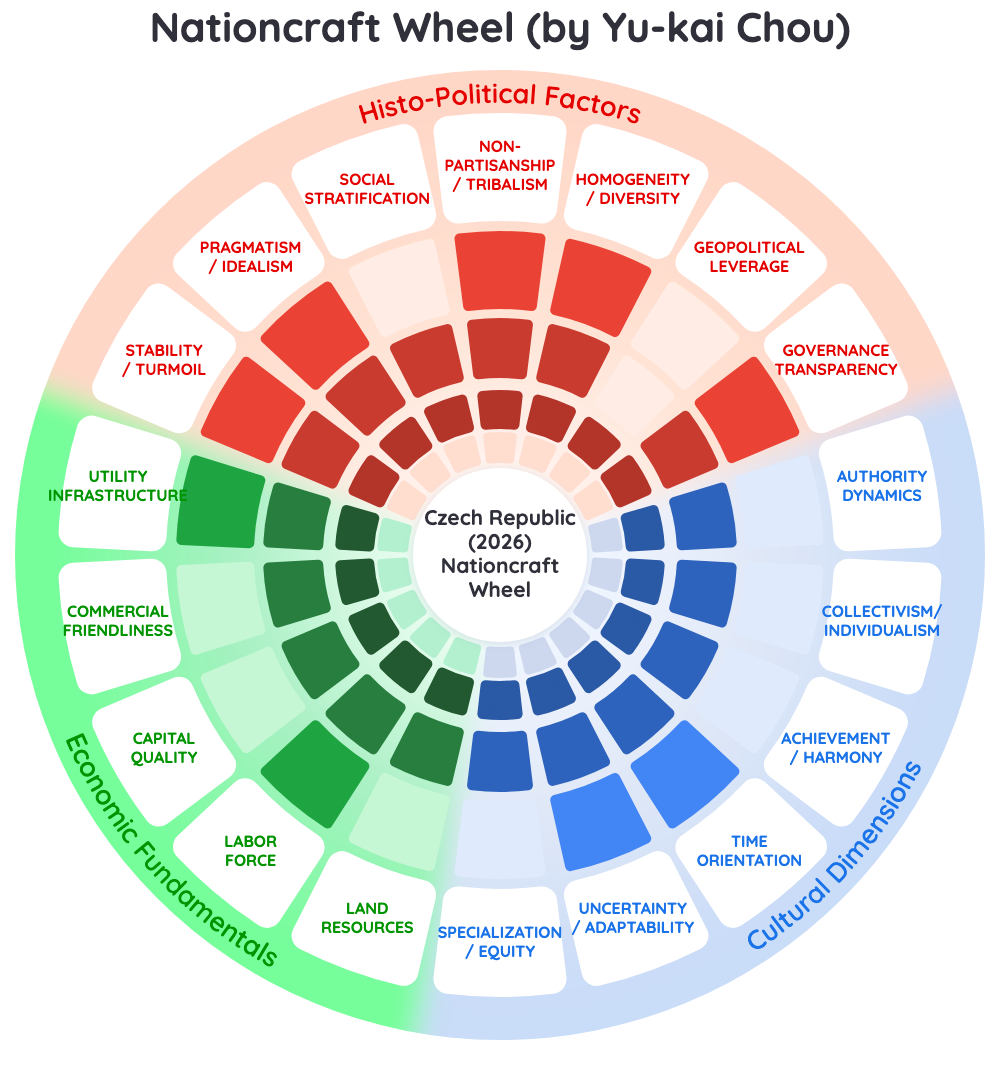
The featured Nationcraft Variables Wheel at the top of this page renders the full Czech V-vector; the table below carries the same 18 scores with the evidence behind each one.
| Variable | Score (1–10) | Evidence anchor |
|---|---|---|
| V1 Authority Dynamics | 5 | Consensual parliamentary system; power flows through coalitions rather than through any vertical |
| V2 Collectivism / Individualism | 5 | Mid-scale Central European profile; strong private sphere, weak mass-mobilization tradition |
| V3 Achievement / Harmony | 6 | Industrial work culture with moderate status competition |
| V4 Time Orientation | 8 | Long-horizon engineering and savings culture; among the highest long-term orientation scores in the region |
| V5 Uncertainty Adaptability | 7 | Absorbed the 1993 federal split, 2004 accession, and the 2008 and 2020 shocks without institutional rupture |
| V6 Specialization / Equity | 6 | Deep engineering specialization layered on an egalitarian wage structure |
| V7 Stability / Turmoil | 8 | No unconstitutional transfer of power since 1989; turbulence stays inside parliamentary procedure |
| V8 Pragmatism / Idealism | 8 | Transactional political culture; voters reward managers over visionaries |
| V9 Social Stratification | 4 | Income inequality among the lowest in the EU; a genuinely flat society |
| V10 Non-Partisanship / Tribalism | 7 | Bloc polarization is rising since 2021, but coalitions still form and dissolve on policy, within rules both camps accept |
| V11 Homogeneity / Diversity | 8 | One of the most ethnically homogeneous EU members; large Ukrainian inflow absorbed without systemic friction |
| V12 Geopolitical Leverage | 3 | Small landlocked economy; its leverage is borrowed through EU and NATO membership |
| V13 Governance Transparency | 7 | Strong courts and free press; mid-pack EU corruption perception, now stress-tested by an apex conflict of interest |
| V14 Land Resources | 4 | Limited natural endowment, no coastline, energy import dependence |
| V15 Labor Force Quality | 7 | Unemployment near 3%, dense vocational base, real wages rising 4.2% in early 2026 |
| V16 Capital Quality | 6 | Deep FDI stock, but profits repatriate; domestic capital formation remains the weak link |
| V17 Commercial Friendliness | 6 | Full single-market access; permits and licensing sit mid-table in the EU |
| V18 Utility Infrastructure | 7 | Dense rail and grid; post-2022 energy rewiring largely complete |
Read as a whole, this is one of the strongest V-vectors in the Nationcraft corpus outside the advisory tier. Seven scores at 7 or above, no score below 3, and the weaknesses (V12, V14) are geographic facts no policy can repeal.
Which raises the obvious question: how does a country with this profile end up in an institutional argument usually reserved for fragile states?
The Firm-State Trap
Every Nationcraft Analysis names the pattern its V-vector produces, because a named pattern can be watched. The Czech pattern is the Firm-State Trap: a pragmatic electorate hires an owner-manager to run the state like a firm, and the state then inherits the one governance defect every firm has, which is that nobody inside the firm audits the owner.
The trap needs three variables to fire, and the Czech Republic has all three.
The first ingredient is a high V8. Czech pragmatism at 8 is the national virtue that ended communism in ten days and split a federation without a single casualty, and it is also the reflex that discounts a conflict of interest as a technicality so long as the trains run and wages rise.
The second ingredient is a high V7. At stability 8, the system shrugs off shocks, so the warning lights that would force a resolution in a fragile state simply never reach critical. The Chamber debated no confidence in February and again in September 2026, and between those dates the government operated normally.
The third ingredient is a V13 that is high without being maximal. At transparency 7, courts, auditors, and journalists can see the conflict perfectly well. They documented it for years: Brussels auditors concluded back in 2021 that Agrofert’s EU subsidies placed its founder in a conflict of interest while he held office. The result is visibility without resolution: everyone can see the problem, and seeing it has quietly become a substitute for solving it.
It is worth being precise about what the trap is not. It is not state collapse, and the doomsayers predicting a Czech slide into autocracy have the mechanism wrong. The binding force here is ownership psychology operating at national scale. A plurality of voters feel the state is finally run by someone who treats it as his asset, with the care an owner gives an asset. The psychological trade is real, and so is its price: an owner’s asset is managed for the owner’s balance sheet, and the 2027 budget is what that looks like in fiscal form.
The trap compounds through plain loss aversion. Each year the conflict stays unresolved, the cost of resolving it rises for everyone invested in the arrangement, so the system’s pragmatism keeps choosing deferral. That is how a 7 becomes a 6 without any single day on which the score visibly changed.
Detailed Justifications: Reading the Czech V-Vector
Scores earn trust only when the reasoning behind them is visible. Here is the variable-by-variable case, grouped the way the Nationcraft Framework groups them.
Cultural Dimensions (V1–V6): a long-horizon society that distrusts grand narratives
V1 Authority Dynamics sits at 5 because Czech political culture never rebuilt a vertical after 1989. Even Babiš at peak popularity governs through coalition arithmetic, and his second premiership depends on two smaller parties whose 31 combined seats he cannot discipline, only accommodate.
V2 at 5 and V3 at 6 describe a society that mobilizes rarely but works hard: weak mass-movement tradition, strong professional pride. The exception proves the scores, because the one genuine mass mobilization of the past decade was the 2019 anti-Babiš demonstrations, the largest since 1989, and even those changed no institutional outcome.
V4 Time Orientation sits at 8. Czech households save, Czech firms plan in decades, and Czech voters notice intergenerational costs, which is why a CZK 389 billion deficit proposal became a no-confidence motion rather than a footnote.
V5 at 7 reflects a system that metabolized the Velvet Divorce, EU accession, and two global crises without constitutional drama. V6 at 6 captures the specialization-equity balance: a machine-tool and software workforce layered on the EU’s flattest wage structure, with the tension between those two facts rising as talent gets globally priced.
Histo-Political Factors (V7–V13): the strongest scores, and the two under live stress
V7 Stability at 8 and V8 Pragmatism at 8 are the twin engines of the whole Czech story, and the Firm-State Trap section above explains their dark side. The same two scores that carried the country through 1989, the 1993 split, and 2004 accession now produce the patience that lets an apex conflict of interest ride.
V9 Stratification at 4 means reform here never has to fight an entrenched class structure, a luxury nearly every other country in the corpus would envy. V11 Homogeneity at 8 removes the ethnic fault line that fractures reform coalitions elsewhere.
V10 Non-Partisanship at 7 is under pressure. The ANO-versus-SPOLU bloc divide has hardened since 2021, and the governing coalition now includes a party that campaigns against the EU mainstream. The score still holds, because both camps continue to transfer power by election and fight inside the rules. V10 therefore stays at 7 on this reading, recorded as a watch item rather than a drift.
V12 Geopolitical Leverage at 3 is structural. What leverage Prague has, it borrows: EU membership, NATO membership, and in recent years a specific moral asset, since the Czech-led ammunition initiative made a small state briefly indispensable to Ukraine’s wartime economy. The parties now governing criticized that initiative from opposition, then kept it running once in office, confirming in January 2026 that Prague would remain its coordinator. How much of this borrowed leverage survives the current parliament is the cleanest live test of where V12 goes next.
V13 Governance Transparency at 7 is the variable this entire analysis orbits. The infrastructure of transparency is intact: independent courts, a free press, functioning audit institutions, and EU-level oversight through the conflict-of-interest provisions of Regulation 2021/1060. What is being tested is whether infrastructure that can see a conflict can still act on one when the conflict sits in the prime minister’s office.
Economic Fundamentals (V14–V18): a strong base with one missing layer
V14 Land at 4 is geography: landlocked, resource-light, energy-dependent. V15 Labor at 7 is the compensating asset, a workforce running near full employment with real wages up 4.2% year on year in early 2026.
V16 Capital at 6 carries the transition’s one lasting structural disappointment. The privatization era built an economy that is owned more than it owns; profits flow out to foreign parents, and one of the largest domestically owned conglomerates sits in the prime minister’s trust. V17 at 6 and V18 at 7 round out a base that is good enough to support any reform program this analysis will recommend.
Best-Match Historical Packets
Nationcraft treats history as a library of tested programs. The table below summarizes how the most commonly proposed playbooks score against the Czech V-vector, and the subsections argue the six rejections and three fits in depth.
| Packet | Country, era | Verdict for Czechia | Decisive variable clash |
|---|---|---|---|
| SP-059 Orbán & EU Convergence | Hungary, 1990–2010 | Reject | Requires V10 tribalism and a supermajority; Czech V10=7 and coalition math refuse both |
| FP-016 Yeltsin Shock Therapy | Russia, 1991–1999 | Reject | Oligarch-making under V13 collapse; Czechia already ran a cleaner version in the 1990s |
| SP-014 Chicago Boys Reform | Chile, 1975–1990 | Reject | Technocracy shielded from accountability needs V1 vertical authority Czechia lacks at 5 |
| SP-051 Saakashvili Reform | Georgia, 2004–2012 | Reject | Anti-corruption blitz built for V13=2 institutions; applied at V13=7 it concentrates power instead |
| SP-037 Vision 2030 Transformation | Saudi Arabia, 2016– | Reject | Megaproject statecraft needs V1=9 and rent income; Czechia has V1=5 and V14=4 |
| SP-064 Bukele Security & Digital | El Salvador, 2019– | Reject | Trades institutions for popularity; solves a V7 crisis Czechia does not have at V7=8 |
| SP-109 1990s Banking Crisis & Fiscal Consolidation | Sweden, 1990–1996 | Study | Consensus-built consolidation matches V8=8, V10=7, V4=8 |
| SP-111 Chretien-Martin Deficit Elimination | Canada, 1993–1998 | Study | Program review by a pragmatic plurality government mirrors the Czech position almost exactly |
| SP-112 Wassenaar Consensus Labor | Netherlands, 1982–1995 | Study | Tripartite pact machinery fits Czech corporatist bones and V9=4 flatness |
1. Orbán & EU Convergence (SP-059, Hungary): the gravitational pull to name first
Every analysis of Central Europe now runs in Hungary’s shadow, so start there. The packet’s capture phase required three preconditions: a two-thirds supermajority, a fragmented opposition that could be kept fragmented, and a media market cheap enough to buy.
Czechia fails all three preconditions, and that failure is the most reassuring finding in this analysis. ANO holds 80 seats of 200, not a supermajority; the opposition blocs are battered but intact; and the institutions that would have to be hollowed out sit at V13=7, four points above where Hungary’s stood when the hollowing began. Hungary’s Two-Thirds Trap records what that packet costs a population across fifteen years; the Czech configuration cannot run it, and a reformist reader should stop treating the Hungarian endpoint as the default Czech forecast.
The realistic Czech risk operates more quietly than capture. A decade of normalized conflict of interest does not produce Budapest on the Vltava. It produces a V13 of 6 and a V10 of 6, a country that still holds elections and still publishes audits but has taught its citizens that audits change nothing. The packet to fear is erosion, which arrives without a single dramatic day to rally against.
2. Yeltsin Shock Therapy (FP-016, Russia): the cautionary packet Czechia already outperformed
The Nationcraft corpus files Russia’s 1990s as a Failure Packet, and its core lesson is that privatization at V13 near zero manufactures oligarchs who then purchase the state. Czech voucher privatization in the 1990s had its own scandals, but it ran under functioning courts and a free press, which is why the country produced billionaires without producing a captured presidency.
The record also carries an inversion of the Yeltsin pattern: the one Czech oligarch who did eventually reach the top of the state got there through elections, by being genuinely popular. That is a different mechanism with different remedies, and it is why imported anti-oligarch rhetoric keeps missing the Czech target. The problem is not hidden wealth seizing power; it is visible wealth being handed power, repeatedly, by an electorate that knows exactly what it is doing.
3. Chicago Boys Reform (SP-014, Chile): technocracy without accountability needs a vertical
Whenever deficits swell, someone proposes insulated technocrats with emergency powers. The Chilean packet shows what that requires: a V1 authority vertical (there, a dictatorship) that shields the technocrats from every constituency they harm.
Czech V1=5 cannot supply that shield, and a reformer should be glad. The fuller record sits in the Chile analysis: the packet’s economic results arrived welded to a repression bill no democracy should envy, and its sequencing simply does not exist without the repression. Fiscal correction in Czechia will have to be argued through a parliament, which is slower and better.
4. Saakashvili Reform (SP-051, Georgia): a defibrillator applied to a healthy heart
Georgia 2004 is the corpus’s best example of the anti-corruption blitz: fire the entire traffic police overnight, rebuild agencies from zero, accept the concentration of power that makes such speed possible. It worked because Georgian institutions at V13=2 were worth less than the risk of the surgery.
Run that same packet at V13=7 and the math inverts. Czech agencies mostly work; firing them wholesale would destroy functioning capacity, and the emergency powers the blitz requires would land in the hands of the very office whose conflict of interest is the live problem. An anti-corruption program whose first step is concentrating authority in the prime minister is, in the Czech configuration of 2026, indistinguishable from the disease it claims to treat.
5. Vision 2030 Transformation (SP-037, Saudi Arabia): megaproject statecraft without the rent
The managerial temptation has a maximalist edition: pick national champions, pour sovereign money into flagship projects, measure the state by what it builds. The Saudi packet runs on two inputs Czechia does not have, V1=9 command authority and V14 resource rents, and even with both inputs the packet’s outcome trajectory remains unproven.
A Czech government that tried to govern by megaproject would simply be running Agrofert logic at national scale, allocating capital by executive preference in a country whose actual strength is thousands of mid-sized exporters it did not pick. The V16=6 capital gap is real, but the remedy is deeper capital markets; a ministry of champions would only recreate the concentration problem at public expense.
6. Bukele Security & Digital (SP-064, El Salvador): a solution to a crisis Czechia does not have
The Bukele packet trades institutional constraints for executive speed, and its popularity rests on ending a homicide emergency that made the trade feel survivable. Czechia at V7=8 has no such emergency; it is one of the safest societies in Europe.
Imported here, the packet’s only deliverable would be the removal of constraints itself, and a reformist reader should treat every proposal to streamline decision-making past the Chamber as this packet wearing local clothes.
7. Study: 1990s Banking Crisis & Fiscal Consolidation (SP-109, Sweden)
Now the fits. Sweden entered the 1990s with a banking collapse and a runaway deficit, and exited with durable surpluses and an intact welfare state. The packet’s engine was procedural: a cross-party fiscal framework, multi-year expenditure ceilings, and a consolidation designed so that every major constituency could watch every other constituency take its share of the cut.
The preconditions read like a Czech personality profile: high pragmatism, functional cross-bloc trust, long time orientation (the Czech V4=8 matching Sweden’s famous planning culture), and an electorate that punishes fiscal theater. Sweden’s own scores have drifted since, as the Sweden analysis records, but the 1990s packet remains the gold standard for how a consensus society repairs a deficit without burning its social contract.
The Czech translation is concrete: replace the annual deficit argument with binding multi-year ceilings adopted by a supermajority convention, so that no single government, including this one, can write a CZK 389 billion year on its own signature.
8. Study: Chretien-Martin Deficit Elimination (SP-111, Canada)
Canada 1993 is the closest historical rhyme to Czechia 2026 in the entire corpus: a pragmatic plurality government, no supermajority, a bond market growing skeptical, and a population that wanted the books fixed without ideology. The Program Review answered with one question asked of every single spending line: does this program serve the public interest, and must the federal government be the one to run it?
Three design features made it work, and all three travel. The review was universal, which denied every ministry an exemption, and its targets were published so that slippage became visible within months. The framing mattered just as much: stewardship for the next generation, a white-hat motivation that keeps its energy across several election cycles in a way fear-driven austerity never manages.
For a Czech reader the lesson lands on the 2027 draft directly: a government that argues its deficit is acceptable because the EU average is worse has conceded it has no spending-line answer, and a reform movement should demand the Canadian question line by line.
9. Study: Wassenaar Consensus Labor (SP-112, Netherlands)
The 1982 Wassenaar Agreement is the corpus’s cleanest proof that a small, flat, export-dependent European economy can reset its trajectory through a negotiated pact: unions accepted wage moderation in exchange for working-time reform, while employers committed to preserving jobs. The state’s role was to guarantee the bargain and absorb its political cost.
Czechia has the tripartite machinery already, inherited and underused. It has V9=4 flatness, so a pact does not have to bridge a class canyon. And it has the same structural exposure the Dutch had, a small open economy whose wage growth (7.2% nominal in early 2026) is racing ahead of an economy forecast to grow 1.8%. The Netherlands eventually found new traps of its own, as the Netherlands analysis covers, but the pact mechanism itself is the right instrument for a country whose coming argument is wages versus competitiveness.
One packet deliberately not on either list: Singapore. Readers keep asking whether the Czech manager-state is just the LKY packet in a European key, and the answer is no on the variable that matters. Lee Kuan Yew ran the firm-state with the owner subordinated to the firm: ministers paid like executives but audited like suspects, and a corruption regime that jailed the founder’s own allies. The Czech edition inverts that hierarchy entirely: the owner oversees the state, while the question of who oversees the owner is the one the Chamber keeps having to debate.
Governance Strategy Recommendations
These recommendations are written for the reader the Nationcraft Framework always writes for: the citizen, analyst, or future reformer asking what it would take to get the Czech Republic out of the Firm-State Trap with its strengths intact. Every item is designed to open the system, and every item names the mechanism that would hold it open.
| Recommendation | How it opens the system | Packet anchor | Variables addressed |
|---|---|---|---|
| Resolve the apex conflict of interest through enforcement, not assurances | Act No. 159/2006 applied by courts that can rule against a sitting prime minister, backed by the EU’s power to withhold funds under Regulation 2021/1060 until divestment is verified by an authority independent of the government | SP-058 lesson carried forward | V13, V10 |
| Adopt binding multi-year expenditure ceilings | A supermajority fiscal convention takes the deficit out of single-government hands and gives the independent fiscal council published targets it can score in public | SP-109 Sweden | V4, V13 |
| Run a universal program review of the state budget | Every spending line answers the same two public questions, so consolidation lands by argument rather than by decree | SP-111 Canada | V8, V4 |
| Negotiate a wage-productivity pact through the tripartite council | Unions, employers, and the state trade wage moderation for investment commitments in the open, with the terms published | SP-112 Netherlands | V15, V17 |
| Publish beneficial ownership for every recipient of public and EU money | One searchable register lets any journalist or citizen trace every koruna of subsidy to its ultimate owner | Transparency floor across all fit packets | V13, V16 |
| Deepen domestic capital markets for household savers | Pension and retail capital flowing into Czech firms through regulated markets narrows the V16 gap while keeping the gains in Czech households | V16 remediation, SP-058 unfinished business | V16, V15 |
Each row deserves a note on why it fits this configuration and no other.
The conflict-of-interest row comes first because it is upstream of everything. A fiscal convention signed by a government whose leader privately benefits from state policy is paper; the same convention signed after verified divestment is architecture. The mechanism matters more than the outcome: whichever way courts and the Commission ultimately rule, what rebuilds V13 is the demonstration that the process runs to a conclusion no office can suspend.
The fiscal rows lean deliberately on consensus packets. Czechia’s V8=8 means an austerity crusade would be discounted as theater, while a published, universal, boringly procedural consolidation is the one move its political culture respects. The 2027 draft deficit is the test case sitting in front of parliament right now.
The capital-market row is the long game. The transition left Czech savings underemployed and Czech equity foreign-held, and the healthiest answer to an owner-dominated economy is several million smaller owners, which turns the same ownership psychology that powers the Firm-State Trap toward the population for once.
Strategic Implications
For Czech citizens and civic coalitions, the implication is a change of target: away from forecasting a dramatic turn, toward the unglamorous enforcement and fiscal machinery described in the recommendations, because the slow conversion of visibility into tolerance only reverses when some piece of machinery forces a conclusion.
For the EU, Czechia is becoming the test of whether the conflict-of-interest provisions in its financial regulations bind member-state heads of government in practice. The 2021 audit round established the principle. The 2026–2027 funding cycle will establish whether the principle has consequences, and every smaller member state is watching the answer.
For investors and analysts, the V-vector and the balance sheet, with debt at 44.3% of GDP and unemployment near 3%, say Czech exposure remains among the most stable in Central Europe, and the governance story says to price one specific risk: regulatory and subsidy decisions drifting toward owner-adjacent sectors. The restored fuel-price regulation of September 2026 is a small, legible example of policy reaching into price formation for political comfort.
For the region, the Czech case closes a loop that began in 1989. The country that proved post-communist transition could work is now testing whether the institutions that transition built can discipline their own most successful product. Poland’s Liberum Veto Trap and Bulgaria’s borrowed anchor each show a different member state outsourcing discipline it could not generate internally. Czechia has the internal scores to generate its own. Whether it chooses to is the question the next two budgets will answer.
Comparative Context: Czechia Among the Transition Cohort
Five variables carry most of the comparative signal across the Visegrád group and its western anchor.
| Variable | Czech Republic | Poland | Hungary | Germany |
|---|---|---|---|---|
| V7 Stability / Turmoil | 8 | 7 | 5 | 9 |
| V8 Pragmatism / Idealism | 8 | 8 | 6 | 8 |
| V10 Non-Partisanship / Tribalism | 7 | 3 | 1 | 8 |
| V13 Governance Transparency | 7 | 6 | 4 | 9 |
| V16 Capital Quality | 6 | 5 | 5 | 9 |
The table explains the region’s last fifteen years in five rows. Hungary’s V10=1 is what a decade of deliberate polarization produces, and it is the moat that keeps the Orbán packet running. Poland at V10=3 fought the same war and pulled back from the same edge, at a cost its institutions are still counting.
Czechia’s V10=7 is the regional outlier, the healthiest polarization score among the larger post-communist states. The Firm-State Trap operates through pragmatic tolerance rather than tribal warfare, which makes it gentler to live inside and easier to exit. Erosion, unlike capture, reverses when the incentives change.
The Germany column shows where this road can lead. On V7, V8, and V10 the two neighbors are nearly twins, and the gaps that remain, V13 and V16, are precisely the two variables this analysis recommends working. A reader who wants the longer version of how consensus systems develop their own pathologies can compare Germany’s consensus machine, where the same scores that stabilize can also paralyze.
The Nationcraft Framework in Practice
Step back from Czechia for a moment, because the method itself is what travels to the next case. A Nationcraft Analysis starts from measured variables rather than headlines, which is why this one could say something more useful than the two stock narratives, the complacent one in which strong fundamentals mean nothing is wrong, and the alarmist one in which every populist government is Budapest after a delay.
The variables showed that both narratives miss the case. The fundamentals are real (V7=8, V15=7, V18=7), the stress is real (V13 and V10 under live pressure), and the packet library says which repairs fit a high-pragmatism, high-stability configuration and which famous remedies would actively hurt it.
That discipline, rather than any single verdict about Prague, is what this method protects. The full methodology lives on the Nationcraft Framework hub, and every published country analysis applies the same 18 variables so the scores stay comparable across the corpus.
Explore More Nationcraft Analyses
The complete collection of country analyses, each with its own Nationcraft Variables Wheel, lives in the Nation Variables Library. For readers tracking the questions this analysis raised: the small-state leverage problem continues in the Albania analysis, and the fiscal-credibility thread runs through Zambia’s Model Debtor Trap.
Related Reading
- The Nationcraft Framework: 18 Variables, 8 Goals, 100+ Proven Reform Packets
- Nationcraft Nation Variables Library
- Nation Variable Analysis: Thailand (2026)
- Nationcraft Analysis: Kuwait Future Generations 2026
- Nation Variable Analysis: Ukraine (2026)
- Nation Variable Analysis: United States of America (2026)
Frequently Asked Questions
What is the Firm-State Trap?
The Firm-State Trap is the Nationcraft name for a configuration in which a pragmatic electorate hands government to an owner-manager and the state inherits the central governance defect of a firm, the absence of anyone who audits the owner. It requires high pragmatism (Czech V8=8), high stability (V7=8), and institutions strong enough to see the conflict but politically unable to resolve it (V13=7).
Is the Czech Republic becoming another Hungary?
The variables argue against that reading, because Hungary’s consolidation required a two-thirds supermajority, V10 tribalism near the floor, and institutions already weakened before capture began. Czechia has a coalition government holding 111 of 200 seats, V10=7, and courts and media that remain independent. The realistic Czech risk is gradual erosion of V13 and V10 through normalized conflict of interest, which is a different disease with different remedies.
How bad are the Czech Republic’s public finances really?
The stock is healthy and the flow is worsening. Debt stood at 44.3% of GDP at the end of 2025, well below the EU average, and the 2025 deficit was 2.1% of GDP. The dispute concerns the direction: a draft 2027 budget with a CZK 389 billion deficit, defended as roughly 3.5% of GDP, which reverses consolidation while the economy grows and unemployment sits near 3%.
What would actually resolve the Agrofert conflict of interest?
A resolution has two parts: verified separation of the prime minister from the conglomerate’s benefits under Act No. 159/2006, confirmed by an authority that does not answer to his office, and consistent application of the EU’s conflict-of-interest rules for Union funds under Regulation 2021/1060. Announcements of trust structures are inputs to that process rather than the conclusion of it.
Which historical reform packets fit the Czech Republic best?
Three consensus-era packets fit the V-vector: Sweden’s 1990s fiscal consolidation (SP-109), Canada’s Chretien-Martin deficit elimination (SP-111), and the Netherlands’ Wassenaar labor pact (SP-112). All three run on published targets and negotiated burden-sharing, which suit a society scoring V8=8 on pragmatism and V4=8 on time orientation far better than any strongman or blitz-reform import.
Footnotes
- Government of the Czech Republic, press conference after the cabinet meeting of September 14, 2026 (CZK 389 billion draft 2027 deficit; the 3.5% of GDP framing): vlada.gov.cz
- Czech Statistical Office / official election results portal, Chamber of Deputies election October 3–4, 2025: volby.cz
- Brno Daily, “Babiš To Be Appointed Prime Minister On 9 December After Announcing Handover of Agrofert,” December 5, 2025 (appointment date; the announced irrevocable trust structure for Agrofert): brnodaily.com
- European Commission, Economic forecast for Czechia (GDP 2.6% in 2025, 1.8% forecast 2026; deficit 2.1% of GDP 2025; debt 44.3% of GDP end-2025; HICP 2.3% in 2025): economy-finance.ec.europa.eu
- Czech Statistical Office, Average wages, 1st quarter of 2026 (nominal +7.2%, real +4.2% year on year): csu.gov.cz
- Eurostat, harmonized monthly unemployment series (Czechia around 3% in mid-2026): ec.europa.eu/eurostat
- Regulation (EU) 2021/1060, Article 61 and related conflict-of-interest provisions governing Union funds: eur-lex.europa.eu
- Kyiv Independent, “Czech-led ammunition initiative for Ukraine will continue, Babiš says,” January 6, 2026: kyivindependent.com
- Government of the Czech Republic, cabinet outcomes of September 21, 2026 (draft state budget discussion; restoration of fuel-price regulation): vlada.gov.cz