


On 18 March 1554, Princess Elizabeth was taken to the Tower of London on the orders of her half-sister, Mary I, under suspicion of a part in Wyatt’s Rebellion.
She was twenty years old at the time. Her mother, Anne Boleyn, had been executed when Elizabeth was two years and eight months old, and she herself had been declared illegitimate.
She left the Tower on 19 May and spent most of the following year under guard at Woodstock, and nothing was ever proved against her.
Four years later she was queen. She held the throne for 44 years, the longest reign of any Tudor monarch, through a string of plots, a war with Spain and the Spanish Armada, and the crown passed to James VI of Scotland when she died at Richmond Palace in 1603.
The six Steps below follow her run from a prisoner in the Tower to the throne she held until the day she died.
⚡ Speed Run Notes
- Elizabeth’s Game was sovereignty on her own terms: no husband, foreign court, church party or rival claimant would get a share of her power.
- Her signature move was delay used as a bargaining chip. She kept marriage offers and the succession question open for decades, and the open question kept suitors and rivals invested in her goodwill.
- Her government ran on a small set of long-serving Allies, led by William Cecil for forty years and by Francis Walsingham’s intelligence network.
- Her canon Skills: Divine Shield (Paladin), Gravity Flip (Warlock), Tactical Command (Ranger), Thunder Clap (Paladin) and Bat Signaling (Ranger).
- Her setbacks were real ones: near-fatal smallpox in 1562, the loss of Le Havre in 1563, the Essex rising of 1601 and an Irish war that outlasted her.
Table of Contents
About Yu-kai Chou

Yu-kai Chou is the author of 10,000 Hours of Play — the book that treats your life as the most important game you’ll ever build a character in, and gives you the 6-Step framework (Game · Attributes · Role · Skills · Allies · Quests) to play it on purpose. He has spent two decades developing the system through which this post analyzes its OP Hero, and applies it to his own life and to the lives of the people he advises around the world.
Chou’s other framework, the Octalysis Framework, has been applied by LEGO, Microsoft, Porsche, Coca-Cola, Salesforce, and MrBeast, impacting over 1.5 Billion Users. He has taught the methodology at Harvard, Stanford, Yale, Tesla, Google, BCG, and IDEO, and has advised governments in eight nations including Ukraine, the United Kingdom, the Kingdom of Bahrain, Singapore, Taiwan, the Netherlands, Kazakhstan, and South Korea.
His work has been cited by Harvard, Stanford, MIT, Forbes, Wall Street Journal, Wired, US Department of Energy, NIST, NSF, NCBI, US Department of Education, ClinicalTrials.gov, and Google Scholar — with 3,700+ more academic publications. Explore his books here.

Elizabeth I belongs in this series because so much of her build ran through one trained ability, the control of spoken and written words that she was already practising as a child. If I could lift one move from her character sheet, it would be the composure she showed at twenty, as a suspect in a treason case, when anything she said could have been used as evidence against her.
Step 1: The Game — What Elizabeth I Was Actually Playing
Elizabeth’s Game was to stay queen on her own terms. That meant keeping the crown out of the hands of a husband, a foreign power, a religious faction or a rival claimant, and leaving a kingdom that could survive her death.
She gave her own summary of it early. In her reply to Parliament in 1559, as William Camden recorded it, she said she had already joined herself in marriage to the kingdom of England.
Marriage, the succession, religion and war all touched the same question of who held power in England, and she played them as one board.
The religious settlement of 1559 was her first big move on that board. The Act of Supremacy made her Supreme Governor of the Church of England, and the Act of Uniformity put the Book of Common Prayer back into use in every parish.
Historians usually describe the result as a deliberately moderate settlement. It asked for outward conformity and loyalty to the crown, and it left enough room that most of her subjects could live inside it.
The rest of her reign followed a recognisable pattern. She postponed the irreversible choice, kept every faction hoping, and acted hard once waiting had become more dangerous than acting.
That pattern produced both her biggest wins and her biggest risks, because a question left open for too long can be settled by somebody else.
Step 2: Attributes — The Innate Stats
Attributes are the stats a player brings before any training, and three of Elizabeth’s were visible before she was out of her teens.
The first is verbal and linguistic talent. Her tutors were William Grindal, who taught her until his death in 1548, and then Roger Ascham, who praised her command of Latin and Greek, as well as French and Italian, in The Schoolmaster.
In 1544, at the age of eleven, she translated Marguerite de Navarre’s poem The Mirror of the Sinful Soul into English prose and gave it to her stepmother, Katherine Parr, as a New Year gift.
The second is composure under surveillance. In the Tower in 1554, and at Woodstock afterwards, she was a suspect in a treason case, and she came through both without handing her accusers anything they could use.
The third is patience on a scale most rulers could not tolerate. She kept Mary, Queen of Scots in custody for about nineteen years before agreeing to her execution, and she never formally named a successor at all.
The OP Talent Triangle Method asks you to find your edge strength, the ability that sets your build apart from the people around you.
For Elizabeth that edge looks like timing, which is the instinct for how long a question could be left open before it turned dangerous.
Step 3: Role(s) — The Character Class Across Chapters
Elizabeth changed Roles at least five times, and what actually transferred across every change was her control of language.
Her first Role was the scholar-princess. Royal by birth and illegitimate by statute, she was educated by Grindal and Ascham and stayed useful to her family only as long as she stayed out of trouble.
Her second Role was the suspect. Under Mary I she was the obvious focus for Protestant opposition, which is how she ended up in the Tower after Wyatt’s Rebellion in 1554.
Her third Role was the architect of a new regime. She became queen on 17 November 1558, appointed William Cecil as her principal secretary three days later, and was crowned at Westminster Abbey on 15 January 1559.
Her fourth Role was the balancing monarch. Through the 1560s and 1570s she played councillors, favourites, Parliament and foreign courts against each other, so that no single one of them became indispensable.
Her fifth Role was the war queen. With the Treaty of Nonsuch in August 1585 she agreed to support the Dutch revolt against Spain, and at Tilbury in August 1588 she put herself in front of her army.
Each of those Roles ran on the same equipment. The eleven-year-old translating a French poem for Katherine Parr and the queen addressing soldiers at Tilbury were using the same command of words on very different stages.
Step 4: Skills — The Real-Life Game Skills Elizabeth I Mastered
Skills are what a player trains on top of the starting stats, and five canon Skills explain most of Elizabeth’s run.
The first is Divine Shield (Paladin): saying no regardless of how persuasive the other side is. Parliament pressed her repeatedly to marry and to settle the succession, and she refused to be hurried on either question for more than four decades.
The second is Gravity Flip (Warlock): steering a negotiation toward the outcome you want. Her marriage negotiations with foreign princes, including Archduke Charles of Austria and later François, Duke of Anjou, kept foreign courts invested in English goodwill, and the last of them, with Anjou, ended in the early 1580s without a wedding.
The third is Tactical Command (Ranger): getting people with different talents to work as one team. Cecil ran administration and finance, Walsingham ran intelligence, Robert Dudley commanded her army in the Netherlands, and Francis Drake fought at sea, with the final say left to her.
The fourth is Thunder Clap (Paladin): public speaking that charges people up. In the best-known text of her Tilbury speech, recorded by Leonel Sharp and published in 1654, she told the troops: “I know I have the body but of a weak and feeble woman; but I have the heart and stomach of a king, and of a king of England too.”
The same Skill shows up in Winston Churchill‘s speeches to the House of Commons in 1940, and in both cases the speaker named the danger plainly before claiming the strength to meet it.
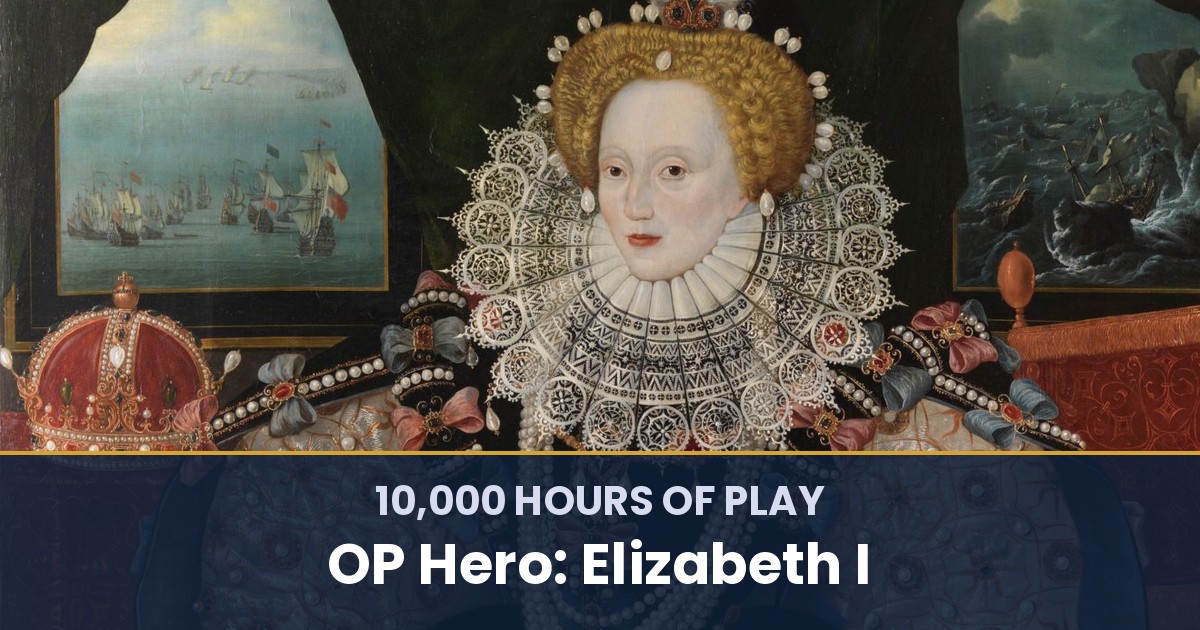
The fifth is Bat Signaling (Ranger): building a reputation and a brand over time. Portraits such as the Armada Portrait, painted around 1588 with the Spanish fleet in the background, and her summer progresses through southern England put a deliberate image of the queen in front of her subjects.
On the Skills Spectrum, Elizabeth reads as a Master whose core craft was political language, with intelligence management and image-making stacked on top of it.
Step 5: Allies — The People Who Multiplied Elizabeth I
Elizabeth worked with a small circle of Allies, and most of them served her for decades.
William Cecil was the most important of them. He became her principal secretary on 20 November 1558, was created Baron Burghley in 1571, became Lord High Treasurer in 1572 and served her until his death in 1598, which gave her forty years of administrative continuity.
Francis Walsingham became principal secretary in 1573 and ran the intelligence network that uncovered the Babington Plot in 1586. That discovery led directly to the trial and execution of Mary, Queen of Scots.
Robert Dudley, whom she created Earl of Leicester in 1564, was her favourite for most of the reign and commanded the English expedition to the Netherlands from December 1585. He died on 4 September 1588, a few weeks after Tilbury.
Francis Drake sailed around the world between 1577 and 1580, and she knighted him aboard the Golden Hind at Deptford in April 1581.
The logic behind choosing Allies by what they can do that you cannot is easy to see in this list. Cecil supplied administration, Walsingham supplied information, and Dudley and Drake supplied force, while Elizabeth supplied the legitimacy and the final decision.
Being her Ally carried risks too. After Mary was executed in February 1587, Elizabeth blamed her secretary William Davison, who was fined 10,000 marks by the Star Chamber and imprisoned in the Tower.
Step 6: Quests — The Milestones That Shaped the Saga
Elizabeth’s Quests run from a prison cell to a 44-year reign, and two of them are outright setbacks.
Quest 1 was survival: she was in the Tower from 18 March to 19 May 1554, and then under guard at Woodstock until 1555.
Quest 2 was the settlement: accession on 17 November 1558, coronation on 15 January 1559, and the Acts of Supremacy and Uniformity the same year.
Quest 3 was a pair of setbacks. In 1562 she caught smallpox and nearly died, and the English garrison she had sent to Le Havre, weakened by plague, surrendered to the French in July 1563.
Quest 4 was the Mary problem. After about nineteen years of custody and the Babington Plot of 1586, Mary, Queen of Scots was executed at Fotheringhay Castle on 8 February 1587.
Quest 5 was the Armada, which sailed in 1588 with roughly 130 ships and failed to carry out its invasion after English fireships at Calais and storms on the voyage home.
Quest 6 was the late game, which was harder than the middle. The Earl of Essex led a failed rising in London on 8 February 1601 and was executed on 25 February, and the Nine Years’ War in Ireland, which began in 1594, only ended with the Treaty of Mellifont days after her death.
She died at Richmond Palace on 24 March 1603, aged 69, and James VI of Scotland succeeded her as James I of England.
What You Can Steal From Elizabeth I’s Build
First, treat an open decision as an asset with an expiry date. Her unanswered marriage question kept foreign courts courting England for years, and she still had to act on Mary, Queen of Scots once the Babington Plot made waiting the more dangerous option.
Second, once an Ally has proven reliable, keep them for decades. Cecil’s forty years of service gave her a government that worked while she spent her own energy on decisions and on public image.
Third, when an audience is already thinking about your weakness, say it out loud first. At Tilbury she named the objection about her body and then claimed the heart of a king, and the line is still quoted more than four centuries later.
Fourth, expect the late game to be harder than the middle. The Essex rising, the Irish war and the Commons’ anger over monopolies all arrived in her last years, and in 1601 she answered that anger in person. The Golden Speech used the same Thunder Clap in a softer register: “though God hath raised me high, yet this I count the glory of my crown, that I have reigned with your loves.”
Where this framework comes from

Want the full system this profile is built on?
Every OP Hero piece runs through the same 6-Step framework from 10,000 Hours of Play: Unlock Your Real-Life Legendary Success. The book covers the full system, walks through Yu-kai’s own life run as the first applied case study, and gives you the worksheets to audit your own build.
Related Reading
- All OP Hero Profiles — the full hub
- 10,000 Hours of Play by OP Hero: Margaret Thatcher
- 10,000 Hours of Play by OP Hero: Lee Kuan Yew
- 10,000 Hours of Play by OP Hero: Sun Tzu
- 10,000 Hours of Play by OP Hero: King Sejong the Great