
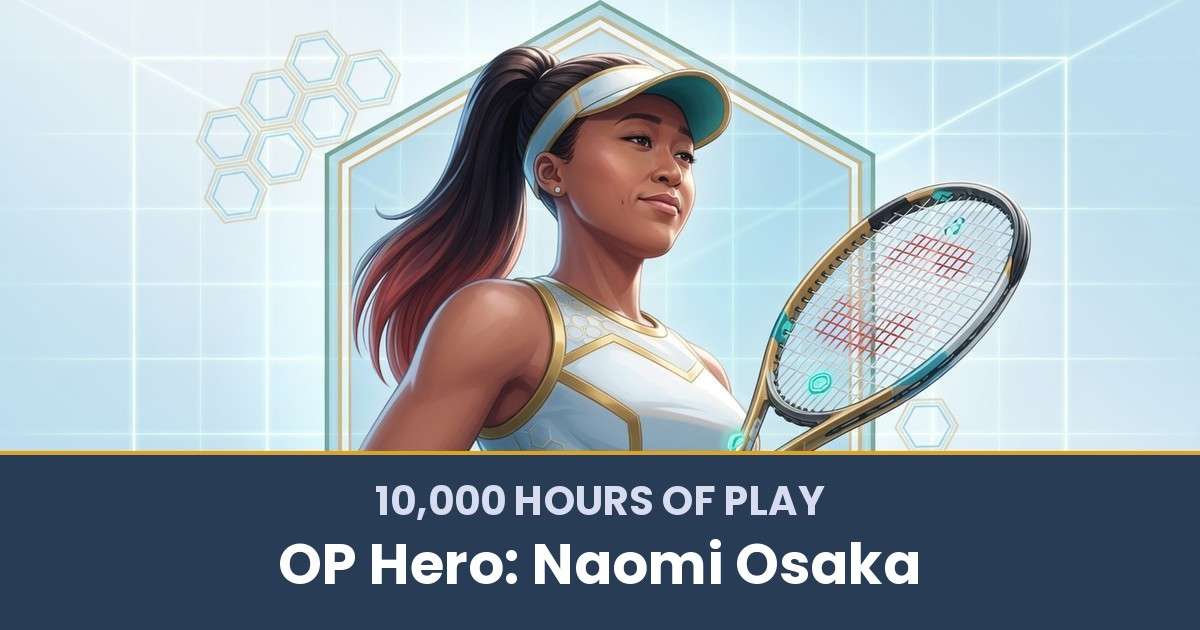


On September 8, 2018, a 20-year-old played the most psychologically hostile tennis match of the modern era, beat her childhood idol 6–2, 6–4 to win her first Grand Slam, and stood at the trophy ceremony crying inside a stadium that was booing the result. Three years later, the same player walked off the Roland-Garros grounds rather than walk into a press conference, and the entire professional sport had to renegotiate what it owed its athletes.
Naomi Osaka’s run is not the run people argue about. It is the run people argue with. Win the most contested US Open final in recent memory, become the first Asian player to hold the world No. 1 ranking, wear seven masks for seven Black victims at a single Slam, withdraw mid-tournament to protect your own brain, return after motherhood. Each individual move has been litigated to death. Almost nobody has lined them up as a single build.
When you line them up, the through-line is simple. It is the same through-line the 10,000 Hours of Play framework keeps finding in every long career worth studying. One Game, held still while almost everything visible about the work — the racquet results, the press cycle, the body, the family structure — was being rewritten underneath her.
⚡ Speed Run Notes
- Osaka’s Game is not “win Grand Slams.” It is one sentence: use the platform of elite tennis to compete at the highest level, protect her own mental architecture, and amplify the people her identity is built from.
- The 2018 US Open final win over Serena was not the loud match. It was a Mana Buffer (Mage) firing — closing a Slam inside a stadium hostile to her own win.
- The 2020 US Open seven-masks campaign — Breonna Taylor, Elijah McClain, Ahmaud Arbery, Trayvon Martin, George Floyd, Philando Castile, Tamir Rice — was the cleanest Courageous Heart (Paladin) firing in modern individual sport.
- The 2021 Roland-Garros withdrawal is the move that broke the consensus. It is a Holy Barrier (Paladin) skill rendered visibly enough to force the WTA, ATP, and Grand Slams into joint mental-health statements within 72 hours.
- The July 2023 motherhood pause and January 2024 return is the Phoenix Rebirth chapter — same Game, second life, new constraint stack.
- The lesson for your own life run: a long career is not built by stacking achievements. It is built by holding one Game still while every Role you take inside it gets honest about what it costs you.
Table of Contents
- Step 1: The Game — What Naomi Osaka Was Actually Playing
- Step 2: Attributes — The Innate Stats
- Step 3: Role(s) — The Character Class Across Chapters
- Step 4: Skills — The Real-Life Game Skills Naomi Osaka Mastered
- Step 5: Allies — The People Who Multiplied Naomi Osaka
- Step 6: Quests — The Milestones That Shaped the Saga
- What You Can Steal From Naomi Osaka’s Build
- Where this framework comes from
- Related Reading
About Yu-kai Chou

Yu-kai Chou is the author of 10,000 Hours of Play — the book that treats your life as the most important game you’ll ever build a character in, and gives you the 6-Step framework (Game · Attributes · Role · Skills · Allies · Quests) to play it on purpose. He has spent two decades developing the system through which this post analyzes its OP Hero, and applies it to his own life and to the lives of the people he advises around the world.
Chou’s other framework, the Octalysis Framework, has been applied by LEGO, Microsoft, Porsche, Coca-Cola, Salesforce, and MrBeast, impacting over 1.5 Billion Users. He has taught the methodology at Harvard, Stanford, Yale, Tesla, Google, BCG, and IDEO, and has advised governments in eight nations including Ukraine, the United Kingdom, the Kingdom of Bahrain, Singapore, Taiwan, the Netherlands, Kazakhstan, and South Korea.
His work has been cited by Harvard, Stanford, MIT, Forbes, Wall Street Journal, Wired, US Department of Energy, NIST, NSF, NCBI, US Department of Education, ClinicalTrials.gov, and Google Scholar — with 3,700+ more academic publications. Explore his books here.
What I find instructive about Naomi Osaka’s build is that the most replicable thing about it is not the serve or the forehand. It is the willingness to publicly redraw the boundary between an athlete’s job and an athlete’s life, in real time, at the cost of points, prize money, and consensus. The lesson I would lift for your own run is at Step 4: most operators treat Holy Barrier (Paladin) as a private skill they hope they never have to fire. Osaka fired it in front of every camera at Roland-Garros and changed her sport’s labor norms inside one week. The skill is only load-bearing once you use it where it is visible.
Step 1: The Game — What Naomi Osaka Was Actually Playing
One sentence: use the platform of elite tennis to compete at the highest level, protect her own mental architecture, and amplify the communities her identity is built from — Black, Japanese, Haitian, and immigrant.
The same sentence covers a three-year-old being moved from Osaka, Japan, to Long Island, New York, in 2001 because her father Leonardo Francois decided to coach her and her older sister Mari by self-studying Richard Williams’ methods. It covers turning professional in 2013 at age 15. It covers the September 8, 2018 US Open final against Serena Williams in Arthur Ashe Stadium, the January 26, 2019 Australian Open final win over Petra Kvitová that pushed her to world No. 1 two days later, and the 2020 US Open run during which she walked onto Ashe Court seven straight times in a different mask. It covers withdrawing from the 2021 French Open on May 31, 2021. It covers giving birth to her daughter Shai on July 7, 2023 and being back on tour by January 2024.
The substrate keeps shifting. Tour rookie becomes Slam champion becomes No. 1 becomes activist becomes mental-health flashpoint becomes mother becomes returning player. The Game does not. In a 2020 US Open post-match interview she said it plainly: “I feel like I’m a vessel at this point in order to spread awareness… I’m not sure what I would be if I wasn’t playing tennis.” Translation: the racquet is not the point. The platform the racquet earns is the point. That sentence only makes sense if the writer has been pointing at the same Game since long before the cameras showed up.
The 2024 comeback interviews at Indian Wells made the through-line explicit again. She described resetting her values around “being there for my daughter” and “showing her what it looks like to chase your dreams while protecting your peace.” Same Game. New constraint. Same one-sentence mission underneath.
Step 2: Attributes — The Innate Stats
Five Attributes show up before she could vote, and have not gone offline since.
Hostile-room composure. The 2018 US Open final is the cleanest evidence on tape. Serena Williams received a game penalty late in the second set, the Arthur Ashe crowd turned on the chair umpire, and Osaka had to serve out the match inside a stadium that was loudly hoping she would not. She held, won 6–2, 6–4, and cried at the trophy ceremony apologizing for winning. That is not a learned trait at 20 years old. The Talent Triangle Method would tag this Attribute as her base multiplier: the trait that makes every Role downstream of it more valuable than the same Role would have been in a more reactive nervous system.
Cross-cultural identity awareness. Born September 16, 1997 in Osaka, Japan, to Tamaki Osaka (Japanese) and Leonardo Francois (Haitian), raised in Long Island and then Florida from age three, holding dual Japanese-American citizenship until choosing Japanese citizenship in 2019. She has spoken openly — in the 2021 Netflix docuseries Naomi Osaka and in Japanese-media interviews from 2018 onward — about the experience of being “different” in Japan and “different” in the US. This is an Attribute, not a developed political stance. Multi-belonging shows up in her childhood reflections before it shows up in any public action.
Introvert observation. Across years of press conferences and the Jay Shetty podcast appearance (“I Used to Think Losing Meant My Life Was Over”), Osaka has consistently described herself as shy, preferring to watch and internalize before speaking. This is what makes her press conferences and her social-media statements read so different from each other: the public format she chooses gives her room to think first. The introvert Attribute is not a weakness in the platform game she is playing; it is the input filter that produces the unusually unfiltered written statements that have repeatedly moved the sport.
Moral instinct that triggers before strategy. On August 26, 2020, after the police shooting of Jacob Blake, she withdrew from her Western & Southern Open semifinal with a one-line public reason: “before I am an athlete, I am a Black woman.” The WTA, ATP, and USTA suspended play for a day in response. The 2020 US Open seven-masks campaign followed the same instinct two weeks later. The moral move comes first; the strategy is fitted to it. This is the same instinct ordering that the closest comparison case — Malala Yousafzai’s run — operates on, just in a different arena.
Raw ball-striking power without tactical decoration. ITF junior reports and early WTA commentary from 2014–2016 already described her serve, sitting above 190 km/h (118 mph), and her flat groundstrokes as having top-five tour ceiling years before her tactics caught up. The 2016 Miami Open second-round dismantling of Sara Errani, then world No. 18 and a former Roland-Garros finalist, ended 6–1, 6–3 — the kind of scoreline a flat-hitting power baseliner only puts on a defensive specialist when the ball-striking is already operating above her own ranking. The Attribute is not “she became a great hitter.” It is “the hitting was already there; the rest of her career is the surrounding stack catching up.”
Step 3: Role(s) — The Character Class Across Chapters
Five Roles, none cleanly retired.
From roughly 2001 to 2012 she was the Father-Coached Apprentice. Leonardo Francois self-trained as a coach by studying Richard Williams’ public methodology and applied it to Naomi and her older sister Mari. The Florida years (the family moved south from Long Island in 2006 for tennis development) were heavy on volume, light on the formal junior tour. Osaka has said in multiple interviews that she barely played the junior ITF circuit at all. The Role was: physical foundation builder, mostly invisible to the public tennis world.
From 2013 to early 2018 she was the Unknown Power Baseliner. She turned pro in 2013 at age 15. Made her WTA main-draw debut at Stanford in 2014 as a qualifier and beat Samantha Stosur in the first round. Reached the third round at the 2016 Australian Open and US Open. Won the 2016 WTA Newcomer of the Year. The Role was: high-ceiling outsider with a serve nobody on tour wanted to draw early.
From March 2018 to early 2021 she was the Hard-Court Boss / Slam Champion. Won her first WTA title at Indian Wells in March 2018. Won the 2018 US Open on September 8, 2018, the 2019 Australian Open on January 26, 2019, the 2020 US Open in September 2020, and the 2021 Australian Open in February 2021 — four Grand Slam titles by age 23, all on hard courts. On January 28, 2019 she became the first Asian player ranked No. 1 in singles. The Role was: tour-defining offensive force on hard courts, with serve, forehand, and short points as her main damage output. A close sibling Role chapter shows up in Serena Williams’ run, where the same hard-court power-first archetype anchored an even longer arc.
From May 2021 into 2023 she was the Mental-Health Reformer / Reluctant Activist. Her statement on May 26, 2021 declining French Open press, her withdrawal on May 31, 2021 after the tournament threatened default and a fine, and her subsequent disclosure of depression since 2018 collectively forced the WTA, ATP, and the four Grand Slams to issue joint statements on athlete mental health within the week. The Role was: live case study in athlete labor norms, often against her own preference for staying out of the discourse. The closest sibling case is Simone Biles’ build, where the parallel withdrawal at the 2021 Tokyo Olympics created the second half of the same year’s reset for elite individual sport.
From January 2024 onward she has been the Returning Mother-Athlete. Gave birth to her daughter Shai on July 7, 2023. Returned to competition at the Brisbane International in January 2024. Played the Australian Open, won her opening match at the 2024 French Open against Lucia Bronzetti, and held a match point against eventual champion Iga Świątek in the third set of their second-round meeting. The Role borrows the power game from the Hard-Court Boss Role and the platform sensibility from the Reformer Role; the new surface area is the family constraint stack.
Step 4: Skills — The Real-Life Game Skills Naomi Osaka Mastered
Five canon Real-Life Game Skills carry the build. Each earns its slot from a specific moment.
Mana Buffer (Mage). Compartmentalize stressors so one cannot overwhelm the others. The clearest firing is the second set of the September 8, 2018 US Open final. The Serena game penalty had just happened. The Arthur Ashe crowd was actively hostile to the result that her serve was minutes from producing. Most 20-year-olds in their first Slam final lose that game and possibly the set. Osaka quietly buffered the stadium noise, the moral confusion of beating her idol, and the live press storm into a separate compartment from “hold my serve and end this match,” and ended it in straight sets. Same canon Mage-family skill that anchors the extreme-focus skill set in the 10K HP catalog — different domain, same architecture.
Vision Manifestation (Warlock). Visualize success through mental rehearsal so vividly it shapes reality. From childhood she has described picturing herself winning Grand Slam finals against Serena Williams. The 2018 US Open final was, structurally, that childhood visualization landing inside a real bracket on a real Saturday in New York. The Warlock pattern is consistent: rehearse the future state so completely that when the bracket finally produces it, the body already knows what to do. The same skill anchors elite individual-sport peaks across the catalog, including Michael Phelps’ Olympic-cycle visualization protocols.
Courageous Heart (Paladin). Charging into uncomfortable zones, uncharted territory, hostile environments. The 2020 US Open seven-masks campaign — one mask per round, each naming a Black victim of racial violence (Breonna Taylor, Elijah McClain, Ahmaud Arbery, Trayvon Martin, George Floyd, Philando Castile, Tamir Rice) — was not a sponsor activation. It was an athlete using two pre-match and post-match TV minutes per round to put seven names that the news cycle had already cycled past back into the most-watched sport in America. She kept the campaign visible across the entire tournament, won the title, and changed how individual-sport activism is read by every governing body downstream. Courageous Heart is not bravado. It is the willingness to walk onto the most-watched court in tennis carrying a name that the sport’s broadcast partners would rather she did not say, every round.
Holy Barrier (Paladin). Set boundaries to protect mental and emotional wellbeing. On May 26, 2021 she announced she would skip Roland-Garros press to protect her mental health. The tournament responded with a $15,000 fine and a joint statement from all four Grand Slams threatening default. On May 31, 2021 she withdrew from the tournament entirely and disclosed she had experienced “long bouts of depression” since the 2018 US Open. Inside one week, the WTA, ATP, ITF, and the Grand Slams collectively shifted public posture on player mental health; mid-tournament withdrawals on mental-health grounds were no longer a sanctionable PR crisis by 2022. The Skill is the visible firing of a boundary at a level of stakes high enough that the rules around it had to change. Set the boundary where the cameras are and the rule book follows.
Phoenix Rebirth (Paladin). Recover from devastating failure and come back stronger. The 2021–2023 stretch was an unbroken sequence of devastating chapters: the French Open withdrawal, the third-round Australian Open exit in 2022, a yearlong ranking slide, then the pregnancy pause from September 2022 through July 2023, the birth of Shai, and a full year off competitive tennis. The return at Brisbane in January 2024, the deep run at the 2024 French Open against Bronzetti and the Świątek tiebreak in the second round, and the 2024 Toray Pan Pacific quarterfinal in Tokyo are the rebirth chapter rendering. The 2025 season picked up the same arc. Phoenix Rebirth is not “win again at peak.” It is “come back fully, with the constraint stack now permanently larger, and keep firing the Game underneath the new constraints.” The same chapter rhythm shows up in the most parallel modern individual-sport build, Simone Biles’ 2024 Olympic comeback, where the post-2021-reset return produced more gold than any pre-reset Games.
Step 5: Allies — The People Who Multiplied Naomi Osaka
Leonardo Francois. Father and original coach. Self-trained by studying Richard Williams’ publicly described methodology and built the early development program for both Naomi and Mari Osaka over roughly a decade in Long Island and Florida. The proof of his Ally impact is the timeline: a child who barely played the formal junior tour arrived on the WTA main draw at 16 with a serve and forehand the tour considered top-tier from her first qualifying campaign. That is not random; that is decade-long Ally infrastructure.
Tamaki Osaka. Mother and the household financial spine through the long years when professional tennis development costs are a household-bankrupting bet and the payoff is years away. In multiple Japanese-media interviews she has described the years of supporting the family economically through the development phase. The proof of impact is that the development phase survived; the bet held.
Sascha Bajin. Coach from late 2017 through February 2019. Hired after the 2017 season, was on her box for the 2018 Indian Wells title, the 2018 US Open, and the 2019 Australian Open — the entire stretch in which she went from outside the top 60 to world No. 1. He was named WTA Coach of the Year for 2018. The proof of impact is the bracket: three Slam-equivalent titles in 13 months, including two Grand Slams, none before the partnership, none with the same compressed cadence after.
Wim Fissette. Coach from April 2020 through 2022 and again from 2024. Held the box for the 2020 US Open and 2021 Australian Open titles, and is the coach guiding the post-motherhood return. The proof is repeat hiring across two distinct chapters: she trusts him to coach the version of her that wins Slams and the version of her that is rebuilding the body around a daughter.
Mari Osaka. Older sister and lifelong hitting partner through the entire father-coached development era. The Ally relationship is structural: there is no version of Leonardo’s plan that works as a one-child plan. Two daughters going through it together is what made the volume sustainable for the years before either of them was on the tour radar.
Cordae. Partner and father of Shai. His public posture during the 2020 US Open masks campaign (visibly in her box wearing matching messaging) and during the 2021–2023 mental-health and motherhood chapters has been to amplify her platform on his own platform without absorbing it. The proof is the absence of public drama and the consistent presence in the family-facing chapter rendering. The spouse-as-amplifier-not-absorber pattern is the rare Ally archetype; a different version of it anchors Beyoncé’s build in a much louder industry context.
Step 6: Quests — The Milestones That Shaped the Saga
September 16, 1997 — Born in Osaka, Japan to Tamaki Osaka and Leonardo Francois. The family moves to Long Island, New York in 2001 when Naomi is three.
2006 — Family relocates to Florida for tennis development. Leonardo Francois self-coaches both Naomi and Mari Osaka using Richard Williams’ public methodology.
September 2013 — Turns professional at age 15.
July 2014 — WTA main-draw debut at Stanford as a qualifier; defeats Samantha Stosur in the first round.
March 18, 2018 — Wins Indian Wells for her first WTA title, defeating Daria Kasatkina 6–3, 6–2 in the final.
September 8, 2018 — Wins US Open 6–2, 6–4 over Serena Williams. First Japanese player to win a Grand Slam singles title. The trophy ceremony, with the crowd booing the chair umpire and Osaka apologizing for winning, becomes one of the most-watched moments in modern tennis broadcast.
January 26, 2019 — Wins Australian Open 7–6, 5–7, 6–4 over Petra Kvitová. Two days later she becomes world No. 1, the first Asian player to hold the ranking in singles.
August 26, 2020 — Withdraws from Western & Southern Open semifinal in response to the police shooting of Jacob Blake. The WTA, ATP, and USTA pause play for a day. The next day she announces she will play, after organizers agree to the pause.
September 12, 2020 — Wins US Open 1–6, 6–3, 6–3 over Victoria Azarenka after wearing seven masks across the tournament, one per round, each naming a Black victim of racial violence.
February 20, 2021 — Wins Australian Open 6–4, 6–3 over Jennifer Brady for her fourth Grand Slam title.
May 26 to May 31, 2021 — Roland-Garros withdrawal. Announces she will skip press at the French Open to protect her mental health. After a $15,000 fine and a joint Slam statement threatening default, she withdraws from the tournament and discloses long-running depression since the 2018 US Open. The WTA, ATP, ITF, and Grand Slams issue mental-health statements within the week.
July 7, 2023 — Births daughter Shai with partner Cordae. Takes the remainder of the year off competitive tennis.
January 2024 — Returns to the tour at Brisbane International. Plays the Australian Open later that month and the French Open in May 2024.
2024–2025 — Comeback chapter consolidates. Held a match point against Iga Świątek in the third set of the 2024 French Open second round (Świątek saved it and won 7–6(1), 1–6, 7–5 on the way to taking the title); quarterfinals at the Toray Pan Pacific in Tokyo later that year. The Game keeps firing under the new motherhood constraint stack.
What You Can Steal From Naomi Osaka’s Build
Three transferable patterns.
First, your Game has to survive a public failure that the discourse cannot stop chewing on. Osaka’s Game survived a 2018 trophy ceremony that the entire sport spent six months arguing about. It survived the 2021 French Open withdrawal that half the press corps openly mocked. It survived a yearlong absence in which most of the same press wrote her career as a cautionary tale. Each time, the racquet results recovered because the Game underneath the racquet results had not actually changed — only the public narrative had. Write the one-sentence Game that survives a year of bad press without quietly mutating. If your sentence cannot survive a season of “she’s done,” it was not your Game; it was your last quarter’s KPI.
Second, Holy Barrier (Paladin) is the skill operators most consistently underweight in their own builds. Most people imagine boundary-setting as the small, private act of declining one extra meeting. Osaka’s career demonstrates the much larger version: a single visibly-fired boundary at high stakes can rewrite the rules of the system you operate inside. The 2021 Roland-Garros sequence changed how four Grand Slams handle mental health, changed how the WTA and ATP code press obligations, and changed the social-media posture every governing body now takes on the topic. The skill compounds when fired in public, not in private. Pick the one boundary you have been quietly carrying and ask whether firing it visibly would change something larger than your week.
Third, Phoenix Rebirth (Paladin) is what separates a champion from a career. The same player who won four Slams by age 23 is also the player who came back from a 16-month absence with a daughter, kept the one-sentence Game intact, and rebuilt a competitive baseline inside an entirely new constraint stack. Most operators look at the comeback chapter as an optional finale. The 10K HP framework treats it as the load-bearing test of whether the Game and the Attributes were real or borrowed. The fuller library of builds passing or failing that test lives in the OP Hero profiles hub; read three or four sibling builds and you will find the closest analogue for the comeback chapter your own run is either inside, or about to be.
Where this framework comes from

Want the full system this profile is built on?
Every OP Hero piece runs through the same 6-Step framework from 10,000 Hours of Play: Unlock Your Real-Life Legendary Success. The book covers the full system, walks through Yu-kai’s own life run as the first applied case study, and gives you the worksheets to audit your own build.
Related Reading
- All OP Hero Profiles — the full catalog of builds analyzed through the 6 Steps.
- Simone Biles — OP Hero profile — the closest sibling case for Holy Barrier and Phoenix Rebirth firing in elite individual sport, with the 2021 Tokyo withdrawal and 2024 Paris comeback forming a parallel arc.
- Serena Williams — OP Hero profile — the hard-court power-first Slam Champion Role at its longest-running rendering, and the opponent whose 2018 US Open final is the inflection point of Osaka’s own build.
- Malala Yousafzai — OP Hero profile — the closest analogue for moral-instinct-first Courageous Heart firings used to amplify the communities the operator’s identity is built from.
- The Talent Triangle Method — how to pick the Attribute, Skill and Role combinations your own Game is built on.
- The Skills Spectrum — Specialist, Dabbler, Master, Strategy. The taxonomy under every Skill mention in this profile.