

Most NFT commentary gets distracted by price action because price is the easiest thing to screenshot. But the projects that last are rarely the ones with the loudest charts. They are the ones that create a durable game loop, a believable reason to return, and an economy design that does not collapse the moment hype cools down. If the only motivation is “maybe someone else will pay more later,” then the design is weak no matter how expensive the collection becomes for one weekend.
That is why I do not think the most important NFT question is, “Will this go up?” The better question is, “What type of ownership does this asset actually create?” The strongest NFT concepts activate Core Drive 4: Ownership & Possession in a way that feels legitimate, not cosmetic. If users do not truly feel attached to what they hold, then there is no moat. There is only a tradable file waiting for the next mood swing.
Scarcity matters too, but only when it feels real. Artificial scarcity can create short-term motion, yet it rarely creates enduring conviction. What gives a project staying power is when Core Drive 6: Scarcity & Impatience is anchored to something the market intuitively respects. In Metablox, that anchor is physical place and lived memory, which is why the concept fits so naturally with my Digital Convergence Model of blending digital systems with meaningful real-world context.
Even then, mechanics alone are not enough. A project needs the kind of narrative and trust that can trigger a voluntary adoption cascade, where people join because the system becomes increasingly meaningful as others participate. That is where community design stops being a marketing afterthought and becomes a core asset. The NFT I believe in is not the one with the flashiest mint. It is the one that can still make emotional sense after the initial frenzy has passed.
⚡ Speed Run Notes
- Most NFT value is downstream of behavioral design, not artwork alone. The image gets attention, but the mechanics decide whether attention compounds or evaporates.
- Scarcity, meaning, and community matter because they shape whether people feel proud to hold, anxious to lose, and motivated to contribute.
- The best NFT ecosystems give different player types distinct ways to participate, so collectors, storytellers, speculators, and community builders all have reasons to stay engaged.
- Metablox is compelling precisely because it does not start with a random collectible. It starts with places and memories that people already care about.
Table of Contents
- Why NFTs Are Valuable in the First Place
- The Premise of Metablox
- Join the Metablox Discord Channel
- Related Reading
About Yu-kai Chou

Yu-kai Chou is an S-Tier Behavioral Designer, author of Actionable Gamification, and creator of the Octalysis Framework. His work has influenced products and communities reaching over 1.5 billion users across clients, audiences, and research citations that include LEGO, Microsoft, Porsche, Tesla, Harvard, Stanford, Google, and more than 3,700 academic publications.
Verify: Wikipedia · Google Scholar · Wikidata · LinkedIn
For that, we need to break down why NFTs are valuable in the first place.
NFTs retain their value because of three components: 1) Scarcity, 2) Meaning, and 3) Community.
These three forces matter because they map to three different questions the market keeps asking, often subconsciously. Scarcity answers, “How replaceable is this?” Meaning answers, “Why should anyone care?” Community answers, “Who else will still care when the novelty fades?” A project that only answers one of these questions can spike, but it rarely becomes durable. A project that answers all three starts behaving less like a collectible gimmick and more like a culture with an economy attached to it.
This is also why so many NFT debates become confused. People argue about whether a collection is valuable while using completely different definitions of value. One person means resale value next month. Another means signaling value inside a tribe. Another means long-term emotional significance. Another means utility inside a future digital environment. Unless you separate those layers, people talk past each other. Good behavioral design does not treat them as identical. It understands which value layer it is trying to strengthen, and then builds mechanics that make that layer more believable over time.
If you apply my Octalysis Framework, these correspond to three distinctive Core Drives:
- Core Drive 6: Scarcity & Impatience
- Core Drive 1: Epic Meaning & Calling
- Core Drive 5: Social Influence & Relatedness

Scarcity is a built in function of NFTs. By limiting the quantity that is released in the world, things become rare.
However, the quantities are often still arbitrary based on the releasing party.
The releasing party could release 10,000 of these NFTs this week. Then, a month later, they could also release another 10,000 if they wanted to.
It theoretically could be like a central bank printing more money based on how they see fit (I understand fiat money is not non-fungible but the point still stands).
Similarly, even though Diamonds are relatively abundant in the world compared to other gems, the De Beers company withholds the world’s Diamond supply to create artificial scarcity.
This in effect massively increases the price of each Diamond in the marketplace.
Meaning is one of the most critical components on whether an NFT should have lasting value or not.
Sure it’s unique and scarce, but what does it represent and why should people care?
I have a friend in Denmark who owns a pretty beat up couch that he cherishes greatly, because it was a couch that Winston Churchill owned and hence has great meaning.
This is also why the Endowment Effect matters so much in NFT design. Once an object becomes psychologically “mine,” its perceived value changes. Meaning is not just stored in scarcity. It is stored in attachment, memory, and identity.
However, if there was a company that could suddenly mass produce 50,000 Winston Churchill’s couches anytime they wanted, suddenly the meaning, and hence value, would be greatly diminished.
Similarly, Jack Dorsey, founder of Twitter, sold the image of his first tweet from 2006 for $2.9 Million.
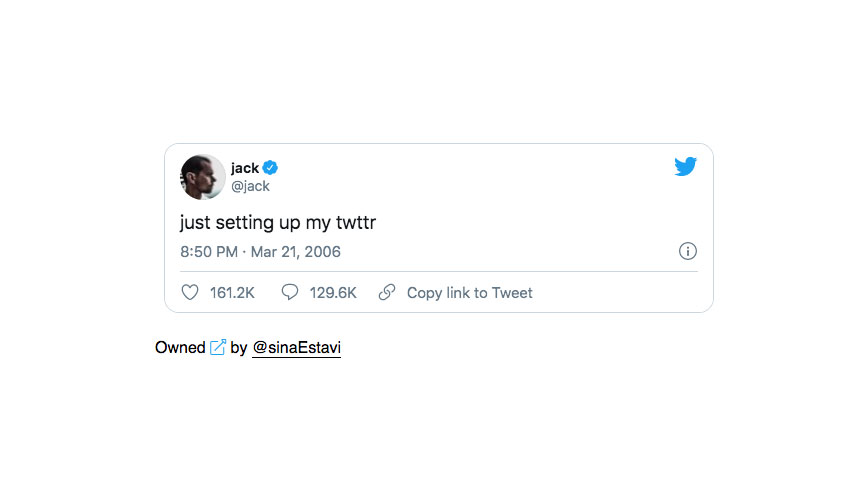
However, if it was a random person who took that same image and tried to sell the NFT, it would not be valuable because the meaning came from the legitimacy of the agent who released the NFT (Jack Dorsey).
Finally, there is a Community piece.
Most things, including money, are only valuable if enough people believe in their value.
When you get any form of currency, you must believe that someone else would see this currency as valuable and would exchange their own goods for the currency you have.
Community creates a social agreement where people here believe in the (hopefully) lasting value of this NFT.
That is also why projects with weak social architecture fade even when the mint goes well. If the community has no rituals, no stories, and no reasons to care for one another, the NFT becomes a lonely asset instead of a shared world. Durable value comes from making people feel like they are participating in something worth protecting together.
There is also the psychological effect of safety in numbers. If there are a lot of people in the community, we automatically feel like something new is safe and trustworthy.
Having recognized and credible people be part of an NFT community adds more legitimacy and enhances the social proof, making the NFT more sought after and hence more valuable.
So what is the NFT I believe in? The premise of Metablox.
So as I search through my own knowledge and the literature in value-systems, I wanted to find out what has more-than-arbitrary scarcity, has true meaning to people, and therefore could grow an active community with lasting value.
The end conclusion is a concept I now call Metablox.
If you want to see how that premise later evolves into a fuller behavior system, the mechanics become much clearer in Metablox Whitepaper 2.0 Part III, where memory, progression, and game economy start reinforcing one another instead of living as separate ideas.
So what is Metablox? It’s a Metaverse/NFT concept that is an embodiment of real-world locations and real-life memories.
What has inherent scarcity in the real world? Gold and real-estate.
Whereas gold and oil are generally fungible, real estate is non-fungible, as every address and building on it is unique.
The scarcity and non-fungibility of real-estate is what makes property prices rise up massively over the years while becoming lovable homes for people who live there.
What has lasting meaning? The memories of people.
In this world, without human memory, nothing is meaningful.
This is why even the wealthiest people in this world care about building their legacy or “being remembered,” because if everything is forgotten, nothing matters.
Generally, memories are connected to a place, whether it’s physical or virtual.
That’s why many other NFT Projects try to install meaning into their platforms by introducing theme-based fantasy locations or using good storytelling techniques to make their NFTs more meaningful.
On the other hand, real-world addresses and locations already have meaning built into them. It’s the story of our lives!
For instance, I would want to own an NFT of the street address 2011 California St. in Mountain View because that is where I ran one of my first startups while living with three other guys in a two bedroom apartment.
I slept on the couch next to the kitchen every day for a year and it still has some of my fondest and most meaningful memories.
Of course, this address would not have that much meaning for anyone else in the world besides myself because of my unique memories and the meaning that it created for me.
But there are many other locations that have unique memories for hundreds or thousands of people because of the things that happened at that location.
In that sense, we are creating an NFT that honors people’s memories.
With the principle of real-world addresses and real-life memories, I can then apply my gamification design skillsets to create an ecosystem that honors people who spend more time and care to record their memories and maintain their NFTs.
That is where the idea shifts from being an interesting collectible to being a meaningful system. If a location accumulates memories over time, then ownership is no longer just about holding a token. It becomes about stewardship, contribution, and narrative continuity. The owner is not simply sitting on an asset and hoping for number-go-up behavior. The owner is helping shape what that digital place means, how it is remembered, and why other people may eventually want to participate in it.
That distinction matters for long-term value because stewardship creates a different emotional posture than speculation. Speculation asks, “When do I exit?” Stewardship asks, “How do I make this richer?” The former can create fast volume, but the latter creates the kind of attachment that gives an ecosystem resilience. When a project makes people want to deepen its meaning instead of merely flipping its price, it has a chance to become part of someone’s identity. That is a much stronger foundation for lasting value than hype alone.
Over time, these NFTs will grow in their own value but also produce “MetaRent” that can be used to do a variety of interesting things beyond that.
That future utility matters because it gives the asset an arc. A static collectible can only appreciate through attention or rarity. A living asset can appreciate through participation. The moment an NFT begins to reward memory, contribution, curation, or stewardship, the owner’s relationship to it changes. They are no longer simply waiting for a buyer. They are building into the object itself. That is the sort of design move that makes a digital asset feel more like property, more like legacy, and more like a place inside a broader world than a souvenir from a trend cycle.
Currently, I’m applying my decently-recognized Octalysis 5 Steps Design process to define the whole experience of Metablox and will be announcing some really exciting things once we get to a variety of concrete milestones.
As per all NFT projects and opportunities in life, the earlier you get in on it and start engaging with the community the more rewarding it is for you.
Early visionaries always benefit the most if something takes off (of course, they take the most risks too if things don’t work out).
That tradeoff is exactly why meaningful early communities matter. When people arrive early only for upside, they leave the moment momentum weakens. When they arrive early because the mission feels important, they become the culture-setters who give the project its tone, memory, and standards. Those are the participants who make a future world feel inhabited instead of empty.
If you would like to explore early participation of the Metablox experience, make sure you join our Metablox Discord Channel.
Join the Metablox Discord Channel
Excited about where the future is going.
The future gets much more interesting when digital ownership starts preserving human meaning instead of merely monetizing attention, status, memory, belonging, and permanence.
Related Reading
- Metablox.co Resurgence: New Web3 Game Loop
- Metablox Whitepaper 2.0 Part I
- The Web3 Metaverse and How It Will Change Everything
- 3 Great Gamification Examples in Blockchain and NFTs
- The Octalysis Framework for Gamification & Behavioral Design
- Actionable Gamification: Beyond Points, Badges & Leaderboards