
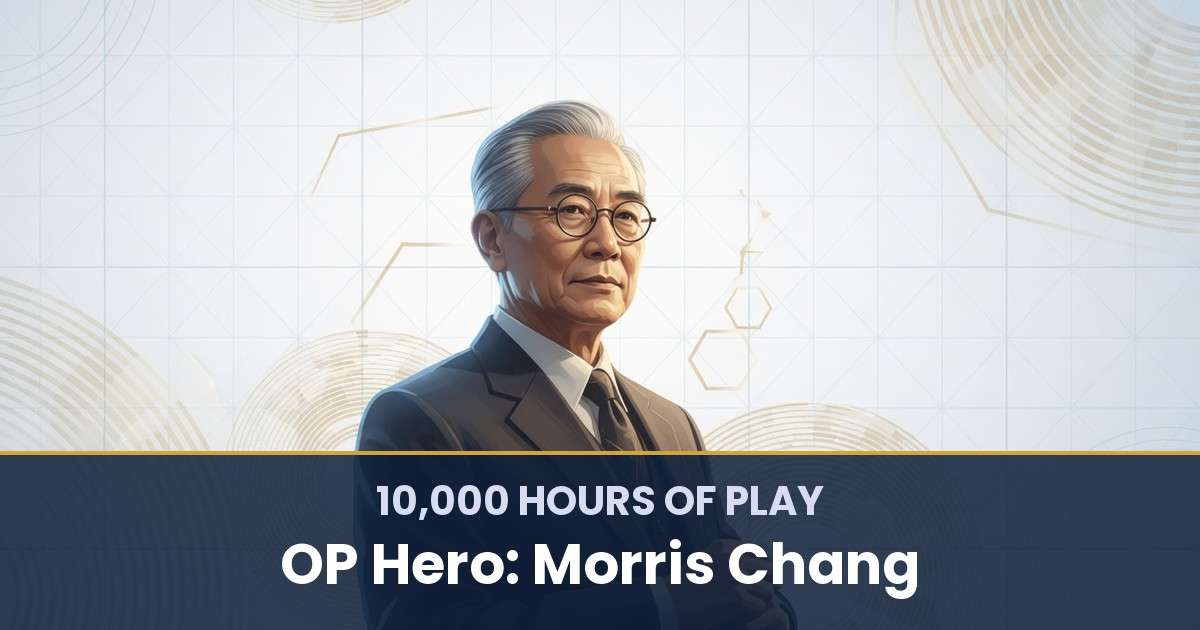


In 1983, Morris Chang walked away from Texas Instruments after roughly twenty-five years, most of them spent building the company’s semiconductor business into the world’s largest operation of its kind. The top job had gone to someone else.
He was 52, and by every conventional scoreboard his run was over.
Here is what actually followed: a short, unhappy year at General Instrument, a recruiting call from Taiwan, and then, in 1987, the founding of Taiwan Semiconductor Manufacturing Company. TSMC ran on a business model that was a large, unproven bet at the time, the pure-play foundry, and that same model now carries much of the world’s advanced chip production.
Run his life through the 6-Step framework from 10,000 Hours of Play and you get one of the cleanest late-bloomer builds in the catalog: Mage-grade study habits, Warlock-grade pricing aggression, and a main quest that only began in his mid-50s.
⚡ Speed Run Notes
- Morris Chang’s Game stayed constant for six decades: make advanced chip manufacturing predictable and scalable, then point that capability at something bigger than one company’s quarter.
- The 25-year Texas Instruments chapter reads like a loss because it ended in a passed-over CEO race. It was actually the stat grind that made TSMC possible.
- Three Skills did the heavy lifting: Ley Line Infusion (self-taught semiconductor physics), Sacrificial Cycle (learning-curve pricing), and Track Treasure (seeing the foundry opportunity everyone else walked past).
- Allies decided the outcome. Chang’s own words in 2023: “There would be no TSMC if not for Li Kwoh-ting.”
- TSMC launched in 1987 with about US$220 million from Taiwan’s government and Philips, led by a founder in his mid-50s. Late game is still game.
Table of Contents
About Yu-kai Chou

Yu-kai Chou is the author of 10,000 Hours of Play — the book that treats your life as the most important game you’ll ever build a character in, and gives you the 6-Step framework (Game · Attributes · Role · Skills · Allies · Quests) to play it on purpose. He has spent two decades developing the system through which this post analyzes its OP Hero, and applies it to his own life and to the lives of the people he advises around the world.
Chou’s other framework, the Octalysis Framework, has been applied by LEGO, Microsoft, Porsche, Coca-Cola, Salesforce, and MrBeast, impacting over 1.5 Billion Users. He has taught the methodology at Harvard, Stanford, Yale, Tesla, Google, BCG, and IDEO, and has advised governments in eight nations including Ukraine, the United Kingdom, the Kingdom of Bahrain, Singapore, Taiwan, the Netherlands, Kazakhstan, and South Korea.
His work has been cited by Harvard, Stanford, MIT, Forbes, Wall Street Journal, Wired, US Department of Energy, NIST, NSF, NCBI, US Department of Education, ClinicalTrials.gov, and Google Scholar — with 3,700+ more academic publications. Explore his books here.
What makes Chang’s build worth studying twice: he treated the lost CEO race at 52 as a re-spec, and the attribute that carried him afterward was patience measured in decades. If your current chapter feels like grinding for a promotion that never comes, Step 6 of this profile shows what that grind can still become.
Step 1: The Game — What Morris Chang Was Actually Playing
Chang was born in Ningbo, China, in 1931, and in his Computer History Museum oral history he frames his childhood around “war, poverty and social injustice.” He left for the United States at 18, landed at Harvard, and moved to MIT for mechanical engineering.
From the outside, the next fifty years look like several different careers. Underneath, one Game runs the whole way through: make advanced semiconductor manufacturing predictable and scalable, then aim that capability at something larger than a quarterly earnings call.
At Texas Instruments the scoreboard was yield: the percentage of working chips coming off a production line. Later, at Taiwan’s Industrial Technology Research Institute, he described the mission as using technology to advance Taiwan’s larger social and economic goals.
That second scoreboard matters. Chang was playing a nation-scale game with an industrial toolkit, closer to the build of Lee Kuan Yew than to a typical chip executive.
The win condition he defined for TSMC follows the same pattern: a trusted manufacturing platform so reliable that the world’s chip designers would stake their companies on it. Speaking at MIT in 2023, he distilled the formula to disciplined process, long-term capital commitment, and talent development.
The Game was the platform itself: chips for everyone else’s products, under everyone else’s brands.
Step 2: Attributes — The Innate Stats
Strip away the résumé and four innate stats show up early and never leave.
Pattern recognition in messy systems. As a young engineer, Chang could stare at a misbehaving transistor line and see the process variables everyone else missed. That diagnostic instinct got him promoted at TI, and thirty years later it let him read the entire industry’s structure the same way he once read a production line.
Decade-scale patience. He stayed at TI for roughly twenty-five years. He then held the TSMC chairmanship until 2018. People with this stat treat years the way others treat quarters.
Calculated risk appetite. The pattern repeats three times: leaving a senior TI post for General Instrument in 1983, leaving America for ITRI in 1985, and betting his reputation on an unproven foundry model in 1987. Each jump was large, and each was priced carefully before he took it.
Cross-cultural range. Ningbo to Boston to Dallas to Taipei, with US citizenship in 1962 along the way. He operated in every one of those worlds without losing standing in the others.
In the OP Talent Triangle Method, the exercise is finding where your innate stats overlap into an unfair advantage. Chang’s overlap was rare: engineer’s precision, statesman’s horizon, gambler’s nerve. The foundry model sits exactly at that intersection.
Step 3: Role(s) — The Character Class Across Chapters
Chang’s class changed five times, and the sequence explains the build.
Student-Engineer (1949–1955). Degrees from MIT in mechanical engineering, BS in 1952 and SM in 1953. Stats grinding, plain and simple.
Yield Engineer, then Operations Strategist (mid-1950s–1983). A start at Sylvania Semiconductor, then TI from 1958. He rose from debugging transistor lines to running TI’s worldwide semiconductor operations, picking up a Stanford PhD in electrical engineering in 1964 while working full-time.
Miscast Executive (1983–1984). President and COO of General Instrument, a diversified company where his semiconductor-centric instincts had no room to run. He lasted about a year. Wrong class for the character.
National Technology Steward (1985–1994). Running ITRI, he learned to move government capital, research talent, and industrial policy as one system. This chapter was the tutorial for the one that made him famous.
Foundry Architect (1987–2018). Founder and CEO of TSMC until 2005, chairman until 2018, with a dramatic return to the CEO seat in 2009. The class shift, from salaried operator to founder in his mid-50s, is as dramatic as Chung Ju-yung willing Hyundai’s shipyard into existence.
Late in life he added one more: Elder Statesman, representing Chinese Taipei at APEC meetings. Every class he mastered fed the next one.
Step 4: Skills — The Real-Life Game Skills Morris Chang Mastered
Attributes are the stats you spawn with. Skills are what you build, and Chang built three that changed semiconductor history.
Ley Line Infusion (Mage) — rapidly absorbing a large body of knowledge in a new subject. Chang’s MIT degrees were in mechanical engineering, yet his career demanded solid-state physics. His fix was self-study, working through the material at Sylvania with coaching from a colleague until he could hold his own with formally trained physicists. Carl Jung ran the same Skill on a different battlefield: when the existing map fails you, absorb the territory yourself.
Sacrificial Cycle (Warlock) — reinvesting today’s gains back into the engine instead of banking them. At TI, working with the Boston Consulting Group, Chang turned this into pricing doctrine: cut integrated circuit prices every quarter, “even when the market did not demand lower price,” sacrificing near-term margin to buy volume, learning, and a cost position no rival could match. Critics called the approach foolish. Chang called it a pioneer effort in the semiconductor industry, and it worked.
Track Treasure (Ranger) — spotting the opportunity hiding in plain sight. By the mid-1980s, Chang had watched a generation of chip designers struggle under the crushing capital cost of building their own fabs. Everyone saw the same fact. Chang treated it as an opening: a manufacturer that only manufactured, competing with nobody’s designs, would let a thousand fabless companies exist.
On the Skills Spectrum, Chang is a textbook Master: one narrow domain, semiconductor manufacturing, compounded for sixty years until the depth itself became the moat.
Step 5: Allies — The People Who Multiplied Morris Chang
Chang is blunt about the ally who mattered most. Speaking in 2023 about Taiwan’s legendary economic architect, he said: “There would be no TSMC if not for Li Kwoh-ting.”
K.T. Li recruited Chang to lead ITRI in 1985 and then backed the foundry experiment with the full weight of the Taiwanese government. That backing became concrete fast.
Bind Fate (Warlock) — tying your quest to a more powerful patron’s resources and credibility. TSMC launched in 1987 with about US$220 million raised from Taiwan’s government and Philips. Chang supplied the model and the operating discipline; his patrons supplied capital, legitimacy, and patience that no venture fund of that era would have offered a first-time founder in his mid-50s.
The earlier chapters had allies too. The Boston Consulting Group co-developed the learning-curve pricing method with him at TI, and a Sylvania colleague tutored the young mechanical engineer through solid-state physics.
At TSMC he built a bench deep enough to survive him. Rick Tsai took the CEO seat in 2005. After returning in 2009, Chang groomed three operational deputies, Shang-yi Chiang, Mark Liu, and C.C. Wei, appointing them co-COOs; Liu and Wei eventually carried the company forward as co-CEOs.
His customers were allies of a different kind. Fabless founders like Jensen Huang could bet everything on chip design precisely because Chang’s foundry had no ambition to compete with their products. The alliance was structural, built into the business model itself.
Step 6: Quests — The Milestones That Shaped the Saga
Quest 1: Fix the yield (late 1950s–1960s). At TI, Chang systematically raised yields on transistor production lines, and the promotions followed. This quest gave him his reputation and his method: measure everything, then attack the biggest variable.
Quest 2: Price the future (late 1960s). The learning-curve pricing campaign made TI’s integrated circuit business a volume machine and taught Chang that a well-designed sacrifice compounds.
Quest 3: The lost crown (1983–1984). The failure quest. Passed over for the TI CEO role after a quarter century, he jumped to General Instrument and discovered within a year that he was the wrong character for that campaign. At 53, he had no company, no obvious next move, and a résumé too senior for almost any job on earth.
Quest 4: Build the foundry (1985–1987). Phoenix Rebirth (Paladin) is the Skill of coming back from a devastating loss stronger than before, and this is its cleanest execution in the entire OP Hero catalog. Chang took the ITRI post, then converted a government research project into TSMC: US$220 million, one unproven business model, and a founder in his mid-50s betting the last act of his career.
Quest 5: The return (2009). On June 11, 2009, TSMC announced that Rick Tsai would step aside and the 77-year-old founder would retake the CEO seat, amid public anger over layoffs and performance-review handling. Chang retook operational command, installed his three co-COOs, and ran Phoenix Rebirth a second time, on the company itself rather than on his own career.
Quest 6: Hand off the saga (2013–2018). He stepped back from the CEO role, then retired fully in 2018, leaving a leadership structure he had spent a decade testing.
What You Can Steal From Morris Chang’s Build
You will probably never run a chip foundry. The build still transfers.
Your grind chapter is banked experience. Chang’s twenty-five TI years looked like a career that peaked below the summit. Every yield lesson, pricing experiment, and management scar from that chapter became TSMC’s operating manual. If your current game ends badly, the stats survive the character.
Run a Sacrificial Cycle on your own terms. Chang priced chips below the market’s demand curve to buy learning. The life equivalent is choosing the project that pays less this year and compounds your skill curve for a decade.
Watch for the treasure everyone walks past. The foundry insight required no secret data, just a willingness to price a pain point the whole industry had normalized. Your industry has one of those too.
Stay recruitable. The TSMC saga started with someone else’s phone call. K.T. Li could only summon Chang because Chang had spent decades becoming the obvious person to summon, and then said yes at an age when saying no would have been understandable.
Browse the other OP Hero profiles and you will find faster starts and flashier arcs. You will not find a better argument that the deciding quest can begin after 52. Chang founded TSMC in his mid-50s and ran his final boss fight at 77.
Keep the character sheet open.
Where this framework comes from

Want the full system this profile is built on?
Every OP Hero piece runs through the same 6-Step framework from 10,000 Hours of Play: Unlock Your Real-Life Legendary Success. The book covers the full system, walks through Yu-kai’s own life run as the first applied case study, and gives you the worksheets to audit your own build.
Related Reading
- OP Hero Profiles: 100+ Legendary Lives as RPG Builds
- Jensen Huang: OP Hero Profile
- Chung Ju-yung: OP Hero Profile
- Akio Morita: OP Hero Profile
- Lee Kuan Yew: OP Hero Profile