

On September 28, 2026, the IMF’s Executive Board signed off on Liberia’s fourth review under its $210 million Extended Credit Facility and released another $26 million.[1] Every quantitative performance criterion for end-2025 was met.
By the scorecard most of the world uses, Africa’s oldest republic is finally a good student. Growth ran 5.1% in 2025, inflation has cooled to around 5%, and the World Bank expects another 5% year in 2026.[3]
Here is the problem with that scorecard. Liberia has been a good student before (under structural adjustment in the 1980s, under post-war donor trusteeship in the 2000s, under HIPC debt relief in 2010), and each time the passing grades measured how well the state serviced its external patrons, never how well it served Liberians.
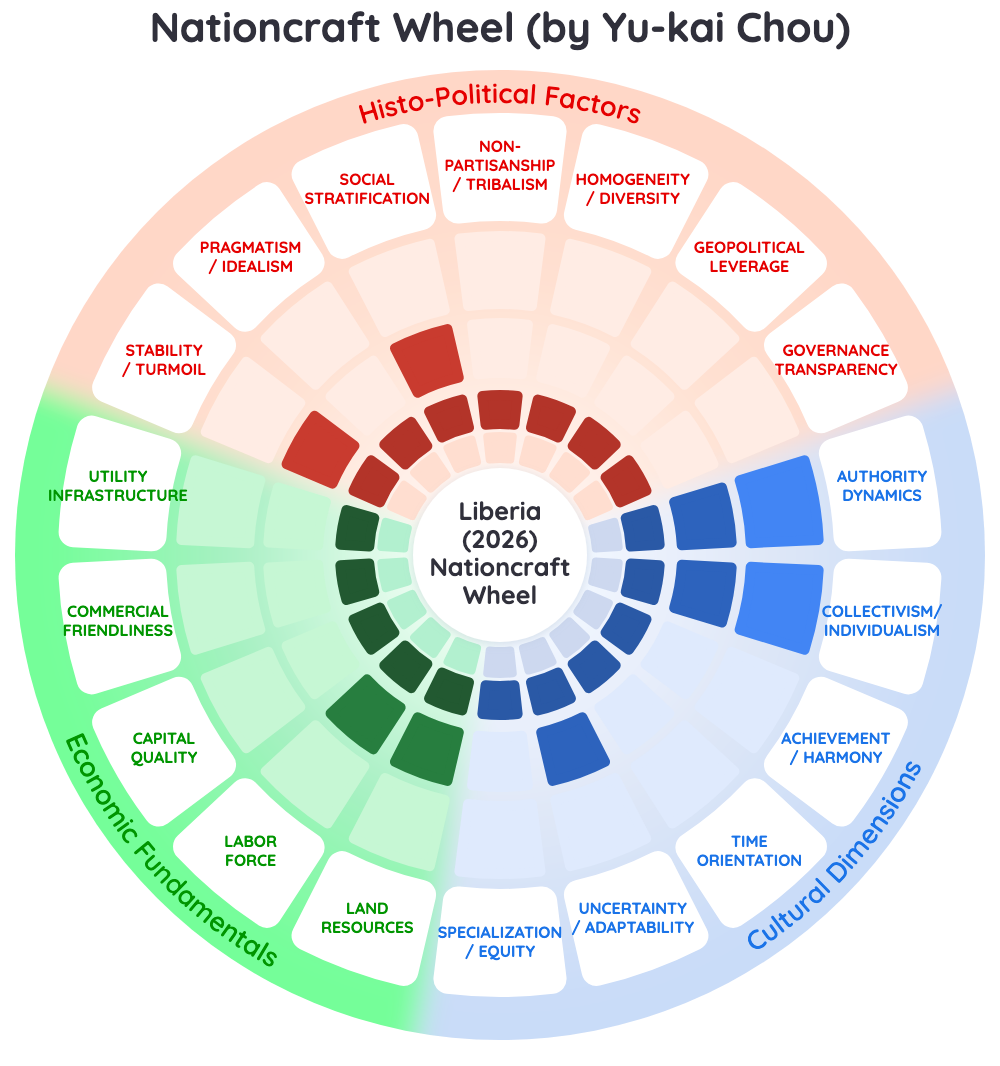
The country’s 18-variable Nationcraft profile explains why. Liberia runs on what I call the Concession Republic Trap: a 179-year-old state that survives by leasing pieces of itself — a million acres to Firestone in 1926, iron ore ranges to foreign miners, its flag to one of the world’s largest ship registries, its budget to donors, and for fifteen years even its security to UN peacekeepers.
Rent from those leases keeps the state alive without ever forcing it to build the three things its people need most: honest institutions (V13=1), a functioning financial system (V16=1), and a place where an ordinary Liberian can legally run a business (V17=1). This analysis maps the full V-vector, names which historical reform packets would fail here and which three are actually worth studying, and lays out what reform would require. It is a guide for anyone who wants Liberia’s next good report card to be written by its citizens instead of its creditors.
⚡ Speed Run Notes
- Liberia passed its fourth IMF review on September 28, 2026, with every criterion met. But compliance measures obedience to creditors, and V13=1 transparency says the state still answers to patrons, never citizens.
- The Concession Republic Trap: since Firestone’s 1926 million-acre lease, Liberia has survived by renting out land, minerals, its ship flag, and its budget, so rents substitute for the institutions reform would require.
- The V-vector’s brutal core: V13=1 transparency, V16=1 capital, V17=1 commercial friendliness. Everything a citizen touches is broken; everything a concessionaire touches is negotiable.
- Five celebrated playbooks fail this profile, from Singapore’s LKY packet to Mozambique’s donor-darling path. Three are worth studying: Ghana 1983, Botswana’s Debswana negotiation, Côte d’Ivoire’s post-war rebound.
- The reform sequence runs through V13 first: publish every concession, audit every account, and convert the 2026 mining-concession payment from a capture opportunity into Liberia’s first transparency win.
Table of Contents
- Understanding Liberia’s Governance Landscape Through Nationcraft
- What Is the Nationcraft Framework?
- Why This Liberia Variables Analysis Matters
- The 18 Liberia Nation Variables
- The Concession Republic Trap
- Detailed Justifications: Reading Each Variable
- Strategic Implications
- Five Reformer Playbooks Liberia Reform Should Reject
- Three Reformer Playbooks Liberia Should Actually Study
- Governance Strategy Recommendations
- What This Means Practically for Liberia Reform
- Comparative Context
- The Nationcraft Framework in Practice
- Explore More Nationcraft Analyses
- Closing
- Frequently Asked Questions
About Yu-kai Chou

Yu-kai Chou is a Human-Systems Architect & Behavioral Designer and the creator of the Nationcraft Framework — an 18-variable diagnostic for matching a country’s structural profile to the reform packets that have historically worked under similar conditions. He has consulted for governments in eight nations, including Ukraine, the United Kingdom, the Kingdom of Bahrain, Singapore, Taiwan, the Netherlands, Kazakhstan, and South Korea, and has worked directly with President Zelenskyy’s team on post-war reconstruction priorities for Ukraine.
Chou’s prior framework — the Octalysis Framework — has been applied by LEGO, Microsoft, Porsche, Coca-Cola, Salesforce, and MrBeast, impacting over 1.5 Billion Users. He has taught the methodology at Harvard, Stanford, Yale, Tesla, Google, BCG, and IDEO.
His work has been cited by Harvard, Stanford, MIT, Forbes, Wall Street Journal, Wired, US Department of Energy, NIST, NSF, NCBI, US Department of Education, ClinicalTrials.gov, and Google Scholar — with 3,700+ more academic publications. Explore his books here.

This Liberia analysis applies the Nationcraft Framework to the concession-state problem in its purest surviving form: a republic older than Italy or Germany whose government has rented out land, minerals, and even its flag for a century while its own institutions stayed unbuilt, and asks what the September 2026 IMF milestone would have to trigger for that pattern to finally break.
Understanding Liberia’s Governance Landscape Through Nationcraft
Liberia is the country the standard development models keep mispredicting. It was never colonized, yet it behaves like the most extractive of post-colonial states.
It was founded in 1847 by freed Black Americans with a constitution modeled on Washington’s, yet for 133 years that constitution governed a two-tier society in which the Americo-Liberian settler minority ruled the indigenous majority. The 1980 Doe coup ended that order, and what followed was worse: two civil wars between 1989 and 2003 that killed roughly 250,000 people and dismantled what little state existed.
Since the 2003 Accra peace agreement, Liberia has assembled a genuinely rare asset for a post-conflict state: political peace that holds. Power has changed hands through the ballot box twice, from Ellen Johnson Sirleaf’s party to George Weah in 2018, and from Weah to Joseph Boakai in January 2024, both times without violence.
Freedom House scores the country 65/100, Partly Free, with political rights stronger than most of its neighbors.[5] That is the surface a donor sees.
The Nationcraft Framework looks underneath, at the 18 structural variables that decide which reforms can actually take root. And underneath, Liberia’s profile is one of the starkest in the 147-country corpus. Real cultural cohesion (V1=7, V2=7) and a workable labor endowment (V15=6) sit on top of institutional foundations that score at or near the floor: V13=1 on transparency, V16=1 on capital quality, V17=1 on commercial friendliness, V18=2 on utilities.
A configuration like that does something specific to policy. It routes every serious economic decision around the domestic system, toward whichever external actor can supply what the institutions cannot: a concessionaire brings its own capital, a donor brings its own auditors, a peacekeeping mission brings its own security.
That routing is the trap this analysis names.
What Is the Nationcraft Framework?
The Nationcraft Framework is my system for diagnosing why the same reform succeeds in one country and fails in another. It scores a nation on 18 variables across three families: cultural (V1–V6), histo-political (V7–V13), and economic (V14–V18).
The core claim is that configuration is strategy. Policies are not good or bad in the abstract; they fit or misfit a specific variable profile, which is why importing Singapore’s playbook into Caracas or Kyiv’s playbook into Monrovia keeps failing.
Against the profile, Nationcraft matches over 100 historical Success Packets (documented reform programs with their preconditions, sequencing, and outcomes), plus failure packets that show which configurations doomed similar attempts. Liberia itself carries a failure packet in the corpus, FP-015, covering the 1980–2020 conflict and stalled-recovery period.
The method grew out of the same human-focused design work as the Octalysis Framework: nations, like products, run on motivation structures, and reform fails when the people inside the system have no reason to play the new game.
Why This Liberia Variables Analysis Matters
Three things make September 2026 the right moment to read Liberia through Nationcraft.
The first is the IMF milestone. Completing the fourth ECF review and the first review of the new $265 million Resilience and Sustainability Facility in a single board meeting puts Liberia in the strongest standing with its creditors it has enjoyed in years.[1] Program credibility of this kind is a perishable asset, and what a government does with it decides the next decade. Sri Lanka’s compliance paradox shows how program obedience can substitute for reform; the question is whether Liberia is walking into the same pattern.
The second is a named test already on the table. The IMF’s own review flags “the transparent management of a one-off mining-concession payment” as a program priority.[1] For a state with Liberia’s concession history, that single line is the whole reform question in miniature: does a large discretionary payment from a foreign extractor get published, audited, and budgeted, or does it disappear the way concession revenue has disappeared for a century?
The third is the political window. President Boakai’s six-year term runs to 2030, his ARREST agenda (Agriculture, Roads, Rule of Law, Education, Sanitation, Tourism) is explicitly a governance-and-basics program, and Liberia holds a non-permanent UN Security Council seat for 2026–27 that raises the reputational price of visible capture. Windows like this one do not stay open, and the Nationcraft corpus is full of countries that let them close.
The 18 Liberia Nation Variables
Every score below comes from the canonical Nationcraft Nation Variables corpus, sanity-checked on September 30, 2026 against the IMF’s fourth-review documentation, World Bank country data, Transparency International’s CPI 2025, and Freedom House’s 2026 assessment. Scores run 1–9, and per Nationcraft doctrine they are never averaged: the configuration is the strategy.
| Variable | Score | Reading for Liberia |
|---|---|---|
| V1 Authority Dynamics | 7/9 | Hierarchy is accepted: a dominant presidency, county chieftaincy, and the Poro and Sande societies structuring rural authority |
| V2 Collectivism | 7/9 | Communal and extended-family obligation networks remain strong despite two wars |
| V3 Achievement vs Harmony | 3/9 | Survival and patronage orientation; performance is rarely what gets rewarded |
| V4 Time Orientation | 2/9 | Short horizons; election-cycle politics; two wars and Ebola taught households not to plan far ahead |
| V5 Uncertainty Adaptability | 4/9 | Deep informal resilience, low formal adaptability |
| V6 Specialization vs Equity | 2/9 | Narrow enclave specialization: rubber, iron ore, the ship registry |
| V7 Stability vs Turmoil | 4/9 | No war since 2003 and two peaceful transfers of power, but Ebola exposed how thin state capacity runs |
| V8 Pragmatism vs Idealism | 2/9 | Patronage logic and symbolic politics have usually beaten problem-solving; the ARREST agenda is the live test |
| V9 Social Stratification | 6/9 | The Americo-Liberian and indigenous divide casts a long shadow; Monrovia elite vs county poverty |
| V10 Non-Partisanship vs Tribalism | 2/9 | Ethnicized parties, county-bloc politics, successor networks of the war factions |
| V11 Homogeneity vs Diversity | 3/9 | 16+ ethnic groups; English official over 20+ living languages |
| V12 Geopolitical Leverage | 2/9 | Historic US relationship but asymmetric; the 2026–27 UN Security Council seat is prestige rather than leverage |
| V13 Governance Transparency | 1/9 | CPI 28/100 in 2025; chronic audit failures; concession revenue capture is the IMF’s named risk |
| V14 Land Resources | 5/9 | Iron ore, rubber, timber, gold, offshore potential: rich, but extracted through enclaves |
| V15 Labor Force Quality | 6/9 | Young, anglophone workforce with a skilled diaspora; schooling quality is the drag |
| V16 Capital Quality | 1/9 | Shallow banking sector still under restructuring; dual-currency economy; minimal domestic credit |
| V17 Commercial Friendliness | 1/9 | Among the world’s hardest places to run a formal business: land title chaos, weak contract enforcement |
| V18 Utility Infrastructure | 2/9 | Electricity access among the lowest anywhere; roads that close when the rains come |
Read the shape of the vector rather than any average of it. Liberia pairs a genuinely cohesive society (V1=7, V2=7) and a usable workforce (V15=6) with the worst institutional triple in West Africa: V13=1, V16=1, V17=1.
That pairing is rarer than either half alone, and it is what makes the trap specific.
The Concession Republic Trap
In 1926, the Firestone Tire and Rubber Company signed a 99-year lease on up to one million acres of Liberian land, at a few cents an acre, and built the largest rubber operation of its kind in the world.[6] The deal set the template the republic has run on ever since.
When iron ore boomed in the 1950s and 60s, foreign concessions extracted it from enclave mines with their own ports and railways. When the maritime industry wanted cheap flags, Liberia rented out its sovereignty itself: its open ship registry, run for decades from offices in the United States, grew into one of the largest on earth.[7]
When the wars ended in 2003, the pattern continued in a new costume. UNMIL peacekeepers supplied the state’s security function until 2018.[8] Donors supplied much of its budget and most of its service delivery. HIPC relief in 2010 cleared the debts the old concession economy had left behind.
Each lease solved a real problem, and this is what makes the trap a trap rather than a simple villain story. Firestone brought wages where there were none; UNMIL kept a peace no Liberian force could have kept; the ECF program is right now the strongest fiscal discipline the country has.
The damage is structural, and it compounds through three of the 18 variables.
The first channel is that rents bypass V13. A state financed by concession payments and aid does not need its citizens’ taxes, so it never has to build the transparency that taxation forces. This is the classic resource-curse mechanism (pattern ET-001 in the Nationcraft corpus), and Liberia runs it with the added twist that even its security and budget functions were leased.
The second channel is that enclaves bypass V16 and V17. A concessionaire imports its own capital and operates under its own negotiated legal regime, so the banking system and the commercial courts that ordinary Liberians would need never become anyone powerful’s problem. Ninety-nine years after Firestone, domestic credit is minimal and the formal business environment scores at the floor.
The third channel is that external guarantors bypass V8. When every crisis summons a rescuer (the Marines in 1990s folklore, UNMIL in fact, the IMF today), the political class never faces the full price of its own choices, and the pragmatism muscle (V8=2) never develops. The aid-dependency pattern in the corpus (ED-001) names the mechanism: a government that answers to donors stops answering to citizens, and local capacity atrophies in parallel systems.
The Concession Republic Trap, stated in one sentence: Liberia’s leases keep the state alive at exactly the institutional level where leasing remains necessary.
Detailed Justifications: Reading Each Variable
The cultural base (V1–V6): stronger than the state built on it
V1=7 and V2=7 are Liberia’s quiet assets. Authority is respected when it is seen as legitimate (the presidency, the chiefs, the church, the societies), and communal obligation networks carried people through wars and Ebola when the state carried nothing.
A reform program that works through these structures inherits real compliance power; the corpus shows V1+V2 configurations like this sustaining demanding national programs elsewhere. What the culture does not currently supply is achievement orientation (V3=3) or long horizons (V4=2). Two generations learned that saving, investing, and planning are bets on a future that may be looted or burned.
V4=2 is not a national character flaw; it is rational memory. It becomes self-undoing only if the institutions never give planning a reason to pay.
The political layer (V7–V13): peace without accountability
V7=4 records something real: twenty-two years without war and two peaceful transfers of power is an achievement most post-conflict states never manage. But the same score records that the peace was underwritten from outside for fifteen of those years, and that Ebola in 2014–16 showed how little indigenous crisis capacity existed beneath it.
V10=2 and V11=3 explain the party system: coalitions are county and ethnicity blocs, and the war factions’ successor networks still organize loyalty. V9=6 keeps the old settler-indigenous stratification alive in its modern form, Monrovia against the counties.
And V13=1 is the score the whole analysis turns on. Transparency International puts Liberia at 28/100, moving one point a year.[4] The General Auditing Commission produces reports; the reports produce headlines; the headlines produce almost no prosecutions. Concession revenue in particular has vanished so reliably, under so many governments, that the IMF now writes the transparency of a single mining payment into its program conditions.[1]
The economic engine (V14–V18): rich ground, empty pipes
V14=5 understates how much geology Liberia has and captures how little of it reaches Liberians: iron ore led the 2025 growth surge, and mining is why the World Bank’s projections stay near 5%,[3] but enclave extraction with imported capital adds little V15 employment and less V16 depth.
V15=6 is the underused asset: a young, English-speaking population with a large skilled diaspora, priced out of formal work by V17=1 rules and V18=2 power and roads. V16=1 is earned the hard way: a banking system still being restructured under the IMF program, a dual-currency economy split between Liberian and US dollars, and domestic credit too thin to fund a mill, let alone an industrial policy.
The engine, in short, runs (4.0% growth in 2024, 5.1% in 2025), but it is bolted to the concessions, and the drivetrain to ordinary households is missing.
Strategic Implications
Five implications fall straight out of the V-vector.
First, macro success will keep overstating reform. Growth near 5% and inflation near 5% are enclave-and-program numbers; they can coexist indefinitely with V13=1 institutions, as the corpus’s rentier and aid-dependency patterns (ED-004, ED-001) demonstrate across continents.
Second, the binding constraint is V13, and it is upstream of everything. At V13=1, capital-market reform becomes capture, privatization becomes asset transfer, and even good concession deals leak at the collection stage. No V16 or V17 program can outrun that arithmetic, which is why sequencing (transparency floor first) dominates every recommendation below.
Third, Liberia’s cultural configuration can carry a compliance-heavy reform if the legitimacy is real. V1=7 and V2=7 mean that a visibly fair rule gets followed here more readily than in low-V1 fragmented societies; the constraint has never been the people’s willingness to follow rules, it has been the rules’ unwillingness to bind the top.
Fourth, the external environment is unusually favorable and unusually temporary. A passing IMF program, an RSF climate facility, a Security Council seat, and a US relationship being renegotiated around critical minerals all raise the payoff to visible clean governance right now — and all expire.
Fifth, the trap predicts its own next chapter unless interrupted. On current form, the mining boom becomes the next Firestone: a decade of concession-led growth, celebrated abroad, captured at home, and leaving V13, V16, and V17 exactly where they stand. Ukraine’s escrowed recovery shows the opposite design philosophy of external money deliberately wired through accountability structures, and the contrast is the point.
Five Reformer Playbooks Liberia Reform Should Reject
Nationcraft’s core discipline is subtraction: before choosing a playbook, eliminate the famous ones whose preconditions this V-vector cannot meet. Five get invoked for Liberia constantly, and all five misfit.
1. The Singapore Model: SP-002, Lee Kuan Yew Industrialization (1965–1990)
Every West African reform conversation eventually reaches “be like Singapore,” and Liberia’s V1=7 hierarchy seems to invite it. The invitation does not survive contact with the variables.
SP-002 ran on V8=9 pragmatism and a leadership clique that made corruption existentially expensive from year one: the CPIB answered to the Prime Minister and jailed ministers. Liberia enters with V8=2 and V13=1, the exact inversion of the packet’s two load-bearing variables, plus a patronage system that is the political settlement itself rather than a deviation from it.
Grafting LKY-style state discretion onto a V13=1 polity concentrates rents faster; I stress-tested the packet’s precondition set in Singapore’s own 2026 profile in the Singapore LKY packet stress test, and Liberia fails the entry conditions before the first phase begins.
2. The Norway Model: SP-106, Oil Fund Sovereign Wealth (1990–2010)
With mining revenue surging and offshore oil prospective, a Liberian sovereign wealth fund sounds prudent. SP-106’s own precondition kills it: Norway’s V13 stood at effectively 10 before the first krone of oil money arrived, which is why the fund’s rules held.
The corpus states the resource-blessing pattern (ET-002) as sequencing law: transparent institutions first, fund second, or the fund becomes the capture vehicle. Mozambique’s hidden-debt scandal ($2 billion in secret loans inside a celebrated donor darling) is what fund-shaped structures do at low V13.
A Liberian SWF belongs in phase three of this analysis’s sequence, after the transparency floor exists. Proposed today, it would be a honeypot with a mission statement.
3. The Rwanda Model: SP-006, Post-Genocide Reconstruction (1994–2020)
Rwanda is the fashionable post-conflict comparison: shattered society, disciplined rebuild, donor showcase. The packet’s engine was a cohesive ruling organization able to enforce internal discipline down to the village, converting V1 authority into clean-enough execution.
Liberia’s V10=2 fragmented, ethnicized party system cannot supply that engine; a dominant-party discipline model without the discipline simply hands the concession pipeline to whichever coalition wins it. And as I argued in Rwanda’s star-pupil trap, even the original carries costs and fragilities Liberia has no reason to import.
What travels from Kigali is narrower: performance contracts and visible service metrics, adoptable inside a Liberian ministry without the political architecture.
4. The Zambia 1991 Model: SP-072, Chiluba Privatization (1991–2011)
The advice Liberia will hear as bank restructuring proceeds: privatize fast, get the state out. SP-072 is the corpus’s cautionary answer.
Zambia broke up and sold off ZCCM, its copper crown jewel, along with a wave of other state enterprises, on terms the packet record bluntly labels unfavorable, and the promised investment mostly never came. The packet’s lesson is arithmetical: privatization at low V13 is redistribution to whoever controls the paperwork.
Liberia’s V13=1 is below Zambia’s 1991 level, and its capital market (V16=1) cannot even price the assets domestically. Zambia’s later chapters, the debt spiral I covered in Zambia’s model-debtor trap, show where the road goes when ownership reform outruns institutions.
5. The Donor-Darling Path: SP-085, Mozambique Post-Civil War Recovery (1992–2015)
This is the playbook Liberia is closest to running by default, which is why it must be named. Mozambique after 1992 was the template post-conflict success: peace held, growth averaged 7%, donors ran the services, mega-projects supplied the headlines.
Then the hidden-debt scandal revealed the institutions had never been built. The success story was donor scaffolding around a hollow frame, and the gas boom arrived amid insurgency. The packet’s critical insight reads like a Liberian prophecy: spectacular post-conflict recovery is sustainable only with institutions, and donors will choose not to look.
Liberia has already lived the first two phases of this packet. The entire point of the current window is to refuse the third.
Three Reformer Playbooks Liberia Should Actually Study
Three packets fit the actual V-vector because their countries started from floors comparable to Liberia’s, whatever glory came later.
1. SP-038: Ghana, Rawlings Structural Adjustment (1983–2000)
Ghana in 1983 was the region’s basket case: GDP down 30% in a decade, hyperinflation, a million citizens expelled from Nigeria, and a V-profile close to Liberia’s now: V13=4, V17=3, V16=4, with the same V1=7/V2=7 cultural base. It is the corpus’s best evidence that a West African state can adjust its way out.
The load-bearing element was ownership. Rawlings did not perform reform for the IMF; he claimed the program as his own revolution, raised cocoa producer prices to buy rural support, and sequenced stabilization before structural change before democratization.
The mapping to 2026 Monrovia is direct: Liberia has just met every quantitative criterion of its own program,[1] and the fork is whether the Boakai government narrates that as Liberia’s project or as the Fund’s. Ghana’s later relapses, the bailout cycle I traced in Ghana’s bailout cycle, add the warning label: adjustment without durable V13 gains must be repeated every decade.
2. SP-004: Botswana, Diamond Management (1966–1999)
Botswana at independence was poorer than Liberia is today: $70 per-capita GDP, twelve kilometers of paved road, and then diamonds. What it did next is the corpus’s gold standard for the exact decision Liberia faces on its mining revenue.
The Debswana joint venture kept De Beers’s expertise while securing half the profits for the state; the Pula Fund saved before spending; the DCEC gave anti-corruption enforcement teeth; and crucially the institutions came before the revenue was deployed.
Honesty about the precondition: the packet itself warns it does not transfer where V13 sits below 6 at the moment of resource exploitation, and Liberia is at 1. So the study assignment is narrower and still valuable. The negotiation mechanics and the publish-everything revenue protocols are learnable now, and the one-off mining-concession payment the IMF has flagged[1] is the perfect scale model on which to practice them.
3. SP-061: Côte d’Ivoire, Post-Civil War Recovery (2011–2020)
The nearest-neighbor packet: a West African republic emerging from civil war within living memory, rebuilding around commodity exports and infrastructure, and posting some of Africa’s fastest growth within a decade.
The fit runs through the shared profile (V1 and V2 high, institutions damaged, an export engine that could be restarted quickly) and through the demonstration that peace plus roads plus predictable rules attracts investment even before deep institutional reform completes. For Liberia’s ARREST agenda, with agriculture and roads as its first two letters, Abidjan is the proof of concept two borders away.
The packet’s limits are equally instructive: reconciliation stayed shallow, victor’s-justice resentments persisted, and transparency gains lagged growth. Côte d’Ivoire shows what the growth phase of a Liberian recovery looks like; it does not yet show the accountability phase, which is exactly why the V13 sequencing below cannot be skipped.
| Packet | Country / era | Verdict for Liberia | Deciding variables |
|---|---|---|---|
| SP-002 LKY Industrialization | Singapore 1965–90 | Reject | Needs V8≥8, clean-center V13; Liberia V8=2, V13=1 |
| SP-106 Oil Fund SWF | Norway 1990–2010 | Reject (for now) | ET-002 requires institutions before fund; V13=1 makes a fund a honeypot |
| SP-006 Post-Genocide Reconstruction | Rwanda 1994–2020 | Reject | Needs a disciplined dominant center; Liberia V10=2 |
| SP-072 Chiluba Privatization | Zambia 1991–2011 | Reject | Privatization at V13=1 is asset transfer |
| SP-085 Post-Civil War Recovery | Mozambique 1992–2015 | Reject: the default trap | Donor scaffolding hid V13 hollowness until the hidden-debt crash |
| SP-038 Rawlings Adjustment | Ghana 1983–2000 | Study | Same cultural base, comparable floor; ownership made adjustment stick |
| SP-004 Diamond Management | Botswana 1966–99 | Study (negotiation + revenue protocols) | Concession renegotiation and publish-everything rules; full packet gated on V13≥6 |
| SP-061 Post-Civil War Recovery | Côte d’Ivoire 2011–20 | Study | Nearest-neighbor proof that peace + roads + predictability restarts growth |
Governance Strategy Recommendations
What follows is a reform guide in the Nationcraft sense: what breaking the Concession Republic Trap would require, written for the citizens, analysts, civil-society auditors, diaspora professionals, and future reformers who will have to demand it and staff it. The beneficiary throughout is the Liberian public; every step opens the system rather than tightening anyone’s grip on it.
| Phase | Target variables | What reform would require | Packet evidence |
|---|---|---|---|
| 1. Transparency floor (years 1–2) | V13: 1→3 | Every concession contract, payment, and audit published by default; the flagged mining-concession payment handled in full public view; audit findings that actually reach prosecution | SP-004 revenue protocols; PB-09 evidence base |
| 2. Citizen-facing basics (years 1–4) | V18: 2→4, V17: 1→3 | Roads and power delivered where people live, not only to enclaves; business registration and land titling simplified so formality stops being a privilege | SP-061 growth phase; ARREST’s own A and R |
| 3. Financial system rebuild (years 3–6) | V16: 1→3 | Bank restructuring completed under the ECF, then domestic credit and the 2027 VAT base grown so the state is funded by its economy rather than its leases | SP-038 stabilization sequencing; IMF program priorities |
| 4. Resource architecture (years 4+) | V14 capture, V13: 3→5 | Concessions renegotiated toward Debswana-style shared ownership; only after phases 1–3 hold, a rules-bound savings vehicle | SP-004; ET-002 sequencing law |
Two design notes govern the whole table. Sequencing is the strategy: every phase is gated on the transparency floor beneath it, because at V13=1 all downstream reforms convert into capture channels.
And the motivational architecture matters as much as the policy content. A population with V4=2 time orientation rationally ignores five-year promises; reform earns belief only through visible, fast, citizen-facing wins (the streetlight that works, the clinic that has medicine, the audit that ends in a trial), which is the same early-wins logic the post-conflict playbook (PB-04) documents across its evidence base.
What This Means Practically for Liberia Reform
For a reader tracking Liberia from outside government, the diagnosis converts into a short watchlist.
The first thing to watch is the mining payment. The IMF has named it;[1] its handling in the next budget cycle is the single cleanest signal of whether V13 is moving. Full publication and a clean audit trail would be the first genuine break in the concession pattern in decades.
The second signal is the VAT build-out for 2027. A working VAT is boring and revolutionary at once: it shifts state financing from leases toward the domestic economy, which is the structural exit from ED-001 aid dependency. The register’s breadth and the refund system’s honesty will tell you more than the rate.
Watch whether ARREST’s roads reach counties without concessions. Enclave infrastructure serves the leaseholders; citizen infrastructure serves the reform. The map of where the asphalt goes is a map of who the state believes it works for.
The third signal is the audit-to-prosecution ratio. Reports without consequences are the old equilibrium; a single senior conviction would reprice corruption across the system, as Venezuela’s reform playbook analysis argued from the other direction; I laid out that selection logic in the Venezuela reform playbooks piece.
The last signal is the narrative fork. If program success keeps being announced from Washington while capture stories keep being broken by Monrovia’s press, the country is running SP-085. If the government starts claiming the reforms as Liberia’s own project, in Liberian terms, it is running SP-038. The difference decided Ghana’s next twenty years, and it will decide Liberia’s.
Comparative Context
Liberia’s configuration becomes clearer against its published siblings in this series.
Haiti’s ballot-first trap is the closest historical mirror: the western hemisphere’s oldest Black republic, like Africa’s oldest republic, shows what two centuries of sovereignty without institutions produce. Haiti’s V7 collapse marks the road Liberia avoided after 2003 — and the fragility it must still respect.
Kenya’s concession trap runs the same mechanism at a higher institutional level: debt-financed concessions to external creditors rather than land leases, proof that the pattern scales up rather than disappearing with development.
The DR Congo’s cobalt trap shows the enclave-extraction endgame at continental scale, and Angola’s prosecution dividend tests the most hopeful adjacent hypothesis: that visible anti-corruption enforcement can begin repricing a rentier system from inside.
Against all four, Liberia’s distinguishing asset is time: twenty-two years of peace, a legitimate government, and a creditor relationship currently in good standing. None of the four comparison states enjoys all three at once.
The starting-floor comparison below puts Liberia’s 2026 profile beside the three study packets at their own intervention start, using each packet’s benchmark-year scores from the Nationcraft corpus.
| Variable | Liberia 2026 | Ghana 1983 (SP-038) | Botswana 1966 (SP-004) | Mozambique 1992 (SP-085) |
|---|---|---|---|---|
| V1 Authority Dynamics | 7 | 7 | 7 | 7 |
| V2 Collectivism | 7 | 7 | 7 | 7 |
| V7 Stability | 4 | 3 | 6 | 2 |
| V8 Pragmatism | 2 | 8 | 9 | 6 |
| V13 Transparency | 1 | 4 | 7 | 3 |
| V16 Capital Quality | 1 | 4 | 1 | 4 |
The table makes the diagnosis quantitative. Liberia shares the cultural base of all three packets, matches Botswana’s V16=1 capital floor, and sits below every one of them on the two variables that decided their outcomes: V8 pragmatism and V13 transparency. That gap, and nothing about geology or geography, is what the reform sequence has to close.
The Nationcraft Framework in Practice
This analysis demonstrates the Nationcraft method end to end: score the 18 variables against current evidence, find the paradox the configuration hides, eliminate the playbooks whose preconditions fail, and sequence the ones that fit.
The same procedure produced the Ukraine nation variable analysis that now anchors this series, and the motivational layer underneath it (why populations sustain or abandon reforms) comes from the behavioral design work described in how the Octalysis Framework applies to nation-building and public policy.
Nationcraft’s wager, in Liberia’s case, is falsifiable: if the transparency floor is built first, the country’s V1/V2/V15 assets can carry a Ghana-style owned adjustment; if the floor is skipped, the mining boom will re-run the Firestone century in miniature. Either way, the variables will keep score.
Explore More Nationcraft Analyses
The full country series lives in the Nationcraft Nation Variables Library. For the resource-rent family this analysis belongs to, start with Bolivia’s gas dividend trap and Iraq’s rentier sovereignty trap, two more configurations where rents kept a state solvent while its institutions stayed unbuilt.
Closing
Liberia’s tragedy has never been scarcity. The ground holds iron and rubber and gold; the population is young, anglophone, and connected to a capable diaspora; the culture sustains authority and solidarity that richer states envy.
The missing piece has been a state that needs its own citizens (their taxes, their consent, their prosperity) more than it needs its tenants. The September 2026 review handed Liberia’s reformers something rare: a moment when the creditors are satisfied, the books are briefly open, and one well-lit mining payment could set a precedent the next century of concessions would have to live with.
The trap has been running since 1926. The window that could finally break it is open right now, and it will not stay open past this program cycle.
Frequently Asked Questions
What is the Concession Republic Trap?
It is the named paradox of Liberia’s Nationcraft profile: a state that finances itself by leasing national assets: land to Firestone since 1926, iron ore to enclave miners, its flag to a giant ship registry, its budget to donors, and therefore never faces the pressure to build transparent institutions (V13), domestic capital (V16), or a workable business environment (V17). The rents keep the state alive at exactly the institutional level where renting remains necessary.
What are Liberia’s strongest and weakest Nation Variables in 2026?
Strongest: V1 Authority Dynamics (7/9) and V2 Collectivism (7/9), a genuinely cohesive social base, plus V15 Labor Force Quality (6/9). Weakest: V13 Governance Transparency, V16 Capital Quality, and V17 Commercial Friendliness, all at 1/9, the worst institutional triple in the West African corpus, with V18 Utility Infrastructure at 2/9.
Doesn’t Liberia’s passing IMF review show reform is already working?
It shows fiscal and monetary compliance, which is real and valuable: all end-2025 quantitative performance criteria were met, growth is near 5%, and inflation has cooled. But program compliance is measured by creditors, and Liberia has passed external scorecards before without institutional change. The Nationcraft reading is that the review opens a window; whether V13 actually moves depends on tests like the flagged mining-concession payment.
Why reject the Singapore and Rwanda models for Liberia?
Both packets depend on preconditions Liberia lacks. Singapore’s SP-002 required V8=9 pragmatism and a center that made corruption existentially costly from day one; Liberia enters at V8=2 and V13=1. Rwanda’s SP-006 required a disciplined dominant political organization; Liberia’s V10=2 fragmented, ethnicized coalitions cannot supply one, so the model’s discretionary power would feed the patronage system it is meant to break.
What should reformers watch over the next two years?
Four signals: whether the one-off mining-concession payment is published and audited in full; whether the 2027 VAT launches with a broad, honestly administered base; whether ARREST-agenda roads and power reach counties without concessions; and whether any senior audit finding ends in prosecution. Together they measure whether V13 is moving from 1 toward 3: the gate for everything else.
Related Reading
- The Nationcraft Framework: 18 Variables, 8 Goals, 100+ Proven Reform Packets
- Nationcraft Nation Variables Library
- Nationcraft Analysis: Senegal Tandem Trap 2026
- Nationcraft Analysis: Madagascar Refoundation Trap 2026
- Nationcraft Analysis: Nigeria Reform Dividend 2026
- Nationcraft Analysis: Small-State Borrowed Buffer 2026
Footnotes
- IMF Press Release 26/309, “IMF Executive Board Completes the Fourth Review under the Extended Credit Facility and First Review under the Resilience and Sustainability Facility for Liberia,” September 28, 2026. imf.org
- IMF Press Release 26/266, staff-level agreement on the fourth ECF review and first RSF review, July 28, 2026. imf.org
- World Bank, Liberia country overview: growth 4.0% (2024), 5.1% (2025), ~5.0% projected (2026); inflation trajectory through June 2026. Accessed September 30, 2026. worldbank.org
- Transparency International, Corruption Perceptions Index 2025, Liberia: 28/100. transparency.org
- Freedom House, Freedom in the World 2026, Liberia: 65/100, Partly Free. freedomhouse.org
- Firestone’s 1926 Liberia concession (99-year lease, up to one million acres); company account of the operation’s history. firestonenaturalrubber.com
- The Liberian Registry, one of the world’s largest open ship registries. liscr.com
- United Nations Mission in Liberia (UNMIL), 2003–2018. peacekeeping.un.org
- IMF Press Release 26/129, third ECF review completion and approval of the SDR 193.8 million RSF arrangement, April 27, 2026. imf.org