
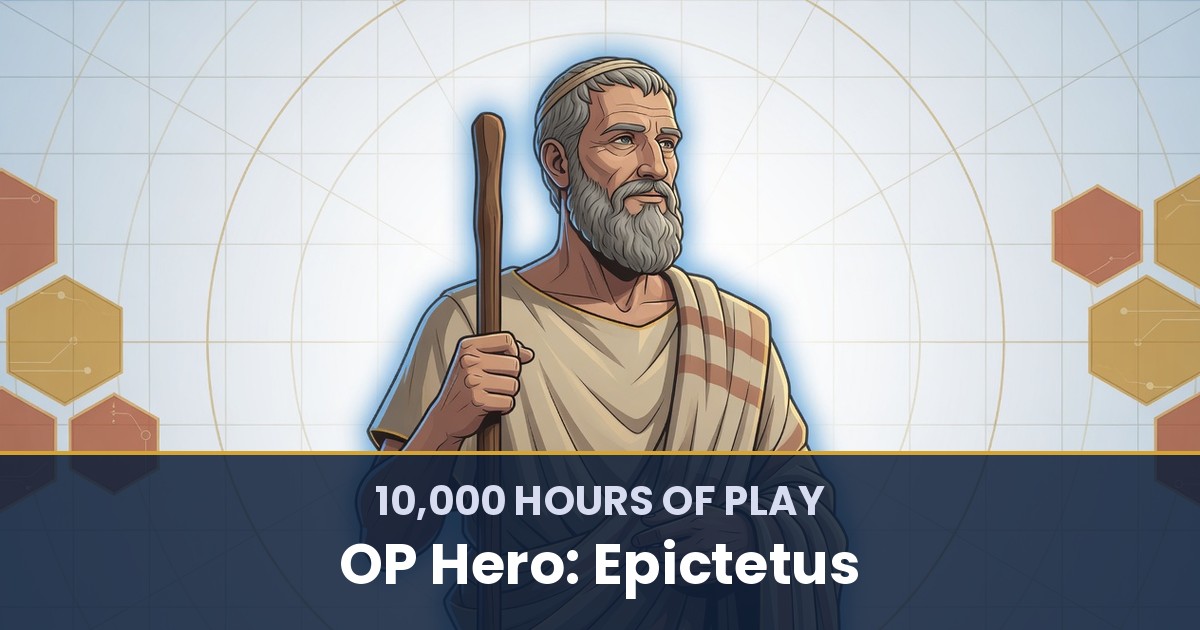


Around 89 CE, the emperor Domitian threw the philosophers out of Italy. One of the people who packed up was a former slave with a lame leg, a man whose very name, Epiktetos, is just the Greek word for “acquired.”
He settled in Nicopolis, a provincial town on the west coast of Greece, and opened a school. He never wrote a single book.
Within a generation, the most powerful man alive was studying his lecture notes. In the opening pages of the Meditations, the emperor Marcus Aurelius thanks a friend for lending him the recorded teachings of this ex-slave.
Run that life through the six Steps of the 10,000 Hours of Play framework and you get a character build where every external stat starts at zero, and the player still wins. Here is how he did it.
⚡ Speed Run Notes
- Epictetus played one Game for sixty years: making the mind’s faculty of choice free and sound regardless of body, status, money or politics. Slavery, lameness and exile never changed the objective.
- His build started with every external stat at zero: enslaved, disabled, propertyless, provincial. The run worked because he put every point into the one stat nobody could touch.
- Canon Skills on his sheet: Self Mastery (Rogue), Locked Heart (Warlock), Battle Instinct (Warrior), Floral Blossom (Druid) and Reflect Damage (Paladin).
- His decisive Ally carried a notebook: Arrian’s classroom transcripts are the only reason the Discourses and the Enchiridion exist at all.
- The Quest log runs from surviving slavery in Nero’s Rome to a banishment that became a school, and then to a posthumous quest: his handbook trained an emperor and was still being copied in monasteries centuries later.
Table of Contents
About Yu-kai Chou

Yu-kai Chou is the author of 10,000 Hours of Play — the book that treats your life as the most important game you’ll ever build a character in, and gives you the 6-Step framework (Game · Attributes · Role · Skills · Allies · Quests) to play it on purpose. He has spent two decades developing the system through which this post analyzes its OP Hero, and applies it to his own life and to the lives of the people he advises around the world.
Chou’s other framework, the Octalysis Framework, has been applied by LEGO, Microsoft, Porsche, Coca-Cola, Salesforce, and MrBeast, impacting over 1.5 Billion Users. He has taught the methodology at Harvard, Stanford, Yale, Tesla, Google, BCG, and IDEO, and has advised governments in eight nations including Ukraine, the United Kingdom, the Kingdom of Bahrain, Singapore, Taiwan, the Netherlands, Kazakhstan, and South Korea.
His work has been cited by Harvard, Stanford, MIT, Forbes, Wall Street Journal, Wired, US Department of Energy, NIST, NSF, NCBI, US Department of Education, ClinicalTrials.gov, and Google Scholar — with 3,700+ more academic publications. Explore his books here.

Of every hero I have run through the 6 Steps, Epictetus is the purest test case for Step 4, because his entire legend is built from trainable Skills rather than lucky Attributes. His build proves that the Skill tree alone can carry a character whose Attributes, Role and starting resources were all assigned by someone else.
Step 1: The Game — What Epictetus Was Actually Playing
Every hero in this series picks a Game, the one objective their decades keep orbiting. Epictetus chose a strange one for a man who owned almost nothing: make the mind’s faculty of choice completely free and completely sound, whatever happens to everything else.
The Stoics called that faculty prohairesis: the capacity to judge, to choose, to refuse. In Discourses 1.1, Epictetus argues it is the one human faculty that can evaluate every other faculty, including itself.
His opening move in the Enchiridion draws the whole map of the Game. Judgments, impulses, desires and aversions are up to us; body, property, reputation and office are off the board.
Notice what this objective does to the usual victory conditions. Escaping slavery, getting comfortable and being admired in Rome all sat off his scoreboard; the entire scoreboard was self-command under every external condition.
He also built in a scoring system that would embarrass most of us. In Discourses 2.19, he tells students that reciting doctrine proves nothing, and that the only acceptable evidence of philosophy is changed conduct.
That is a Game you can lose publicly every single day. He played it from a slave quarters in Nero’s Rome to a classroom in provincial Greece, and the sources never show him switching objectives.
Step 2: Attributes — The Innate Stats
Here the honest move is to admit what the sources can and cannot show. No childhood biography of Epictetus survives, so his innate Attributes are inferences from sixty years of recorded behavior rather than documented early-life facts.
The inference is still strong, because the same traits show up in every surviving chapter of the life. The clearest is pattern recognition of a very specific kind: he converted ordinary incidents into general tests of judgment, the way a chess master converts any position into a tactics puzzle. Enchiridion 5 is the signature example, where he separates the event itself from the judgment a person adds to it.
Second: an unusual tolerance for adversity. He treated slavery, a lame leg, poverty and banishment as raw material for his Game rather than as reasons to quit it; Discourses 1.24 casts difficulty itself as the wrestling partner that reveals what a person is made of.
Third: moral independence from status. A former slave who taught elite Romans could easily flip to resentment or to flattery. He did neither, and judged everyone by their use of choice rather than their legal rank.
Fourth: psychological realism about students. His classroom starts from the fear, grief or ambition actually disturbing the person in front of him, then works backward to the judgment producing it.
In the OP Talent Triangle Method, the advice is to build where your strongest innate stats intersect. Epictetus stacked analytical pattern recognition on top of adversity tolerance, and the intersection became his profession: a teacher who could take any disaster a student brought in and calmly dissect the judgment hiding inside it.
Step 3: Role(s) — The Character Class Across Chapters
Epictetus changed Roles under constraints nobody chooses. He was born a provincial subject in Hierapolis around 50 CE, and his first recorded Role in Rome was enslaved intellectual in the household of Epaphroditus, a powerful freedman associated with Nero’s court.
Inside that constraint he found a second Role: student. While still enslaved, he studied under the Stoic teacher Musonius Rufus, an apprenticeship attested in Discourses 1.9.29.
Manumission opened the third chapter. Freed after 68 CE, he became an independent Stoic teacher in Rome, building a school that drew students from elite families.
Then Domitian deleted that Role with an empire-wide expulsion of philosophers, and Epictetus had to reroll in his forties. The exile chapter became his final class: founder and head of a demanding school at Nicopolis, where he taught until his death around 135 CE.
He also wrote this Step’s rulebook himself. Enchiridion 17 compares life to a play in which the casting is out of your hands and the performance is entirely in them; slave, exile, invalid and teacher are parts, and the only thing scored is how well you play the one assigned.
Compare Seneca, the other Roman Stoic in this series, who played his Stoicism from inside the palace as a wealthy insider. Same philosophy, nearly opposite character class, which tells you Step 3 is about the fit between the player and the part.
Step 4: Skills — The Real-Life Game Skills Epictetus Mastered
Attributes are rolled for you; Skills are earned. On the Skills Spectrum, Epictetus is a textbook specialist, a man who trained one tight cluster of Real-Life Game Skills to mastery and then taught them for forty years.
The anchor of the build is Self Mastery (Rogue): high self-awareness, achieved quickly. His version was a drill for inspecting impressions before accepting them. The Enchiridion opens with it: train yourself to answer any harsh appearance, “You are an impression and not at all the thing you appear to be,” then test it against what is actually in your control. Discourses 2.18 runs the same drill in slow motion, telling the impression to wait and be examined before it gets your assent.
Second: Locked Heart (Warlock), the pain-contrasting skill of converting suffering into gratitude and fuel. Warlock Skills share one signature, paying a hard price on purpose for capacity, the way the Lich Pact trades normal sleep for extra waking hours; Locked Heart pays in remembered pain. The ancient sources disagree about his lameness, with Origen claiming a master broke his leg and the Suda blaming rheumatism, but every source agrees on how he carried it: as material for practice.
Third: Battle Instinct (Warrior), the mental-contrasting skill of holding your goal and your obstacles in view at the same time. Enchiridion 4 tells you to picture in advance the splashing and jostling you will meet at the baths, and Enchiridion 21 tells you to keep death, exile and everything that seems terrible before your eyes daily, so nothing meets you as a surprise.
Fourth: Floral Blossom (Druid), the mentoring skill. His classroom method was interrogation and correction, pulling the hidden assumption out of a student’s complaint, and Discourses 3.21 and 3.23 frame the whole practice as athletic training: repetitions, correction, and performance under pressure.
Fifth: Reflect Damage (Paladin), turning attacks into growth. Domitian’s expulsion was the biggest hit his character ever took, and he converted it into the school that preserved his teaching.
Step 5: Allies — The People Who Multiplied Epictetus
Step 5 in this framework is about the people who multiply your output, and Epictetus’ roster is short: a mentor, an owner, a student with a notebook, and a senator who passed that notebook on.
Musonius Rufus gave him the doctrinal toolkit. Studying under a leading Roman Stoic while still enslaved also handed Epictetus a living model of philosophy practiced daily instead of performed.
Epaphroditus occupies the uncomfortable slot on the character sheet. Calling an owner an Ally would whitewash a coercive relationship, yet his household put an enslaved boy within reach of Rome’s intellectual life, and tradition says Epaphroditus eventually freed him. Sometimes the character sheet records access granted by people who were never on your side.
Then came the student with the notebook. Arrian of Nicomedia attended the lectures at Nicopolis around 108 CE and wrote the conversations down, by his own account word for word as far as possible, producing the Discourses and condensing them into the Enchiridion. Epictetus wrote nothing himself, so without Arrian this entire profile would have no sources to cite.
The alliance chain kept compounding after his death. The senator Junius Rusticus lent a copy of the Discourses to his young student Marcus Aurelius, who thanks him for it in Meditations 1.7: the emperor of Rome running a character sheet drafted by a former slave.
Step 6: Quests — The Milestones That Shaped the Saga
Quest one was brutal and unchosen: survive enslavement in Nero’s Rome with mind intact. He cleared it by converting the constraint into an education, studying under Musonius Rufus while legally owned by another man.
Quest two: build a teaching practice in Rome as a freedman. He cleared that too, attracting students from elite families through the Flavian years.
Quest three was the failure: the expulsion of philosophers, commonly dated 89 CE though some accounts place it around 93, erased his Roman school overnight. A man in his forties with a lame leg lost his city, his students and his livelihood by imperial decree.
The recovery became quest four: found a school in Nicopolis and make it matter. It became the most documented classroom of his life, because the student who wrote everything down was sitting in it.
Quest five ran mostly after his death around 135 CE. The Enchiridion trained an emperor, then outlived the empire itself as a practical handbook copied in Christian monasteries.
What You Can Steal From Epictetus’ Build
Start with his sorting drill, because it costs nothing and works immediately. Before reacting to anything today, ask the Enchiridion 1 question: is this inside my control? Spend energy only where the answer is yes.
Steal the impression test when your mind catastrophizes. Saying “you are an impression and not at all the thing you appear to be” sounds odd exactly once, and then it becomes a reframing tool you will reach for daily.
Steal his Step 3 discipline: when a Role gets deleted, grade yourself on the performance of the next one rather than the unfairness of the casting. Epictetus lost his Roman school by decree and built the one history remembers in exile.
Steal the Arrian lesson too. Epictetus multiplied across twenty centuries because one Ally wrote things down, so find the person who documents, records and ships what you teach, or be that person for a master you admire.
His Game is still open to anyone. The entry fee is the decision to treat your life as a game whose one non-negotiable stat is the quality of your choices.
Where this framework comes from

Want the full system this profile is built on?
Every OP Hero piece runs through the same 6-Step framework from 10,000 Hours of Play: Unlock Your Real-Life Legendary Success. The book covers the full system, walks through Yu-kai’s own life run as the first applied case study, and gives you the worksheets to audit your own build.
Related Reading
- All OP Hero Profiles — the full catalog
- 10,000 Hours of Play by OP Hero: Socrates
- 10,000 Hours of Play by OP Hero: Viktor Frankl
- 10,000 Hours of Play by OP Hero: Wang Yangming
- 10,000 Hours of Play by OP Hero: Confucius