
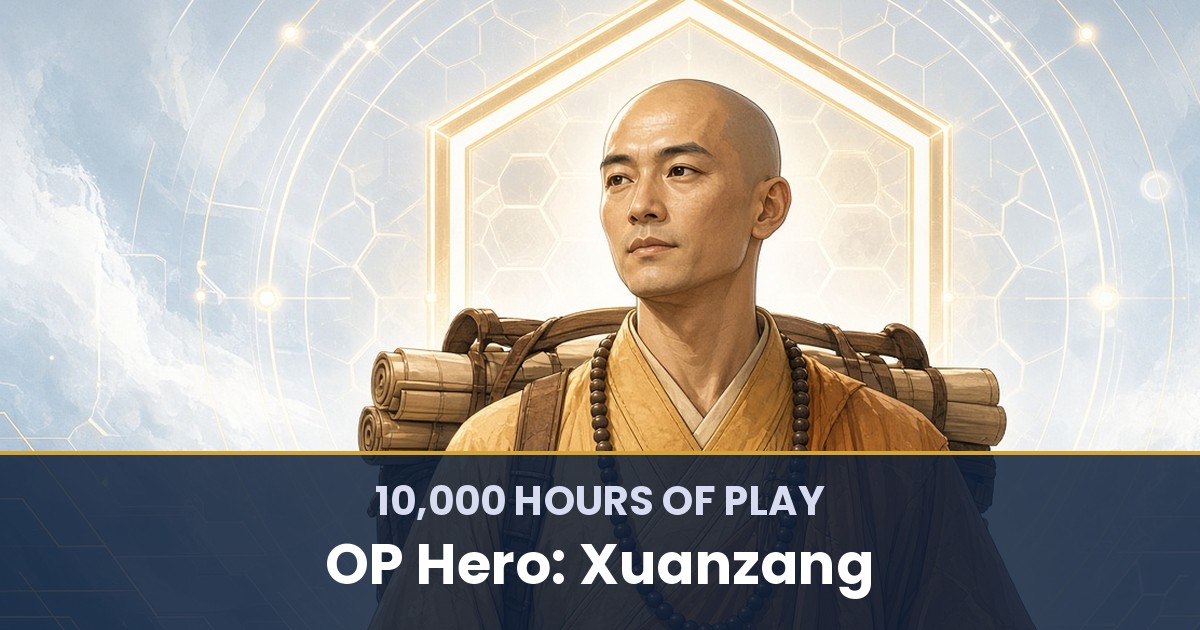


In 629, a young monk slipped out of Chang’an and headed west, violating the Tang government’s prohibition on unauthorized travel beyond the frontier.
He had asked his teachers a question none of them could answer: China’s Buddhist texts disagreed with each other, so which reading was right?
Xuanzang concluded that the dispute could never be settled from inside China. The answer lived in Sanskrit manuscripts on the far side of the deserts, in India, and he decided to go read them himself.
The round trip took roughly sixteen years of his life, and the homework he carried back took the rest of it. His life maps almost perfectly onto the 6-Step framework, so let’s run the build.
⚡ Speed Run Notes
- In 629 Xuanzang broke an imperial travel ban to reach India. His real Game was repairing corrupted knowledge at the source, then building the institution to transmit it.
- His standout Attributes showed up early: he detected contradictions other monks tolerated, and he could commit to a single objective across decades.
- At Nālandā he converted curiosity into trained Skill: Sanskrit, Buddhist logic, and formal debate under the abbot Śīlabhadra.
- He returned in 645 with 657 Sanskrit texts, then scaled himself through Allies: an emperor funded the work, and a trained team carried it on past his death.
- He died in 664 with the backlog unfinished, and his Quest still won: the school, the records, and the texts outlived him by thirteen centuries.
Table of Contents
About Yu-kai Chou

Yu-kai Chou is the author of 10,000 Hours of Play — the book that treats your life as the most important game you’ll ever build a character in, and gives you the 6-Step framework (Game · Attributes · Role · Skills · Allies · Quests) to play it on purpose. He has spent two decades developing the system through which this post analyzes its OP Hero, and applies it to his own life and to the lives of the people he advises around the world.
Chou’s other framework, the Octalysis Framework, has been applied by LEGO, Microsoft, Porsche, Coca-Cola, Salesforce, and MrBeast, impacting over 1.5 Billion Users. He has taught the methodology at Harvard, Stanford, Yale, Tesla, Google, BCG, and IDEO, and has advised governments in eight nations including Ukraine, the United Kingdom, the Kingdom of Bahrain, Singapore, Taiwan, the Netherlands, Kazakhstan, and South Korea.
His work has been cited by Harvard, Stanford, MIT, Forbes, Wall Street Journal, Wired, US Department of Energy, NIST, NSF, NCBI, US Department of Education, ClinicalTrials.gov, and Google Scholar — with 3,700+ more academic publications. Explore his books here.

The move I would steal from Xuanzang’s sheet is how he handled the offers to stay in India at the height of his standing there: he had defined his Game as bringing the knowledge home, so a flattering invitation registered as a detour, and he declined it without drama. Write your own mission down sharply enough that you can recognize a tempting offer as a detour while it is still on the table.
Step 1: The Game — What Xuanzang Was Actually Playing
On the surface, Xuanzang’s Game looks like a pilgrimage: a devout monk walks to the holy land and comes home blessed.
Read his actual behavior and a different Game appears. From his early monastic years he was bothered by discrepancies among Buddhist teachings, and he went from master to master without finding an explanation that held up.
So the Game he committed to was knowledge repair. Identify where the transmission of a tradition had broken, obtain better source material, and then build the infrastructure so the repaired knowledge could survive without him.
That framing explains every strange decision in his life. It explains why he left illegally in 629 when staying home was safe and respectable.
It explains why he spent years studying Sanskrit grammar instead of rushing home with trophies. And it explains why, after sixteen years of adventure, he chose to spend his remaining nineteen years at a desk, translating.
That is the work of choosing your Game. Xuanzang’s mission stayed fixed for thirty-five years, and after 645 even an emperor was reorganizing state resources around it.
Step 2: Attributes — The Innate Stats
Xuanzang’s character sheet shows a few stats that were visible long before he was famous.
Contradiction detection: as a young monk he noticed that the teachings in front of him could not all be true at once, and he refused to shrug it off. Most students absorbed whichever interpretation their master taught; he kept comparing.
Risk tolerance: he undertook an unauthorized crossing of the frontier in 629, accepting legal jeopardy and physical danger because the objective mattered more than his safety.
Long-horizon persistence: his one mission spans more than three decades on the timeline: departure in 629, return in 645, the great travel record in 646, and translation work that continued until his death in 664.
Comparative pattern recognition: he saw that competing Chinese translations could only be judged against the Sanskrit originals, which turned a theological argument into a solvable research problem.
Notice that these Attributes are raw material, and raw material alone wins nothing. The Talent Triangle Method is the exercise I give people for finding their own version of this list: the traits that showed up before anyone trained you.
A contradiction detector pointed at trivia makes an annoying colleague; pointed at a civilization’s broken canon, it makes history.
Step 3: Role(s) — The Character Class Across Chapters
Xuanzang changed his character class several times, and each class matched the chapter he was in.
In his early monastic years he played the doctrinal seeker, studying under multiple masters and cataloguing where their teachings collided.
From 629 to 645 he played the pilgrim and field researcher, moving through Central Asia and India while recording the geography, politics, and religious life of the regions he passed.
At Nālandā he re-classed into the advanced student and disputant, submitting to formal training under the abbot Śīlabhadra inside India’s greatest monastic university.
After 645 he took his final and most productive class: imperial scholar-translator and institution builder, directing a state-supported translation enterprise and training the successors who would carry his school forward.
Study the sequencing when you think about selecting your Role, because each class he adopted fed the next one.
The seeker’s unresolved questions defined the pilgrim’s itinerary. The pilgrim’s access produced the student’s credentials, and the student’s mastery made the translator credible enough to command imperial backing.
Many talented people fail by clinging to a Role after its chapter ends. Xuanzang let the adventurer class go in 645, while it was still at its peak, and worked in the translator role for the rest of his life.
Step 4: Skills — The Real-Life Game Skills Xuanzang Mastered
In the 10K HP system, Skills are named, trainable techniques, the way Lich Pact (Warlock) names a specific sleep-schedule discipline. Xuanzang’s build shows five of them with unusual clarity.
Courageous Heart (Paladin): charging into hostile, uncharted territory. The traditional accounts record that during the desert crossing he lost his water bag and nearly died of thirst, and he still completed the crossing and continued west.
Ley Line Infusion (Mage): rapidly absorbing a large body of knowledge in a subject. At Nālandā he took on Sanskrit, Buddhist logic, and Yogācāra philosophy under Śīlabhadra, and he kept at that curriculum until he could debate its masters in their own language.
Mind Shift (Warlock): changing minds through persuasion. At the Kanyakubja assembly convened by King Harsha around 643, he presented Mahāyāna doctrine before representatives of multiple religious traditions and defended it in open debate.
Loremaster (Druid): weaving knowledge into compelling, durable stories. His Great Tang Records on the Western Regions, completed in 646, converted sixteen years of travel into a structured account that became a primary source for the history of medieval Central Asia and India.
Tactical Command (Ranger): making people of different talents work in harmony. His translation bureau combined language specialists, scribes, and doctrinal experts into a production system that turned one monk’s language skill into an institution’s output.
Where do you sit on the Skills Spectrum with your own craft? Xuanzang sat at the specialist end of it, and he stayed there for the rest of his working life.
Step 5: Allies — The People Who Multiplied Xuanzang
A solo walk across Asia sounds like the ultimate single-player run. It was anything but, and building your Alliance is the step where his story repays the closest reading.
Śīlabhadra, the abbot of Nālandā, became his principal mentor in India. Under him, Xuanzang received the advanced Yogācāra training that became the doctrinal foundation of everything he later taught in China.
Emperor Taizong converted a private, technically illegal pilgrimage into an imperial knowledge project. After Xuanzang returned in 645, Taizong commissioned the account of his travels and put state resources behind the translation work.
Bianji helped turn memory into literature, shaping the written text of the Great Tang Records under imperial order while Xuanzang supplied the substance.
Kuiji, his leading Chinese disciple, carried the Yogācāra tradition forward after his master’s death. Succession was designed, and the school survived because a successor had been trained.
Each ally covered a gap in Xuanzang’s own character sheet: institutional access, funding and legitimacy, literary polish, and continuity beyond his lifespan.
Instead of trying to become an emperor or an heir himself, he recruited the people who already held those positions on his character sheet.
Step 6: Quests — The Milestones That Shaped the Saga
Quest 1, the illegal departure (629): he left Chang’an in secret, in violation of the travel prohibition, committing to the mission before any authority endorsed it.
Quest 2, the desert crossing that nearly ended the run: losing his water supply in the desert was the setback that almost finished him in the first chapter. He survived it and kept moving west, and the brush with death hardened the commitment.
Quest 3, the Nālandā years: years of formal study under Śīlabhadra turned a motivated pilgrim into a technically trained scholastic who could debate India’s best on their own terms.
Quest 4, the Kanyakubja assembly (c. 643): defending Mahāyāna doctrine at Harsha’s great assembly established his authority across traditions, and he then declined offers to remain in India because the mission pointed home.
Quest 5, the return haul (645): he re-entered Chang’an with 657 Sanskrit texts, carried in roughly 520 cases by a caravan of about 20 horses, and the acquisition phase of the Game was finally complete.
Quest 6, the transmission engine (645 to 664): from monasteries associated with the Great Wild Goose Pagoda, his team translated roughly 75 works in 1,335 fascicles, including his standard version of the Heart Sutra and the massive 600-fascicle Perfection of Wisdom corpus. Around 647 he reportedly even translated in the other direction, rendering Laozi’s Daodejing into Sanskrit (the text is now lost).
He died in 664 with much of the collection still untranslated, and the remaining work passed to the disciples and institutions he had spent nineteen years preparing.
What You Can Steal From Xuanzang’s Build
Go to the source: Xuanzang refused to arbitrate between secondhand accounts, and every modern knowledge worker faces the same choice between citing summaries and reading originals. The sixteen-year walk was him choosing primary sources at maximum cost.
Convert experience into artifacts: the travel record, the translations, and the trained disciples were all compressions of lived experience into forms that could outlive him. Experience you never encode dies with you.
Let the boring chapter be the victory chapter: his fame rests on the adventure, and his impact rests on nineteen unglamorous years of translation management afterward.
Centuries later, storytellers turned his pilgrimage into the novel Journey to the West, giving him a magical monkey bodyguard and a permanent place in popular imagination. The fiction is delightful, and the real build is better, because every step of it is reproducible by a person with no superpowers at all.
Where this framework comes from

Want the full system this profile is built on?
Every OP Hero piece runs through the same 6-Step framework from 10,000 Hours of Play: Unlock Your Real-Life Legendary Success. The book covers the full system, walks through Yu-kai’s own life run as the first applied case study, and gives you the worksheets to audit your own build.
Related Reading
- The Full OP Hero Profiles Hub
- 10,000 Hours of Play by OP Hero: Fukuzawa Yukichi
- 10,000 Hours of Play by OP Hero: Confucius
- 10,000 Hours of Play by OP Hero: Gertrude Bell
- 10,000 Hours of Play by OP Hero: Raoul Wallenberg