

On October 25, Brazilian voters will choose between Luiz Inácio Lula da Silva and Flávio Bolsonaro. The man this runoff is actually about appears on neither line of the ballot.
Jair Bolsonaro sits under a 27-year sentence, convicted by the Supreme Federal Tribunal on September 11, 2025 for plotting a coup against the election he lost. Thirteen months later, his son finished first in the opening round with 47.03% of the vote, ahead of the sitting president at 45.16%.
Call this the Amnesty Ballot Trap: when a nation’s tribalism score sits at V10=3, even a supreme-court conviction of a former president fails to settle the question it ruled on. The verdict migrates from the courtroom to the ballot, where it must now win 50%+1 to survive.
That migration from courtroom to ballot carries a structural price. A court whose ruling can be undone by the next election is no longer a referee in the eyes of half the country; it has become a contestant, and both campaigns are treating it as one.
The Nationcraft Framework reads this election the way an engineer reads a stress test. Brazil’s 18-variable profile explains why the verdict reached the ballot, what each amnesty design in the historical record would do to the country’s institutions, and which reform sequence could ever take accountability off the ballot again.
⚡ Speed Run Notes
- Brazil’s October 25 runoff is formally Lula vs Flávio Bolsonaro. Functionally it is a referendum on whether the September 2025 coup verdict against Jair Bolsonaro survives. That structure is the Amnesty Ballot Trap.
- At V10=3 tribalism, a Supreme Court conviction cannot settle a political question. Enforcement that must win 50%+1 at the polls converts the referee into a faction in half the electorate’s eyes.
- First round: Flávio Bolsonaro 47.03%, Lula 45.16%, every alternative under 3%. The two-bloc duopoly consolidated further instead of cracking.
- History’s four amnesty designs: Spain’s mutual pact (SP-017), Uruguay’s ballot-tested law (SP-047), South Africa’s truth-priced amnesty (SP-048), Peru’s pardon loop (SP-033). The first three survived; Peru’s did not.
- The winner inherits gross debt at 82.9% of GDP with interest costs near 9% of GDP. Sweden’s consolidation packet (SP-109) required exactly the cross-party trust that Brazil’s V10=3 cannot currently supply.
Table of Contents
- Understanding Brazil’s Runoff Through Nationcraft
- What Is the Nationcraft Framework?
- Why This Brazil Variables Analysis Matters
- The 18 Brazil Nation Variables
- The Amnesty Ballot Trap
- Detailed Justifications: The Variables That Set the Trap
- The Two Mornings After
- Strategic Implications
- Best-Match Historical Packets
- Governance Strategy Recommendations
- Comparative Context
- The Nationcraft Framework in Practice
- Explore More Nationcraft Analyses
- Frequently Asked Questions
About Yu-kai Chou

Yu-kai Chou is a Human-Systems Architect & Behavioral Designer and the creator of the Nationcraft Framework — an 18-variable diagnostic for matching a country’s structural profile to the reform packets that have historically worked under similar conditions. He has consulted for governments in eight nations, including Ukraine, the United Kingdom, the Kingdom of Bahrain, Singapore, Taiwan, the Netherlands, Kazakhstan, and South Korea, and has worked directly with President Zelenskyy’s team on post-war reconstruction priorities for Ukraine.
Chou’s prior framework — the Octalysis Framework — has been applied by LEGO, Microsoft, Porsche, Coca-Cola, Salesforce, and MrBeast, impacting over 1.5 Billion Users. He has taught the methodology at Harvard, Stanford, Yale, Tesla, Google, BCG, and IDEO.
His work has been cited by Harvard, Stanford, MIT, Forbes, Wall Street Journal, Wired, US Department of Energy, NIST, NSF, NCBI, US Department of Education, ClinicalTrials.gov, and Google Scholar — with 3,700+ more academic publications. Explore his books here.

This Brazil analysis applies the Nationcraft Framework to the question that now decides reform capacity in every polarized democracy: what keeps a reform coalition functional when the referee institutions themselves become the campaign issue.
Understanding Brazil’s Runoff Through Nationcraft
Most election coverage treats October 25 as a personality contest between an 81-year-old president seeking a fourth term and a senator carrying his father’s movement. Nationcraft treats it as a structural event: a major democracy asking its electorate to ratify or overturn the imprisonment of a former head of state while the sentence is still running, with no clean precedent in the modern record for how that vote resolves.
In Brazil’s Renewal-Deficit Trap analysis this July, I showed how institutional resilience and party-system stagnation coexist: the courts proved strong enough to convict a coup plotter, while the political system kept recycling the same two names. Three months later, the first round delivered the numbers.
Flávio Bolsonaro took 47.03% and Lula took 45.16%, while every remaining candidate finished below 3%.[1] The duopoly did not crack; it absorbed 92% of the valid vote.
What changed since July is the question on the table. The July analysis asked whether Brazil could renew its leadership class. This one asks something sharper: whether a judicial verdict can survive contact with a V10=3 electorate.
What Is the Nationcraft Framework?
The Nationcraft Framework is my 18-variable diagnostic for matching a country’s structural profile to the reform packets that have historically worked under similar conditions. The core claim is that policy effectiveness is decided by context-fit rather than policy quality.
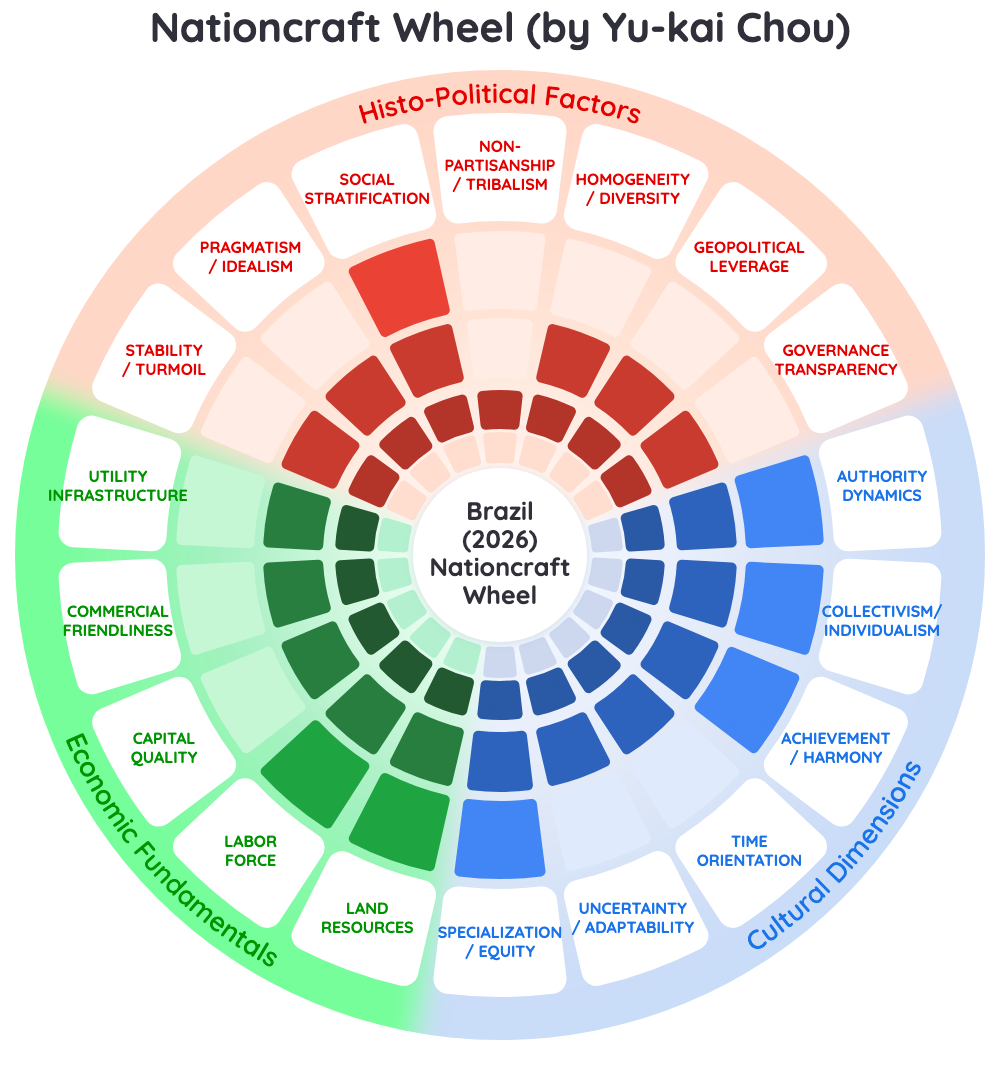
The 18 Nation Variables split into three clusters. Cultural variables (V1–V6) capture how a society distributes authority, loyalty, and ambition. Histo-political variables (V7–V13) capture the institutional terrain: stability, pragmatism, stratification, tribalism, diversity, leverage, and transparency. Economic variables (V14–V18) capture the material base.
Against this profile, Nationcraft matches over 100 Success Packets: documented historical reform programs with their preconditions, sequencing, and outcomes. A packet that transformed one country can wreck another when the V-vectors diverge.
Why This Brazil Variables Analysis Matters
Brazil is the largest democracy ever to criminally convict a former president for an attempted coup. How that conviction fares at the ballot will become precedent for every polarized democracy weighing accountability against stability.
The stakes compound because the winner inherits a fiscal problem that demands the one resource this election is burning: cross-bloc trust. Gross general government debt reached 82.9% of GDP in August 2026, up from roughly 74% at the end of 2022, with interest costs running near 9% of GDP over the twelve months to June.[2]
A country paying Selic at 13.75% while its two political blocs treat each other as existential threats is spending its future on its feud. The Nationcraft reading connects those two facts causally: V10 tribalism at 3/9 is what keeps V16 Capital Quality pinned at 5/9, because lenders price the risk that each transfer of power reopens every settled question.
Brazil also provides a live test of whether PT-002, the Authoritarian Backslide pattern, holds at scale: its single listed immunity factor is a strong independent judiciary established before the backslide, and Brazil’s judiciary just spent that immunity in the most public way possible.
The 18 Brazil Nation Variables
These scores come from the canonical Nationcraft corpus, sanity-checked this week against the first-round results, fiscal data, and the macro picture. Zero variables required a major revision since the July pass; the configuration is stable even while the politics are volatile.
| Variable | Score (1–9) | October 2026 reading |
|---|---|---|
| V1 Authority Dynamics | 7 | Strong presidency and an assertive Supreme Federal Tribunal check each other; both institutions survived a coup attempt and a conviction |
| V2 Collectivism vs Individualism | 7 | Family and community-centric society; strong solidarity networks cushion economic shocks |
| V3 Achievement vs Harmony | 7 | Competitive, status-driven, entrepreneurial energy from agribusiness to fintech |
| V4 Time Orientation | 5 | Electoral cycles dominate planning horizons; the runoff calendar is currently the national clock |
| V5 Uncertainty & Adaptability | 4 | Institutions react slowly; society absorbs shocks the state cannot anticipate |
| V6 Specialization vs Equity | 7 | Market specialization alongside a large transfer state |
| V7 Stability vs Turmoil | 6 | A peaceful first round with 78.92% turnout, under four years after the January 8 attack, is genuine institutional performance |
| V8 Pragmatism vs Idealism | 6 | Coalitional bargaining still works; the Centrão is already repricing itself for the runoff winner |
| V9 Social Stratification | 8 | Among the world’s most unequal societies; inequality feeds both blocs’ narratives |
| V10 Non-Partisanship vs Tribalism | 3 | The anchor variable: a 47–45 two-bloc split with every third option under 3% |
| V11 Homogeneity vs Diversity | 6 | Racially and regionally diverse under one language and a syncretic culture |
| V12 Geopolitical Leverage | 6 | BRICS member operating under a 50% US tariff on most of its exports |
| V13 Governance Transparency | 4 | Mid-low transparency; a live scandal environment touches both campaigns |
| V14 Land Resources | 9 | Amazon, agribusiness superpower, minerals, offshore oil |
| V15 Labor Force Quality | 7 | Large and improving workforce; informality and skills gaps persist |
| V16 Capital Quality | 5 | Deep financial system at punishing prices: Selic 13.75%, long rates near 14% |
| V17 Commercial Friendliness | 6 | A continental market throttled by Custo Brasil red tape and tax complexity |
| V18 Utility Infrastructure | 6 | Broad coverage and a renewable-heavy grid; logistics gaps tax everything |
The Nationcraft convention bears repeating: configuration is strategy, and these scores are never averaged. Brazil’s problem has never been its endowment (V14=9, V15=7); it is the interaction between V10=3, V13=4, and V16=5 that decides what any government can actually execute.
The Amnesty Ballot Trap
Judicial accountability, exercised in a V10=3 society, converts its own verdict into the next election’s ballot question — and either runoff outcome damages the court that issued it.
Working through both branches shows why the structure binds. If Flávio Bolsonaro wins, the governing coalition will read 50%+1 as a mandate to relieve the verdict, whether through the congressional amnesty discussions that began after the conviction, a presidential pardon, or slower institutional pressure on the tribunal itself.[3] The court’s hardest ruling would stand revealed as reversible by one election.
If Lula wins, the verdict survives, and half the electorate concludes that the judiciary and the government formed a single bloc to keep their champion caged and their movement leaderless. The court keeps its ruling and loses its standing as a neutral referee for roughly 47% of the country.
The numbers that frame the runoff make the bind visible:
| First-round fact (October 4, 2026) | Value | Why it matters for the trap |
|---|---|---|
| Flávio Bolsonaro (PL) | 47.03% | A convicted coup plotter’s movement, led by his son, won the opening round outright[1] |
| Lula da Silva (PT) | 45.16% | A sitting president enters the second round behind, against the pattern-setting record below |
| All other candidates combined | <8% | V10=3 in one statistic: the system offers no third pole |
| Turnout | 78.92% | High mobilization on both sides; neither bloc can claim the other stayed home |
| PL seats in the Chamber | 121 of 513 (largest party) | The movement converted grievance into legislative power[1] |
| Runoff precedent | First-round leaders are 7 for 7 since 1989 | Every prior runoff confirmed the first round’s leader[2] |
The trap also rewrites the meaning of the word “mandate.” Both candidates are campaigning on continuity of themselves and reversal of the other side’s institutional gains, so whichever mandate emerges will be read by the loser as procedural capture rather than persuasion.
That reading comes from V10=3 interacting with V1=7: strong institutions plus weak cross-bloc trust produce a politics where every institution’s output gets sorted into “ours” and “theirs” at the moment of publication.
Detailed Justifications: The Variables That Set the Trap
Seven variable interactions carry this analysis. Each one below cites the score, the behavioral observation behind it, and the role it plays in the trap.
V10=3: The Anchor That Turns Verdicts Into Ballots
V10 measures whether citizens grant legitimacy across party lines. At V10=3, Brazilians increasingly evaluate institutions by which bloc benefits from their output.
The first round of voting quantified the condition precisely. Two blocs took 92% of the valid vote between them, and the strongest third-party candidate managed 2.89%.[1]
Under these conditions a 4–1 Supreme Court conviction reads to one bloc as justice and to the other as warfare by judicial means. That score is why the September 2025 verdict could not stay settled: settlement requires both tribes to accept the referee, and the first-round numbers show neither tribe currently does.
V1=7 and V7=6: Strong Institutions That Keep Colliding
Brazil’s configuration pairs a powerful presidency with a tribunal willing to rule against presidents, which is why V1 scores 7 rather than drifting toward either autocracy or paralysis. The same pairing produced the 2025 conviction and now produces the collision: two strong institutions, each with a constituency, each claiming final authority over the same question.
The V7=6 score records the surprising durability underneath those collisions. A country that absorbed a coup attempt, a presidential conviction, and a dynastic restoration campaign, then ran a peaceful first round at 78.92% turnout, has real shock-absorption capacity.[1] The trap threatens the legitimacy layer rather than the stability layer, at least so far.
V13=4: Opacity That Arms Both Tribes
V13 measures governance transparency, and Brazil’s 4/9 shows up in this campaign as a scandal environment that implicates both camps at once: a central bank intervention at Banco Master with alleged links reaching into the Bolsonaro camp, and a benefits-deduction scandal reaching into the president’s circle.[1]
At higher transparency, scandals discipline politicians. At V13=4 combined with V10=3, each scandal simply becomes ammunition that confirms each tribe’s prior, because no investigative institution retains cross-bloc credibility to adjudicate.
V9=8 and V2=7: The Inequality Engine Behind the Duopoly
V9=8 stratification keeps supplying both movements with real grievances: the left narrates inequality as elite extraction, the right narrates crime and state failure as elite indifference. V2=7 collectivism then organizes those grievances into durable identity blocs rather than floating issue voters.
The first round bore the interaction out. A party system fed by V9=8 grievance and bound by V2=7 loyalty does not generate third poles; it generates succession within blocs, which is precisely what a son on the ballot represents.
V16=5 and V4=5: The Fiscal Clock Nobody Is Watching
While the campaign litigates 2022, the debt compounds. Gross debt at 82.9% of GDP, a primary deficit of 0.4%, and interest costs near 9% of GDP define the inheritance, with growth slowing from above 3% to around 2%.[2]
V16=5 prices the distrust: Selic at 13.75% and long-dated rates near 14% are what lenders charge a country whose policy continuity resets every four years.[2] V4=5 explains why neither campaign has published a consolidation plan; the electoral clock outranks the fiscal one, and both candidates know consolidation math loses runoffs.
V12=6: A Tariff With a Ballot Preference
Brazil’s geopolitical leverage held at V12=6 through a year of operating under a 50% US tariff on most of its exports, a measure whose easing now appears tied to the runoff’s outcome in analysts’ scenarios.[2] An external power holding a price lever over an election is a V12 stress Brazil has not faced at this intensity since the Cold War.
The interaction with V10=3 is the dangerous part. When trade relief correlates with one bloc’s victory, the losing bloc gains yet another reason to read the result as externally rigged, deepening the legitimacy deficit the trap already feeds on.
V14=9 and V15=7 supply the counterweight: an agricultural and energy exporter at world scale, with a large workforce, has outside options, and both blocs know the tariff hurts Washington’s import bill too, so leverage keeps Brazil at the table even though it cannot keep the tariff out of the campaign.
V8=6: The Centrão Already Hedged
Brazil’s pragmatism score V8=6 shows up in the congressional arithmetic. The PL became the largest party in both chambers, while the Centrão’s seat bloc shrank and began repositioning toward the likely winner within days of the first round.[2]
Transactional politics at V8=6 means no bloc can govern alone, every majority is rented, and even a president inclined toward institutional rupture must purchase votes from brokers with no interest in ending the market they trade in.
The same variable also caps how ambitious any reform package can be. A conditional-amnesty framework or a fiscal-rule renewal must pay the Centrão’s toll like everything else, which argues for designs with concentrated, visible benefits (rate relief, scandal adjudication both blocs can use) rather than diffuse civic goods.
The Two Mornings After
Scenario analysis under the Nationcraft lens starts from the variables rather than the polls, and the variables say October 26 opens one of two distinct games.
In scenario one, Flávio Bolsonaro wins the runoff, which the 7-for-7 precedent and the first-round margin make the base case.[2] The new government’s first-year agenda collides with itself: the movement’s base expects its founder freed, the market expects spending discipline, and both expectations route through institutions (the STF, the fiscal framework) the campaign spent years delegitimizing.
The V-vector prediction for this branch is sequencing pressure. An immediate blanket amnesty spends the government’s honeymoon on its most divisive act and invites the Peruvian loop; deferring it fractures the coalition that won. Watch whether the transition team reaches for the conditional designs in the table above, because that choice will reveal whether anyone in the movement is thinking past the restoration.
In scenario two, Lula holds the presidency by overturning a first-round deficit, defying the 7-for-7 precedent, which is why this branch is the institutional stress case rather than the relief case. A movement that won the first round, won both chambers, and then lost the presidency by a point will test every V7=6 shock absorber the system has, starting with the January 8 playbook’s unanswered question of whether the security forces hold.
Even the calm version of this branch leaves the verdict’s legitimacy unsettled for 47% of the electorate, a governing coalition without a Chamber majority, and a fiscal consolidation that needs votes the PL now controls.[2] The trap does not spring in this branch; it waits for the 2030 cycle while the legitimacy deficit and the debt both compound.
Both mornings share one feature the V-vector makes non-negotiable: the amnesty question survives the runoff in every branch. That is what it means for a verdict to live on the ballot at V10=3, and it is why the recommendations below target the question’s design rather than its answer.
Strategic Implications
Four Nationcraft implications follow for anyone who analyzes, invests in, or studies Brazil.
First, the runoff cannot end the conflict it is pricing. Markets treating October 25 as a resolution event misread the structure: a 47–45 society with V10=3 will contest the result’s meaning regardless of the result. The JPMorgan observation that first-round leaders are 7 for 7 in runoffs since 1989 says the outcome may be predictable; the aftermath is the unpredictable part.[2]
Second, watch the amnesty mechanism, because the design decides the damage. Congress opened amnesty discussions in the wake of the 2025 conviction.[3] The historical packets below show that amnesty’s institutional cost depends almost entirely on whether it is mutual and conditional or unilateral and total.
Third, the fiscal window narrows on both branches. A Flávio Bolsonaro government promising tax cuts and a Lula government defending transfers both face the same arithmetic at 82.9% debt and 9%-of-GDP interest. Whoever wins will discover that V16 relief requires exactly the cross-party credibility this campaign destroyed.[2]
Fourth, the external variable now has a price tag. The 50% US tariff on most Brazilian exports gives Washington a stake in the outcome, and analysts expect a Bolsonaro win to ease it faster than a Lula win would.[2] V12=6 leverage means Brazil can absorb the tariff; the political problem is that the tariff has a preferred winner.
Best-Match Historical Packets
The Nationcraft corpus holds four amnesty-and-accountability designs with documented outcomes, plus three adjacent packets this moment keeps tempting Brazil toward. The table scores the fit against Brazil’s current V-vector; the subsections carry the evidence.
| Packet | Design | Key precondition | Brazil fit at V10=3 |
|---|---|---|---|
| SP-017 Post-Franco Transition (Spain 1975–1986) | Mutual amnesty as founding pact | Both sides exhausted and both amnestied | Partial: the mutuality is missing |
| SP-047 Social Democracy & Stability (Uruguay 1985–2020) | Amnesty tested at the ballot, twice | Losers accepted the referee both times | Partial: requires V10 ≥ 5 loser’s consent |
| SP-048 Post-Apartheid Transformation (South Africa 1994–2008) | Amnesty priced in truth, case by case | Constitutional court anchor + full disclosure | Best structural fit for V1=7 |
| SP-033 Fujimori Shock Therapy (Peru 1990–2000) | Pardon traded for votes | None: the design is the failure | The path to refuse |
| SP-034 Plano Real (Brazil 1994–2002) | Credibility by institutional design | Cross-party exhaustion with the status quo | Brazil’s own proof it can exit doom loops |
| SP-109 Fiscal Consolidation (Sweden 1990–1996) | Crisis consolidation via cross-party pact | Packet’s own lesson: V10=9, V13=9 | Blocked until depolarization |
| SP-064 Bukele Security & Digital (El Salvador 2019–) | Security populism via emergency powers | Small state, collapsed party system | Rejected: fails scale and openness |
SP-017: Spain’s Amnesty Was a Pact, Never a Prize
Spain’s 1977 Amnesty Law passed the first elected Cortes on October 14, 1977 by 296 votes to 2, freeing political prisoners and simultaneously shielding Francoist officials.[4] What mattered was a design detail: both sides received amnesty from each other, voted by a chamber both sides had just elected, before anyone knew who would dominate the new system.
That is the opposite of an amnesty delivered by a victorious bloc to its own champion after winning 50%+1. Spain’s version lowered the stakes of future elections; the version on Brazil’s table would raise them, by teaching both blocs that imprisonment and liberation ride on each runoff.
The packet’s recorded limits apply too: Spain’s “forgetting pact” left a reckoning unfinished that resurfaced decades later. For a live reading of modern Spain’s different bind, see Spain’s Rented Border Trap.
SP-047: Uruguay Put Amnesty on the Ballot and Survived It
Uruguay’s 1986 Expiry Law shielded dictatorship-era military personnel from prosecution, and citizens voted on it twice: a 1989 referendum and a 2009 plebiscite both left the law standing.[5]
On the surface this looks like Brazil’s path: let the ballot decide the verdict. The precondition underneath was loser’s consent: Uruguayan losers accepted both results, because Uruguay’s consensus politics (the packet’s cross-party agreement on democratic rules after 1985) kept the referee legitimate for everyone.
Uruguay could ballot-test an amnesty because its tribalism ran low, while Brazil is ballot-testing a verdict precisely because its tribalism runs at 3/9, so the same instrument arrives with its preconditions inverted and should be expected to invert the outcome as well.
SP-048: South Africa Priced Amnesty in Truth
South Africa’s Truth and Reconciliation Commission granted amnesty only where the applicant fully disclosed a politically motivated, proportionate act.[6] Amnesty was individual, conditional, and administered by an institution anchored to a new constitutional court.
Of the four designs, this one maps best onto Brazil’s V1=7 configuration, because it routes mercy through institutions instead of around them. A conditional-amnesty framework, legislated across blocs and reviewable by the tribunal itself, would let Brazil trade finality for truth without teaching future coup plotters that elections erase verdicts.
The packet’s recorded costs stay on the label: the TRC’s compromises left inequality untouched and expectations unmet, a pattern visible today in South Africa’s Empty Chair Trap.
SP-033: Peru Ran the Experiment Brazil Is Contemplating
Peru’s packet carries the direct warning. President Kuczynski pardoned Alberto Fujimori on December 24, 2017, days after Fujimorista votes saved him from impeachment; the Supreme Court annulled the pardon in October 2018, Fujimori returned to prison in January 2019, and the constitutional court released him again in December 2023.[7]
A pardon transacted for political survival settled nothing: it consumed three presidencies, kept the courts at war with the executive, and left the underlying question open for six more years. Peru’s pattern of disposable presidencies is documented in Peru’s Carousel Trap, and its current security-first temptation in Peru’s Iron-Fist Mandate Trap.
The transferable lesson lands on both Brazilian blocs. An amnesty read as a transaction reproduces the Peruvian loop, where every subsequent election re-litigates the pardon and the judiciary spends a decade as a combatant.
SP-034: Brazil Already Proved It Can Exit a Doom Loop
The most hopeful packet in the table is Brazil’s own. The Plano Real, launched July 1, 1994, broke a 30-year inflationary psychology that five previous plans had failed to crack, and the Fiscal Responsibility Law of 2000 made the credibility structural.[8]
Nationcraft reads inflation expectations and polarization as the same class of problem: a self-fulfilling belief about how other Brazilians will behave. The Plano Real worked by changing the belief through institutional design (the URV transition currency) rather than through exhortation.
The packet therefore sets the bar for any depolarization program: it must be a mechanism citizens can verify, legislated across blocs, that makes defection expensive for both sides. Brazil has engineered a belief change at national scale once, which makes depolarization a repeat assignment on harder material rather than an untested hope.
SP-109: The Consolidation Sweden Could Run and Brazil Cannot Yet
Sweden’s 1990s crisis response (bank guarantee, bad-bank resolution, then consolidation worth roughly 8% of GDP across 1994–98) is the standard template for the fiscal problem Brazil’s winner inherits.[9]
The packet’s own recorded variable lesson disqualifies a direct import: V10=9 low tribalism and V13=9 transparency enabled the cross-party unity that made the guarantee credible. Sweden’s modern strain on that same trust capital is traced in Sweden’s Trust Overdraft Trap.
Brazil at V10=3 and V13=4 attempting a Swedish-style pact would produce a document, and the first transfer of power would shred it. Sequencing conclusion: depolarization instruments come before consolidation instruments, or the consolidation fails and discredits its authors.
SP-064: The Security Populism Import to Refuse
With crime polling as the top voter concern, El Salvador’s packet hovers over this election as the available shortcut: emergency powers, mass incarceration, dramatic homicide reduction, and documented institutional destruction riding together.[1]
The packet’s recorded preconditions fail at Brazil’s scale: a small, manageable territory and a collapsed party system that offered no institutional resistance. Brazil’s V1=7 institutions would resist, which under V10=3 conditions converts a security program into another front of the institutional war. Chile’s electorate walked to the edge of this same import and partially stepped back, a sequence examined in the comparative section below.
Governance Strategy Recommendations
These recommendations are addressed to the reform-minded reader: the analyst, the civil-society designer, the voter, the future coalition builder trying to get accountability off the ballot and the fiscal clock back on it. Each one opens the system; none of them requires knowing who wins on October 25.
| Priority | Reform design | Variables addressed | Historical anchor |
|---|---|---|---|
| 1 | Any amnesty must be conditional, individual, and judicially reviewable: truth-priced on the TRC model, legislated across blocs, never a blanket restoration | V10, V1, V13 | SP-048; the SP-033 pardon loop as the counterexample |
| 2 | Loser’s-consent infrastructure: pre-committed concession protocols, cross-bloc observation of the count, and both campaigns bound to the electoral court’s result before the vote | V10, V7 | SP-047’s twice-accepted ballots |
| 3 | Depolarization by mechanism design: lower the duopoly’s structural rents through ballot-access and coalition rules that let third poles survive a round | V10, V8 | SP-034’s logic: change the belief by changing the mechanism |
| 4 | A fiscal-rule renewal written to survive alternation: automatic triggers and an independent fiscal council, so consolidation does not depend on cross-bloc goodwill that does not exist | V16, V4 | SP-034’s Fiscal Responsibility Law; SP-109 deferred until V10 recovers |
| 5 | Transparency instruments with cross-bloc governance: scandal adjudication bodies whose appointments require supermajorities from both blocs, so V13 findings regain adjudicative force | V13, V10 | SP-048’s disclosure pricing |
The ordering of those five rows carries the argument: items 1 and 2 decide whether the October 25 result is survivable, while items 3 through 5 decide whether the next decade repeats it.
Reform in this sequence benefits the population by its own definitions: verdicts that stick regardless of who governs, elections whose losers stay in the game, borrowing costs that stop taxing the feud, and investigations both tribes can believe. None of it requires either bloc to lose its identity; it requires both to accept referees again.
Comparative Context
Brazil’s trap is the acute case of a pattern running through the 2026 Nationcraft corpus: democracies asking courts to hold lines their electorates keep contesting.
Colombia’s Polarization Pendulum shows the regional baseline: a V10-driven oscillation where each presidency exists to reverse the last one, and institutional memory resets every four years. Brazil’s version adds a jailed ex-president, which converts the pendulum’s usual policy stakes into personal liberty stakes.
Thailand’s Judicial Veto Trap sits at the far end of the same road. A judiciary that repeatedly overrules electoral outcomes eventually becomes a standing political faction, and every Thai election since has been a referendum on the referee. Brazil is one unconditional amnesty, or one more contested verdict, away from entering that loop.
India’s Umpire Trap frames the moderate scenario: institutions that retain function while bleeding cross-bloc credibility, with the damage showing up as slow-motion erosion rather than rupture. Brazil’s V7=6 suggests it can hold this middle path if the amnesty question gets institutional handling.
The Philippines’ Dynasty Trap illuminates the Flávio phenomenon from the succession side: at low V10, movements outlive convictions by converting family names into institutional vessels. A verdict against a founder redirects the movement; it rarely dissolves one.
And Argentina’s Anchor Trap supplies the fiscal rhyme next door: a society that keeps choosing monetary and fiscal anchors it then votes against servicing. Brazil’s 82.9% debt at V10=3 is drifting toward the same contradiction, with the runoff accelerating the drift.
The Nationcraft Framework in Practice
Readers can run the same check on any election: fix the country’s 18-variable profile before reading the headlines, ask which variable interactions turn the event into a structural trap, and test each tempting policy import against the packet record’s preconditions.
Spain’s amnesty, Uruguay’s referendum, and Sweden’s consolidation all look importable until the V-vector comparison exposes the missing precondition each one quietly assumes.
Brazil now has two entries in the Nationcraft country analyses library, reading the same configuration through two different stress events three months apart.
Explore More Nationcraft Analyses
The library holds 100+ country analyses and packet deep-dives, each built on the same 18-variable spine, so the Brazil reading above can be checked against its neighbors and its historical anchors directly.
For this trap’s nearest relatives, start with the polarization cluster (Colombia, the United States) and the judicialized-politics cluster (Thailand, India), then follow the packet links into the Spain, Uruguay, South Africa, and Peru source analyses cited above.
Related Reading
- The Nationcraft Framework: 18 Variables, 8 Goals, 100+ Proven Reform Packets
- Nationcraft Nation Variables Library
- Nationcraft Analysis: Chile Mano Dura Mirage 2026
- Nationcraft Analysis: Venezuela Reform Playbooks 2026
- Nation Variable Analysis: United States of America (2026)
- Nationcraft: How the Octalysis Framework Applies to Nation-Building and Public Policy
Frequently Asked Questions
What is the Amnesty Ballot Trap?
The Amnesty Ballot Trap is the Nationcraft name for what happens when judicial accountability meets extreme polarization: at V10=3 tribalism, a court verdict against a political leader becomes the next election’s central question, forcing the ruling to win 50%+1 at the polls to survive. Either runoff outcome then damages the court, because one bloc reads enforcement as capture and the other reads reversal as impunity.
Who is actually on the ballot in Brazil’s October 25 runoff?
Formally, President Lula da Silva (45.16% in the first round) faces Senator Flávio Bolsonaro (47.03%), after no candidate cleared 50% on October 4. Functionally, the contest centers on Jair Bolsonaro, convicted in September 2025 and sentenced to 27 years and 3 months, whose potential amnesty or pardon is the runoff’s defining stake.
Could a President Flávio Bolsonaro simply free his father?
Congress began discussing amnesty after the 2025 conviction, and Brazil’s presidency holds pardon powers, so the instruments exist. Every route runs back through the Supreme Federal Tribunal that issued the verdict, which is why this analysis focuses on the design of any amnesty: a blanket, unilateral restoration would reproduce Peru’s pardon loop, while a conditional, truth-priced framework on the South African model could survive review without teaching future plotters that elections erase verdicts.
Which Nation Variables matter most in this analysis?
V10=3 (tribalism) is the anchor that put the verdict on the ballot; V1=7 (authority dynamics) explains why two strong institutions are colliding rather than one absorbing the other; V13=4 (transparency) keeps scandals from adjudicating anything; and V16=5 (capital quality) prices the distrust at a 13.75% Selic while debt sits at 82.9% of GDP.
Which historical packets fit Brazil right now?
South Africa’s SP-048 conditional amnesty is the best structural fit, Brazil’s own SP-034 Plano Real supplies the proof that belief-changing institutional design works at national scale, and Uruguay’s SP-047 shows the loser’s-consent precondition Brazil must rebuild first. Spain’s SP-017 mutual pact lacks its mutuality precondition here, Sweden’s SP-109 consolidation is blocked until V10 recovers, and Peru’s SP-033 pardon transaction plus El Salvador’s SP-064 security populism are the two imports to refuse.
Footnotes
- Wikipedia, “2026 Brazilian general election”: first-round results (Flávio Bolsonaro 47.03%, Lula da Silva 45.16%, turnout 78.92%), runoff date, congressional seats, and campaign-issue record. https://en.wikipedia.org/wiki/2026_Brazilian_general_election
- J.P. Morgan Private Bank, “Brazil first round: heading to a runoff” (October 2026): debt 82.9% of GDP (Aug 2026), primary deficit 0.4%, interest costs ~9% of GDP, Selic 13.75%, long rates ~14%, growth ~2%, congressional composition, the 7-for-7 runoff precedent, and the US 50% tariff scenario. https://privatebank.jpmorgan.com/latam/en/insights/markets-and-investing/ideas-and-insights/brazil-first-round-heading-to-a-runoff
- Wikipedia, “Trial of Jair Bolsonaro” (AP 2668): conviction September 11, 2025, 27 years 3 months, STF 4–1, and congressional amnesty discussions following the verdict. https://en.wikipedia.org/wiki/Trial_of_Jair_Bolsonaro
- Wikipedia, “1977 Spanish Amnesty Law”: passed October 14, 1977, 296–2 with 18 abstentions. https://en.wikipedia.org/wiki/1977_Spanish_Amnesty_Law
- Wikipedia, “Expiry Law” (Uruguay, Law 15,848 of 1986): upheld by voters in the 1989 referendum and the 2009 plebiscite. https://en.wikipedia.org/wiki/Expiry_Law
- Wikipedia, “Truth and Reconciliation Commission (South Africa)”: conditional amnesty for fully disclosed, politically motivated, proportionate acts. https://en.wikipedia.org/wiki/Truth_and_Reconciliation_Commission_(South_Africa)
- Wikipedia, “Pardon of Alberto Fujimori”: pardon December 24, 2017 after the December 21 impeachment vote; annulled October 2018; returned to prison January 2019; released December 2023. https://en.wikipedia.org/wiki/Pardon_of_Alberto_Fujimori
- Wikipedia, “Plano Real”: stabilization program launched with the real on July 1, 1994. https://en.wikipedia.org/wiki/Plano_Real
- AS/COA, “Poll Tracker: Brazil’s 2026 Presidential Election” (updated October 19, 2026): first-round outcome corroboration and runoff framing. https://www.as-coa.org/articles/poll-tracker-brazils-2026-presidential-election