
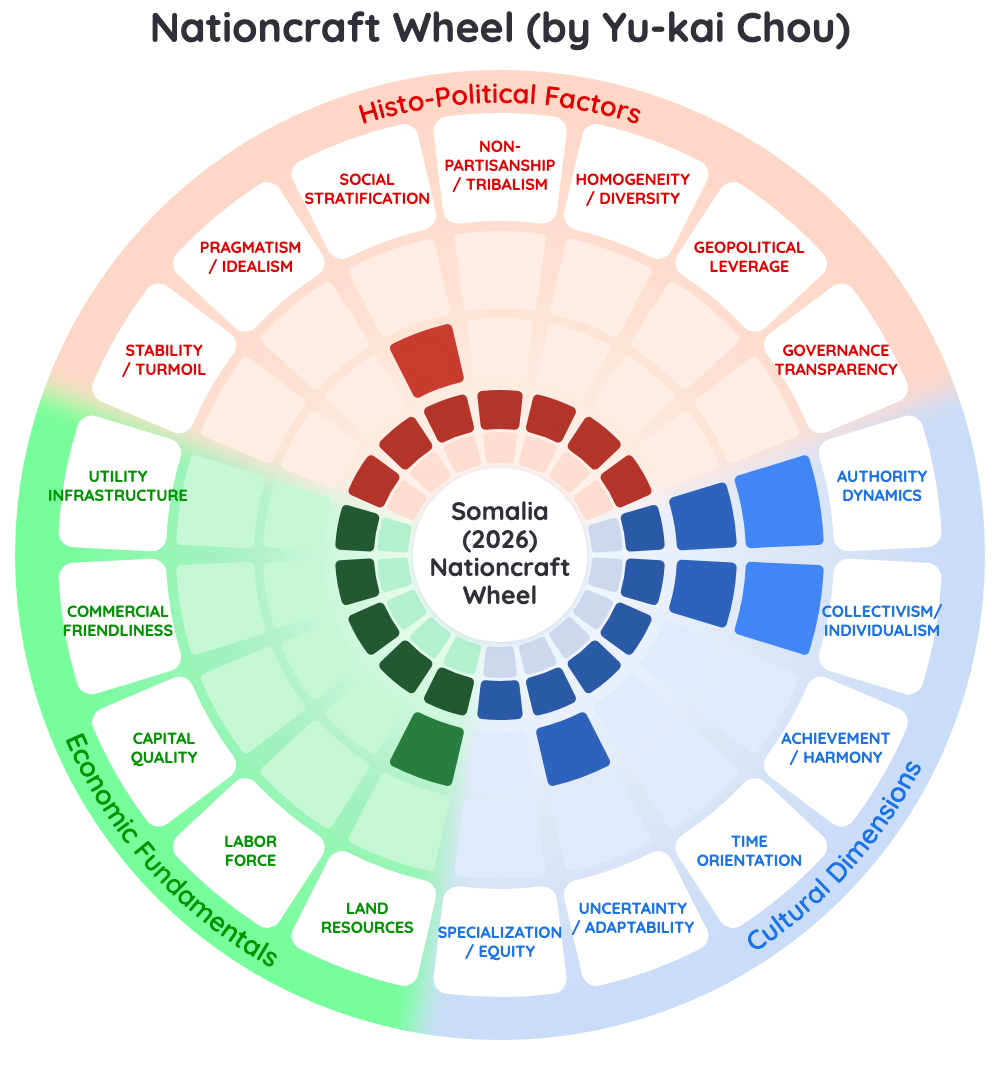

Somalia’s presidential term ran out on 15 May 2026. The president is still in office, the election that was supposed to replace him is now scheduled for 15 May 2027, and the rule that bridges those two dates was written in March 2026 by the parliament his coalition controls.
That one-year bridge is where the whole dispute now lives. A constitutional amendment stretched every federal term from four years to five, the government read the new rule as applying to the sitting president, and the opposition read it as a self-granted extra year. Three collapsed negotiation formats later, nobody has moved.
I call this configuration the Overtime Mandate: a government playing past the final whistle, under a rule change made mid-game, while insisting that the match is still on. The referee who could settle it — a constitutional court both sides accept — does not exist in Somalia, so there is no neutral clock to appeal to.
The stakes carry specific dates and dollar figures. The African Union mission holding the security line is mandated only through 31 December 2026 and is short of money. Al-Shabaab is still fighting through all of it. And the flagship reform that is supposed to resolve everything, one person one vote, is the very thing the two camps cannot agree on. This analysis reads the standoff through the Nationcraft Framework‘s 18 Nation Variables, shows why the ballot itself became the prize, and lays out what an exit that benefits ordinary Somalis would require.
⚡ Speed Run Notes
- Somalia’s V1=9 authority instinct still cannot be nationalized past V10=1 clan capture. The May analysis showed the mandate was borrowed; six months later the mandate is expired and the standoff is constitutional.
- The March 2026 amendment moving terms from four years to five is the trap’s mechanism: a democratizing reform that also extends the sitting president to May 2027, so every ballot promise reads as incumbency insurance.
- With V8=1 zero-sum bargaining, talks collapsed in May, stalled in July, and never convened in November. One person one vote cannot legitimize a government the other side believes is already out of time.
- Best-match packets are SP-061 (Côte d’Ivoire’s two-presidents crisis), SP-072 (Zambia’s 1991 handover), and SP-024 (Cambodia’s UN-guaranteed 1993 vote); each resolved a contested clock before building anything else.
- The reject list matters more: Yemen’s National Dialogue (FP-011), South Sudan’s independence-without-institutions (FP-005), and Haiti’s intervention cycle (FP-010) are all live temptations for Somalia’s donors right now.
Table of Contents
- Understanding Somalia’s Governance Standoff Through Nationcraft
- What Is the Nationcraft Framework?
- Why This Somalia Variables Analysis Matters
- The 18 Somalia Nation Variables
- The Overtime Mandate: Playing Past the Final Whistle
- What Changed Between May and November 2026
- Detailed Justifications: Reading the Variables That Decide This
- Best-Match Historical Packets
- Five Reformer Playbooks Somalia Should Reject
- Governance Strategy Recommendations
- Strategic Implications
- Comparative Context: Somalia Among Its Peers
- Frequently Asked Questions
About Yu-kai Chou

Yu-kai Chou is a Human-Systems Architect & Behavioral Designer and the creator of the Nationcraft Framework — an 18-variable diagnostic for matching a country’s structural profile to the reform packets that have historically worked under similar conditions. He has consulted for governments in eight nations, including Ukraine, the United Kingdom, the Kingdom of Bahrain, Singapore, Taiwan, the Netherlands, Kazakhstan, and South Korea, and has worked directly with President Zelenskyy’s team on post-war reconstruction priorities for Ukraine.
Chou’s prior framework — the Octalysis Framework — has been applied by LEGO, Microsoft, Porsche, Coca-Cola, Salesforce, and MrBeast, impacting over 1.5 Billion Users. He has taught the methodology at Harvard, Stanford, Yale, Tesla, Google, BCG, and IDEO.
His work has been cited by Harvard, Stanford, MIT, Forbes, Wall Street Journal, Wired, US Department of Energy, NIST, NSF, NCBI, US Department of Education, ClinicalTrials.gov, and Google Scholar — with 3,700+ more academic publications. Explore his books here.

This is the second Nationcraft reading of Somalia in 2026, and the hardest kind: Chou’s government advisory work has mostly run through functioning states, while Somalia is the configuration where the state itself is the missing packet. The May analysis diagnosed a mandate borrowed from donors and clan bargains; this one examines what happens when that mandate expires mid-reform, a failure pattern Chou has tracked across post-conflict transitions from Côte d’Ivoire to Yemen.
Understanding Somalia’s Governance Standoff Through Nationcraft
Six months ago, the first Somalia reading in this series diagnosed the Borrowed-Mandate Trap: a state whose authority is rented from donors, AU troops, and clan bargains rather than owned through citizen consent. That diagnosis has now produced its predicted crisis.
Rather than an election at the four-year mark, Somalia got the March amendment and a moved finish line.
The government reads the new rule as moving the finish line to 15 May 2027. The opposition, organized as the Somali Future Council and including the leaders of Puntland and Jubaland, reads it as a player rewriting the rulebook while the ball is in play.
Nationcraft treats this as a configuration problem before it is a personality problem. Somalia scores V1=9 on Authority Dynamics, among the highest deference instincts in the 147-country corpus, and V10=1 on Non-Partisanship, meaning clan identity intercepts that deference before it ever reaches the state.
Add V8=1 on Pragmatism, a political culture where every bargain is scored as win-or-lose, and you get exactly what 2026 delivered: a year in which no negotiation format survived contact, while the franchise reform itself became the contested ground.
What Is the Nationcraft Framework?
The Nationcraft Framework scores a country on 18 Nation Variables: cultural (V1–V6), historical-political (V7–V13), and economic (V14–V18). It then matches that profile against a corpus of historical Success Packets: documented reform programs, from the Meiji Restoration to Botswana’s diamond management, each tagged with the variable preconditions it needed to work.
The core claim is that policy effectiveness is decided by context-fit rather than policy quality. A program that transformed one country fails in another when the underlying variables differ, which is why the framework spends most of its effort on diagnosis.
Nationcraft grew out of the Octalysis Framework, which maps the drives behind human motivation in products and organizations. A nation is the largest motivational system there is, and the bridge between the two frameworks is explored in Nationcraft and Octalysis for nation building.
Somalia is a demanding test for any such system because most packets assume a state that can execute. For this file, the operative question is whether that machine exists, and the variables table below is where the answer starts.
Why This Somalia Variables Analysis Matters
Three clocks make this reading urgent rather than academic.
The first is the security clock. AUSSOM, the African Union mission whose mandate was extended through 31 December 2026 by UN Security Council Resolution 2809, is underfunded against that mandate, and the record on its financing beyond December is unresolved. The force holding the perimeter around Somalia’s political argument is itself running on a contested timetable.
The second is the legitimacy clock. Every month of overtime rule compounds the opposition’s claim that the government negotiates from a position it no longer legally holds. Cabinet decisions taken in this window, including the 24 November 2026 cabinet approval of closed party lists for the 2027 parliamentary vote, inherit the dispute.
The third is the money clock. Somalia reached the HIPC completion point in December 2023, clearing roughly $4.5 billion in debt and cutting external debt from around 64% of GDP in 2018 to under 6% by the end of 2023. That fiscal headroom is the first real reform capital Somalia has held in a generation, and a constitutional standoff is currently spending it on survival politics.
For readers tracking the wider series, Somalia also serves as the control case. Readers of Kosovo’s midnight mandate and Serbia’s castling trap will recognize the move, a rule rewritten mid-game. The difference is that Somalia has no institutional floor underneath the rewrite.
The 18 Somalia Nation Variables
The scores below are Somalia’s current profile in the Nationcraft corpus, on a 1–9 scale where higher means easier to govern through that dimension. They are unchanged from the May 2026 reading: six months of standoff confirmed the configuration rather than moving it.
| Variable | Score | What it means in Somalia |
|---|---|---|
| V1 Authority Dynamics | 9/9 | Deep deference to elders, sheikhs, and seniority, routed to clan structures rather than the state |
| V2 Collectivism vs Individualism | 8/9 | Intense kinship solidarity; diaspora remittances as a parallel welfare state |
| V3 Achievement vs Harmony | 3/9 | Survival orientation; harmony maintained by bargain rather than shared purpose |
| V4 Time Orientation | 2/9 | Month-to-month crisis horizon; election timetables slip routinely |
| V5 Uncertainty Adaptability | 4/9 | World-class informal adaptation (hawala, telecoms) under a brittle formal layer |
| V6 Specialization vs Equity | 3/9 | No institutional framework rewarding either path |
| V7 Stability vs Turmoil | 1/9 | Active al-Shabaab insurgency plus a live constitutional standoff |
| V8 Pragmatism vs Idealism | 1/9 | Zero-sum clan politics; every 2026 negotiation format collapsed |
| V9 Social Stratification | 6/9 | Clan hierarchy with marginalized minority clans, institutionalized by the 4.5 formula |
| V10 Non-Partisanship vs Tribalism | 1/9 | Clan is the political unit; every electoral rule doubles as a clan ledger |
| V11 Homogeneity vs Diversity | 2/9 | Ethnolinguistically homogeneous, yet clan cleavage functions as hard diversity |
| V12 Geopolitical Leverage | 1/9 | Donor- and AU-dependent; the Red Sea location card remains uncashed |
| V13 Governance Transparency | 1/9 | Perennial bottom cohort of Transparency International’s index |
| V14 Land Resources | 6/9 | Longest coastline in mainland Africa; livestock, fisheries, hydrocarbon potential |
| V15 Labor Force Quality | 2/9 | Low schooling, chronic brain drain |
| V16 Capital Quality | 1/9 | No domestic capital market; HIPC relief created fiscal space, not yet capital |
| V17 Commercial Friendliness | 1/9 | Near-zero formal layer; famously energetic informal private sector |
| V18 Utility Infrastructure | 1/9 | Minimal grid, water, and sanitation coverage |
Two minor drifts are worth recording without changing scores. V12 is arguably pressing upward as Türkiye deepens its military commitment and Red Sea politics raise Somalia’s salience, and V16 gained real headroom from debt relief.
Neither drift survives contact with V7=1 and V13=1, because patrons and investors price the standoff before they price the coastline or the balance sheet.
The Overtime Mandate: Playing Past the Final Whistle
Every named pattern in this series is a specific variable interaction. The Overtime Mandate is what happens when V1=9 meets V10=1 and V8=1 under an expired clock.
Begin with how the trap actually works. In configurations with a working referee (a constitutional court, an electoral commission trusted across camps, even a dominant external guarantor), an expired term triggers a procedure. Somalia’s March amendment was instead produced by the same political machine whose term it extends, so the rule and the player are the same entity.
Now run the variables through that gap. V1=9 means Somalis grant authority readily, which should make incumbency stable. V10=1 means the authority grant runs through clan, so the half of the clan map aligned with the opposition experiences the extension as another clan’s seizure rather than as continuity of the state.
V8=1 then locks the door on compromise. In a zero-sum bargaining culture, accepting the other side’s clock is scored as a loss, which is why the May collapse, the July stall, and the cancelled November round all ended the same way. Each camp is waiting for the other to concede the one asset that cannot be split: time.
The ballot itself occupies the strangest position in this configuration. One person one vote is the reform Somalia’s partners have urged for decades, and in most configurations it raises V13 by making power auditable. Decreed unilaterally by a government past its term, the same reform reads as a device for choosing the arena in which the incumbent is strongest.
Stripped of labels, what physically changes is this: the cabinet sets the voting model, the cabinet-appointed commission runs registration, and the extended mandate is the clock under which both happen. Without consensus, the same enfranchisement program functions as overtime insurance for the government that decreed it. That is the Overtime Mandate: the franchise-shaped version of an instrument Somalia’s neighbors have seen before — Algeria’s empty mandate ran on managed elections, and DR Congo’s eternity clause on constitutional redrafting.
What Changed Between May and November 2026
The May analysis closed by warning that the mandate question would decide everything else. Here is the ledger six months on.
| Date (2026) | Event | Variable it expresses |
|---|---|---|
| March | Parliament amends the constitution; federal terms move from four years to five, read by the government as extending the presidency to 15 May 2027 | V13=1: rule change without a neutral arbiter |
| 13–15 May | Government–opposition talks end without agreement as the original term expires | V8=1: zero-sum bargaining |
| July | Turkish-brokered dialogue stalls after Puntland and Jubaland withdraw | V10=1: member states as clan-coalition actors |
| October | Electoral commission publishes a timetable: parliamentary vote 15 April 2027, presidential vote 15 May 2027 | V4=2: deadlines as negotiating positions |
| 1–30 November | Party registration reopens; the deadline slips to 30 November under extension | V4=2 again: the clock stretches on contact |
| 14–18 November | Proposed dialogue round never convenes; the Somali Future Council rejects the format, demanding international mediation | V8=1: talks as score-keeping |
| 24 November | Cabinet approves closed party lists for the 2027 parliamentary polls | The Overtime Mandate: rules set by the extended government |
Every institutional move in 2026 was made by one side and rejected by the other, and each deadline moved when tested.
The table also holds no battlefield events. Somalia’s security war and its constitutional war run on separate tracks, and the second is where a variables framework has the most to add.
Detailed Justifications: Reading the Variables That Decide This
Eighteen scores are a profile; four clusters carry this particular crisis. Each cluster below names the variables doing the work and the behavior that justifies the number.
The authority cluster: V1=9, V9=6, V10=1
Somalia’s paradox has always been that an extremely authority-friendly culture produces an extremely weak state. V1=9 reflects genuine, observable deference: to elders, to religious scholars, to seniority within lineage.
V10=1 explains where all of that deference actually goes. The clan is the unit that collects taxes of loyalty, provides security, and negotiates marriages and blood payments, so the state arrives as a second claimant on an already-allocated resource. V9=6 adds a vertical dimension: the 4.5 formula that shares power among four major clan families, with a half-share for everyone else, hard-codes stratification into the constitutional order itself.
For the current standoff, this cluster predicts exactly the coalition structure we see. The Somali Future Council functions less as a programmatic party than as a clan-coalition ledger, with Puntland and Jubaland’s leaders as its anchor entries.
The bargaining cluster: V8=1, V4=2, V7=1
V8=1 is the series’ lowest pragmatism score, and 2026 earned it. Every negotiation format attempted in 2026 failed, including one run by Türkiye, the external actor with the most skin in the game.
V4=2 means the shared time horizon is too short for the standard trade that resolves such standoffs (concede now, collect later) because nobody prices “later.” V7=1 keeps the threat point violent: with an insurgency running, walking away from the table never means peace, only a different war.
This cluster is why process proposals keep failing. A dialogue format is itself a bargain, which in a V8=1 culture means the argument starts over the shape of the table before anyone reaches the agenda.
The economic floor: V14=6 against V15=2, V16=1, V17=1, V18=1
Somalia’s one mid-range economic card, V14=6, is real: the longest mainland coastline in Africa, livestock exports the Gulf actually buys, and offshore potential. Everything needed to convert that card is at or near the floor.
The HIPC completion point of December 2023 changed the V16 story from hopeless to latent. Debt below 6% of GDP and a roughly $13 billion economy give Somalia, for the first time in decades, a balance sheet a reform program could borrow against.
Converting latent V16 into actual investment requires the one thing the Overtime Mandate destroys: a counterparty who can sign for the state beyond next May.
The leverage wildcard: V12=1, V13=1
V12=1 records dependence: on AUSSOM for security, on donors for budget, on Türkiye and others for hard power. The drift worth watching is that dependence is becoming contested ground among patrons, with Ankara, Gulf actors, and Washington each holding different pieces of Somalia’s survival kit.
V13=1 marks the referee-shaped hole at the center of the system. There is no institution in Somalia whose word on the amendment both camps would accept, which converts a legal question into a pure power question. The series has covered referees captured from within, most recently in Poland’s constitutional-court crisis. Somalia’s harsher version is a post never filled at all, which is why a legal question about one amendment turned into a raw power question within weeks.
Best-Match Historical Packets
The Nationcraft corpus scores each Success Packet by the variable preconditions present when it started. Somalia’s 2026 profile matches almost nothing in the success column, which is itself diagnostic — but three packets speak directly to the expired-clock problem.
| Packet | Case | Precondition overlap with Somalia 2026 | What it resolved |
|---|---|---|---|
| SP-061 | Côte d’Ivoire 2011–2020 | V7=2, V10=4 at start; disputed presidential legitimacy; regional force present | A two-presidents standoff settled before reconstruction began |
| SP-072 | Zambia 1991–2011 | V13=3 at start; exhausted incumbent; united opposition | An incumbent leaving on schedule, making the clock credible for a generation |
| SP-024 | Cambodia 1993–2015 | V7=1, V16=1, V18=1 at start; factions fresh from war | A first election externally guaranteed when no domestic referee existed |
| FP-019 | Somalia 1991–2006 | The home case: V10=1, V13=1, V7=1 | Nothing: fifteen years of statelessness; the floor this analysis measures against |
SP-061 (Côte d’Ivoire): settle the clock first
Côte d’Ivoire entered 2011 with two men claiming the presidency after a disputed 2010 vote, roughly 3,000 dead in the post-election crisis, and a V7=2 stability floor not far above Somalia’s. The packet’s lesson is sequencing: nothing in the Ouattara-era recovery — the infrastructure program, the cocoa reform, the growth decade — started until the legitimacy question had one answer.
The second half of the lesson is how that answer arrived: international certification of the vote and, ultimately, external force. Somalia has the external actors and lacks the certified vote, which is why SP-061 reads here as a warning about what the absence of an agreed count eventually costs.
What transfers to Somalia is the certification architecture. The UN certified Côte d’Ivoire’s results under a mandate both sides had accepted in advance; Somalia’s 2027 vote currently has no equivalent pre-commitment from the Somali Future Council side, and building one is cheaper than any alternative on the table.
SP-072 (Zambia): the handover as infrastructure
Zambia’s 1991 transition matters to Somalia for one image: Kenneth Kaunda, a one-party incumbent of 27 years, losing an election and leaving. The packet’s V13 score at start was 3, only modestly above Somalia’s, and Zambia’s later debt troubles show the transition solved governance succession, not economics.
What the handover bought was V10 capital. “One Zambia, One Nation” had been slogan-deep until the moment power actually changed hands peacefully; afterward it was a precedent every subsequent loser could be held to.
Somalia has never had that precedent at the one-person-one-vote level. The packet’s claim is that the first credible handover is worth more than any single policy program, because it converts the clock from something each side fights over into something both sides can simply read.
SP-024 (Cambodia): rent a referee when you cannot build one
Cambodia in 1993 ran a national election with V7=1, V16=1, and V18=1 (Somalia’s floor) under UNTAC, a UN administration with a budget above $1.6 billion and its own guarantee power. The vote was imperfect and the aftermath messier, with Hun Sen bending the coalition result his way, but the election happened and the state that followed, tracked in Cambodia’s patronage ceiling, grew from it.
The transferable core is the rented referee: when no domestic institution can certify outcomes, an external one can, provided every major faction signs the rental agreement first. AUSSOM is not UNTAC and was never mandated to be, yet the architecture — electoral guarantee as an explicitly contracted external service — is the closest thing the corpus offers to a bridge over V13=1.
The packet’s limit is just as instructive as its lesson. UNTAC-scale money arrives roughly once per geopolitical era, and Somalia’s donors in 2026 are debating a far smaller question: whether to fund AUSSOM past December at all.
Five Reformer Playbooks Somalia Should Reject
Used honestly, the corpus filters more than it prescribes. Each packet below is either being proposed for Somalia right now or sits one donor memo away from it, and each fails on a named variable.
FP-011 — Yemen’s National Dialogue import
Yemen’s 2013–14 National Dialogue Conference was the model inclusive process: every faction at the table, international sponsorship, a documented roadmap. The Houthis took Sanaa anyway, because the dialogue design ignored the fact that one participant retained an army and the incentive to use it.
The packet’s variable lesson, that V7=2 plus V10=3 plus V13=2 meant no transition framework could hold, maps almost line for line onto Somalia’s V7=1, V10=1, V13=1. A grander dialogue conference is the most likely donor proposal after a year of failed rounds, and Yemen’s record suggests the format was never the missing piece: commitment was, and no conference design manufactured it. Yemen’s decade since, read in the frozen war trap, is the bill.
FP-005 — South Sudan’s independence-without-institutions
South Sudan’s 2011 referendum delivered 99% consent and worldwide goodwill, and the new state was in civil war within two years, at a cost the packet records as 400,000 dead. The variable configuration — V10=2, V13=2, intense V2 ethnic solidarity — made oil revenue a prize to capture rather than a budget to govern.
The Somali application is the temptation to treat a successful 2027 vote as the finish line. FP-005 records what a ballot delivers when no institutions stand behind it, and Somalia’s HIPC windfall is exactly the kind of prize such a fight would form around.
FP-010 — Haiti’s intervention cycle
Haiti has absorbed repeated external interventions (occupations from 1915–34, 1994–95, and 2004 onward, plus roughly $10 billion in post-earthquake aid), and each cycle left the state weaker, a trajectory charted in Haiti’s ballot-first trap. The packet’s critical insight is that external force without local institution-building creates permanent dependency.
For Somalia the live risk is AUSSOM’s December cliff being answered with a successor mission with a new mandate and the same funding fight, while the constitutional question rolls forward unresolved. FP-010’s warning is that each renewal without an exit plan turned the mission itself into Haiti’s de facto governance layer, a role no mission has managed to perform.
SP-038 — Ghana’s adjustment-first sequence
Ghana 1983 is a genuine success packet: a collapsed economy, a 900% devaluation, cocoa reform, and eventually a democratic transition that legitimized the gains, with echoes into Ghana’s current imported-discipline dilemma. It is on the reject list because its sequence ran economics first under an uncontested strongman, politics second.
Somalia’s configuration inverts that precondition completely. Rawlings held V1 authority that was nationalized, however roughly; Somalia’s V10=1 means no economic program can precede the legitimacy settlement, because the program’s revenues become the next clan prize. Rawlings could run economics first because nobody disputed who governed; in Somalia, who governs is the dispute, so the Ghana order of operations has nothing to attach to.
SP-004 — Botswana’s institutions-before-rents, read too early
Botswana is the corpus’s favorite proof that transparency built before resource exploitation (V13=7 by the time diamonds mattered) converts luck into development. Donors cite it to Somalia whenever offshore hydrocarbons come up, and the small-state comparison series shows why the citation flatters.
Botswana started with a functioning, uncontested government at independence and a V8=9 pragmatism culture, the exact inverse of Somalia’s V8=1. The packet’s own what-cannot-be-copied list says the timing was luck; proposing it to a state in constitutional overtime skips every precondition that made it work.
Governance Strategy Recommendations
Everything below is written for the general reader asking what reform in Somalia would actually require, and the beneficiary test applied throughout is simple: does the step move rights, information, or recourse toward ordinary Somalis? A step that merely helps whoever holds Villa Somalia next is not on this list.
| Sequence | Requirement | Variable it repairs | Who benefits |
|---|---|---|---|
| 1 | An agreed clock: a jointly signed electoral calendar with a named, mutually accepted arbitration mechanism for disputes (regional court, AU panel, or treaty-based commission) in place before the 2027 votes | V13 | Voters gain a vote whose result both camps are pre-committed to honor |
| 2 | A franchise bargain, not a franchise decree: one person one vote phased in where member states consent, with the indirect model retained where they do not, and the mixed result published as such | V10 | Citizens gain real enfranchisement where it can be honest, instead of nominal enfranchisement everywhere |
| 3 | An electoral commission appointed across camps, with published voter rolls and party registers open to independent audit | V13 | The register becomes checkable by any Somali, not an artifact of one cabinet |
| 4 | HIPC headroom ring-fenced by published budgets and external audit, with allocations disclosed down to member-state level | V16 | Debt-relief savings reach services rather than campaign war chests |
| 5 | AUSSOM transition terms negotiated openly, with the funding gap and the post-December plan published rather than managed | V12 | Communities inside the security perimeter can see the actual clock they live under |
The table also leaves two familiar recommendations out on purpose. There is no recommendation to speed the vote up, because a rushed ballot under a contested clock is the FP-005 path. There is no recommendation to postpone it indefinitely either, because unbounded overtime is the Algeria path.
The sequence has one load-bearing joint: step 1. Once a mutually accepted referee exists, the remaining four steps become ordinary institutional craft. Until one exists, they stay stuck at the level of communiqué language.
Strategic Implications
For Somalia’s reform constituency of civil society, the diaspora, and member-state reformers, the implication is to put more effort into the referee question than into the result itself. The 2027 contest will produce a president either way; whether it produces a precedent depends entirely on whether the loser agreed to the rules in advance.
For the region, Somalia is becoming the test of whether the Horn’s patrons can act as guarantors rather than sponsors. Türkiye’s position is singular: combat participant, mediator of the stalled July talks, and the external actor both camps still receive.
For donors, the AUSSOM funding decision and the constitutional standoff are one file, not two. Financing a security mission through a contested election without financing the arbitration architecture around that election buys the next crisis at full price.
For students of the framework, Somalia extends a series-wide finding about V13 gating every other variable, the same finding that surfaced when Venezuela’s interrupted transition lost its arbiter mid-game in January.
Comparative Context: Somalia Among Its Peers
Somalia’s nearest structural neighbors in the corpus are not its geographic ones. Eritrea’s permanent siege runs a strong state over suppressed society; Somalia runs a strong society over a missing state, with Ethiopia’s federal wars in between.
The closer cousins are Yemen, with the same tribal-solidarity-over-state configuration one sea away, and Myanmar’s command trap, where a different institution — the army rather than the clan — intercepts the V1 authority grant before it reaches a national government.
Against the series’ constitutional-crisis cluster, Somalia marks the outer edge. Bosnia’s Dayton deadlock, Kosovo’s coalition arithmetic, and Lebanon’s confessional ledger all show power-sharing formulas aging badly inside real institutions; the 4.5 formula is the same design pattern running with no institutional floor beneath it at all.
The Nationcraft Framework in Practice
Somalia’s file demonstrates the framework’s method at every step. The variables localize the problem: this is a V13/V10/V8 crisis wearing a V1 disguise, so leadership changes alone cannot fix it.
The packet corpus then converts diagnosis into sequence, and the filtering exercise above, three fits against five rejects, is the Nationcraft method working as intended: most of its value sits in what it rules out.
The motivation layer runs underneath all of this. In Octalysis terms, clan politics is powered by Core Drive 1 (CD1): Epic Meaning & Calling — membership in something older and larger than any government — and a state that cannot out-mean the clan must instead make itself useful to clan members as citizens, one audited budget and one honored result at a time.
That is also why the recommendation table above is mostly paperwork rather than drama. In low-V13 systems, published registers and pre-agreed arbitration are the behavioral design; they are the feedback mechanics that let fifteen million people watch the game being played fairly.
Explore More Nationcraft Analyses
The full library of Nationcraft country analyses now covers more than a hundred readings. Natural companions to this one are the May 2026 Somalia analysis for the pre-expiry baseline, the Yemen and Haiti files for the failure patterns Somalia is navigating against, and the Saakashvili anti-corruption packet deep-dive for what a V13 repair looks like when it works.
Closing
Somalia’s 2026 is a reminder that the scarcest institution in a fragile state is an agreed way of telling time. Somalia has at various points fielded armies, passed budgets, and drafted constitutions, and has never yet agreed on a clock.
The Overtime Mandate ends in one of two ways: a referee both camps hire, or a result one camp imposes. The packet record above favors the first path in every case that lasted, and the months before April 2027 are when that choice is still open.
Frequently Asked Questions
Did Somalia’s president’s term actually expire?
The four-year term that began with the May 2022 election reached its scheduled end on 15 May 2026. A March 2026 constitutional amendment lengthened federal terms to five years, which the government applies to the sitting presidency, moving its end to 15 May 2027. The opposition rejects that application, and no court ruling accepted by both sides has resolved it.
What is the Overtime Mandate in Nationcraft terms?
It is the interaction of V1=9 (high authority deference), V10=1 (clan capture of that deference), V8=1 (zero-sum bargaining), and V13=1 (no trusted referee) under an expired term. In that configuration, any rule change made by the incumbent reads as a move in the game rather than a rule of the game, including democratizing rule changes like one person one vote.
Why is one person one vote controversial if it expands the franchise?
Because of who decrees it and when. Decided unilaterally by a government past its original term, the voting model, the registration process, and the closed party lists approved in November 2026 are all authored by one side of a live dispute. Somalis broadly favor direct elections; the dispute is over who authored the rules, and under which clock.
Which historical packets fit Somalia best right now?
SP-061 (Côte d’Ivoire) for pre-agreed certification of results, SP-072 (Zambia 1991) for the value of a first honored handover, and SP-024 (Cambodia 1993) for externally guaranteed elections where no domestic referee exists. The failure packets FP-011 (Yemen), FP-005 (South Sudan), and FP-010 (Haiti) mark the paths to avoid.
What happens to AUSSOM after December 2026?
UN Security Council Resolution 2809 extended the African Union mission’s mandate through 31 December 2026, and the mission has been operating under acknowledged funding shortfalls. Its financing and configuration beyond that date were unresolved at the time of writing, which makes the security umbrella over the 2027 electoral calendar itself part of the negotiation.
Related Reading
- The Nationcraft Framework: the 18 variables, goals, and packet method
- Nationcraft Country Analyses Library: every published reading
- Nationcraft Analysis: Somalia Mandate Trap 2026: the May baseline this update builds on
- Nationcraft Analysis: Yemen Frozen War Trap 2026: the nearest failure configuration
- Nationcraft Analysis: Haiti Ballot-First Trap 2026: elections without institutions
- Nationcraft Analysis: Algeria Empty Mandate Trap 2026: the managed-mandate cousin
Footnotes
- EUAA, Country of Origin Information Report: Somalia — Security Situation (May 2026), recording the presidential mandate’s 15 May 2026 expiry and AUSSOM’s funding constraints: euaa.europa.eu
- The Somali Digest, “Cabinet approves closed-list model under new elections law” (25 November 2026): thesomalidigest.com
- ACLED expert comment, “Could Somalia’s election dispute push the country towards renewed conflict?” (November 2026): acleddata.com
- IMF and World Bank, “IMF and World Bank Announce US$4.5 billion in Debt Relief for Somalia” (Press Release 23/438, 13 December 2023): imf.org
- UN Security Council Resolution 2809 (2025), extending AUSSOM’s mandate: press.un.org
- Horseed Media, “Somalia’s election crisis deepens as talks collapse” (November 2026): horseedmedia.net
- World Bank, Somalia overview and GDP data (2025): data.worldbank.org