
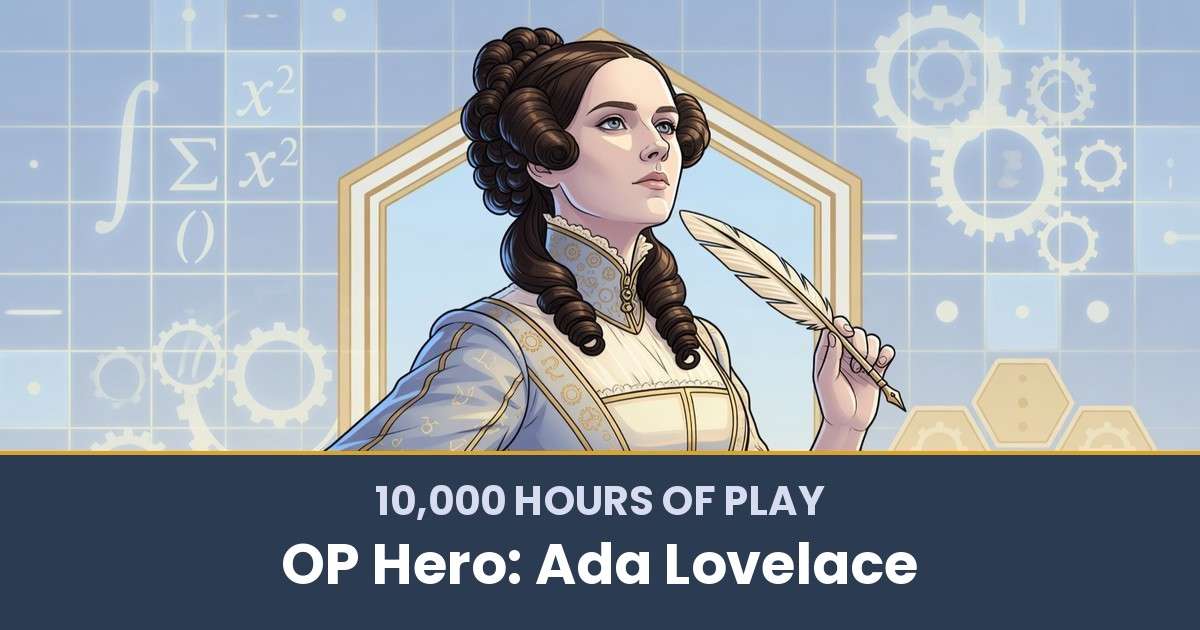


In 1843, a 27-year-old countess in London published the operating instructions for a machine that wouldn’t be built for another century.
Ada Lovelace wasn’t translating someone else’s manual. She was inventing the discipline of computer programming inside the footnotes of a translation, and she knew exactly what she was doing. Her Note A described the Analytical Engine as a general manipulator of symbols whose operations belonged, in her phrase, to an “abstract science of operations” — not arithmetic, but any symbolic system. Her Note G laid out an operation-by-operation algorithm to compute Bernoulli numbers — the worked example everyone now calls the first computer program.
The machine never ran. Babbage never finished building it. Ada was dead at 36, buried beside the father she barely knew. And yet a hundred years later, when Alan Turing wrote his 1950 paper on machine intelligence, he wrote a section called “Lady Lovelace’s Objection” to argue against her — because her 1843 footnotes were still the position to beat. Treat her run through the 10,000 Hours of Play framework and the lesson sharpens fast. She didn’t get lucky on a famous father. She built the most consequential vision-and-detail loop in 19th-century science, and she got 23 working adult years to do it.
⚡ Speed Run Notes
- Ada’s core Game wasn’t “be a mathematician.” It was: prove that abstract symbolic rules — math, logic, music, thought — can be mechanized, and stake a serious scientific identity on that claim while she still could.
- Her standout innate Attribute was visible by age 12, when she designed mechanical wings and called the project “Flyology.” Decompose a problem; build the apparatus; imagine the use. That same loop runs the 1843 Notes.
- Ada ran at least four distinct Roles: prodigy-student, mathematical apprentice under De Morgan, expositor of the Analytical Engine, and proto-theorist of symbolic computation. Each Role earned credibility for the next.
- The Skill that cracked the Engine open wasn’t a flash of insight. It was an intense nine-month period in 1842–43 — a Lich Grind — where she translated Menabrea’s paper and tripled it with original Notes that became the actual technical record.
- Her Allies — Mary Somerville, Augustus De Morgan, Charles Babbage, Charles Wheatstone — each multiplied a different layer of the build. Without Somerville she never meets Babbage. Without De Morgan she can’t write Note G.
- The 1844 letter where she speculates about a “calculus of the nervous system” shows the real range of the vision. She wasn’t only describing a calculator. She was describing computation as a way of thinking about thought.
Table of Contents
- Step 1: The Game — What Ada Lovelace Was Actually Playing
- Step 2: Attributes — The Innate Stats
- Step 3: Role(s) — The Character Class Across Chapters
- Step 4: Skills — The Real-Life Game Skills Ada Lovelace Mastered
- Step 5: Allies — The People Who Multiplied Ada Lovelace
- Step 6: Quests — The Milestones That Shaped the Saga
- What You Can Steal From Ada Lovelace’s Build
- The 10K HP Frame — Ada Lovelace Through the 6 Steps Lens
- Which Octalysis Core Drives Ada Lovelace’s Arc Activated
- Modern Echo — Who’s Playing This Game Today
- Frequently Asked Questions
- Where this framework comes from
- Related Reading
About Yu-kai Chou

Yu-kai Chou is the author of 10,000 Hours of Play — the book that treats your life as the most important game you’ll ever build a character in, and gives you the 6-Step framework (Game · Attributes · Role · Skills · Allies · Quests) to play it on purpose. He has spent two decades developing the system through which this post analyzes its OP Hero, and applies it to his own life and to the lives of the people he advises around the world.
Chou’s other framework, the Octalysis Framework, has been applied by LEGO, Microsoft, Porsche, Coca-Cola, Salesforce, and MrBeast, impacting over 1.5 Billion Users. He has taught the methodology at Harvard, Stanford, Yale, Tesla, Google, BCG, and IDEO, and has advised governments in eight nations including Ukraine, the United Kingdom, the Kingdom of Bahrain, Singapore, Taiwan, the Netherlands, Kazakhstan, and South Korea.
His work has been cited by Harvard, Stanford, MIT, Forbes, Wall Street Journal, Wired, US Department of Energy, NIST, NSF, NCBI, US Department of Education, ClinicalTrials.gov, and Google Scholar — with 3,700+ more academic publications. Explore his books here.
Ada’s run is the one I cite when people tell me their idea is too early. She wasn’t early — she was on time, and the rest of the world was a century late. The lesson I lift from her build is the Skill of visualizing a system fully formed before any of its parts physically exist. Most people need to see the apparatus before they can describe what it will do. Ada described it first and let the apparatus catch up.
Step 1: The Game — What Ada Lovelace Was Actually Playing
The mistake we make with Ada is reducing her game to “write the first computer program.” That’s the artifact, not the game.
The actual game she played from her late teens until her death was this: prove that abstract symbolic rules — mathematics, logic, even music and thought — can be mechanized, and earn a serious scientific identity for herself by being the person who articulated that claim with rigor. Every project she ran fed that mission. The childhood Flyology notebooks. The years of calculus with De Morgan. The translation of Menabrea. The seven original Notes that ran longer than the paper they footnoted. The 1844 letter where she speculated about a “calculus of the nervous system.” All one game, played seven ways.
Note A is the cleanest statement of the game. The Engine, she wrote, is “not merely adapted for tabulating the results of one particular function … but for developing and tabulating any function whatever.” That sentence is the entire 20th century in compressed form. The point of the machine wasn’t arithmetic. The point of the machine was symbol manipulation as a general capacity.
This is why Ada is such a useful 10K HP case study. Most ambitious people pick a Game in their twenties that’s too narrow — “become a published author,” “become a senior engineer,” “make partner” — and then drift in their thirties because the Game can’t tell them which project to take and which to skip. Ada’s Game was specific enough that even her gossip-laden letters to Babbage about the Engine’s promotion served it. If your Game can’t tell you whether to translate a French paper next Tuesday, it isn’t a Game yet — it’s still a job description.
Step 2: Attributes — The Innate Stats
Three Attributes show up so early in Ada’s life that they can only be innate.
Systems-level imagination. At twelve, in 1828, Ada launched a self-directed project she called “Flyology”: she studied bird anatomy, examined materials for wing construction, mapped out propulsion methods, and sketched a steam-powered mechanical horse with wings. This wasn’t a child’s daydream. It was a structured decomposition of an engineering problem — anatomy, materials, mechanics, use case — by a girl who hadn’t yet been taught calculus. The same decomposition style runs Note G fifteen years later.
High abstract-pattern reasoning. Augustus De Morgan, one of the leading logicians of the era and her tutor by correspondence, wrote her mother in January 1844 that her power of mathematical thinking had been “something so utterly out of the common way for any beginner, man or woman.” He compared her capacity to that of a future original investigator of first-rate eminence. De Morgan was not a flatterer. He was a working mathematician describing what he saw across two years of letters that tested her grasp of limits, series, and functional analysis. Compare that to the way the Talent Triangle Method surfaces innate aptitude — Ada’s results in De Morgan’s correspondence are exactly the kind of signal Yu-kai’s method is trying to make visible in your own life.
High-variance risk tolerance. The same person who proposed in 1843 to take over the public management of the Analytical Engine also placed elaborate mathematical bets on horse racing in the early 1850s and lost heavily. Her tolerance for uncertain outcomes was unusually high — across both intellectual and financial domains. The Notes are an intellectual long shot: she staked her scientific reputation on a machine that didn’t exist, on a claim about symbol manipulation that no one was ready to evaluate. That same risk profile, applied to gambling, became her undoing. The trait doesn’t change. The arena does.
Step 3: Role(s) — The Character Class Across Chapters
Ada ran at least four distinct Roles across her short adult life, and each one earned credibility for the next.
Prodigy-student (1820s–1832). Tutored from childhood by William Frend, then later by Mary Somerville. Designed her Flyology system at twelve. Suffered a serious illness in 1829 — most likely measles followed by prolonged paralysis — that kept her partly bedridden until about 1832. The Role looked like a sickly aristocrat’s daughter being kept away from her father’s poetry. Underneath, the symbolic-reasoning Attribute was compounding.
Mathematical apprentice (1833–1842). Mary Somerville introduced her to Charles Babbage on 5 June 1833. She married William King in July 1835 — King became Earl of Lovelace in 1838, making her the Countess — and had three children between 1836 and 1839. From 1840 onward she received structured advanced instruction by correspondence from De Morgan: algebra, calculus, limits, Bernoulli numbers. This is the Role that buys her the technical authority to do the Notes.
Expositor of the Analytical Engine (1842–1843). Charles Wheatstone commissioned her in 1842 to translate Luigi Menabrea’s French paper on Babbage’s Engine. Babbage urged her to expand the translation with original Notes. The result — published 1843 in Scientific Memoirs, signed only with her initials “A.A.L.” — was three times the length of the paper it footnoted and became the major published technical account of the machine. Babbage called her the “Enchantress of Numbers.” The Role made her, in the British scientific community, the public explainer of computation itself.
Proto-theorist of symbolic computation (1843–1852). In the Notes, especially Note A and Note D, she moves past reportage to propose general principles. Machines that operate on rules can in principle act on any symbol system, not just numbers. In an 1844 letter signing herself “Lady-Fairy,” she speculates that mathematics might eventually yield a “calculus of the nervous system.” Like Nikola Tesla, who described AC power grids decades before the infrastructure existed, Ada described the conceptual architecture of computation before anyone could build it.
Step 4: Skills — The Real-Life Game Skills Ada Lovelace Mastered
Four canon 10K HP Skills show up so clearly in Ada’s run that you can date the moment she leveled each one.
Vision Manifestation (Warlock). The Skill of visualizing success so vividly it shapes reality. Ada used it on a machine that hadn’t been built. In Note A she sees a general symbol-manipulator. Later in the same Note she sees it composing “elaborate and scientific pieces of music of any degree of complexity.” The Engine itself was a half-finished pile of brass; her vision of it was complete, and the vision is what historians still cite. Compare it to the way Einstein’s thought experiments ran inside his head decades before the experimental equipment existed to test them. Both built the apparatus inside the mind first and let the world catch up.
Astral Projection (Mage). Seeing all possible outcomes — the Skill of running a system forward across decades of consequence. Ada doesn’t only see what the Analytical Engine could do this year. She projects forward to music composition, to symbolic logic, to a “calculus of the nervous system.” That’s not extrapolation. That’s a working simulation of where general-purpose computation eventually goes — written in 1843, validated by the 1950s. Most working scientists project two or three years out. Ada projected a century out and got the structure right.
Cognitive Lens (Mage). Zooming in on detail and zooming out for strategy. The Notes are the cleanest example of this Skill in 19th-century writing. In Note G she compiles an operation-by-operation table — identify the stored variables, compute intermediate results, reuse previous outputs, iterate — at the granularity of individual machine cycles. In Note A she pulls back to call the engine “the material and mechanical representative of analysis.” The same paper holds both the microscope and the telescope. This range is the same range the Skills Spectrum describes — Specialist depth feeding Master synthesis. Ada had both lenses by twenty-seven.
Lich Grind (Warlock). Intense, secluded work periods — the same Skill profiled in the Lich Pact deep-dive, applied here to nine months. Between late 1842 and the summer of 1843, Ada drove herself harder than her health allowed. De Morgan warned her mother that Ada would make herself ill from “overstrained” mental effort. She produced a 66-page paper of Notes that tripled the original translation. Note G alone is roughly the technical density of a modern computer-science paper. Without those nine months of monastic concentration, the Bernoulli algorithm is a footnote. With them, it’s the founding document of programming.
Loremaster (Druid). Weaving compelling, inspiring stories. In a July 1843 letter to her mother, Ada described her own work with a phrase that’s become famous: “poetical science.” She meant the union of imaginative insight and rigorous analysis — a story-form for technical work. That framing is what made the Notes readable a hundred years later. Note A doesn’t read like a manual; it reads like an argument. She had inherited Lord Byron’s instinct for prose rhythm and trained it on machinery. Most engineers can’t tell the story of their own systems. Ada could.
Step 5: Allies — The People Who Multiplied Ada Lovelace
Ada’s Allies are the part of her build that gets undersold. She had no formal academic position. She shipped through other people.
Lady Byron (Anne Isabella Milbanke) — her mother — enforced and financed a rigorous mathematical education from Ada’s childhood onward, deliberately to counterbalance her absent father’s poetic legacy. Lady Byron hired William Frend and later Augustus De Morgan as tutors. Without that program, Ada is a literary widow’s literate daughter. With it, she’s a mathematician.
Mary Somerville — herself one of the most accomplished women in 19th-century British science — mentored Ada through her late teens in mathematics and physical science, brought her into London scientific circles, and on 5 June 1833 introduced her to Charles Babbage. Without Somerville, the meeting that defined Ada’s career never happens.
Augustus De Morgan — logician and her structured mathematics tutor from 1840 to 1844 — drilled her through algebra, calculus, limits, series, and Bernoulli numbers by correspondence. The technical scaffolding of Note G is De Morgan’s training. He wrote Lady Byron in January 1844 that Ada had the capacity to become “an original mathematical investigator, perhaps of first-rate eminence.”
Charles Babbage — inventor of the Difference Engine and the Analytical Engine — gave Ada the machine. From their first meeting in 1833 until her death he served as intellectual collaborator, correspondent, and at moments antagonist. In an 1843 letter to Faraday he called her “that Enchantress who has thrown her magical spell around the most abstract of Sciences.” He also refused to let her include her own preface attacking the British government for failing to fund the Engine — and the relationship was tense for months because of it.
Charles Wheatstone — physicist and editor — commissioned the Menabrea translation in 1842 and encouraged her to expand it with original commentary. Wheatstone is the Ally who unlocks the platform.
William King-Noel, Earl of Lovelace — her husband — provided social standing and a country house at Ockham where she could work undisturbed. The marriage was strained by her later gambling, but the early years gave her the operating environment a serious intellectual life required of a Victorian woman.
Step 6: Quests — The Milestones That Shaped the Saga
Six Quests structure Ada’s life.
Quest 1: Flyology (1828–1829). At twelve, she designed a mechanical flying machine, studied bird anatomy, sketched a steam-powered winged horse, and wrote her mother letters describing the project in serious engineering language. The whole 10K HP build pattern — observe a system, decompose it, design the apparatus, imagine the use — is already running.
Quest 2: The setback — childhood paralysis (1829–1832). A serious illness, most likely measles followed by prolonged debility and partial paralysis, kept Ada bedridden or partly so for nearly three years. Most accounts of her life skip past this. They shouldn’t. For a child whose Attribute was systems-level imagination, three years immobilized would either end the build or compress it. Ada’s Phoenix Rebirth (Paladin) is the year she walks again and resumes formal mathematical study under her mother’s hired tutors. Like Marcus Aurelius using physical fragility as a forcing function for inner work, Ada used the bedridden years to read.
Quest 3: First meeting with Babbage (5 June 1833). Mary Somerville arranges for seventeen-year-old Ada and her mother to attend a Babbage soirée. Ada sees the Difference Engine No. 1 in operation. Unlike most guests, she engages technically with its mechanism. The intellectual relationship that produces Note G ten years later is set in motion that evening.
Quest 4: Intensive mathematical study with De Morgan (1840–1842). Two years of structured advanced instruction by correspondence. Algebra, calculus, limits, series, the foundations of analysis. This is the apprenticeship Quest — the years that look quiet from outside but build the actual capacity for the famous Quest that follows.
Quest 5: The Menabrea translation and Notes A–G (1842–1843). Wheatstone commissions the translation. Babbage urges her to expand it. Nine months of intense work. Published in Scientific Memoirs volume 3, signed “A.A.L.” Note G contains the worked Bernoulli-numbers algorithm — a finite, machine-executable sequence of operations, complete with data dependencies, written for a general-purpose computing machine. This is the Quest that the rest of computing rests on. Compare the structural pattern to Jensen Huang’s decades of unfashionable chip work — both runs spent years on technical groundwork the world ignored, then shipped the artifact that defined an industry.
Quest 6: The gambling collapse and final illness (1851–1852). Ada became involved with a horse-racing syndicate alongside John Crosse and others, applying mathematical models to betting. The system failed. She accumulated heavy losses, reportedly pawned jewels, strained her marriage, and concealed details from her husband. Within the same window she fell ill with uterine cancer. She died on 27 November 1852, age 36, and was buried beside Lord Byron in the Byron family vault at the Church of St Mary Magdalene, Hucknall, Nottinghamshire. The combination — high-risk intellectual bet that paid off across a century, plus high-risk financial bet that destroyed her last year — is the same Attribute, played twice, with very different outcomes.
What You Can Steal From Ada Lovelace’s Build
Three lessons for anyone running an early-vision Quest.
Describe the apparatus before it exists. The most underrated move in Ada’s run is that she wrote the operating principles of a machine that hadn’t been built. She didn’t wait for the brass and gears. She built the description, in prose tight enough that the description outlived the machine, the inventor, and her. If your Game involves a system that doesn’t exist yet — a product, a method, a discipline — write the manual now. Don’t wait for the apparatus. The manual is the apparatus, at the layer that matters first.
Run a Lich Grind on the unsexy technical layer. Note G works because De Morgan put Ada through two years of unglamorous correspondence on series, limits, and Bernoulli numbers. The dramatic Quest — the published Notes — rests on a quiet apprenticeship that nobody photographed. Most people skip the apprenticeship and try to ship the dramatic Quest, and the Quest doesn’t survive scrutiny. Find your De Morgan. Take the years.
Pair the vision with someone who can ship it physically. Babbage was a finisher’s nightmare — brilliant, distractible, hostile to government bureaucracy, never completed either Engine. Ada didn’t try to be Babbage. She paired her vision-and-Notes layer with his apparatus-and-engineering layer. The pair is what made the work survive. If your Skill stack is heavy on Vision Manifestation and lighter on physical execution, the question is not “should I learn execution.” The question is “who is my Babbage.” Look for a building partner before you need one.
Ada Lovelace’s run sits inside a longer canon Yu-kai is building one OP Hero at a time. If you want to compare her vision-and-detail loop to other early-prophet builds, start at the OP Hero hub and pick the build closest to your own — Hedy Lamarr and Isaac Newton both ran versions of the same “see it first, the world catches up later” pattern.
The 10K HP Frame — Ada Lovelace Through the 6 Steps Lens
Run the whole story back through the 10,000 Hours of Play framework in a single pass and Ada’s build resolves into one of the cleanest early-vision runs in the OP Hero library.
Her Game was chosen before the world had a name for it: prove that symbolic rules can be mechanized, and earn a serious scientific identity by being the one who said so with rigor. Everything else in the run is scaffolding for that single claim.
The Attributes were visible by age twelve. Flyology already contains the full loop she would later run on the Analytical Engine: study the system, decompose it, design the apparatus, imagine the use.
Her Roles laddered with unusual discipline. Prodigy-student earned the education, apprentice under De Morgan earned the technical depth, expositor of the Engine earned the platform, and proto-theorist spent the credibility the first three had banked.
The Skill stack reads Mage-Warlock at the core with a Druid finish. Vision Manifestation (Warlock) and Astral Projection (Mage) supplied the century-out sight, Lich Grind (Warlock) supplied the nine brutal months of 1842–43, and Loremaster (Druid) made the Notes readable enough to survive.
Three more canon Skills deserve names this pass. Ley Line Infusion (Mage): between 1840 and 1842 she absorbed university-grade analysis by correspondence, while raising three young children, compressing a degree’s worth of mathematics into two years.
Shadow Dance (Rogue): the meeting that defined her career came through someone else’s network. Mary Somerville’s standing in London science is what put a seventeen-year-old in Babbage’s drawing room on 5 June 1833.
And Cloak (Rogue): she signed the most consequential technical publication of her century “A.A.L.” Executing without being noticed was the price of being read fairly in 1843, and she paid it deliberately.
The first computer program shipped a century before the machine that could run it. That is what a maxed-out vision Skill tree looks like.
Read as a whole, the run also shows why the framework insists on all six Steps. Biography flattens Ada into one artifact and one collaborator; the 6 Steps recover the mother who funded the Attributes, the tutor who built the Skills, and the twenty quiet years of Roles that made nine famous months possible.
The practitioner translation is direct. Pick a claim precise enough to steer your Tuesdays, apprentice under the sharpest teacher who will answer your letters, and write the definitive description of the thing you believe in before anyone asks for it.
Then find your Babbage. Vision that never pairs with a builder stays commentary, and builders who never recruit a describer ship machines that history forgets how to read.
If you want the full 6-Step system this reading comes from, the 10,000 Hours of Play book walks the whole framework with worksheets. The Claude Shannon profile then picks up this exact thread a century later, when the “abstract science of operations” Ada described finally met hardware that could carry it.
Which Octalysis Core Drives Ada Lovelace’s Arc Activated
The 6 Steps explain what Ada built. The Octalysis Framework explains why she could not stop building it.
Four of the 8 Core Drives show up in her arc with datable evidence.
Core Drive 1: Epic Meaning & Calling. “Poetical science” was a mission statement, and she meant it literally.
Note A carries the tell. She interrupts a technical exposition to declare what the Engine means for the future of science, because for her the meaning was the point of the mathematics.
When she offered in 1843 to manage the Engine’s public affairs, she was volunteering for a cause she expected to outlive her. It did.
Core Drive 3: Empowerment of Creativity & Feedback. The Flyology notebooks at twelve, the Notes at twenty-seven, the music-composition passage in Note A: every artifact in her run is a creative construction inside rigorous constraints.
De Morgan’s correspondence course gave the loop its feedback half. She submitted proofs, he sent back corrections, and two years of that cycle produced the mathematician who could write Note G.
Core Drive 5: Social Influence & Relatedness. Ada held no university post and no society membership, so her entire career ran on relationships: Somerville’s mentorship, Babbage’s soirées, De Morgan’s letters, Wheatstone’s commission.
Recognition flowed back through the same channels. Babbage’s “Enchantress” letter, De Morgan’s first-rate-eminence verdict, Somerville’s sponsorship: in an era that would not put her name on a title page, praise from allies was the scoreboard.
The relatedness thread cuts deeper than networking. She named her first son Byron, and she chose burial beside the father she barely knew; the pull of that absent relationship shaped both the poetry her mother feared and the “poetical science” she invented instead. Emmy Noether’s run shows the ally-routed half of this pattern seventy years later: institutional doors closed, and the work traveled through people anyway.
Core Drive 7: Unpredictability & Curiosity. Curiosity powered the whole run: a machine nobody understood, a mathematics nobody had systematized, a future nobody could see.
Then the same drive found the racetrack. The mathematical betting syndicate of her final years ran on identical psychological fuel, stripped of the Epic Meaning that had kept her science aimed somewhere worth going.
A Core Drive has no conscience. The curiosity that wrote Note G also ran the betting syndicate that consumed her final year.
Notice which drives are missing, because the absences are just as diagnostic. Core Drive 2: Development & Accomplishment barely registers; Ada collected no degrees, no medals, and no titles beyond the one her marriage supplied.
Core Drive 8: Loss & Avoidance shows up secondhand, in Lady Byron’s project to mathematize her daughter before the Byron inheritance could surface. The education that produced the first programmer was designed as a defense.
The design lesson is one Yu-kai teaches in every Octalysis workshop: White Hat drives like Epic Meaning keep a motivation engine pointed somewhere, and when they fall away, the remaining drives keep burning fuel with nowhere good to go. Ada’s arc demonstrates both halves inside one lifetime.
Modern Echo — Who’s Playing This Game Today
Ada’s 1844 letter about a “calculus of the nervous system” reads today like a job posting that took 180 years to fill.
Demis Hassabis is the clearest occupant. Trained as a cognitive neuroscientist before founding DeepMind, he shared the 2024 Nobel Prize in Chemistry with John Jumper for AlphaFold, the system that taught computation to read biology’s symbol language of protein structure.
The scale of the echo is measurable. More than two million researchers have used AlphaFold, and his drug-design company Isomorphic Labs raised $2.1 billion in 2026 to push the first AI-designed medicines toward human trials.
Ada described symbol manipulation reaching music, logic, and thought. Hassabis carried the same bet into molecules, and it is paying out inside a single career instead of across a century.
Yoshua Bengio holds the other half of her inheritance: the Objection. Alan Turing spent a section of his 1950 paper arguing with Ada’s claim about machine originality, and the argument has never closed.
Bengio, a Turing Award laureate, now chairs the International AI Safety Report backed by 30 countries, and in June 2025 he founded the nonprofit LawZero to build AI that is safe by design. Writing the operating limits of machines that do not fully exist yet is the most Lovelace job description of this decade.
Every generation gets a few people who write the manual before the machine exists. In 1843 it was a countess working in the footnotes.
Neither echo is decorative. Both careers test her two specific predictions: that computation would eventually reach every symbol system including life and thought, and that the question of what machines can originate would demand an answer.
Both also repeat the 10K HP lesson from her build: describe the apparatus first, then recruit the era’s best builders as Allies. Browse the OP Hero hub to find the run closest to the one you are playing.
Frequently Asked Questions
Did Ada Lovelace really write the first computer program?
Historians note that Babbage had sketched fragments of Engine instructions earlier, but the operation-by-operation Bernoulli algorithm in Ada’s 1843 Note G is the first published algorithm written for a general-purpose computer. Her larger first is conceptual: the Notes are the earliest published argument about what software could eventually become, including applications beyond number entirely.
Why is Ada Lovelace called the Enchantress of Numbers?
Charles Babbage coined the phrase in an 1843 letter, writing that she had “thrown her magical spell around the most abstract of Sciences.” The nickname endured because it captures her signature pairing of imaginative vision with mathematical rigor.
What is Lady Lovelace’s Objection?
In his 1950 paper on machine intelligence, Alan Turing gave that name to Ada’s claim that the Analytical Engine had “no pretensions whatever to originate anything.” Her 1843 footnote framed the machine-creativity debate that AI researchers are still arguing about today.
When is Ada Lovelace Day?
Ada Lovelace Day falls on the second Tuesday of October each year as an international celebration of women in science, technology, engineering, and mathematics. It began in 2009, and Ada was chosen as its figurehead because her story combines technical achievement with an against-the-odds path into science.
What framework is this Ada Lovelace profile based on?
This profile runs Ada’s biography through the 10,000 Hours of Play framework, the 6-Step system (Game, Attributes, Role, Skills, Allies, Quests) from Yu-kai Chou’s book of the same name. Every figure in the OP Hero series gets the same treatment, so the builds can be compared side by side.
Where this framework comes from

Want the full system this profile is built on?
Every OP Hero piece runs through the same 6-Step framework from 10,000 Hours of Play: Unlock Your Real-Life Legendary Success. The book covers the full system, walks through Yu-kai’s own life run as the first applied case study, and gives you the worksheets to audit your own build.
Related Reading
- All OP Hero Profiles — the full library of 10K HP-framework character studies, updated as new heroes ship.
- 10,000 Hours of Play by OP Hero: Hedy Lamarr — another woman inventor whose ideas arrived decades before the technology was ready.
- 10,000 Hours of Play by OP Hero: Nikola Tesla — a parallel “see it a century out” build whose visions outlived the man who described them.
- 10,000 Hours of Play by OP Hero: Richard Feynman — for the playful-rigor version of Ada’s “poetical science” framing.
- The 10,000 Hours of Play framework hub — start here if you want to map your own Game · Attributes · Role · Skills · Allies · Quests.