
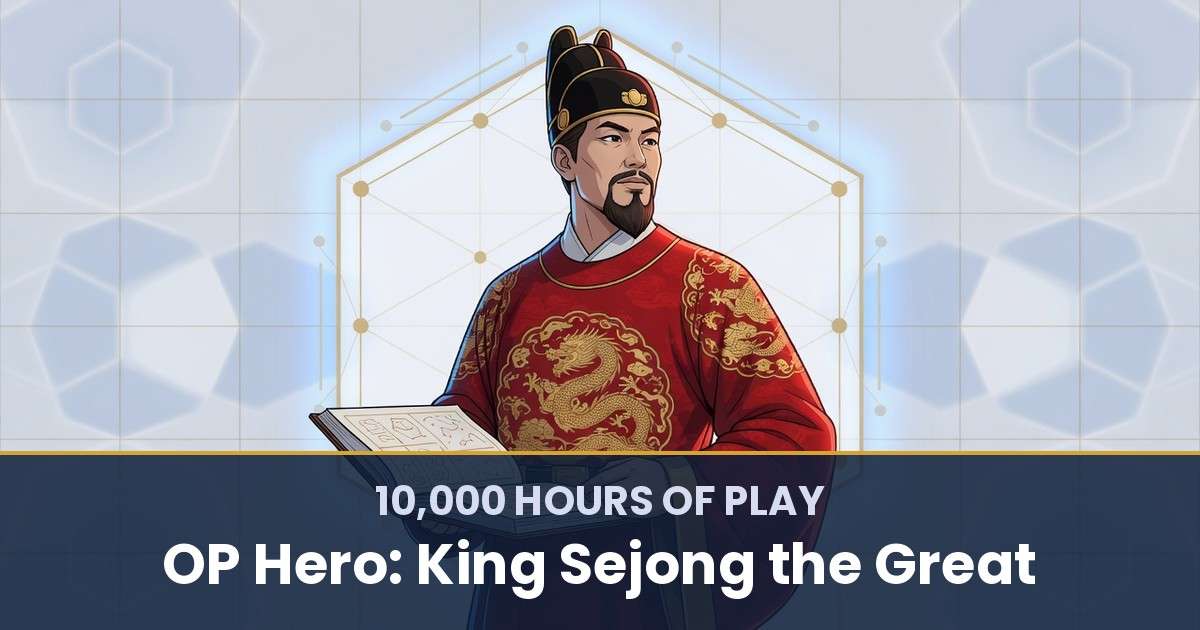


In the ninth lunar month of 1446, the royal court of Joseon Korea issued a slim manuscript whose opening argument the king had written himself. The speech of his country differed from China’s, he explained, and ordinary people who could not put their thoughts into writing deserved letters of their own.
The manuscript was Hunminjeongeum, “the correct sounds for the instruction of the people.” Its alphabet ran to 28 letters, and the scholars’ postface claimed a wise man could learn them before a morning ended, while a fool needed ten days.
Sejong, the fourth king of Joseon, ran his entire thirty-two-year reign like that: an absolute monarch spending his power to make capability cheaper for the people below him. Cheaper literacy, cheaper timekeeping, cheaper weather data.
Run him through the 10,000 Hours of Play framework and the build reads as an unusually clean one: a king who played designer, and whose 28-letter deliverable is still in daily use across an entire peninsula nearly six centuries later.
⚡ Speed Run Notes
- Sejong’s Game was lowering the cost of capability: a 28-letter alphabet, court-built instruments, and state records engineered so useful knowledge could reach the people who needed it.
- His defining Quest shipped in 1446: Hunminjeongeum, the alphabet now called Hangul, completed in 1443 and published with a written design rationale from his own research institute.
- Skills on display: Arcane Wisdom (Mage), Track Treasure (Ranger), Tactical Command (Ranger), Floral Blossom (Druid), Devour (Warlock), and Aegis (Paladin).
- Allies were recruited on output: Hall of Worthies scholars wrote the alphabet’s commentary, and an engineer whom standard accounts describe as born a government slave built the court’s clocks and rain gauge.
- The steal: compress the entry cost of your craft. Sejong bet that letters learnable in days would beat a prestige script that took years, and history sided with him.
Table of Contents
About Yu-kai Chou

Yu-kai Chou is the author of 10,000 Hours of Play — the book that treats your life as the most important game you’ll ever build a character in, and gives you the 6-Step framework (Game · Attributes · Role · Skills · Allies · Quests) to play it on purpose. He has spent two decades developing the system through which this post analyzes its OP Hero, and applies it to his own life and to the lives of the people he advises around the world.
Chou’s other framework, the Octalysis Framework, has been applied by LEGO, Microsoft, Porsche, Coca-Cola, Salesforce, and MrBeast, impacting over 1.5 Billion Users. He has taught the methodology at Harvard, Stanford, Yale, Tesla, Google, BCG, and IDEO, and has advised governments in eight nations including Ukraine, the United Kingdom, the Kingdom of Bahrain, Singapore, Taiwan, the Netherlands, Kazakhstan, and South Korea.
His work has been cited by Harvard, Stanford, MIT, Forbes, Wall Street Journal, Wired, US Department of Energy, NIST, NSF, NCBI, US Department of Education, ClinicalTrials.gov, and Google Scholar — with 3,700+ more academic publications. Explore his books here.
Sejong points in a direction most powerful people don’t. Given real authority, he used it to remove steps for the people downstream of him rather than to add them. If other people have to use what you build, that instinct — subtract friction for the user rather than add prestige for yourself — is worth training early.
Step 1: The Game — What King Sejong the Great Was Actually Playing
Born in 1397 as Yi Do, the third son of King Taejong, Sejong was never supposed to define an era.
Once the throne was his, the Game came into focus fast: strengthen the state through practical learning, and move useful knowledge from the palace out to the people.
Everything he backed follows that single quest line. Calendar reform, astronomy, printing, agriculture, law, and eventually a phonetic script were treated as one connected program rather than separate royal hobbies.
Ambition at that scale usually points at territory or monuments. His pointed at usability: the flagship deliverable of the reign was an alphabet that shipped with a user manual.
Marcus Aurelius’ OP Hero build shows the philosopher-king pattern from the Roman side of the map, a ruler treating governance itself as the practice. Sejong ran the same archetype with an engineer’s toolkit.
The Hunminjeongeum preface reads as the mission statement of the whole Game: a king explaining, in writing, that the state’s most basic tool should fit the people who actually use it.
Step 2: Attributes — The Innate Stats
Attributes are the stats you carry into the game before any training touches them. Four of Sejong’s are visible across every project he ran.
Scholarly intensity. His reign institutionalized learning to a degree the sources treat as its defining feature, and the king kept himself personally tied to the reign’s hardest intellectual work: the composition and framing of Hunminjeongeum.
Systems pattern recognition. Sejong treated language, astronomy, agriculture, and calendrics as one connected machine. Fix the script and ordinary people can put their case in writing; fix the clocks and the whole capital runs on the same hour.
Empathy for commoners. The stated rationale for the alphabet was access: letters that people without classical training could learn easily. From an absolute monarch, that instinct is rare enough to count as a stat.
Practical vision. The record keeps circling a single theme: usefulness over ornament. He backed the version of each project that worked in ordinary hands over the version that merely looked impressive at court.
None of those four stats is rare on its own. What made Sejong unusual was the overlap, which is the pattern the Talent Triangle Method is built to find: a real edge tends to come from where several ordinary strengths meet, not from one maxed-out trait. Scholarly depth, a builder’s pragmatism, and unusual empathy rarely share a single person, and here they shared one who also held absolute power.
Step 3: Role(s) — The Character Class Across Chapters
Roles are the character classes you equip for a chapter of life. Sejong’s first class change was one nobody scripted.
Third Son (1397–1418). His eldest brother Yangnyeong had been crown prince since 1404. In 1418 Yangnyeong was removed, Sejong was elevated in his place, and his father Taejong abdicated to him within the same year.
King-Reformer (1418 onward). From accession, he governed through knowledge institutions: scholarly offices, technical projects, and formal records rather than personal decree alone.
Scientific Sponsor (1430s–1440s). He turned the throne into a funding engine for astronomy, timekeeping, and weather measurement, staffed by specialists he personally elevated.
Language Architect (1443–1446). The sources tie the king directly to the intellectual framing of the new script; the preface and the project’s rationale are attributed to Sejong himself.
Patron-Archivist (the whole reign). Court diarists logged the administration day by day, and those files later became the Veritable Records of Sejong.
Lee Kuan Yew’s OP Hero build is the closest modern parallel in this library: a head of state who treated the nation as a system to be engineered. Sejong ran that class five centuries earlier, with brush and bronze instead of spreadsheets.
Step 4: Skills — The Real-Life Game Skills King Sejong the Great Mastered
Skills are the learnable half of a build. The Skills Spectrum separates the specialist, who goes deep on one craft, from the strategist, who collects many Skills and aims them at a single goal. Sejong is the strategist case: no one skill maxed out, but a whole stack of them pointed at the same Game.
Arcane Wisdom (Mage): absorbing wide knowledge and synthesizing it into clear outputs. The clearest artifact is the alphabet itself, published with commentaries and worked examples, which is why Hangul is described as the only major writing system whose inventor and design rationale are both documented. John von Neumann’s OP Hero profile shows the same Skill compounding in a modern Mage; Sejong ran it wearing a crown.
Track Treasure (Ranger): identifying hidden value others walk past. Standard accounts describe Jang Yeong-sil as born into government-slave status, and Sejong pulled him into court service and promoted him to official rank as an engineer. The talent was real and the pedigree was nonexistent, and Sejong hired on the first.
Tactical Command (Ranger): making people of different talents work as one unit. The Hall of Worthies supplied scholarship, Jang’s workshop supplied machines, and the throne sequenced both into a single program of practical learning.
Floral Blossom (Druid): educating and mentoring at scale. The alphabet was teaching infrastructure, letters designed so common people could learn them easily, shipped with explanatory examples from his scholars.
Devour (Warlock): stripping a process down to its leanest form. Literacy in classical Chinese demanded years of study. Sejong’s replacement ran on 28 letters, 17 consonants and 11 vowels, learnable by the postface’s own claim in a morning if you were sharp and in ten days if you were slow.
Aegis (Paladin): pushing the Quest through public criticism. When the formal protest against his alphabet arrived in 1444, Sejong rejected it and kept shipping, a confrontation Step 6 returns to in full.
Step 5: Allies — The People Who Multiplied King Sejong the Great
Nobody engineers a dynasty alone. Sejong’s Allies were institutions as much as individuals, and he built most of them himself.
The Hall of Worthies (Jiphyeonjeon). His court’s scholarly office turned royal intent into durable systems. UNESCO’s record of the 1446 manuscript credits these scholars with the commentaries and examples that made the new script teachable, which is the difference between an idea and an institution.
Jang Yeong-sil. The promoted engineer’s output reads like a patch log for a kingdom: the self-striking water clock Jagyeongnu completed in 1434, Angbu-ilgu sundials placed in the capital in the 1430s, and the cheugugi rain gauge introduced in 1441. The annals record the clock sounding the hours automatically, a public utility for time itself.
The record keepers. Court diarists and administrators logged the reign day by day. Their files became the Veritable Records of Sejong, completed in 1454, and that archive is the reason a 15th-century reign can be studied in this much detail at all.
The recruiting pattern is consistent across all three. A research institute, a promoted outsider, and a bureaucracy of scribes were each brought in for what they could produce rather than for the rank they carried.
Step 6: Quests — The Milestones That Shaped the Saga
Quest 1: Take a throne nobody promised you (1418). Yangnyeong’s removal, Sejong’s elevation to crown prince, and Taejong’s abdication all landed within a single year. The new king opened his reign owing his seat to performance rather than birth order.
Quest 2: Instrument the kingdom (1430s–1441). Sundials in the capital, the self-striking clock in 1434, the rain gauge in 1441. Each device moved another natural phenomenon into the column of things the state could measure.
Quest 3: Hold the northern line (1433 onward). Campaigns from 1433 established four counties along the Yalu and six garrisons along the Tumen, the frontier program that secured the kingdom’s north.
Quest 4: Ship the alphabet (1443–1446). The letters were complete by 1443. The Haerye edition with the scholars’ commentary followed, and the manuscript was promulgated in the ninth lunar month of 1446.
The boss fight (1444). The fiercest resistance came from inside his own institute. Choe Manri, a vice-director of the Hall of Worthies, led a memorial protesting that the new script turned away from the civilized world of Chinese letters; Sejong rejected the criticism and the project continued.
The sting was in the source. His own hand-picked scholars, in the institute he had built for exactly this kind of work, were arguing that the script was a mistake.
Quest 5: Leave the log files (1450–1454). Sejong died in 1450, after thirty-two years on the throne. Four years later the court completed the Veritable Records of Sejong, compiled from the daily administrative record, and the reign became permanently auditable.
What You Can Steal From King Sejong the Great’s Build
The moves transfer without the crown.
Compress the entry cost. Whoever uses what you build has to get through the first hour of it. Sejong staked royal prestige on a script simple enough to pick up in an afternoon, so treat the beginner’s first hour of your own work as the thing worth optimizing.
Recruit on demonstrated talent. The court’s best engineer came from its lowest caste. A pedigree filter would have cost Sejong the water clock, the sundials, and the rain gauge.
Publish your design rationale. The Haerye commentary is why Hangul is still studied as a design object centuries later. Write down why your system works the way it does; the explanation outlives every version of the thing itself.
Expect the protest from your own guild. The 1444 memorial came out of the institute Sejong founded. When your best people defend the old standard, you are learning what a real standards change feels like from the inside.
Keep the record. Daily logs became the Veritable Records, and the Records became his afterlife. Your version can be as small as a changelog and a decision journal.
To see how other legendary builds run through the same six Steps, browse the rest of the OP Hero profiles.
Where this framework comes from

Want the full system this profile is built on?
Every OP Hero piece runs through the same 6-Step framework from 10,000 Hours of Play: Unlock Your Real-Life Legendary Success. The book covers the full system, walks through Yu-kai’s own life run as the first applied case study, and gives you the worksheets to audit your own build.
Related Reading
- OP Hero Profiles: 100+ Legendary Lives as RPG Builds
- Louis Braille: OP Hero Profile
- Sun Tzu: OP Hero Profile
- Laozi: OP Hero Profile
- Socrates: OP Hero Profile
- Carl Jung: OP Hero Profile