
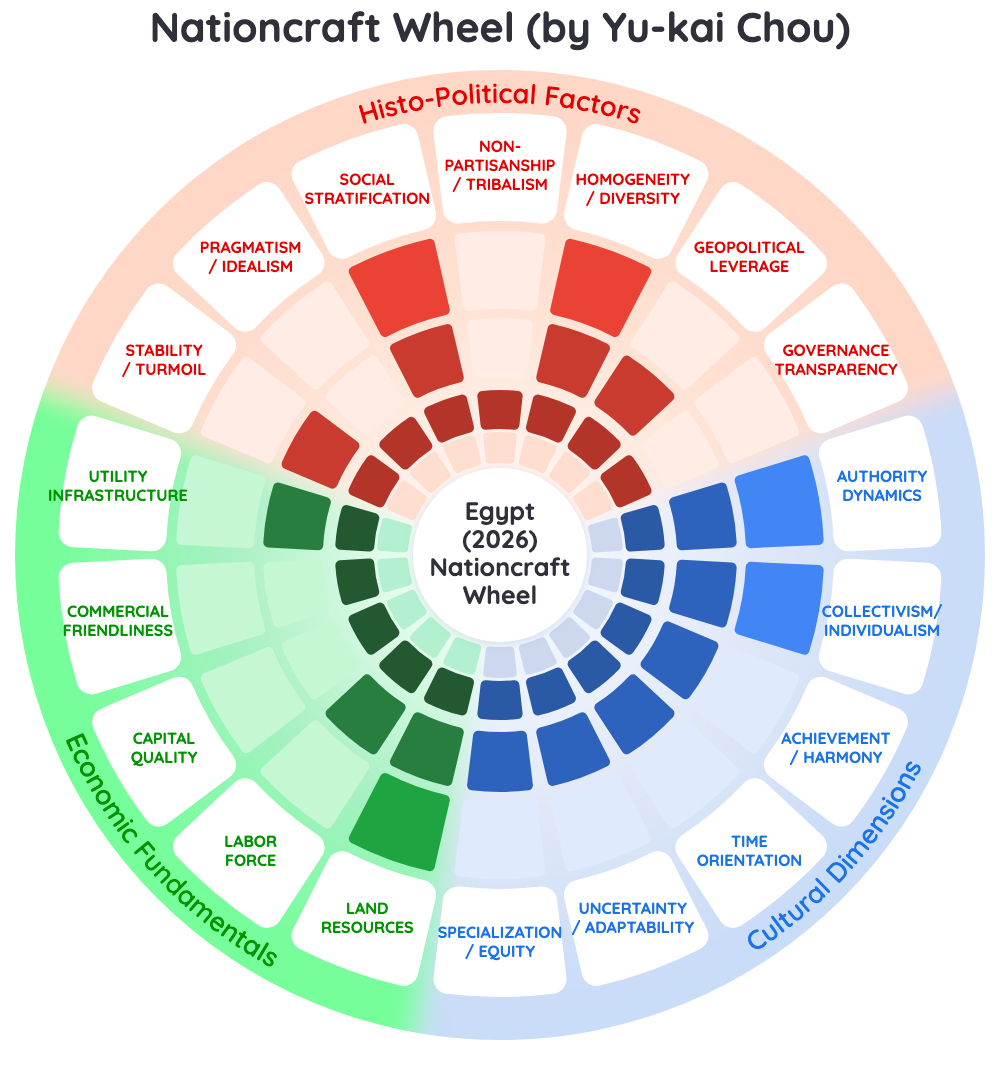

On December 15, 2026, Egypt’s $8 billion IMF program expires. There is no successor arrangement, and no formal talks about one.
On paper, this is graduation day. Reserves stand at 119 percent of the IMF’s adequacy benchmark, seven reviews have been completed, roughly $7.3 billion has been disbursed, and an IMF mission has been working in Cairo toward the final sign-off, worth about $2.3 billion, ahead of a mid-December board target.
But one number in the IMF’s own seventh-review release deserves to stop every reader cold: divestment proceeds to date of around $520 million, in a program whose structural centerpiece was the state selling down its economic empire.
That figure measures the structural heart of the program, the commitment to shrink the state and military footprint in the economy, and it says the footprint barely moved. Egypt is about to pass its final exam while the one question the whole course was built around sits nearly untouched on the desk.
This analysis names that pattern the Exit Exam Trap, reads it through Egypt’s 18 Nationcraft variables, and shows which historical reform playbooks fit a configuration like this one and which would fail on contact.
⚡ Speed Run Notes
- Egypt’s $8 billion IMF program expires December 15, 2026 with no successor. The macro exam is passed: reserves above the IMF’s full adequacy benchmark, seven reviews cleared, $7.3 billion disbursed. The structural exam never really started.
- The IMF’s seventh review puts divestment proceeds to date at around $520 million and lists slow progress in reducing the state’s role among the program’s chief risks. The core question, who owns the economy, exits the program unanswered.
- The Exit Exam Trap: a state can graduate from an IMF program by passing every macro test while skipping the structural coursework. The certificate then certifies dependence, because the buffers are borrowed.
- $18.3 billion in Gulf deposits carries assurances only through program expiry. With V16=3 capital markets and V13=3 transparency, Egypt keeps the scaffolding’s bill after the examiner leaves.
- Nationcraft’s packet reading: study Uzbekistan’s gradual opening (SP-045), Ghana’s Rawlings adjustment (SP-038), and Brazil’s Plano Real institutionalization (SP-034). Thatcher privatization, shock therapy, and the Tiger model all misfit Egypt’s configuration.
Table of Contents
- Understanding Egypt’s Governance Landscape Through Nationcraft
- What Is the Nationcraft Framework?
- Why This Egypt Variables Analysis Matters
- The 18 Egypt Nation Variables
- The Exit Exam Trap
- Detailed Justifications: Reading Each Variable
- The Program Scorecard: What Was Met and What Was Deferred
- Six Reformer Playbooks That Fail Against Egypt’s Configuration
- Three Playbooks Egypt’s Reformers Should Actually Study
- Strategic Implications
- Governance Strategy Recommendations
About Yu-kai Chou

Yu-kai Chou is a Human-Systems Architect & Behavioral Designer and the creator of the Nationcraft Framework — an 18-variable diagnostic for matching a country’s structural profile to the reform packets that have historically worked under similar conditions. He has consulted for governments in eight nations, including Ukraine, the United Kingdom, the Kingdom of Bahrain, Singapore, Taiwan, the Netherlands, Kazakhstan, and South Korea, and has worked directly with President Zelenskyy’s team on post-war reconstruction priorities for Ukraine.
Chou’s prior framework — the Octalysis Framework — has been applied by LEGO, Microsoft, Porsche, Coca-Cola, Salesforce, and MrBeast, impacting over 1.5 Billion Users. He has taught the methodology at Harvard, Stanford, Yale, Tesla, Google, BCG, and IDEO.
His work has been cited by Harvard, Stanford, MIT, Forbes, Wall Street Journal, Wired, US Department of Energy, NIST, NSF, NCBI, US Department of Education, ClinicalTrials.gov, and Google Scholar — with 3,700+ more academic publications. Explore his books here.

This Egypt analysis is the second Nationcraft reading of the country in 2026. The July analysis mapped the military’s economic footprint; this one examines the moment that footprint meets a program deadline. Chou’s advisory work with eight governments has repeatedly centered on the same question Egypt now faces: how a state builds internal discipline once external discipline expires.
Understanding Egypt’s Governance Landscape Through Nationcraft
Egypt in late 2026 is a state that has done something difficult and real. It stabilized a currency crisis that in early 2024 looked capable of consuming the government, rebuilt foreign-currency reserves to $56.5 billion by November 2025 and to 119 percent of the IMF’s reserve-adequacy metric by mid-2026, and brought headline inflation from peaks above 30 percent down to 14.3 percent by June 2026.[1][2]
It did this inside the discipline of an Extended Fund Facility approved in December 2022, expanded to roughly $8 billion, and extended to run through December 15, 2026.[3]
The Nationcraft Framework reads states as configurations, and Egypt’s configuration explains both the achievement and its limit. A V1=9 authority structure can execute painful macro adjustment quickly: float the pound, cut subsidies, raise electricity prices.
What a V1=9 structure resists is the structural half of the same program, because the structural half asks the governing coalition to sell assets the coalition itself holds. With V13=3 transparency and V16=3 capital quality, the sale mechanism barely exists even where the will does.
So the program splits in two, and the sections below measure each half against the record once the examiner leaves in December.
What Is the Nationcraft Framework?
The Nationcraft Framework is an 18-variable diagnostic for matching a country’s structural profile to the reform packets that have historically worked under similar conditions. The 18 variables span culture (V1–V6), political history (V7–V13), and economic endowment (V14–V18).
The core thesis: policy effectiveness is decided by context-fit, and a playbook that transformed one country can wreck another whose variables differ. The framework’s evidence base is a corpus of over one hundred historical Success Packets, each recording the variable preconditions under which a reform program succeeded or failed.
Each Nationcraft analysis scores the country’s current 18-variable vector, names the paradox the configuration produces, then tests historical packets against it. The full method and the growing set of country studies live in the Nationcraft Nation Variables Library.
Why This Egypt Variables Analysis Matters
Program exits are rare and badly understood. Most IMF coverage treats the final review as an epilogue. In the Nationcraft reading, the final review is where external discipline switches off and whatever internal discipline exists gets measured for the first time.
This site has now tracked that moment across several 2026 cases. Sri Lanka’s Graduation Cliff analysis mapped a program exit arriving in March 2027. Ghana’s Imported Discipline Trap examined a state that borrowed its fiscal rules from the lender and must now own them.
Egypt is the largest and most consequential case in this series. A nation of over 100 million people, the Arab world’s demographic anchor, holder of the Suez Canal, is about to exit the scaffolding that held its currency together, with the structural reform ledger showing divestment proceeds of roughly $520 million against a program whose stated purpose included a decisive reduction of the state’s economic footprint.[1]
For reformers, analysts, and anyone whose decisions touch Egyptian risk, the question this analysis answers is concrete: what does the 18-variable configuration say happens after December 15, and what would have to change for the answer to improve?
The 18 Egypt Nation Variables
Here is Egypt’s full Nationcraft V-vector as of November 2026. Scores are on a 1–9 scale; the vector is a configuration, and the paradox lives in the interactions, never in any single score.
| Variable | Score | One-line evidence |
|---|---|---|
| V1 Authority Dynamics | 9 | Military-led presidential autocracy; el-Sisi in power since 2014, re-elected December 2023 |
| V2 Collectivism | 8 | Family, faith, and community primacy; strong in-group norms |
| V3 Achievement vs Harmony | 5 | Stability-over-competition equilibrium |
| V4 Time Orientation | 4 | Prestige megaprojects over deferred payoff; New Administrative Capital |
| V5 Uncertainty Adaptability | 6 | Adapts under acute pressure (2016 and 2024 floats) yet institutionally rigid |
| V6 Specialization vs Equity | 5 | Large informal sector; middling specialization |
| V7 Stability vs Turmoil | 5 | Regime stable; Red Sea trade shock and regional war exposure |
| V8 Pragmatism vs Idealism | 3 | Pragmatic macro fixes coexist with prestige-driven capital spending |
| V9 Social Stratification | 7 | Entrenched military and elite class; wide inequality |
| V10 Non-Partisanship vs Tribalism | 3 | Patronage networks; military-affiliated in-group capture |
| V11 Homogeneity vs Diversity | 8 | Arab-Muslim majority; Coptic minority roughly 10% |
| V12 Geopolitical Leverage | 6 | Suez Canal, Gaza mediation, US and Gulf strategic partnerships |
| V13 Governance Transparency | 3 | Opaque military economy; limited public accounting of state firms |
| V14 Land Resources | 7 | Nile agriculture, Suez geography, Zohr gas field |
| V15 Labor Force Quality | 5 | Young workforce of a 100M+ nation; skills gaps; severe brain drain |
| V16 Capital Quality | 3 | Thin capital markets; state and military crowd-out of private credit |
| V17 Commercial Friendliness | 3 | Hard operating environment; state firms distort competition |
| V18 Utility Infrastructure | 4 | Major buildout last decade; gas and grid strain since 2025 |
Three scores drive everything that follows: V1=9, V13=3, V16=3. The triangle reads as total authority presiding over opaque books and thin capital, and every playbook verdict below turns on it.
The Exit Exam Trap
Every IMF program is two exams wearing one name. The macro exam tests whether the state can hit numeric targets: reserve floors, deficit ceilings, a flexible exchange rate. The structural exam tests whether the state will change who owns and operates the economy.
The Exit Exam Trap is what happens when a configuration like Egypt’s meets that pair. A V1=9 state is excellent at the macro exam, because macro adjustment is a command: the central bank floats the pound, the finance ministry cuts the subsidy line, and the decision executes.
The structural exam resists command, because the people being examined are the ones giving the orders. The State Ownership Policy was the pledge: a published commitment to reduce the state’s role and make room for private investment. The recorded outcome, in the IMF’s own seventh-review release, is divestment proceeds of around $520 million, with the Fund listing slower-than-expected progress in reducing the state’s role among the program’s principal domestic risks.[1]
By late October the IMF’s communications director was still naming divestment acceleration, implementation of the State Ownership Policy, and a level playing field between public and private companies as the priorities for the program’s final weeks.[3]
Here is the trap’s mechanism in Nationcraft terms. The lender can verify macro compliance from outside, so V13=3 transparency does not block it. Structural compliance must be verified inside the state’s own books, which is exactly where V13=3 lives.
So each review becomes a negotiation in which macro overperformance is traded against structural deferral. Benchmarks get rephased and deadlines extended, and the arrangement’s own expiry slid from October to December 15.[3] Every individual deferral is reasonable, and adding them together produces a program that ends without having happened.
And the exit certificate still gets issued, because the macro numbers are real. That is what makes this a trap rather than a failure: the state receives a genuine credential for a partial performance, and the credential itself then suppresses the pressure to finish.
Egypt borrowed the buffers that sit underneath the credential. The IMF’s financing plan rests on firm assurances that $18.3 billion in GCC official deposits at the Central Bank of Egypt will not be withdrawn before the EFF concludes in December 2026.[2] The scoping matters: the pledge is calibrated to the program’s end date, and past it, every renewal is a bilateral favor rather than a framework obligation.
This is the same structural shape documented in the Saudi Arabia Single Artery analysis from the lender’s side of the table: Gulf depositors supply strategic capital, and strategic capital gets repriced whenever the strategy behind it shifts. A state whose reserve adequacy depends on it has converted a liquidity problem into a sovereignty exposure.
Detailed Justifications: Reading Each Variable
Scores without reasoning are astrology. Here is the evidence behind the vector, grouped into the three clusters that do the analytical work.
The authority cluster: V1=9, V9=7, V10=3, V13=3
V1 Authority Dynamics scores 9 because Egypt is a military-rooted presidential system with no meaningful opposition space. President Abdel Fattah el-Sisi has governed since 2014 and was re-elected in December 2023 under rules his government wrote.
V9 Social Stratification at 7 captures the layered elite structure beneath that authority: a military-economic complex at the top, a connected business class around it, and a vast informal economy below. V10 at 3 records that access runs through patronage and institutional affiliation rather than open competition.
V13 Governance Transparency at 3 is the cluster’s keystone for this analysis. Military-affiliated companies publish no consolidated accounts, and the IMF’s structural benchmarks on state-ownership transparency exist precisely because the baseline is opacity.
Together these four scores define the exam-taker. A state like this can execute anything it can order, and will struggle to verify anything it must disclose.
The execution cluster: V5=6, V8=3, V4=4, V7=5
V5 Uncertainty Adaptability at 6 is Egypt’s underrated strength. The 2016 flotation cut the pound’s value roughly in half in one move, and the 2024 adjustment was executed under worse conditions. Both times the system absorbed the shock without regime rupture.
V8 Pragmatism at 3 records the other half of the ledger. The same decade that produced disciplined IMF compliance also produced an $8 billion Suez Canal expansion with modest revenue gain and a $58 billion New Administrative Capital, prestige allocations that a pragmatism-first configuration would have deferred.
V4 Time Orientation at 4 reads the same evidence from the time axis: visible monuments outrank compounding investments in schools and export capacity. V7 at 5 reflects a stable regime running through an unstable region, with Red Sea shipping disruption cutting into Suez earnings and two wars within missile range of the canal.
The capacity cluster: V14=7, V15=5, V16=3, V17=3, V18=4
V14 Land Resources at 7 is the endowment: Nile agriculture, the canal, Zohr gas, and tourism assets most states would trade for. V15 at 5 records a young, large workforce whose education system delivers quantity over quality while emigration drains the top of the skill distribution.
V16 Capital Quality at 3 and V17 Commercial Friendliness at 3 are the scores that make privatization structurally hard, independent of politics. Thin capital markets mean there are few domestic buyers for a divested state firm who are also at arm’s length from the state. A hard operating environment means foreign buyers discount every asset for the regulatory risk of competing against the seller.
V18 at 4 closes the vector: a decade of genuine infrastructure buildout now straining under gas shortfalls and import compression. The capacity cluster explains why even a sincere divestment push would move slowly here, and the authority cluster explains why the push was not sincere.
The Program Scorecard: What Was Met and What Was Deferred
The Exit Exam Trap claims the program split into a completed macro half and a deferred structural half. Here is that claim in table form, anchored to the record.
| Program dimension | Commitment | Recorded outcome by late 2026 | Verdict |
|---|---|---|---|
| Exchange rate | Unified, flexible rate | Pound floated; flexibility maintained through depreciation pressure | Met |
| Reserves | Rebuild reserve buffers | Foreign-currency reserves $56.5bn by end-Nov 2025; 119% of the ARA adequacy metric by end-June 2026; one NIR floor target missed and waived | Met, with a waiver |
| Reviews and disbursements | Complete scheduled reviews | Seven EFF reviews plus two RSF reviews completed; roughly $7.3bn disbursed | Met |
| Subsidy and price reform | Cut fuel subsidies, raise administered prices | Executed across multiple rounds since 2016; inflation cost absorbed by households | Met |
| Divestment proceeds | Decisive reduction of the state’s footprint under the State Ownership Policy | Proceeds to date around $520mn; IMF records the program progressing more slowly than anticipated | Deferred |
| SOE governance and competitive neutrality | Level the playing field between public and private firms | Still named by the IMF in late October as a remaining priority for the final review | Deferred |
| State-ownership transparency | Public accounting of the state’s commercial holdings | Commitments carried forward into the final review window | Deferred |
| Final review | Eighth review completed before expiry | Mission in Cairo in late October; staff-level agreement targeted for board approval by mid-December | Pending |
One column of that table was achievable by command. The other column required the state to disclose, price, and surrender assets held inside its own coalition. The verdicts sort themselves accordingly: the command-executable rows got done, and the disclosure-dependent rows got deferred, which is the trap rendered as a table.[1][3]
Six Reformer Playbooks That Fail Against Egypt’s Configuration
When Egypt-watchers reach for precedents, these six come up constantly, and each one breaks against the vector above.
A summary table opens the section, and the reasoning for each verdict follows it.
| Packet | Case | Core precondition | Egypt’s score | Why it breaks |
|---|---|---|---|---|
| SP-102 | UK Thatcher, 1979–1990 | V13=9 transparency, V16=7 capital depth | V13=3, V16=3 | Privatization without transparent markets transfers assets to insiders |
| FP-016 | Russia shock therapy, 1991–1999 | Institutions before liberalization (absent, hence failure packet) | V13=3, V10=3 | Mass divestiture under opacity produced oligarchs once; it would again |
| SP-014 | Chile Chicago Boys, 1975–1990 | V1=9 plus engineered independent capital (pension funds) | V16=3, no arm’s-length pool | The authority matches; the capital-market creation never happened |
| SP-108 | New Zealand Rogernomics, 1984–1993 | V13=9 transparency, V7=8 stability | V13=3, V7=5 | Blitzkrieg liberalization requires institutions that can absorb speed |
| SP-005 | Poland Balcerowicz, 1990–2004 | EU anchor: permanent external discipline with a membership reward | Anchor expires Dec 15 | Egypt’s anchor is temporary and pays out in tranches, never in membership |
| SP-009 | Taiwan KMT miracle, 1949–1990 | V4=9 long-horizon, land reform, export discipline | V4=4, V8=3 | The Tiger path runs through decades of deferred consumption Egypt’s clock refuses |
SP-102: The Thatcher privatization program
The United Kingdom’s 1979–1990 packet is the canonical privatization story, and it is the one most often projected onto Egypt’s divestment pledge. The projection ignores the preconditions recorded in the packet itself.
Thatcher’s program ran inside V13=9 governance transparency: audited firms, a hostile press, an opposition waiting to punish any scandal. It also ran into V16=7 capital depth, with London’s equity markets able to absorb British Telecom and British Gas flotations through genuinely dispersed public ownership.
Replay that mechanism at V13=3 and V16=3 and the same policy produces a different physical outcome. There is no deep public market to disperse ownership into, so sales concentrate; there is no audited price discovery, so valuations are negotiated privately; and the likeliest buyers of a military-held firm are entities adjacent to the military itself.
The lesson for an Egypt reformer is sequencing. Transparency infrastructure and capital-market depth come first, and the UK packet is evidence for that ordering rather than a license to skip it.
FP-016: Russian shock therapy
The corpus marks the 1991–1999 Yeltsin packet as a failure packet, and its recorded lesson is the institutions-first principle: rapid privatization without a regulatory framework leads to asset stripping and inequality.
The 1990s Russian voucher program moved thousands of enterprises out of state hands at V13=2 transparency and V17=2 commercial friendliness. What physically changed was the ownership column, which passed from ministries to a small set of connected financiers. What never changed was accountability, and the resulting oligarchy shaped everything that followed, a trajectory this site has traced in the Russia Fortress Economy analysis and in the sequencing half of the China Sequencing Paradox.
Egypt’s V13=3 and V10=3 sit one point from those scores. A crash divestment program to hit a proceeds target in the program’s final weeks would be this packet re-run: assets moving to whoever stands closest to the seller, with the IMF checkbox ticked and the population’s stake diminished.
The honest conclusion is uncomfortable for program design everywhere: under this configuration, slow divestment with real price discovery serves Egyptians better than fast divestment that satisfies a deadline.
SP-014: Chile’s Chicago Boys
Chile 1975–1990 is the packet Egypt’s defenders privately like, because its V1=9 authority score matches and its story says a strongman state can liberalize. The match is real and it is the reason this packet is worth rejecting carefully.
Chile’s packet worked through a mechanism Egypt has not built: the 1981 pension reform created private retirement funds that became a domestic, arm’s-length capital pool, lifting the system off its V16=2 starting point. Privatized firms had buyers who were not the junta’s cousins, and a copper stabilization fund disciplined the commodity cycle.
Egypt’s V16=3 has no equivalent engine. Its pension and banking assets are largely state-channeled, meaning the capital available to buy divested firms flows through the state’s own circulatory system, wearing different uniforms.
The packet also carries a warning label its admirers skip: the 1982 financial collapse, when liberalized banks with connected lending blew up and GDP fell by double digits. Liberalization under concentrated authority is survivable only with independent verification layers, and V13=3 is the score that says those layers are missing.
SP-108: New Zealand’s Rogernomics
New Zealand 1984–1993 is the speed-run packet: currency float in 1985, state-enterprise corporatization from 1986, an independent central bank by the 1989 Reserve Bank Act. Its recorded insight is that reform must move faster than opposition can organize.
Speed was survivable because the surrounding institutions scored V13=9 and V7=8. Courts, auditors, a professional civil service, and an election system that could punish the reformers (and did) meant every rapid sale was still a verified sale.
Egypt attempting blitzkrieg SOE reform at V13=3 would get the speed without the verification, which is FP-016 again by another road. The packet’s deeper point for Egypt is about the central bank: the Reserve Bank Act is the kind of law that converts external discipline into internal architecture, and it is the piece of Rogernomics worth studying even while the pace is rejected.
SP-005: Poland’s Balcerowicz plan
Poland 1990–2004 succeeded with shock stabilization followed by institutional convergence, and its decisive variable was never the shock. It was the anchor: the European Union sat outside Poland’s politics, offering permanent conditionality with the largest reward in modern statecraft at the end of it.
Every Polish government of any party had to keep reforming, because the examiner never left and the diploma was membership. Compare the structure of Egypt’s anchor. The IMF offers tranche-sized rewards on a program clock, and on December 15 the clock stops.[3]
An anchor that expires selects for exactly the behavior the scorecard above records: comply on what is cheap and reversible, and defer what is expensive and structural until the examiner’s clock runs out. The behavior is rational, which is why the remedy has to be architectural rather than rhetorical.
Several 2026 cases in this library show the same anchor arithmetic: the Argentina Anchor Trap on borrowed monetary credibility, the Zambia Model-Debtor Trap on performing discipline for creditors, and the Greece Discipline Window on what happens when the troika’s window closes.
SP-009: The Taiwan KMT packet and the Tiger template
The export-led Tiger pattern (ET-003 in the corpus) transformed Taiwan, and its KMT packet shares Egypt’s V1=9 authority score. The resemblance ends at the time axis.
Taiwan’s packet records V4=9 long-horizon orientation and V3=8 achievement drive: land reform in 1949–1953 that dissolved the rural elite’s opposition, then three decades of sequenced patience from agriculture through light industry to the Hsinchu semiconductor cluster. Consumption was deferred for a generation to fund export capacity.
Egypt’s V4=4 and V8=3 describe a different clock. Capital flows toward visible prestige on political timelines, the New Administrative Capital being the $58 billion exhibit, and the patient export-manufacturing base the Tiger path requires keeps losing the allocation contest.
A reformer can change that allocation pattern, but the Tiger packet itself cannot be the instrument, because it presupposes the pattern already changed; it earns its place on Egypt’s bookshelf as a description of the destination rather than a map of the route.
Three Playbooks Egypt’s Reformers Should Actually Study
Rejecting playbooks takes less work than finding ones that fit. The harder question is what a reform path that respects this configuration looks like, and the corpus offers three packets whose preconditions genuinely overlap Egypt’s vector.
| Packet | Case | Precondition overlap with Egypt | What it contributes |
|---|---|---|---|
| SP-045 | Uzbekistan opening, 2016–present | V1=9, V13=3, V9=7 at start; near V-twin | A feasible opening sequence for an entrenched-authority state |
| SP-038 | Ghana Rawlings ERP, 1983–2000 | IMF-partnered adjustment at low V16/V17 | A divestiture program that actually executed, then legitimized by transition |
| SP-034 | Brazil Plano Real, 1994–2002 | Stabilization needing permanence without an external anchor | The Fiscal Responsibility Law: discipline converted into domestic law |
SP-045: Uzbekistan’s post-2016 opening
Uzbekistan’s packet is the closest V-twin Egypt has in the corpus: V1=9 authority, V13=3 transparency, V9=7 stratification at the 2016 starting line. It documents what an entrenched-authority state can actually execute when it chooses opening over fortress maintenance.
The recorded sequence matters as much as the individual policies. Currency liberalization in 2017 came first, because a unified convertible rate is the one reform every other reform prices against. Visa liberalization, abolition of forced labor in the cotton harvest, regional reconciliation, and FDI opening followed, each one widening the circle of people with a stake in continuation.
The packet’s recorded limits are equally instructive: political reform stayed narrow, corruption persisted, and the 2022 Karakalpakstan episode showed the authoritarian reflex intact. The packet is a guide to starting from Egypt’s exact position, with an honest footnote that economics-first opening eventually hits a wall only accountability reforms can pass.
SP-038: Ghana’s Rawlings-era structural adjustment
Ghana 1983–2000 is the corpus’s recorded IMF success story, and its relevance to Egypt is specific: it is a case where divestiture of state enterprises actually happened inside an IMF partnership, from a starting position of V16=4 capital and V17=3 commercial friendliness that rhymes with Egypt’s.
Three recorded elements made it work. Leadership treated adjustment as its own program rather than an imposed one, making compliance credible to lenders and citizens alike. Exchange-rate unification came early and held. And cocoa-sector reform routed tangible gains to rural producers, buying a political base for the painful parts.
Ghana’s closing move carries the most relevant lesson for Egypt: the democratic transition of the 1990s converted the program’s gains into legitimacy, so the discipline survived the program. Ghana’s later relapse into the borrowing cycle, traced in the Ghana Bailout Cycle analysis, shows the conversion must be maintained; the packet still proves the conversion is possible.
SP-034: Brazil’s Plano Real and the Fiscal Responsibility Law
Brazil 1994–2002 answers the exact question Egypt faces on December 16: how does stabilization survive the end of its scaffolding? The Plano Real killed a thirty-year inflation cycle with the URV transition currency and the 1994 Real launch. The packet’s durable achievement came six years later.
The 2000 Fiscal Responsibility Law took the discipline the stabilization had borrowed from circumstance and wrote it into domestic law, binding states and municipalities, with sanctions that outlived any single government. The corpus records it as the element that endured and enabled everything after.
That is the general form of the Exit Exam Trap’s solution: external conditionality must be transcribed into internal institutions before the external version expires. For Egypt, the transcription targets are concrete, and they are the subject of the recommendations below.
Strategic Implications
For Egyptians, the implication of the vector is that December 15 changes the pressure map rather than the fundamentals. The households that absorbed subsidy cuts and a projected 16.7% second-half inflation rate have already paid the program’s price; whether they receive its return depends entirely on the structural half that remains undone.[1]
The fiscal arithmetic keeps the stakes high: gross financing needs are set to peak at 42 percent of GDP this fiscal year, which is why the IMF flagged rollover risk even while clearing the seventh review.[4]
For analysts and investors, the configuration says to watch three gauges rather than headlines. First, the renewal terms of the $18.3 billion in Gulf deposits once the EFF’s assurance window closes, because that is the true reserve position. Second, any audited, public accounting of military-held firms, because V13 moving from 3 to 4 would be worth more than any single sale. Third, the FY2027 budget’s allocation between megaprojects and export capacity, the live reading on whether V8=3 is shifting.
For the region, a 100-million-person pivot state exiting its anchor without internal replacement is a systemic exposure. Egypt’s stability is load-bearing for Gaza mediation, Red Sea security, and Mediterranean migration; each depends on an economy whose buffers are, for now, lent.
For reform thinkers generally, Egypt is becoming the clearest live test of a proposition this framework keeps encountering: externally imposed discipline does not transfer by habit. It transfers by law, by institution, and by constituency, or it does not transfer at all. The Pakistan Borrower’s Gavel analysis shows the alternative equilibrium, a state on its twenty-fourth program because the transfer never happened.
Governance Strategy Recommendations
These are written for the general and reformist reader: what reform would require, given this vector, for the benefit of the people living inside it. The ordering follows the configuration’s own logic.
| Priority | Reform requirement | Variables addressed | Packet precedent |
|---|---|---|---|
| 1 | Transcribe program discipline into domestic law before the habit fades: a fiscal responsibility framework with published rules and independent monitoring | V13, V8 | SP-034 Brazil |
| 2 | Publish consolidated, audited accounts for state- and military-held companies, before any further sales | V13, V17 | SP-102’s precondition, learned in reverse |
| 3 | Build the arm’s-length capital pool: pension and insurance reform that creates domestic buyers independent of the state | V16 | SP-014 Chile’s one transferable element |
| 4 | Sequence divestment by verifiability: sell transparent, competitive-sector assets first; price discovery before proceeds targets | V16, V17, V13 | FP-016 avoided |
| 5 | Shift the allocation contest toward export capacity and skills, measured in published outcome metrics rather than ribbon-cuttings | V4, V8, V15 | SP-045, SP-009’s destination |
| 6 | Widen the circle of stakeholders in continuation: small-business formalization and competitive entry, the constituency that makes reform self-sustaining | V10, V17 | SP-038 Ghana |
The common thread in the table is the direction of benefit. Every row moves information, assets, or access outward: from opaque books to published ones, and from patronage circles toward open entry.
A program exit managed this way would leave Egyptians holding institutions rather than a certificate, while one managed as a communications exercise leaves the configuration exactly as the vector describes it, minus the examiner.
Comparative Context: Egypt Among the 2026 Program States
Set Egypt beside the other IMF-program states this library covered in 2026 and the Exit Exam Trap resolves into a family of traps, each one a different answer to the same question about borrowed discipline.
Sri Lanka approaches its March 2027 exit with higher transparency scores and a genuine political turnover behind it, which is why its cliff is fiscal rather than structural. Ghana passed its program tests early and now faces the ownership transfer Egypt is deferring.
Nigeria’s Reform Dividend Trap shows the subsidy-removal half of Egypt’s playbook executed without an IMF program at all, and the dividend still waiting to reach households. And the July Egypt analysis remains this piece’s foundation: it mapped the garrison economy itself; this analysis maps the moment the garrison economy outlasts its examiner.
The comparative lesson is that program exits sort states by one variable above all: whether discipline acquired a domestic owner. V13 is the best single proxy for that ownership, and Egypt’s V13=3 is the number to watch through 2027.
The Nationcraft Framework in Practice
The method behind this analysis is documented at the framework hub, and every country study built with it lives in the Nationcraft Nation Variables Library.
Explore More Nationcraft Analyses
The library’s program-state series is the natural next read: Sri Lanka’s Graduation Cliff, Ghana’s Imported Discipline Trap, and Pakistan’s Borrower’s Gavel each test a different stage of the same lifecycle this Egypt analysis closes. The full index of country studies lives in the Nation Variables Library.
Frequently Asked Questions
What is the Exit Exam Trap?
The Exit Exam Trap is the pattern where a state completes an IMF program’s macroeconomic requirements while deferring its structural requirements, then receives a legitimate program exit. The exit papers are real, which is exactly why momentum for the unfinished half tends to die with the program, while the underlying configuration, in Egypt’s case V1=9 authority with V13=3 transparency and V16=3 capital, remains unchanged.
Did Egypt fail its IMF program?
No, and that is what makes the case instructive. Egypt met the verifiable macro tests: the pound floated, reserves reached 119 percent of the IMF’s adequacy metric by mid-2026, subsidies were cut, and seven reviews were completed with about $7.3 billion disbursed. The deferred half was structural: the seventh review recorded divestment proceeds of around $520 million, with the IMF listing slower-than-expected progress in reducing the state’s role among the program’s principal domestic risks.
Why does the Nationcraft Framework reject privatization playbooks like Thatcher’s for Egypt?
The packet preconditions differ in the places that decide outcomes. The UK’s SP-102 packet ran at V13=9 transparency and V16=7 capital depth, so sales dispersed ownership through deep, audited markets. At Egypt’s V13=3 and V16=3, the same policy concentrates ownership among state-adjacent buyers, the failure mode recorded in Russia’s FP-016 shock-therapy packet.
What happens to Egypt’s Gulf deposits after the program ends?
The IMF’s financing plan records firm assurances that $18.3 billion in GCC official deposits at the Central Bank of Egypt will not be withdrawn before the EFF concludes on December 15, 2026. Past that date, renewal becomes a bilateral decision by the depositors. That is why this analysis treats the deposits as borrowed buffers rather than owned reserves.
What would a successful program exit look like for Egypt?
The Brazil SP-034 pattern: external conditionality transcribed into domestic institutions before expiry. Concretely, a legislated fiscal responsibility framework, published audited accounts for state- and military-held firms, and pension reform that builds an arm’s-length domestic capital pool. Those three moves would shift V13 and V16, the two scores that currently lock the trap.
Related Reading
- The Nationcraft Framework: 18 Variables, 8 Goals, 100+ Proven Reform Packets
- Nationcraft Nation Variables Library
- Nationcraft Analysis: Egypt Garrison Economy 2026
- Nationcraft Analysis: Sri Lanka Graduation Cliff 2026
- Nationcraft Analysis: Ghana Imported Discipline 2026
- Nationcraft Analysis: Pakistan Borrower’s Gavel 2026
Footnotes
- IMF, “IMF Executive Board Completes the Seventh Review Under the EFF and Second Review Under the RSF Arrangement for Egypt,” Press Release No. 26/271, July 30, 2026. imf.org
- IMF, Arab Republic of Egypt — Staff Report for the 2026 program reviews (Country Report series): reserve levels, NIR waiver, and the $18.3 billion GCC deposit assurances. imf.org
- Kyle Fitzgerald, “IMF sets December target to clear Egypt’s last programme review,” The National, October 29, 2026. thenationalnews.com
- Enterprise, “The IMF flags Egypt’s financing needs as a key risk, even as the review clears USD 1.8 bn,” August 16, 2026. enterpriseam.com