
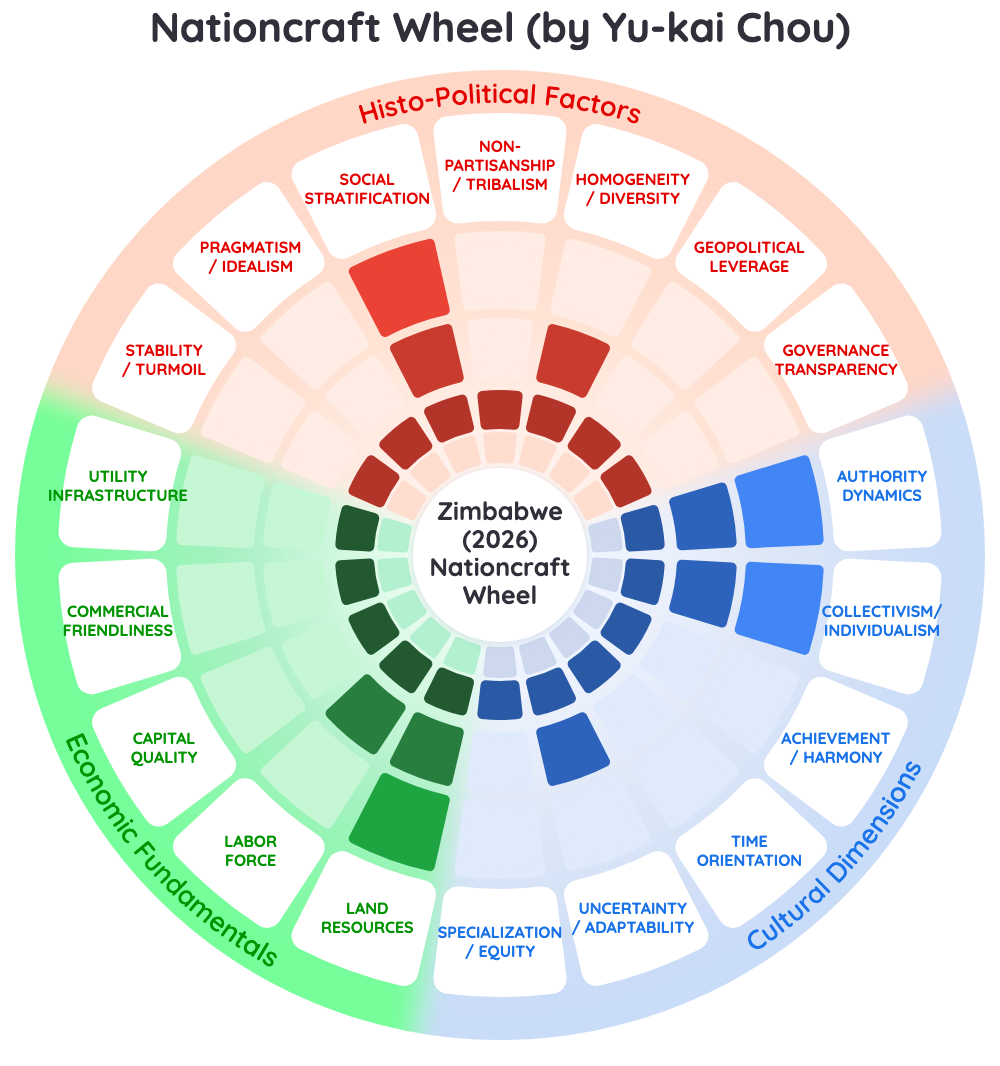

On July 7, 2026, Emmerson Mnangagwa signed a constitutional amendment that ends the direct election of Zimbabwe’s president. Twenty days later, the IMF announced that Zimbabwe had met every quantitative target in its Staff-Monitored Program.
Most coverage treats these as two separate stories: a democratic regression and an economic recovery, running on parallel tracks. Run Zimbabwe through the Nationcraft Framework (the 18-variable diagnostic I use to test whether a reform playbook fits a country’s actual configuration) and they collapse into one story.
The stabilization is paying for the entrenchment.
Zimbabwe has done this before. In 2009, dollarization killed one of the worst hyperinflations ever recorded and a unity government restored growth; by 2013 the recovery had financed ZANU-PF’s reconsolidation. In 2017 the army removed Robert Mugabe under the banner of Operation Restore Legacy, and the “new dispensation” spent its goodwill on the 2018 crackdown and another currency collapse.
Now the third window is open. Gold and lithium receipts are surging, US-dollar inflation is near 1%, the IMF is engaged for the first time in a generation, and the political system has used precisely this moment to extend terms to 2030 and move the choice of president from voters to a parliament ZANU-PF controls.
I call this the Restored-Legacy Trap: a system that converts every recovery window into regime durability, because the variables that would convert it into development are the ones the regime cannot afford to fix. This analysis maps all 18 variables, tests eleven celebrated reform packets against them, and shows why the succession fight between an 83-year-old president and the general who installed him is the only reform lever that actually exists.
⚡ Speed Run Notes
- Zimbabwe signed away direct presidential elections on July 7, 2026, the same month the IMF called its reform program on-track. One system produced both facts: stabilization is funding entrenchment.
- The V-vector: V14=7 resources and V15=6 labor quality trapped under V1=9 authority, V13=1 transparency, V16=1 capital. One of Africa’s best-educated workforces subsidizes its worst-capitalized state.
- RC-003 Authoritarian Succession Crisis is a full signature match: V1=9, V8=2, V10=2, V13=1, an 83-year-old leader, and suppressed factions. The 2017 coup ran on the same mechanics it claimed to end.
- Eight celebrity playbooks fail the variable test: LKY, Deng, Đổi Mới, Saakashvili, Argentine convertibility, Nazarbayev, post-Milošević, and the Bolivarian path Zimbabwe is already walking.
- Three packets fit: Zimbabwe’s own GNU stabilization (SP-076), Botswana’s institutions-before-minerals sequencing (SP-004), and Angola’s within-party succession opening (SP-063).
- Watch V13 before V16. Mineral revenue moving through opaque channels buys entrenchment by default; publishing the accounts is the first move that changes what the boom purchases.
Table of Contents
- Understanding Zimbabwe’s Governance Landscape Through Nationcraft
- What Is the Nationcraft Framework?
- Why This Zimbabwe Variables Analysis Matters Right Now
- The 18 Zimbabwe Nation Variables
- The Restored-Legacy Trap
- Detailed Justifications: Reading Each Variable
- Best-Match Historical Packets: Eight Playbooks to Reject
- Three Packets Zimbabwe Should Actually Study
- Strategic Implications
- Governance Strategy Recommendations
- Frequently Asked Questions
About Yu-kai Chou

Yu-kai Chou is a Human-Systems Architect & Behavioral Designer and the creator of the Nationcraft Framework — an 18-variable diagnostic for matching a country’s structural profile to the reform packets that have historically worked under similar conditions. He has consulted for governments in eight nations, including Ukraine, the United Kingdom, the Kingdom of Bahrain, Singapore, Taiwan, the Netherlands, Kazakhstan, and South Korea, and has worked directly with President Zelenskyy’s team on post-war reconstruction priorities for Ukraine.
Chou’s prior framework — the Octalysis Framework — has been applied by LEGO, Microsoft, Porsche, Coca-Cola, Salesforce, and MrBeast, impacting over 1.5 Billion Users. He has taught the methodology at Harvard, Stanford, Yale, Tesla, Google, BCG, and IDEO.
His work has been cited by Harvard, Stanford, MIT, Forbes, Wall Street Journal, Wired, US Department of Energy, NIST, NSF, NCBI, US Department of Education, ClinicalTrials.gov, and Google Scholar — with 3,700+ more academic publications. Explore his books here.

This Zimbabwe analysis applies the same variable-matching method I have used in cabinet-level advisory work across eight governments to the hardest case in southern Africa: a country whose educated workforce and mineral endowment should make it a regional success story, and whose July 2026 constitutional amendment shows exactly which two variables keep that story from starting. I have watched reform sequencing succeed and fail from inside government rooms; Zimbabwe is what failure looks like when it compounds for three cycles.
Understanding Zimbabwe’s Governance Landscape Through Nationcraft
Zimbabwe is the country where every economics textbook cliché came true at once. It holds the modern record for hyperinflation short of Hungary 1946: prices doubling roughly daily at the November 2008 peak, an episode the Nationcraft corpus catalogs under pattern ET-006 as the canonical Hyperinflation Spiral.
It also holds something rarer: a population that stayed educated through the collapse. Zimbabwe’s literacy rates have long ranked among the highest in Africa, and its professionals run hospitals, banks, and engineering firms across the region.
That combination is the puzzle. Countries with V15=6 labor quality and V14=7 land resources are supposed to converge upward; Zimbabwe has spent four decades converting those endowments into emigration and arrears.
The Nationcraft answer sits in three variables that barely move: V1 Authority Dynamics at 9, V13 Governance Transparency at 1, and V7 Stability vs Turmoil at 2. Power concentrates absolutely, accounts stay closed, and transitions happen through force or fraud rather than rules.
In August 2026, that configuration is on full display. The president who came to power through a 2017 military intervention has just signed Constitution of Zimbabwe Amendment No. 3, and the general who led that intervention is watching the succession he expected get legislated away.
What Is the Nationcraft Framework?
The Nationcraft Framework scores a nation on 18 variables: six cultural (V1-V6), seven historical-political (V7-V13), and five economic (V14-V18). The scores are read as intensity, never as virtue, and they are never averaged: configuration IS strategy.
Against a country’s V-vector, the framework tests Success Packets: documented transformation blueprints like Deng’s opening or Botswana’s diamond management, each with the preconditions that made it work. A packet that transformed one country will fail in another if the enabling variables are missing, which is why policy quality matters less than context fit.
This is the same design philosophy behind the Octalysis Framework, which maps the 8 Core Drives of human motivation. A nation is a motivation system at scale, and I have written about how Octalysis applies to nation-building and public policy.
The connection is direct in Zimbabwe’s case. A state that rules through Core Drive 8: Loss & Avoidance (CD8), the fear of losing pensions, land allocations, or safety, generates compliance without initiative, and the difference between white hat versus black hat motivation shows up in national statistics as emigration.
Why This Zimbabwe Variables Analysis Matters Right Now
Three timelines converged in July 2026, and their convergence is the analysis.
The constitutional timeline. Amendment No. 3 was gazetted on February 16, cleared the Senate on June 24, and was signed on July 7. It extends presidential and parliamentary terms from five years to seven, postpones the 2028 elections to 2030, and replaces the popular presidential vote with selection by a joint sitting of Parliament.
The economic timeline. The IMF agreed a Staff-Monitored Program in February, approved it in April, and completed the first review on July 27 with every quantitative target met. First-quarter mineral exports rose 57% to US$2.37 billion, lithium earned US$782 million in the first half, and US-dollar inflation touched 1%.
The succession timeline. Mnangagwa is 83. Vice President Constantino Chiwenga, who commanded the 2017 intervention, opposes the term extension along with much of the army. War veterans led by expelled ZANU-PF official Blessed Geza have called repeated protests demanding resignation, and Human Rights Watch documented violence and intimidation against amendment opponents as early as March.
Whoever reads these as three stories will misprice all of them. The economy’s good quarter is buying the constitution’s bad decade, and the succession fight is the mechanism that connects them.
The 18 Zimbabwe Nation Variables
Scores below come from the Nationcraft corpus record for Zimbabwe, cross-checked in August 2026 against IMF program documents, mineral-export data, and the constitutional record. A 9 on Authority Dynamics means authority concentrates absolutely; whether that helps or destroys depends on the surrounding configuration.
| Variable | Score | 2026 Reading |
|---|---|---|
| V1 Authority Dynamics | 9 | Amendment No. 3 moves presidential selection to a ZANU-PF-dominated parliament; intelligence services restructured around succession control |
| V2 Collectivism vs Individualism | 7 | Extended-family and diaspora networks are the real social safety net; remittances carry households through each currency failure |
| V3 Achievement vs Harmony | 3 | Survival-mode informal economy; advancement routes through party loyalty rather than performance |
| V4 Time Orientation | 3 | “Vision 2030” rhetoric against short-horizon practice: an overnight export ban in February, quota carve-outs by negotiation |
| V5 Uncertainty & Adaptability | 4 | Extraordinary household-level adaptation (informal trade, multi-currency fluency) that never aggregates into institutional flexibility |
| V6 Specialization vs Equity | 3 | Necessity entrepreneurship dominates; formal specialization thinned by two decades of professional emigration |
| V7 Stability vs Turmoil | 2 | Succession war inside the ruling party, veteran-led protest calls, heavy security deployments in Harare |
| V8 Pragmatism vs Idealism | 2 | A technocratic pocket meets IMF targets while the political core chooses constitutional entrenchment in the same window |
| V9 Social Stratification | 7 | Liberation credentials as caste; a patronage economy orbiting sanctioned business elites |
| V10 Non-Partisanship vs Tribalism | 2 | Party supremacy now constitutionalized: the presidency itself becomes an internal ZANU-PF allocation |
| V11 Homogeneity vs Diversity | 5 | Shona ~70%, Ndebele ~20%; the unhealed Gukurahundi legacy (roughly 20,000 killed, 1983-87) still structures trust |
| V12 Geopolitical Leverage | 2 | A 25-year default caps leverage; lithium adds bargaining chips with Chinese buyers without lifting the floor |
| V13 Governance Transparency | 1 | Mineral revenues route through opaque channels; a platinum producer reports US$100 million in unpaid export proceeds |
| V14 Land Resources | 7 | Gold the largest mineral export earner, lithium US$782M in H1, platinum-group metals projected near US$2B by 2027, farmland recovering |
| V15 Labor Force Quality | 6 | Historically among Africa’s most literate workforces; the discount is that much of it now works abroad |
| V16 Capital Quality | 1 | ZiG lost roughly half of its value by late 2025; reserves cover ~1.7 months of imports; US$8.1B of external debt in arrears |
| V17 Commercial Friendliness | 1 | Abrupt export bans, forex surrender rules, unpaid proceeds: policy risk prices out everyone except investors who buy political access |
| V18 Utility Infrastructure | 2 | Chronic load-shedding and decayed rail; power imports gate mining expansion |
Read the diagonal of that table and the paradox is already visible. The two variables where Zimbabwe scores high with no help from government (V14 resources, V15 people) are exactly the ones a V13=1, V16=1 state can monetize without reforming.
The Restored-Legacy Trap
In November 2017, armored vehicles rolled into Harare under the code name Operation Restore Legacy. The stated target was the “criminals around” Mugabe; the practical output was the transfer of a captured presidency from a 93-year-old to his 75-year-old enforcer.
The name turned out to be honest. The operation restored the legacy — the system of rule — in perfect working order.
The Restored-Legacy Trap is what happens when a state’s recovery mechanisms and its capture mechanisms are the same institutions. Zimbabwe has now run the experiment three times, with a consistency that would impress a lab:
| Stabilization window | What stabilized | What the window purchased | How it closed |
|---|---|---|---|
| 2009-2013 (GNU + dollarization) | Hyperinflation ended overnight; growth averaged near 10% through 2012; schools and hospitals reopened | ZANU-PF regrouped, rebuilt patronage in diamonds, and re-took full control in the 2013 election | Cash crisis, bond notes (2016), succession purge (2017) |
| 2018-2019 (TSP austerity + “open for business”) | Fiscal tightening; IMF re-engagement talk; investor courtship | Post-election violence (2018), currency reintroduction by decree, elite forex arbitrage | RTGS collapse, 2019 fuel-price protests and shutdown |
| 2024-2026 (ZiG + Staff-Monitored Program) | USD inflation ~1%; SMP targets met; record mineral receipts | Amendment No. 3: terms to 2030, direct presidential elections abolished | Open; this is the window being spent now |
Each row follows the same grammar. A stabilization tool (dollar, austerity program, structured currency) buys legitimacy and breathing room; the breathing room is spent on consolidation; consolidation re-breaks the economy; repeat.
The Nationcraft corpus states the mechanism in one line in Zimbabwe’s own packet, SP-076: economic stabilization without political change is temporary, because the same ruling party cannot reform itself.
This is why the trap deserves its own name rather than the generic “resource curse” label. Norway and Botswana prove resources alone curse nobody. Zimbabwe’s curse is a sequencing loop: V14 revenue arrives before V13 transparency exists, so revenue strengthens exactly the coalition whose survival depends on V13 staying at 1.
Detailed Justifications: Reading Each Variable
V1, V7, V10: The Authority Triangle
V1 Authority Dynamics scores 9 because power in Zimbabwe concentrates at the apex of one party and one security establishment, and the July amendment concentrates it further: a president chosen by a joint parliamentary sitting is a president chosen by ZANU-PF’s internal arithmetic.
V7 Stability vs Turmoil scores 2 with a century of evidence: liberation war, the Gukurahundi massacres, the 2000s land invasions and hyperinflation, a 2017 coup, 2018 post-election shootings, 2019 protest crackdowns, and a 2026 succession fight conducted through security deployments.
V10 at 2 completes the triangle. Every institution from electoral commission to grain board is scored by party loyalty first, which is what makes the amendment’s parliamentary selection mechanism a closed loop rather than a check.
V13, V16, V17: The Opacity Engine
V13 Governance Transparency at 1 is the load-bearing score of this whole analysis. Mineral revenues route through opaque marketing channels, a major platinum producer is owed roughly US$100 million in export proceeds, and the businessman widely reported as the president’s preferred successor built his position on fuel and agriculture contracts nobody has audited.
V16 Capital Quality at 1 is the consequence. The ZiG, launched in April 2024 as a gold-backed reset, lost roughly half of its value by November 2025; reserves cover about 1.7 months of imports; and US$8.1 billion of external debt has sat in arrears through 25 years of exclusion from capital markets.
V17 at 1 closes the circuit. A government that can ban raw-mineral exports overnight, then sell exceptions as quotas, has converted commercial law into a negotiation, which is why the only investors who stay are those pricing political access as an asset class.
V14, V15: The Trapped Endowments
V14 Land Resources scores 7 on any honest read: gold as the largest mineral export earner quarter after quarter, Africa’s most significant hard-rock lithium beneath Bikita and Arcadia, the world’s second-largest platinum-group reserves on the Great Dyke, and farmland that carried the region before 2000.
V15 Labor Force Quality at 6 is the sadder score. The education system Mugabe built in the 1980s produced one of the continent’s most literate populations, and the collapse exported it: Zimbabwean doctors staff South African hospitals and Zimbabwean accountants run Botswanan firms.
The corpus pattern RE-005, Diaspora Catalyst, describes how such an exported workforce becomes a reform engine: Ireland’s return wave, Taiwan’s semiconductor engineers, India’s Silicon Valley bridge. RE-005 has a precondition: V17 commercial openness of at least 5. Zimbabwe scores 1, which is why its diaspora sends survival remittances instead of building factories.
V2, V9, V11: The Social Fabric
V2 Collectivism at 7 reflects the extended-family economy that actually kept people alive through 2008: kinship networks pooling foreign currency, urban households feeding rural relatives, diaspora WhatsApp groups functioning as informal insurance.
V9 Social Stratification at 7 measures the liberation aristocracy. War credentials operate as caste: they gate land allocations, mining concessions, and now, after the amendment, the presidency itself.
V11 at 5 records a diversity structured by an unhealed wound. The Gukurahundi campaign killed roughly 20,000 mostly Ndebele civilians in 1983-87, and the perpetrator institutions never faced account, which keeps Matabeleland’s trust in national projects near zero.
V3, V4, V5, V6: The Culture Under Survival Pressure
V3 at 3 and V6 at 3 describe an economy where achievement decoupled from advancement: the informal sector rewards hustle, the formal sector rewards loyalty, and the professions emigrated.
V4 Time Orientation at 3 shows in policy whiplash: a February export ban effective immediately, quotas negotiated within weeks, budget assumptions revised quarterly. Households, ironically, plan longer than the state: diaspora families run multi-year education pipelines for their children.
V5 at 4 captures the asymmetry between adaptive people and a rigid state. Zimbabweans handle five currencies in one marketplace; their central bank has failed at managing one.
V8, V12, V18: The Constraint Set
V8 Pragmatism vs Idealism at 2 is subtler than it looks, because Zimbabwe currently displays real technocratic pragmatism: the finance ministry met every SMP quantitative target through March 2026. The score stays 2 because the political core overrode that pragmatism at the constitutional level in the same window, and regime-level choices are what the variable measures.
V12 at 2: a state in default for a generation negotiates from its knees, and China’s five lithium majors know it. The February export ban extracted processing commitments, which is real leverage, worth perhaps one point of drift, not a re-scoring.
V18 at 2 is the binding physical constraint. Load-shedding gates everything: mines run on imported power and diesel, and no beneficiation mandate can outrun a grid that fails daily.
Best-Match Historical Packets: Eight Playbooks to Reject
Every Zimbabwe policy conversation eventually reaches for a foreign miracle. The Nationcraft method is to test the miracle’s preconditions against the actual V-vector before borrowing its vocabulary. Here is the fit table; the subsections walk through each mismatch.
| Packet | Country / Years | Core precondition | Zimbabwe’s blocker | Verdict |
|---|---|---|---|---|
| SP-002 Lee Kuan Yew Industrialization | Singapore 1965-1990 | V13=9 clean-governance compensating V14=2 | V13=1 | Reject |
| SP-003 Deng Xiaoping Open Reform | China 1978-2000 | V1=10 paired with V8=8 pragmatism; institutionalized party succession | V8=2; succession just de-institutionalized | Reject |
| SP-018 Đổi Mới Reform | Vietnam 1986-2010 | Collective leadership converts crisis into doctrine change (V8=7) | Personalist capture; party is a patronage machine, not a policy machine | Reject |
| SP-051 Saakashvili Reform | Georgia 2004-2012 | Revolutionary mandate to fire the old state wholesale | The incumbent elite IS the reform’s target; no mandate exists | Reject |
| SP-050 Convertibility & Crisis | Argentina 1991-2003 | Hard currency anchor plus fiscal discipline | Already ran it (2009-2013); anchor abandoned when discipline pinched | Reject |
| SP-044 Nazarbayev Resource Management | Kazakhstan 1991-2019 | Technocratic autocracy with sovereign-wealth discipline | V13=1 rules out the discipline; even the original blew up in 2022 | Reject |
| SP-069 Post-Milošević Recovery | Serbia 2000-2020 | Strongman exit via ballot (RC-002 Constitutional Cascade) | Amendment No. 3 just removed the ballot mechanism | Reject |
| SP-095 Bolivarian Revolution & Collapse | Venezuela 1999-2020 | None (cautionary packet) | This is the path currently walked | Reject (mirror) |
| SP-076 Post-Mugabe Transition | Zimbabwe 2009-2020 | External pressure forcing power-sharing | None; Zimbabwe’s own proven stabilizer | Study |
| SP-004 Botswana Diamond Management | Botswana 1966-1999 | Institutions built before resource revenue | Sequence inverted, but lithium offers a second chance | Study |
| SP-063 Post-MPLA Diversification | Angola 2002-2020 | Within-party succession creating a reform opening | None yet; the opening is the current succession fight | Study |
SP-002: the Singapore fantasy
“Zimbabwe is open for business,” the 2018 slogan, was Lee Kuan Yew vocabulary without Lee Kuan Yew variables. The LKY packet’s engine was governance quality so extreme (V13=9) that it substituted for having no resources at all, producing 27x GDP growth from a resourceless island.
Zimbabwe inverts the configuration: V14=7 in resources, V13=1 in governance. Singapore, whose LKY packet I stress-tested separately, teaches that the packet is unusable precisely by the states that cite it most.
SP-003: the Deng misread
Deng’s packet gets cited for its authoritarian shell: reform without losing party control. The shell hid two load-bearing walls: V8=8 pragmatism (“it doesn’t matter if the cat is black or white”) and a party that institutionalized succession with term norms and mandatory retirement, at least until recently.
ZANU-PF has the authoritarian shell and neither wall. Its V8=2 doctrine is liberation entitlement rather than performance, and July’s amendment formally de-institutionalized succession. China’s own supply-reflex trap shows where even the successful version decays when the pragmatism wall thins.
SP-018: the Đổi Mới mismatch
Vietnam entered 1986 with 700%+ inflation and a party capable of collective self-correction: the old guard retired, doctrine was rewritten, and agriculture was freed first so reform fed people before it threatened anyone.
The packet requires a party that is a policy machine. Vietnam’s own variable profile still shows that inheritance. ZANU-PF is a patronage machine: Command Agriculture allocated inputs by loyalty and produced scandals rather than surpluses, which is what the same instrument becomes under V13=1.
SP-051: the Saakashvili impossibility
Georgia’s packet is the anti-corruption fantasy in its purest form: fire the entire traffic police in one day, replace the state wholesale, dare the system to collapse. Its precondition is a revolutionary mandate: the old elite had just lost power and could be fired.
Zimbabwe’s anti-corruption campaigns are conducted BY the elite that would need firing, which converts them into succession weapons. The packet’s own postscript (Saakashvili’s later prosecutions) warns that even with the mandate, concentrated reform power corrupts; without the mandate, it never starts.
SP-050: the convertibility rerun
Argentina’s currency board killed 3,000% inflation and then killed the economy that adopted it, ending in the largest sovereign default in history. Zimbabwe already lived both halves: dollarization (2009) ended hyperinflation overnight, and the same fiscal politics that convertibility disciplines eventually smuggled the printing press back in through bond notes, RTGS, and now the ZiG.
Argentina’s pampas paradox is the reference case for why hard anchors fail without fiscal-political change; Zimbabwe is the reference case for running the failure twice.
SP-044: the Kazakhstan mirage
Nazarbayev’s packet (resource autocracy with technocratic wealth management) is the model Harare’s planners would claim if asked. It required a sovereign fund with published rules and enough V13 to make elites trust deferred consumption.
Zimbabwe’s sovereign-wealth vehicle is best known for opacity, and its elites defer nothing. Kazakhstan’s steppes pivot records how even the disciplined version accumulated tensions that exploded in January 2022; the undisciplined version skips straight to the tensions.
SP-069: the Serbia door, now welded shut
Milošević fell because an election he expected to manage produced a result he could not survive, with security services declining to fire on the Bulldozer Revolution. The packet’s mechanism is RC-002, the Constitutional Cascade: mass pressure resolving through a ballot that still counts.
Amendment No. 3 is best understood as anti-Serbia engineering. By moving presidential selection into Parliament and pushing the date to 2030, it removes the specific institutional surface on which cascades happen. Serbia’s managed exit shows what became available after the ballot worked; Zimbabwe has scheduled that door out of existence.
SP-095: the mirror, twenty years on
Venezuela’s packet is in the corpus as a cautionary tale: the world’s largest oil reserves funding the destruction of every institution, because resource revenue made institutions seem optional. GDP fell 75%; seven million people left.
Zimbabwe is the mirror at smaller scale and earlier stage: mineral rents substituting for capital markets, emigration substituting for opposition. My full analysis of Venezuela’s reform playbooks (eight rejected, three fit) reads as Zimbabwe’s probable future under continued V13=1: the question is not whether the paths rhyme but how many stanzas remain.
Three Packets Zimbabwe Should Actually Study
SP-076: Zimbabwe’s own proven stabilizer
The most useful packet in the corpus for Zimbabwe is Zimbabwe’s. SP-076 documents 2009-2020: dollarization ending hyperinflation overnight, the Government of National Unity restoring 10%+ growth with an opposition finance minister, schools and clinics reopening, followed by the reconsolidation that spent it all.
The study point is precise. Zimbabwe does not lack stabilization technology; it executes stabilization brilliantly when power is genuinely shared, and reverses it when power re-concentrates. Any 2026-2030 plan that does not hard-wire shared control over the recovery (creditor-verified milestones, opposition-held economic portfolios, published accounts) is a plan to rerun phase three.
SP-004: Botswana, the neighbor who sequenced correctly
Next door sits the continent’s great counterexample. Botswana at independence was the world’s third-poorest country with 12 kilometers of paved road; diamonds were discovered AFTER Seretse Khama’s government had established clean-governance norms (V13=8), and the Debswana revenue rules were built before the revenue scaled.
The packet’s critical insight — institutions first, resources second — reads like a taunt across the border, and that is exactly why it matters now. Lithium is Zimbabwe’s second chance at a first impression: the January 2027 concentrate-processing deadline creates a natural moment to publish revenue accounts, ring-fence proceeds, and import Debswana-style joint-venture transparency for a mineral whose boom is young.
SP-063: Angola, or what a within-party succession can open
The realistic reform door for a V1=9, V10=2 state is rarely an election; it is a succession. Angola’s packet documents the case: dos Santos ruled a liberation-party petrostate for 38 years, and his 2017 within-party handover to Lourenço produced anti-corruption prosecutions, IMF re-engagement, and real if limited opening, because the successor needed to dismantle his predecessor’s network to govern.
The mapping onto the Mnangagwa-Chiwenga fight is uncomfortable and useful. Whichever faction wins will inherit rivals’ patronage networks it has every incentive to expose; a Nationcraft-literate international strategy would price that moment in advance, preparing arrears-clearance and investment packages that reward the winner for institutionalizing rather than merely redistributing the rents. Angola also warns about the ceiling: Lourenço’s opening stalled where his own coalition’s interests began.
Strategic Implications
For reform-minded Zimbabweans, the implication is sequencing. Elections are gone as a lever until 2030 by law, and were compromised as a lever before that by administration. The remaining levers are the succession (per SP-063), creditor conditionality (the SMP’s structural benchmarks are now among the few externally-verified facts in the system), and the diaspora’s price for re-engagement.
For creditors and the IMF, the implication is to stop treating quantitative compliance as the story. Zimbabwe’s technocrats will keep hitting monetary targets; SP-076 shows they always do in stabilization phases. Conditionality that does not reach V13 (published mineral-revenue accounts, audited parastatals, enforceable arrears milestones) finances the entrenchment it believes it is reforming, a lesson Ghana’s bailout cycle teaches from seventeen IMF programs and Zambia’s model-debtor path teaches from the restructuring side.
For mineral buyers, the implication is concentration risk wearing a discount. Five Chinese firms control most lithium capacity; the February ban showed Harare will rewrite terms overnight, and DR Congo’s cobalt trap shows how single-buyer mineral states convert dependence into leverage in both directions.
For the region, the implication is that SADC’s quiet-diplomacy default is subsidizing the trap. The GNU — the one intervention that worked — happened because regional pressure forced power-sharing; South Africa’s empty-chair problem and its three million Zimbabwean residents are the standing reminder that the costs of non-intervention migrate.
For students of the framework, Zimbabwe clarifies a comparative family. Cameroon’s indispensable-man trap shows the same aging-strongman geometry without the mineral boom; Egypt’s garrison economy shows a military that owns the economy outright rather than taxing it; Myanmar’s command trap shows the terminal stage where the security economy eats the state; and Ethiopia’s Nobel-laureate trap shows how fast reform credentials convert into war when the underlying variables never moved.
Governance Strategy Recommendations
Nationcraft recommendations are sequenced by variable dependency, not by wish list. Each move below names its target variables and the observable signal that would prove it real.
| Move | Variables targeted | Sequencing logic | Signal it is real |
|---|---|---|---|
| Publish consolidated mineral-revenue accounts (gold, PGMs, lithium) quarterly | V13 first; V16, V12 downstream | Botswana sequencing retrofitted: transparency must precede the lithium scale-up or the boom finances the trap | Independent reconciliation of export receipts vs. treasury inflows; Valterra-class arrears cleared on schedule |
| Hard-wire shared control into the arrears-clearance roadmap | V13, V8; V16 downstream | SP-076’s lesson: stabilization holds only while power over it is shared; creditor-verified milestones substitute for the GNU’s external pressure | Structural benchmarks that name enforcement, published on schedule, surviving a finance-minister change |
| Adopt a verifiable succession rule the security establishment co-signs | V1, V7; V10 downstream | RC-003 says the crisis fires on leader exit regardless; SP-063 says the successor moment is the opening; pre-committing rules converts a coup lottery into a transition | A published order of succession that survives its first test (a hospitalization, a congress) without troop movements |
| Price diaspora re-entry: property protection, currency convertibility, credential recognition | V17 first; V15, V16 downstream | RE-005 requires V17≥5 before diaspora capital returns; remittances already prove the willingness, the state prices the risk | Diaspora bond uptake at market rates; net return migration in any professional category |
| Grid-first industrial policy: power imports, solar PPAs, mine-grid co-investment before beneficiation mandates | V18; V14, V17 downstream | The January 2027 concentrate ban is unenforceable on a failing grid; physics precedes mandates | Load-shedding hours falling while smelter capacity rises; PPAs signed with penalty clauses that bind the state |
Notice what is absent: no election recommendation. Under Amendment No. 3 the honest version of this table cannot pretend the ballot is a 2026-2030 lever; the table routes through the levers that remain.
Comparative Context
Zimbabwe’s V-vector places it in the corpus’s fragile-authority cluster alongside Myanmar, Syria, and Yemen, yet its endowment profile (V14=7, V15=6) belongs with middle-income reformers. That gap between neighborhood and endowment is the analytical signature of capture: the state’s variables sit two tiers below its society’s.
Against the published analyses in this series, the closest structural cousins are Cuba’s doctrine trap (liberation legitimacy outliving its economy), Indonesia’s strongman trap (the New Order as the resource-autocracy Zimbabwe’s planners imagine they run), and Ukraine’s wartime profile as the inverse case: low V16 and battered V18 with high-trust society variables, which is why identical aid instruments produce opposite results in the two countries.
The United States analysis makes the comparative point from the other direction: high-capital systems with eroding V10 partisanship show the early grammar of the same disease Zimbabwe has in late stage: institutions scored by loyalty rather than function.
The Nationcraft Framework in Practice
The Zimbabwe case demonstrates the framework’s core discipline: diagnose configuration before prescribing policy. Every rejected packet above failed on variables, never on intentions, and the three retained packets were selected because their preconditions actually exist in Zimbabwe’s 2026 vector.
That discipline is what separates Nationcraft from the policy-transplant industry. A reform that ignores V13=1 will be eaten by V13=1; a diaspora strategy that ignores V17=1 will stay a remittance pipeline; an election strategy that ignores V1=9 just met Amendment No. 3.
The method scales in both directions: the same variable-matching logic runs on companies and products through Octalysis, and on nations through Nationcraft. If this analysis is your entry point, the framework hub explains the 18 variables and the packet library in full; for the motivational layer underneath policy compliance, my books on behavioral design are the foundation; start with the books here.
Frequently Asked Questions
What is the Restored-Legacy Trap in Zimbabwe’s Nationcraft analysis?
It is the pattern where every stabilization window Zimbabwe opens gets spent on entrenchment rather than institutions. The 2009 dollarization window ended in reconsolidation; the 2018 austerity window ended in violence and currency collapse; the 2024-2026 ZiG and IMF window is being spent on a constitutional amendment extending rule to 2030.
The name comes from Operation Restore Legacy, the 2017 coup that promised renewal and delivered the same system with a new occupant.
Why did Zimbabwe abolish direct presidential elections in 2026?
Amendment No. 3 (gazetted February 16, passed by the Senate June 24, signed July 7) extends presidential and parliamentary terms to seven years, postpones the 2028 elections to 2030, and gives a joint sitting of Parliament the power to choose the president.
In variable terms, a V1=9 / V13=1 system facing an unresolved succession removed the one mechanism that could resolve it against the incumbent. Parliament is ZANU-PF-dominated, so the change converts a public contest into internal party arithmetic.
Is Zimbabwe’s economy actually improving in 2026?
The headline layer is real: US-dollar inflation near 1% in January, projected growth in the 4-5 percent range, Q1 mineral exports up 57% to US$2.37 billion, lithium earnings up roughly 230% in H1, and an IMF program whose first review found all quantitative targets met.
The structural layer has not moved: reserves near 1.7 months of imports, US$8.1 billion in external arrears, an overwhelmingly informal labor market, and a ZiG that lost roughly half of its value by late 2025. Nationcraft reads the gap as a commodity-and-compliance window with V16 still at 1.
What is happening between Mnangagwa and Chiwenga?
A succession war inside the ruling coalition. Chiwenga, the general who executed the 2017 intervention, expected the presidency; Mnangagwa’s faction has extended his tenure to 2030, restructured intelligence services, and is reported to favor businessman Kudakwashe Tagwirei as successor.
War veterans aligned with Blessed Geza have called protests demanding resignation, smothered by security deployments. This is RC-003, the Authoritarian Succession Crisis, in live motion, and per SP-063, it is also the only realistic reform opening the configuration offers.
What would real reform look like for Zimbabwe?
Sequencing that moves V13 before spending V14: quarterly published mineral-revenue accounts, creditor-verified arrears milestones with shared control, a succession rule the security establishment co-signs, diaspora re-entry priced through V17 protections, and grid investment before beneficiation mandates.
None of these require an election to start, which is precisely why they remain available under the amended constitution, and why their absence would confirm the trap’s fourth cycle.
Explore More Nationcraft Analyses
The Nationcraft Nation Variables Library collects every published country analysis with its full 18-variable wheel. Each analysis follows the method used here: score the configuration, name the trap, test the packets.
Sixty-plus countries are mapped as of August 2026, from G7 economies to post-conflict states, and the library is the fastest way to see which national configurations rhyme with the one you just read.
Related Reading
- The Nationcraft Framework: the 18 variables, 9 goals, and Success Packet library
- Nationcraft Nation Variables Library: all published country analyses
- Nationcraft Analysis: South Korea’s Post-Martial Trap: when a democracy survives its own coup attempt
- Nationcraft Analysis: Nigeria’s Reform-Dividend Trap: subsidy courage meeting institutional decay
- Nationcraft Analysis: Taiwan’s Silicon Shield Paradox: when your greatest asset is your greatest exposure
- Nationcraft Analysis: Haiti’s Ballot-First Trap: why elections without institutions reset nothing
Footnotes
- Human Rights Watch, “Zimbabwe: Constitution Amended to Extend President’s Term,” July 8, 2026. hrw.org
- Wikipedia, “Constitution of Zimbabwe Amendment (No. 3) Act, 2026” (gazettal, Senate passage June 24, and provisions). en.wikipedia.org
- Human Rights Watch, “Zimbabwe: Violence and Intimidation Against Opponents of Presidential Term Extension,” March 10, 2026. hrw.org
- International Crisis Group, “Zimbabwe: Constitutional Change and the Fight for Succession”. crisisgroup.org
- Foreign Policy Research Institute, “Mnangagwa vs Chiwenga: The Existential Battle for Power in Zimbabwe,” June 2026. fpri.org
- IMF, “IMF Management Approves Completion of the First Review under Zimbabwe’s Staff-Monitored Program,” July 27, 2026. imf.org
- IMF, “IMF Management Approves a Staff Monitored Program for Zimbabwe,” April 16, 2026. imf.org
- AllAfrica, “Zimbabwe Hits Single-Digit Inflation Milestone,” January 2026. allafrica.com
- Fastmarkets, “Zimbabwe imposes immediate ban on exports of raw minerals, lithium concentrates,” February 2026. fastmarkets.com
- The Rio Times, “Zimbabwe Lithium Exports Earn US$782m in H1 2026”. riotimesonline.com
- Mining Zimbabwe, “Zimbabwe’s Mineral Export Earnings Surge 57% in Q1 2026 to US$2.37 Billion”. miningzimbabwe.com
- New Zimbabwe, “Million Man March: Mnangagwa unleashes security forces to thwart Geza protests”. newzimbabwe.com