

At midnight on August 21, 2026, the trade talks that were supposed to save one of the world’s largest bilateral trading relationships simply stopped. By Saturday morning, 50% American tariffs were live on roughly $20 billion of Canadian goods, and Prime Minister Mark Carney was standing in front of cameras calling the move “a miscalculation.”
Here is what makes Canada different from every other country the United States has squeezed this decade. Canada is rich, stable, and well governed.
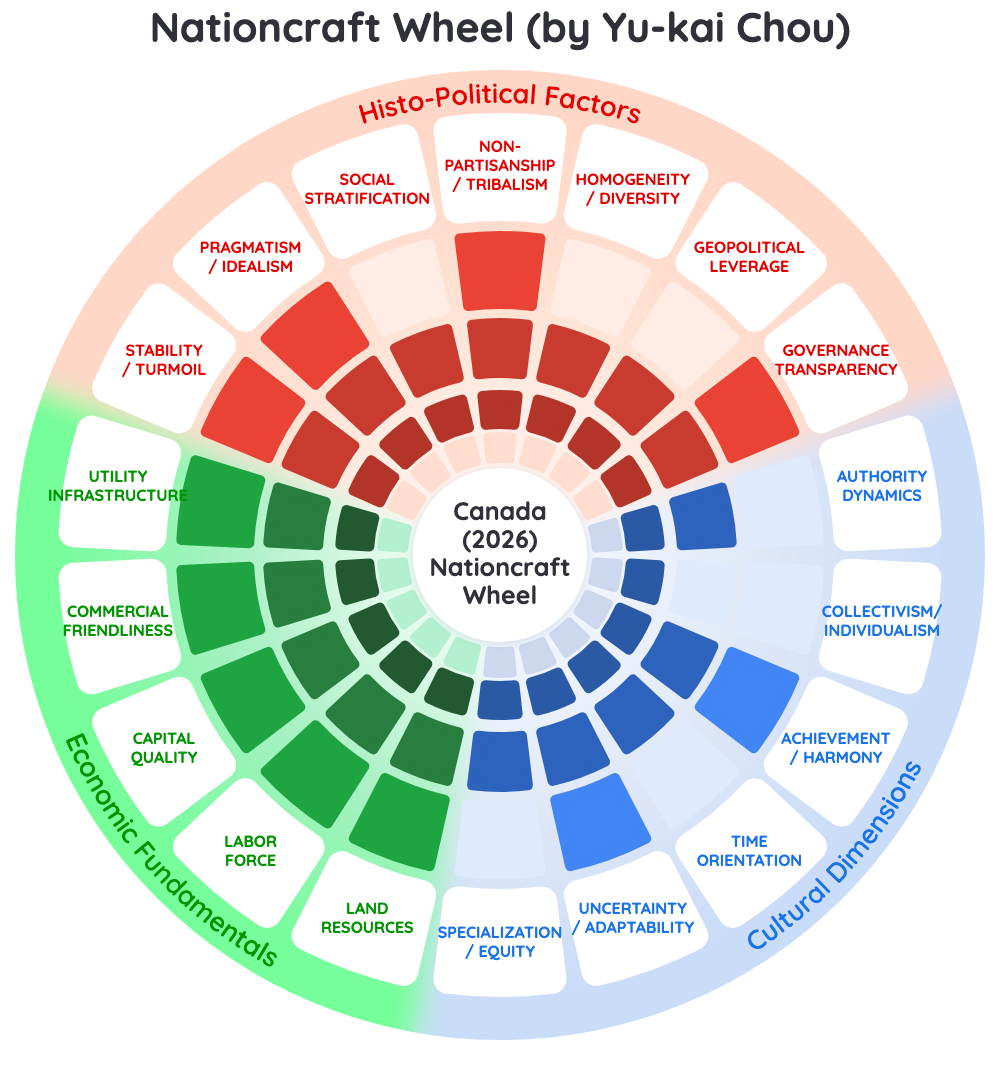
Its 18-variable Nationcraft profile carries nine scores of 8 or 9 out of 9, one of the strongest rows among all 147 countries in the corpus.
And that is precisely the problem. The Branch-Plant Trap: an elite national endowment that built its entire prosperity as an appendage to a single customer.
The endowment made dependence rational. Dependence made the endowment coercible.
Three Canadian governments have tried to escape this trap before.
All three failed for the same structural reason, and the reason is visible in the V-vector. This analysis reads Canada’s 18 variables, shows why the most-cited reform playbooks would fail here, and identifies the three historical packets Ottawa should actually be studying while the September 8 retaliation clock runs.
⚡ Speed Run Notes
- Canada’s V-vector is elite: V7=9 stability, V14=9 resources, V16=9 capital, V18=9 infrastructure. The weakness is architectural — prosperity built as a branch plant of one customer.
- The Branch-Plant Trap: ~75% of exports go to one market, so every diversification attempt since 1957 has died of comparative advantage. Rational actors kept choosing the profitable dependence.
- Singapore, Deng, and Meiji playbooks all fail Canada’s variables — each requires V1 authority concentration of 7-10. Canada runs V1=4 consensus federalism with provinces that own their resources.
- The closest historical rhyme is Finland 1991: a wealthy democracy that lost ~25% of its trade when its dominant market vanished, then pivoted to a knowledge economy in one decade (SP-110).
- Canada has its own proven packet: Chretien-Martin 1993-98 (SP-111) eliminated a 5.6%-of-GDP deficit through program review. The mobilization mechanics transfer directly to the tariff crisis.
- The 2026 window is real because loss aversion has finally flipped the politics: the status quo is now the frightening option. That reversal is rare, and it expires.
Table of Contents
- Understanding Canada’s Governance Landscape Through Nationcraft
- What Is the Nationcraft Framework?
- Why This Canada Variables Analysis Matters Right Now
- The 18 Canada Nation Variables
- The Branch-Plant Trap
- Detailed Justifications: Reading Each Variable
- Best-Match Historical Packets: Eight Playbooks to Reject
- Three Packets Ottawa Should Actually Study
- Strategic Implications
- Governance Strategy Recommendations
- Frequently Asked Questions
About Yu-kai Chou

Yu-kai Chou is a Human-Systems Architect & Behavioral Designer and the creator of the Nationcraft Framework — an 18-variable diagnostic for matching a country’s structural profile to the reform packets that have historically worked under similar conditions. He has consulted for governments in eight nations, including Ukraine, the United Kingdom, the Kingdom of Bahrain, Singapore, Taiwan, the Netherlands, Kazakhstan, and South Korea, and has worked directly with President Zelenskyy’s team on post-war reconstruction priorities for Ukraine.
Chou’s prior framework — the Octalysis Framework — has been applied by LEGO, Microsoft, Porsche, Coca-Cola, Salesforce, and MrBeast, impacting over 1.5 Billion Users. He has taught the methodology at Harvard, Stanford, Yale, Tesla, Google, BCG, and IDEO.
His work has been cited by Harvard, Stanford, MIT, Forbes, Wall Street Journal, Wired, US Department of Energy, NIST, NSF, NCBI, US Department of Education, ClinicalTrials.gov, and Google Scholar — with 3,700+ more academic publications. Explore his books here.

This Canada analysis applies the Nationcraft Framework to the G7’s most trade-concentrated economy at the exact moment its concentration became a weapon pointed back at it. The question it answers is the one every finance ministry from Ottawa to Seoul is now asking: when your largest customer turns coercive, which historical escape routes actually match your variables, and which ones are fantasies wearing another country’s clothes?
Understanding Canada’s Governance Landscape Through Nationcraft
Most country crises the Nationcraft Framework diagnoses are failures of capacity. Weak institutions, captured courts, hollow treasuries.
Canada is the opposite case, and that inversion is rare in the corpus. Nothing inside Canada is broken.
Its courts, elections, and banks work.
The resource base spans oil, gas, potash, uranium, hydro, timber, and the critical minerals every energy transition needs, and the pension funds investing the proceeds get benchmarked by peers abroad.
The vulnerability sits in the architecture, in the way those strengths were wired together. For over a century, Canadian prosperity has been organized around one design decision: sell to the neighbor.
Roughly three-quarters of Canadian exports go to the United States.[6] The auto sector was integrated continentally by the 1965 Auto Pact.
Energy flows south through pipelines that mostly cannot reach any other customer. Even the banking system’s famous stability is, in part, stability purchased by serving a predictable continental market.
Economists have a name for this inheritance: the branch-plant economy, a structure where foreign-owned subsidiaries produce for the local market and ship profits and decisions elsewhere.
Canada modernized far past the literal branch plants of the twentieth century. The geometry survived.
In August 2026, the geometry got expensive. Trade talks with Washington collapsed at a midnight deadline, 50% tariffs landed on roughly $20 billion of goods, and Ottawa announced dollar-for-dollar retaliation starting September 8.[1]
Nationcraft reads this moment through eighteen variables. They describe a country holding almost every input for economic sovereignty except an independent demand structure, because nothing in its history ever forced it to build one.
What Is the Nationcraft Framework?
The Nationcraft Framework is an 18-variable diagnostic system for nation-state analysis. It scores a country across cultural variables (V1-V6), histo-political variables (V7-V13), and economic variables (V14-V18), each on a 1-9 scale.
The core thesis: policy effectiveness is decided by context-fit, not policy quality. A reform that transformed one country will wreck another if the underlying variables differ.
That is why the framework pairs every country profile against a corpus of 140 historical packets, from Meiji Japan to Botswana’s diamond management. The packets encode what was tried, under which variable preconditions, with what sequencing, and what happened next.
The framework shares its human-systems lens with the Octalysis Framework. The difference is scale: reform asks an entire population to keep moving through years of structural change without losing them halfway.
Why This Canada Variables Analysis Matters Right Now
Three events collided in the past twelve months to make Canada the most important live experiment in the Nationcraft corpus.
First, the tariff war stopped being an episode and became a regime. The blanket tariff on Canadian goods jumped to 35% in August 2025, sectoral steel and aluminum tariffs reached 50%, and the August 2026 collapse of talks added 50% duties on a fresh $20 billion of goods.[5] Even the US Supreme Court striking down several emergency tariffs in early 2026 did not unwind the sectoral wall.
Second, the economic damage became measurable. Canada slipped into a shallow technical recession around the turn of the year, with GDP contracting at a 1.0% annualized pace in Q4 2025 and edging down again in Q1 2026. Growth forecasts for 2026 cluster between 0.8% and 1.5%, with unemployment near 6.5%.[4]
Third, the politics of change inverted.
For seventy years, the risky move in Canadian politics was touching the American relationship. Now the risky move is depending on it.
Prime Minister Carney’s government has pledged to double non-US exports within a decade, passed the One Canadian Economy Act to dismantle internal trade barriers, and is advancing a pipeline of nation-building projects approaching half a trillion dollars.[7]
Every prior Canadian diversification drive died in quiet prosperity.
This one was born in loss aversion, and that difference changes what is politically possible. Losses mobilize humans roughly twice as hard as equivalent gains, and for the first time since 1945, the loss frame points away from the status quo.
The window will not stay open.
Loss salience decays as people habituate to the new normal. The Nationcraft question is whether Canada’s variables can convert this rare motivational alignment into structural change before the salience fades.
The 18 Canada Nation Variables
Here is Canada’s full V-vector as of August 2026, drawn from the Nation Variables corpus and sanity-checked against current Freedom House, Transparency International, and macroeconomic data.
| Variable | Score | Reading |
|---|---|---|
| V1 Authority Dynamics | 4/9 | Consensus federal parliamentarism; constitutionally strong provinces; no central-command tradition |
| V2 Collectivism | 2/9 | Among the most individualist societies in the corpus |
| V3 Achievement Orientation | 7/9 | High achievement drive, moderated by a redistribution consensus |
| V4 Time Orientation | 6/9 | Moderate long-termism; electoral cycles bite megaproject timelines |
| V5 Uncertainty Adaptability | 7/9 | Absorbed the 2025-26 tariff shocks without institutional wobble |
| V6 Specialization/Equity | 6/9 | Deep interprovincial equalization tradition |
| V7 Stability | 9/9 | Zero internal instability through the trade war; peaceful 2025 transition |
| V8 Pragmatism | 8/9 | Non-ideological policy culture; calculated rather than performative retaliation |
| V9 Social Stratification | 5/9 | Moderate inequality; higher mobility than the United States |
| V10 Non-Partisanship | 8/9 | National-unity surge under external pressure; Alberta alienation is the watch item |
| V11 Homogeneity | 5/9 | Roughly 23% foreign-born; bilingual federation; managed diversity |
| V12 Geopolitical Leverage | 6/9 | G7 and NATO weight, resource cards, but limited demonstrated deterrence against US coercion |
| V13 Transparency | 8/9 | Top-15 on corruption perception; strong institutions |
| V14 Land Resources | 9/9 | Oil, gas, potash, uranium, hydro, timber, critical minerals |
| V15 Labor Quality | 8/9 | Top-OECD tertiary attainment; the constraint is deployment, never talent |
| V16 Capital Quality | 9/9 | Deep markets; world-class pension funds; weak business investment is allocation, not access |
| V17 Commercial Friendliness | 8/9 | Externally open; interprovincial barriers are the internal drag |
| V18 Utility Infrastructure | 9/9 | Reliable domestic grid and services; export infrastructure is the constrained subset |
Read the bottom third of that table again. V14=9, V15=8, V16=9, V17=8, V18=9, with V8=8 pragmatism and V10=8 consensus capacity backing them up.
In the Nationcraft corpus, countries fight wars and run decades-long reform programs to earn scores like that. Canada holds them all simultaneously, alongside V7=9 stability and V13=8 transparency.
The Branch-Plant Trap
So why does a country with that row of nines need a reform analysis at all?
Because the variables describe capacity, and Canada’s crisis was never about capacity. The Branch-Plant Trap is a specific interaction of four variables: V14=9 resources and V16=9 capital sitting next to V1=4 fragmented authority and V2=2 individualism, all of it bordering the richest market on Earth.
Walk through the logic. If you are a Canadian firm holding world-class resources (V14=9) and cheap capital (V16=9), the highest-return move for a hundred straight years was to sell into the American market next door.
Every actor choosing that individually rational path (V2=2 gives you no collectivist counterweight) produced a national structure no one chose deliberately: north-south integration so deep that Canadian provinces often trade more easily with US states than with each other.
And when the occasional government tried to redirect the flow, V1=4 meant it lacked the authority to override the market’s gravity. Diefenbaker mused about shifting 15% of trade to Britain in 1957; trade patterns barely moved.
The Trudeau government’s 1972 Third Option sought to reduce American dependence; the American share of exports rose anyway. The Team Canada trade missions of the 1990s produced photographs and memoranda; the geometry held.
Each failure had the same anatomy. Diversification is a collective-action problem, and Canada’s variable profile (V1=4, V2=2) is close to the worst possible configuration for collective action against a profitable default.
The default effect runs at nation scale here.
The American market was never merely an option; it was the pre-selected choice that required zero effort to keep choosing. Opt-out systems beat opt-in systems by enormous margins, and for Canadian exporters, the US was the opt-out.
Layer on status quo bias, which compounds with every year an arrangement persists, and the switching costs of continental supply chains, and you get the full trap: a country that kept getting richer by deepening the exact dependence that would one day be priced against it.
The trap converts strength into leverage for the other side.
Saudi Arabia’s version of this pattern runs through one commodity artery; Canada’s runs through one customer. Both discovered in 2026 how much leverage a single delivery channel hands to whoever sits at the other end of it.
Detailed Justifications: Reading Each Variable
V1, V2, V10: The Coordination Triangle
V1 Authority Dynamics scores 4/9, and every serious reform plan must start here. Canada’s federation gives provinces ownership of natural resources, control of most internal regulation, and effective veto power over pipelines and megaprojects crossing their territory.
V2 Collectivism at 2/9 removes the cultural compensation mechanism. Meiji Japan ran reform through V2=10 social cohesion; Canada cannot summon that, and pretending otherwise is how national strategies die in provincial courtrooms.
The saving throw is V10 Non-Partisanship at 8/9.
External coercion has produced a genuine cross-partisan consensus moment, the kind of unity window Canada last saw generations ago. V10=8 is what makes the current window usable at all, because in a V1=4 system, only broad consensus substitutes for command.
V7, V13, V8: The Credibility Engine
V7 Stability at 9/9 and V13 Transparency at 8/9 carry Canada’s reform credibility. Markets believe Canadian fiscal promises.
That combination is rare in the corpus, and it is exactly the pair that let Canada execute its 1990s fiscal consolidation, when markets trusted the plan enough to keep lending through the cuts (SP-111’s variable lesson: V13 high transparency plus V7 stability meant consolidation without capital flight).
V8 Pragmatism at 8/9 completes the engine. Ottawa’s tariff responses have been calibrated and reversible rather than theatrical: retaliation matched dollar for dollar, remission windows for manufacturers, quota carve-outs preserved.[5] Pragmatism at this level means policy can turn without ideological whiplash.
V14, V16, V18: The Coercible Endowment
V14 Land Resources at 9/9 is the fortune.
Add V16 Capital Quality at 9/9 and the fortune can be financed domestically, while V18 Utility Infrastructure at 9/9 keeps the lights on through the build.
The asterisk on all three is directional. Canada’s export infrastructure was engineered almost entirely north-south: pipelines, rail, and grid interconnections that reach American buyers and, with few exceptions, nobody else.
A 9/9 endowment that can only clear through one customer amounts to inventory in someone else’s supply chain, and the 2026 tariffs priced that discovery.
V15, V3, V5: The Underdeployed Humans
V15 Labor Quality at 8/9 reflects one of the most educated workforces in the OECD. V3 Achievement at 7/9 and V5 Uncertainty Adaptability at 7/9 round out a population fully capable of a knowledge-economy pivot.
The chronic complaint, visible in two decades of productivity data, is that Canadian talent scales inside American companies. The brain drain is a rational response to the branch-plant structure: when the commanding heights of your economy take direction from headquarters elsewhere, ambitious people follow the decisions south.
Finland’s SP-110 packet shows what V15=8+ labor can do when a country decides to deploy it at home. Canada has run the precondition for thirty years without running the play.
V4, V6, V9, V11: The Social Ballast
V4 Time Orientation at 6/9 is the quiet constraint on megaprojects: four-year electoral cycles against ten-year build timelines. The One Canadian Economy Act’s fast-track machinery is, in Nationcraft terms, an attempt to institutionalize V4 patience that the political culture cannot supply naturally.
V6 Specialization/Equity at 6/9 and V9 Stratification at 5/9 describe a federation practiced at sharing gains across regions. That tradition, expensive in normal times, becomes an asset during restructuring because adjustment costs will land unevenly (auto workers in Ontario, aluminum towns in Quebec) and Canada already owns the transfer machinery to smooth them.
V11 Homogeneity at 5/9, with roughly 23% of residents foreign-born, cuts both ways: harder consensus formation, but diaspora networks into every alternative market Canada now needs.
V12, V17: The Leverage Gap
V12 Geopolitical Leverage at 6/9 is the humbling score. On paper Canada holds cards: critical minerals, energy the world wants, uranium, potash the world’s food system needs.
In practice, 2025-26 demonstrated that cards you cannot physically deliver to alternative buyers are not leverage; they are potential leverage awaiting infrastructure. V12 rises only when V18’s export-facing subset rises.
V17 Commercial Friendliness at 8/9 carries the same internal asterisk.
Canada is famously easy to trade with from abroad and famously hard to trade across internally. IMF researchers have estimated that interprovincial barriers act like a tariff in the double digits, which means Canada has spent decades imposing on itself roughly what Washington just imposed on it.
Best-Match Historical Packets: Eight Playbooks to Reject
Run Canada’s V-vector against the Success Packet corpus and the nearest-neighbor matches are mostly traps. These eight get cited constantly in Canadian commentary, and each one fails a specific variable test.
| Packet | Country / Years | Why It Fails Canada | Blocking Variables |
|---|---|---|---|
| SP-002 LKY Industrialization | Singapore 1965-1990 | Requires concentrated executive authority and a mobilized population | V1=4 vs required 7+; V2=2 vs 7+ |
| SP-003 Deng Open Reform | China 1978-2000 | Party command over land, banks, and migration | V1=4 vs 10; V13=8 makes SEZ opacity impossible |
| SP-001 Meiji Open Reform | Japan 1868-1912 | Runs on extreme deference and collectivism | V1=4 vs 10; V2=2 vs 10 |
| SP-106 Oil Fund Sovereign Wealth | Norway 1990-2010 | Solves rent mismanagement, which is not Canada’s disease; resources are provincially owned | V1=4 blocks a federal fund; wrong problem |
| SP-004 Botswana Diamond Management | Botswana 1966-1999 | Designed for state-building from scratch around one commodity | Preconditions absent: Canada starts at V16=9, V18=9 |
| SP-090 Velvet Divorce / Tatra Tiger | Slovakia 1993-2004 | FDI-for-accession play requires a bloc to join; Canada already has the FTAs it isn’t using | V17=8 already; access is not the constraint |
| SP-108 Rogernomics Liberalization | New Zealand 1984-1993 | Right crisis, wrong method: blitzkrieg reform against a consensus polity | V1=4 cannot sustain shock sequencing; lasting resentment documented |
| SP-109 Banking Crisis Consolidation | Sweden 1990-1996 | Cure for a banking collapse Canada is not having | Category error; V16=9 is healthy |
SP-002: the Singapore fantasy
Every trade-shock country gets told to become Singapore, and Canada’s commentariat is no exception. The LKY packet stress test already showed how narrow that packet’s preconditions are even for Singapore itself.
The Lee Kuan Yew Industrialization Packet ran on V1=7 executive authority steering land, housing, wages, and capital through bodies like the EDB, with a population whose collectivism could be mobilized behind national survival. Canada’s V1=4 federation cannot steer a pipeline through a neighboring province, let alone command wage policy.
Ottawa can borrow exactly one fragment: the EDB’s one-stop-shop discipline for project approval, which the One Canadian Economy Act’s major-projects office visibly imitates. Borrowing fragments while rejecting the packet is exactly the discrimination the Nationcraft corpus exists to teach.
SP-003: the Deng misread
The Deng Xiaoping packet gets invoked whenever someone proposes special economic zones for Canadian LNG or critical minerals. The packet’s actual machinery was party control of land allocation, captive banking, and the ability to let Shenzhen fail quietly if it had to (V1=10, V13 low enough that experiments carried no political price).
Canada’s V13=8 transparency means every zone, subsidy, and exemption is litigated in public in real time.
That is a feature of Canadian governance, and it rules out the packet’s core move: quiet, deniable experimentation at scale. The China supply reflex analysis shows where forty years of that machinery eventually leads.
SP-001: the Meiji mirage
Meiji Japan is the corpus’s most famous case of a nation rewiring itself after an external shock exposed dependence, which makes it emotionally tempting for Canada in 2026. The Perry ships even rhyme with tariff letters.
The packet is unusable here. Meiji reform ran through V1=10 imperial authority and V2=10 collectivism, a society that could be ordered into new industries.
The Japan long-horizon analysis traces what that inheritance looks like 150 years later. Canada’s V2=2 population cannot be ordered anywhere; it can only be priced and persuaded.
SP-106: the Norway envy
No comparison haunts Canadian policy like Norway’s $1-trillion-plus oil fund next to Alberta’s modest Heritage Fund. The envy misses why the packet worked and why it does not transfer.
Norway’s fund solved a rent-discipline problem: preventing petroleum revenue from inflating the domestic economy.
It was built by a unitary state that owns its petroleum. Canada’s constitution hands resources to provinces, so the federal government cannot build the Norwegian instrument, and the provinces that could have mostly chose current spending decades ago.
More fundamentally, a sovereign fund does not touch Canada’s actual 2026 disease.
Canada’s problem is not what it does with resource revenue; it is who the resources can physically reach. Bolivia’s gas dividend trap shows the rent-management failure mode; Canada’s failure mode is routing.
SP-004: the Botswana anachronism
Botswana’s diamond packet is the corpus’s great state-building story: a country that went from twelve kilometers of paved road to upper-middle income by managing one commodity with discipline.
Its preconditions are a country being built from nothing, where a founding elite could set institutions before interest groups existed to block them.
Canada’s institutions are 159 years old and its interest groups are magnificently organized. The packet’s lessons about negotiating with a dominant buyer (Debswana’s 50/50 structure) reward study; its sequencing is for a different life stage entirely.
SP-090: the accession play without a door
Slovakia’s Tatra Tiger packet turned a landlocked post-communist economy into an auto-export powerhouse by using EU accession as both carrot and anchor: reform at home, and the bloc’s market opens.
Canada has no accession waiting.
More to the point, it does not need one: CETA with Europe and CPTPP across the Pacific already exist, negotiated and in force, and Canadian exporters simply have not filled them. When your FTA utilization is the gap, the missing ingredient is not another agreement; it is the infrastructure and firm-level incentive to use the ones you have.
Slovakia’s packet solved access. Canada’s access already exists on paper; the missing pieces are the delivery infrastructure and the firm-level incentive to use it.
SP-108: the Rogernomics temptation
New Zealand is the closest situational rhyme in the entire corpus: a wealthy, small, commodity-exporting democracy that lost guaranteed access to its dominant market when Britain joined the European Community, then spent a decade in denial before the 1984 crisis forced change.
That rhyme is exactly why the packet is dangerous.
Roger Douglas’s answer was blitzkrieg liberalization, deliberately sequenced faster than opposition could organize. It produced real economic gains and a documented legacy of political resentment that reshaped New Zealand’s entire electoral system.
Canada’s V1=4 consensus machinery cannot execute a blitzkrieg, and its V10=8 unity window would not survive one. The New Zealand case earns its place here as a warning about the cost of waiting a decade to act.
SP-109: the wrong emergency
Sweden’s 1990s packet resolved a systemic banking collapse cleanly enough that it became the template regulators cited through 2008: wipe out bank shareholders, protect depositors, resolve bad assets transparently, and hold cross-party unity through the pain. Its variable requirements (V10=9 low tribalism, V13=9 transparency) are ones Canada nearly meets.
Which is why it is worth rejecting explicitly: a packet can fit the variables and still answer the wrong question.
Canada’s banks are solvent, its V16=9 financial system is healthy, and importing a bank-resolution playbook into a trade-architecture crisis would be treating a broken leg with chemotherapy. The corpus’s first rule is to diagnose before matching, and Canada’s 2026 disease is trade architecture rather than bank solvency.
Three Packets Ottawa Should Actually Study
Strip away the eight misfits and three packets remain whose variable preconditions Canada actually satisfies.
Two are foreign. One is Canada’s own.
| Packet | Crisis Moment | The Shock | Preconditions Canada Shares | Decade Outcome |
|---|---|---|---|---|
| SP-110 Nokia Miracle | Finland 1991 | Dominant market (USSR, ~25% of trade) vanished; banking crisis | V15 labor 8+, V13 transparency, consensus governance | Knowledge-economy takeoff; R&D at 3.5% of GDP by 2000 |
| SP-016 Celtic Tiger | Ireland 1987 | Debt at 120% of GDP, 17% unemployment, dependence on UK orbit | V1=4 consensus polity, V8 pragmatism, educated diaspora | GDP per capita roughly 6x by 2007; dependence diversified |
| SP-111 Chretien-Martin | Canada 1993 | Deficit at 5.6% of GDP; debt at 67%; credit downgrade threat | All of them; this is Canada’s own packet | First surplus in 28 years by 1998, no recession triggered |
SP-110: Finland, the country that lost its customer
In 1991, the Soviet collapse erased roughly a quarter of Finland’s trade almost overnight, compounding a banking crisis into the deepest recession in Finnish history. A wealthy, transparent, consensus-driven democracy woke up to find its dominant market simply gone.
Sound familiar? Finland’s answer, encoded in the Post-Soviet Nokia Miracle Packet, was the most counterintuitive move in the fiscal-crisis literature: it maintained and then raised R&D spending through the worst of the austerity, pushing it toward 3.5% of GDP while cutting nearly everything else.
The variable preconditions were V15=9 labor quality, V4=8 long-term orientation, and enough social cohesion to hold consensus through pain. Canada matches the labor precondition (V15=8) and the institutional ones (V7=9, V13=8); its V4=6 patience is the gap to manage, and its scale is an advantage Finland never had.
The packet’s warning label matters too: Nokia reached 4% of Finnish GDP at its peak, and its 2008-2013 collapse proved how dangerous that concentration was.
The lesson for Canada is the counter-cyclical R&D commitment; the single-champion structure is the part to leave behind. Israel’s startup-nation trap shows the same concentration risk from a different angle.
SP-016: Ireland, the dependency that actually diversified
Ireland in 1987 was the West’s cautionary tale: 17% unemployment, debt at 120% of GDP, emigration draining a generation. It also carried a dependence profile Canada would recognize, with its trade and labor market historically an appendage of the United Kingdom.
The Celtic Tiger packet’s sequencing is the transferable asset. Phase one was credibility: fiscal stabilization plus the Tallaght Strategy, where the opposition publicly committed to support austerity rather than exploit it.
Phase two was social partnership, trading wage moderation for tax relief in negotiated national agreements. Only in phase three did the FDI boom arrive, landing on credibility already built.
Ireland is the corpus’s clearest proof that a small, open, consensus democracy (V1=4, exactly Canada’s score) can escape a dominant-partner orbit without a strongman and without a blitzkrieg. It did so by making membership in a larger system (the European single market) do the work that command authority does elsewhere.
Canada’s equivalent of that larger system is the FTA network it already holds, plus the internal single market it has never completed. Which is why the One Canadian Economy Act is, read through Nationcraft, Canada’s Tallaght move: the consensus-priced version of authority.
SP-111: Canada’s own forgotten packet
Canada’s own history holds the third packet. In 1993, the federal deficit ran 5.6% of GDP, debt-to-GDP touched 67%, and the Wall Street Journal was calling Canada an honorary member of the Third World.
The Chretien-Martin Deficit Elimination Packet fixed it in five years, through a Program Review that tested every federal program against six questions, block-granted transfers to provinces, and a deliberate under-promise/over-deliver budgeting rhythm. By 1998 Canada ran its first surplus in 28 years without triggering a recession.
Per the packet’s own variable lesson, V13=9 transparency plus V7=9 stability meant markets trusted the consolidation and kept lending through it, while V10’s moderate federal-provincial tension was managed by making the provinces’ cuts flexible rather than dictated.
Every one of those preconditions still holds in 2026. The mobilization mechanics (a named crisis, a systematic review with public tests, credibility banked early through over-delivery) transfer directly from deficit-fighting to dependence-fighting.
Canada’s reform culture is already on file. The 1993-98 packet is the one to reread first.
Strategic Implications
Put the rejected and accepted packets side by side and Canada’s strategic geometry clarifies into one sentence: Canada must run a Finland-style capability pivot through Ireland-style consensus machinery, financed and sequenced with the credibility discipline of its own 1990s packet.
The Branch-Plant Trap is a motivation-architecture problem before it is an economics problem.
For seventy years, every individual Canadian actor’s incentives pointed south, and no government could beat that gradient with exhortation. The 2026 tariffs did what no white paper ever could: they repriced the default.
Interdependence theory, which maps relationships by each party’s dependence on outcomes the other controls, would describe the US-Canada relationship as asymmetric dependence, the configuration that invites exactly the coercion now underway.
The design goal is shifting the outcome matrix so that Canada’s best alternatives improve, which mechanically reduces the other side’s leverage. Every LNG terminal, east-west transmission line, and filled CETA quota is a move in that matrix.
Timing is the binding constraint. Three forces expire on different clocks: the V10=8 unity window (fastest decay, as loss salience fades), the CUSMA review process (fixed schedule, mid-2026 onward), and the infrastructure build itself (slowest clock, seven to ten years).[5] The work is using the fast clock to lock in commitments the slow clock needs.
Mexico faces the same squeeze from the same neighbor with a far weaker institutional hand, as the Mexico borrowed-calm analysis details.
The two USMCA partners are running a natural experiment in whether V7/V13 institutional strength actually converts into escape velocity. Canada holds every advantage in that comparison except one: Mexico has no illusions left to shed.
Governance Strategy Recommendations
Nationcraft recommendations follow the variables, so each recommendation below names the variables it leans on and the packet it borrows from.
| Move | Borrowed From | Variables In Play | Sequencing Logic |
|---|---|---|---|
| Lock the internal single market first: implement the One Canadian Economy Act to full mutual recognition, before the unity window closes | SP-016 phase 1 (credibility first) | V10=8 window, V17=8, V13=8 | Cheapest GDP on the table; requires consensus, which is perishable |
| Run a Program Review for the tariff era: every export-facing program tested publicly against diversification impact | SP-111 core machinery | V13=8, V7=9, V8=8 | Banks credibility early via over-delivery; creates the review culture the build-out needs |
| Commit counter-cyclical R&D and hold it through the downturn, targeting diffusion across firms rather than one champion | SP-110, minus the Nokia concentration | V15=8, V16=9 | The recession year is precisely when the commitment signals most |
| Build export-facing infrastructure on both coasts under fast-track approval, with revenue-sharing that buys provincial consent | SP-002 fragment (EDB one-stop discipline) | V14=9, V16=9, V18=9; compensates V1=4 | V12 leverage rises only when delivery routes exist; consent is the Canadian substitute for command |
| Negotiate the CUSMA review from the outcome matrix, pricing every concession against alternative-market progress | Interdependence logic; SP-004’s Debswana posture | V8=8, V12=6 | Leverage in the review is a direct function of visible diversification momentum |
| Pre-build the adjustment transfers for tariff-hit sectors and regions before layoffs peak | SP-111 lesson (provinces bore the unmanaged cost) | V6=6, V9=5 | Protects the V10 consensus the whole program depends on |
The table omits the usual prescriptions on purpose: no sovereign wealth fund, no special economic zones, no shock therapy, no new trade bloc.
Most of the corpus’s value here is subtractive: it names the playbooks Canada’s variables cannot run, before any of them wastes a decade.
Comparative Context
Canada’s 2026 profile sits at a revealing intersection of the corpus.
Against the United States profile, Canada scores higher on stability (V7 9 vs the US’s eroding internals) and transparency, lower on authority concentration and geopolitical leverage. The asymmetry of the trade war is the V12 gap made visible.
Against Saudi Arabia’s single-artery trap, Canada shows the demand-side mirror of the same disease: Riyadh’s dependence is on one commodity, Ottawa’s on one customer, and both discovered that a nine-scored endowment flowing through a single channel concentrates risk the scores never show.
Against Ukraine’s 2026 profile, the contrast is instructive in the other direction: Ukraine runs a war economy on variables Canada would consider catastrophic, and still demonstrates a mobilization capacity that V2=2 individualism denies Canada, which is why Canada’s version has to run on consensus instead.
And against Venezuela’s rejected playbooks, the founding analysis of this series, the symmetry is in the method: Venezuela tested packets against a collapsed profile, Canada tests them against a strong one, and most still fail, because fit depends on variables rather than on wealth.
The Nationcraft Framework in Practice
Each analysis in this series ends where the reader can act: a named trap, the packets that fit, and the sequencing the variables permit.
Canada extends the method to a rich country. The Branch-Plant Trap yields to the same discipline as any other: match packets to variables, sequence by which clocks are running, and check the fit before borrowing another country’s story.
The full library of country analyses now covers more than sixty nations, each with its named trap and packet matches. For the framework’s foundations, the 18 variables, the eight nation goals, and the Success Packet method, start with the Nationcraft Framework hub.
Frequently Asked Questions
What is the Branch-Plant Trap in Canada’s Nationcraft analysis?
The Branch-Plant Trap is the named paradox of Canada’s 2026 V-vector: an elite endowment (nine variables scoring 8-9) whose prosperity was architected as an appendage to a single customer. Because selling to the US was always individually rational (V2=2 individualism, V16=9 capital seeking returns), and because no government held the authority to redirect the flow (V1=4), Canada’s strength compounded into a dependence that the 2026 tariffs converted into leverage against it.
Why is Canada so dependent on the United States for trade?
Roughly 75% of Canadian exports go to the US, the product of a century of rational individual choices: geographic proximity, the 1965 Auto Pact’s continental integration, north-south infrastructure, and free-trade agreements that made the American market the default option. Three diversification attempts (1957, the 1972 Third Option, the 1990s Team Canada missions) failed because no incentive existed strong enough to beat the profitable default.
Can Canada actually diversify away from the US market?
Not quickly, and never completely; geography is permanent. What the Nationcraft analysis shows is that Canada’s variables (V7=9, V13=8, V15=8, V16=9) match the preconditions of packets that reduced dominant-partner dependence elsewhere: Finland’s post-Soviet pivot (SP-110) and Ireland’s escape from the UK orbit (SP-016). Both took roughly a decade, and both required holding a painful commitment through the worst years.
What should Canada do about the 2026 US tariffs?
The analysis recommends sequencing over retaliation theater: complete the internal single market while the V10=8 unity window holds, run an SP-111-style public program review of export-facing policy, commit counter-cyclical R&D, fast-track export infrastructure on both coasts with provincial revenue-sharing, and negotiate the CUSMA review with leverage measured by visible diversification momentum. Dollar-for-dollar retaliation is already policy; the strategic work is everything that changes the next negotiation’s outcome matrix.
Which historical reform packets fit Canada best?
Three: SP-110 (Finland’s Post-Soviet Nokia Miracle, for the counter-cyclical capability pivot after losing a dominant market), SP-016 (Ireland’s Celtic Tiger, for consensus-machinery escape from a dominant partner’s orbit), and SP-111 (Canada’s own Chretien-Martin Deficit Elimination, for the mobilization and credibility mechanics). Eight commonly-cited packets fail Canada’s variable tests, including Singapore’s LKY packet (V1 mismatch), Norway’s oil fund (wrong problem, wrong constitution), and New Zealand’s Rogernomics (V1=4 cannot sustain blitzkrieg sequencing).
Explore More Nationcraft Analyses
The Nationcraft library now spans more than sixty countries. Recent analyses adjacent to Canada’s situation include France’s fragmentation trap (a G7 peer whose crisis is internal rather than external), Vietnam’s double-digit decree (an export economy racing to upgrade before its window closes), and Poland’s liberum veto trap (what happens when internal vetoes freeze a strong hand).
Related Reading
- The Nationcraft Framework — the 18 variables, 8 nation goals, and Success Packet method
- Nationcraft Country Analyses Library — every published country profile in one place
- Nationcraft Analysis: South Korea Post-Martial Trap 2026 — another US ally recalculating its dependence
- Nationcraft Analysis: Thailand Judicial Veto Trap 2026 — when internal vetoes freeze a capable state
- From a Cancelled Meeting with President Zelenskyy to Co-Founding reSTATE — Nationcraft applied to reconstruction
Footnotes
- CNBC, “As U.S.-Canada trade talks collapse, Carney says retaliatory tariffs will start Sept. 8,” August 22, 2026. cnbc.com
- NBC News, “Canadian Prime Minister Mark Carney calls new U.S. tariffs ‘a miscalculation’ after trade talks collapse,” August 22, 2026. nbcnews.com
- Prime Minister of Canada, “Statement by Prime Minister Carney on Canada-U.S. trade negotiations,” August 21, 2026. pm.gc.ca
- Government of Canada, “Economic and fiscal overview,” Spring Economic Update 2026; RBC Economics, “The economy is bruised, not broken,” Q2 2026. budget.canada.ca · rbc.com
- Blakes, “U.S.-Canada Tariffs: Timeline of Key Dates and Documents,” 2025-2026. blakes.com
- Newsweek, “Canada’s economic break: how Mark Carney is diversifying from the US,” 2026. newsweek.com
- Wikipedia, “One Canadian Economy Act,” 2025; Moody’s, “Canadian trade diversification: Hurdles, solutions, and tools,” 2026. wikipedia.org · moodys.com