
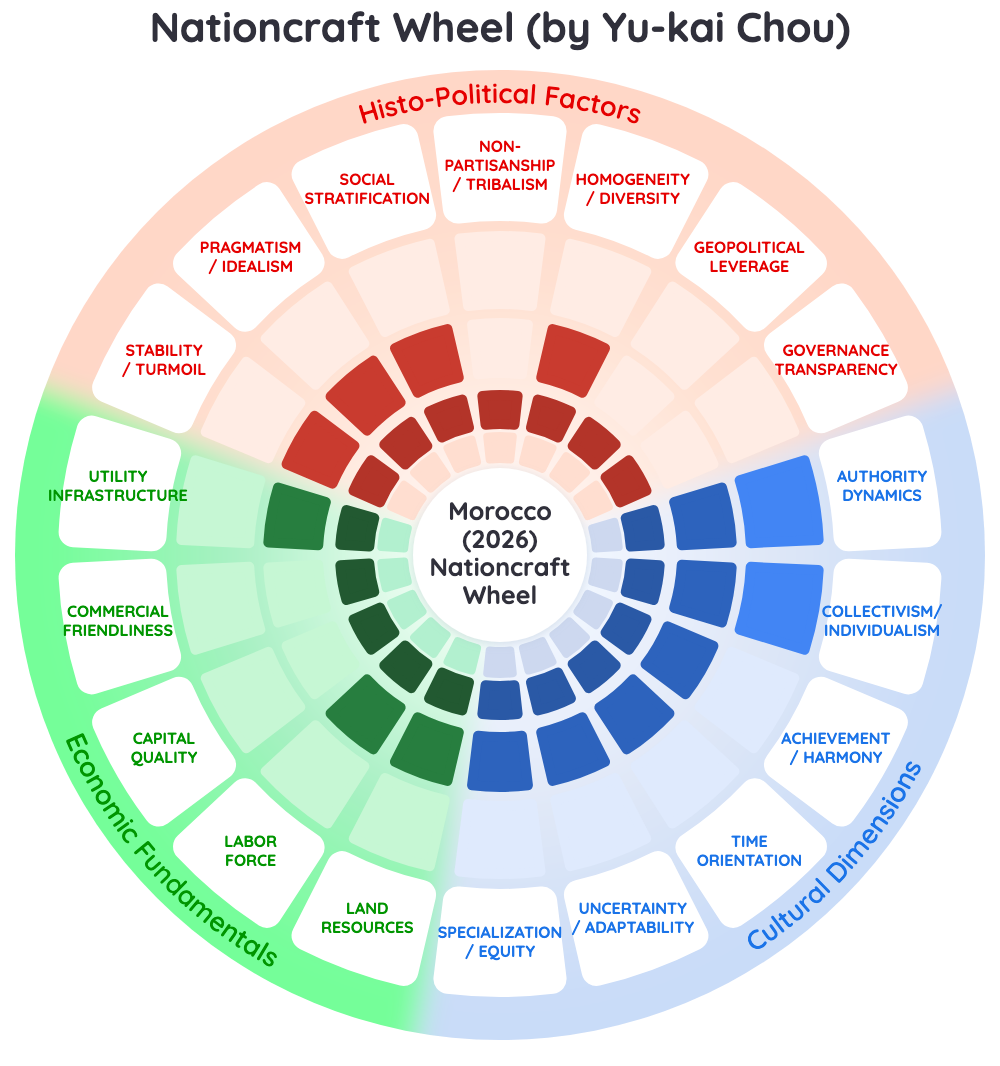
Nationcraft Analysis: Morocco Two-Speed Kingdom 2026
Morocco votes Sept 23 while stadiums rise at decree speed and hospitals crawl at party speed. The Two-Speed Kingdom Trap in 18 Nation Variables.

On September 23, Moroccans elect a new House of Representatives in the first national vote since the GenZ212 protests filled their cities chanting “hospitals before stadiums.”
The voters know exactly what they want fixed, the state has already agreed with them, the money has already been allocated, and the outcome still cannot deliver it. No other vote on the 2026 calendar has that exact shape.
I call this the Two-Speed Kingdom Trap. Morocco runs two delivery systems under one flag. The fast lane answers to the palace and builds at decree speed: Africa’s first high-speed rail, the Mediterranean’s largest container port, a diplomatic sweep that got the UN Security Council to bless its Western Sahara autonomy plan. The slow lane answers to elected coalitions and crawls: hospitals where out-of-pocket costs still eat 34 percent of a family’s health spending, schools that produce a 37 percent youth unemployment rate, an insurance reference-tariff schedule that has gone without comprehensive revision since 2006.
King Mohammed VI named the condition himself in July 2025: there is “no place for a Morocco moving at two speeds.” Fourteen months later, his kingdom is holding an election that only governs the slow lane.
This analysis reads Morocco through all 18 Nation Variables, names the exact variable interactions that keep the two lanes apart, and tests eleven historical reform packets against the profile. Eight fail. Three deserve study. The difference is worth understanding before the polls open, because the trap predicts what happens after they close.
⚡ Speed Run Notes
- Morocco votes September 23 in its first national election since GenZ212. The protests asked for hospitals; the ballot only reshuffles the coalition that manages them. The palace lane is not on the ballot at all.
- The Two-Speed Kingdom Trap: V1=8 authority builds ports, rail, and stadiums at decree speed, while clinics and classrooms crawl at party speed behind V10=3 fragmentation, V13=3 opacity, and V4=4 horizons.
- The corpus gates Morocco out of the modernizer playbook family: RE-004 requires V8≥8 pragmatism and V4≥7 horizons. Morocco scores 4 on both. LKY, Dubai, and Vision 2030 are not importable.
- Morocco already ran its own packet: SP-028 Hassan II Liberalization. Its recorded failures (education too slow, youth unemployment 25%+, regional inequality) read as the GenZ212 grievance list written thirty years early.
- Eight playbooks rejected, three worth studying: Oman’s services-first monarchy (SP-036), Jordan’s stability-without-oil bargain (SP-084), Thailand’s Eastern Seaboard corridor (SP-020) and its inequality side effect.
- Youth are roughly 25% of the population, yet 18-to-24-year-olds are 3% of registered voters. Under full ET-007 and ST-002 signatures, the exit door (Ceuta, July 2026) is outcompeting the ballot box.
Table of Contents
- Understanding Morocco’s Governance Machinery Through Nationcraft
- What Is the Nationcraft Framework?
- Why This Morocco Variables Analysis Matters Right Now
- The 18 Morocco Nation Variables
- The Two-Speed Kingdom Trap
- Detailed Justifications: Variable by Variable
- What the September 23 Ballot Can and Cannot Reach
- Strategic Implications
- Eight Reformer Playbooks Morocco Should Reject
- Three Playbooks Morocco Should Actually Study
- Governance Strategy Recommendations
Author Credibility: Yu-kai Chou

Yu-kai Chou created the Nationcraft Framework, applying behavioral design to the hardest motivational problem there is — getting an entire population to move through structural reform without losing momentum. As of 2026, the framework has informed advisory work with eight governments: Taiwan, the Netherlands, the United Kingdom, Bahrain, South Korea, Singapore, Ukraine, and Kazakhstan. The same 8 Core Drives that have driven design at Microsoft, Porsche, and MrBeast now anchor nation-scale reform sequencing — diagnosing where motivation is broken, which Core Drives to lean into for each phase of reform, and how to sequence the political asks so the public stays bought in.
Published Nationcraft analyses include diagnostic playbooks for Venezuela’s post-Maduro reform window and Thailand’s reset-vs-cycle election dynamics, alongside cabinet-level advisory work on post-conflict recovery, reform-sequencing, and public-policy gamification. Chou also teaches the Octalysis methodology at Harvard, Stanford, Yale, Google, BCG, and IDEO — institutions where the human-systems lens applies whether the system is a product, a company, or a country.
His work has been cited by Harvard, Stanford, MIT, Forbes, Wall Street Journal, Wired, US Department of Energy, NIST, NSF, NCBI, US Department of Education, ClinicalTrials.gov, and Google Scholar — with 3,700+ more academic publications. Explore his books here.

The advisory list above includes Bahrain, a monarchy calibrating modernization against legitimacy, which is precisely the geometry Rabat is managing. What follows is the same diagnostic I run in those rooms: variables first, playbooks second, and no imported template until the profile says it fits.
Understanding Morocco’s Governance Machinery Through Nationcraft
Most election coverage treats Morocco as one political system choosing its next manager. The Nationcraft Framework reads it as two systems sharing one territory, and that single distinction explains nearly everything the coverage finds puzzling.[1]
The Moroccan constitution assigns the king the sovereign domains: national security, religious affairs as Commander of the Faithful, and the strategic direction of foreign policy. The elected government holds economic and social administration, which means the things voters are angriest about (hospitals, schools, jobs) sit in the weaker lane.
That split, and what it does to reform capacity, is the subject of everything below.
When the GenZ212 generation chanted “hospitals before stadiums” in autumn 2025, the comparison underneath ran deeper than two budget lines. One operating system had just delivered a World Cup co-hosting bid, a UN Security Council win, and Africa’s first high-speed rail line, while the other had left eight women to die after cesarean sections in an Agadir public hospital.[4]
Nationcraft gives us the vocabulary to say precisely why one lane performs and the other does not, using the same 18 variables the corpus applies to every state, from Ukraine’s wartime variable profile to Thailand’s judicial-veto trap.
What Is the Nationcraft Framework?
The Nationcraft Framework diagnoses why reforms succeed in one country and fail in another, and it rests on a single observation: policy effectiveness is decided by context-fit, not policy quality.
It scores every nation on 18 Nation Variables across three families. Cultural variables (V1–V6) capture how the population relates to authority, community, achievement, time, uncertainty, and equity. Histo-political variables (V7–V13) capture stability, pragmatism, stratification, partisanship, diversity, geopolitical position, and transparency. Economic variables (V14–V18) capture land, labor, capital, commercial friendliness, and infrastructure.
Against that profile, Nationcraft tests a library of 140 Success Packets: documented reform programs, from Meiji Japan to post-genocide Rwanda, each recorded with the variable preconditions that made it work. A packet that transformed one country will wreck another if the preconditions are absent, which is why the framework spends more effort rejecting playbooks than recommending them.
The motivational layer underneath comes from Octalysis: nations, like products, run on the 8 Core Drives, and the bridge piece on how Octalysis applies to nation-building maps that correspondence in full. Reform sequencing is, at bottom, motivation sequencing.
Why This Morocco Variables Analysis Matters Right Now
Three clocks are converging on Rabat this month, and each one is a Nationcraft variable under stress.
First, the electoral clock. The campaign opened September 10 and voting is September 23: 395 seats, 92 local districts, 12 regional districts, 27 parties, and no minimum threshold to enter parliament, a rule that guarantees the fragmentation V10 measures.[3][10]
Second, the demographic clock. Roughly a quarter of Morocco’s population is between 15 and 29, yet under-35 voters are just 18 percent of the registered electorate, and 18-to-24-year-olds are 3 percent. About 2.2 million fewer Moroccans are registered than in 2021.[1][9]
Third, the delivery clock. The state answered GenZ212 with an 18 percent raise in health and education allocations, to 140 billion dirhams, roughly 15 billion dollars, plus pledges of 8,000 health jobs, 19,000 education jobs, and ninety hospital renovations.[6] Of the 3.3 billion dirhams promised for hospital construction, only the 2026 tranche is programmed, and in Casablanca-Settat, the one region with a published calendar, nothing finishes before the vote.[1]
Money moved in months. Delivery is measured in decades. The gap between those two speeds is the terrain the campaign is actually fought on, whatever the manifestos say.
The 18 Morocco Nation Variables
Here is Morocco’s full Nationcraft profile from the corpus, sanity-checked this week against IMF, AfDB, Court of Accounts, and Security Council reporting.[2][5]
| Variable | Score | Reading |
|---|---|---|
| V1 Authority Dynamics | 8/9 | Monarchy with religious legitimacy; sovereign domains stay with the palace; the king appoints the head of government from the winning party |
| V2 Collectivism | 8/9 | Family and tribal networks carry daily life; even GenZ212 organized as leaderless collectives, not individual dissidents |
| V3 Achievement vs Harmony | 5/9 | Mixed achievement culture; ambition present, harmony preserved |
| V4 Time Orientation | 4/9 | Short political horizons in the party lane; the palace plans in decades, the coalition in news cycles |
| V5 Uncertainty Adaptability | 5/9 | Managed-reform tradition; changes absorbed when introduced gradually |
| V6 Specialization vs Equity | 5/9 | Moderate specialization; the exact band the middle-income-trap pattern flags |
| V7 Stability vs Turmoil | 6/9 | Protests absorbed without regime crisis; the monarchy functions as a shock absorber |
| V8 Pragmatism vs Idealism | 4/9 | Patronage logic in the party lane; known fixes (the AMO reference tariffs) deferred for two decades |
| V9 Social Stratification | 6/9 | The king’s own “two speeds” admission; urban-rural and coastal-interior divides persist |
| V10 Non-Partisanship vs Tribalism | 3/9 | 27 parties, no-threshold proportional rules, notability politics; coalitions of convenience, not program |
| V11 Homogeneity vs Diversity | 6/9 | Arab-Amazigh diversity, officially managed since Amazigh became a state language in 2011 |
| V12 Geopolitical Leverage | 2/9 | Low inherited leverage; every diplomatic asset (Western Sahara recognition, migration file, World Cup 2030) had to be earned |
| V13 Governance Transparency | 3/9 | Court of Accounts finds 91% of AMO reimbursements flowing to private clinics while most citizens use public hospitals |
| V14 Land Resources | 6/9 | Roughly 70% of world phosphate reserves, agriculture, fisheries, world-class solar and wind; six years of drought stress the water table |
| V15 Labor Force Quality | 6/9 | Bimodal: urban engineering and aerospace talent pools beside mass learning poverty |
| V16 Capital Quality | 3/9 | Casablanca Finance City ranks first in Africa while SME credit stays thin and informality high |
| V17 Commercial Friendliness | 3/9 | FDI lands in free-zone enclaves; the economy-wide experience is friction |
| V18 Utility Infrastructure | 4/9 | World-class arteries (Tangier Med, Al Boraq high-speed rail), thin capillaries (rural water, clinics) |
Read the table casually and Morocco looks like a middling profile with two strong cultural anchors. The interactions say otherwise, and they are what the trap is built from.
The Two-Speed Kingdom Trap
Every named trap in this series is a specific variable interaction, and Morocco’s is among the cleanest in the corpus.
Start with what the fast lane runs on. V1=8 gives the palace decree-speed authority. V2=8 gives it a population that mobilizes collectively behind national projects. V14=6 supplies phosphate rents through OCP, and the earned side of V12 converts diplomacy into capital: Gulf investment, EU funds, FIFA’s 2030 co-hosting rights, and UN Security Council Resolution 2797 declaring genuine autonomy under Moroccan sovereignty “a most feasible outcome” for Western Sahara.[7]
That machine built Tangier Med into the Mediterranean’s largest container port, laid Africa’s first high-speed rail line, is extending it 400 kilometers from Kenitra to Marrakech, and has pointed a multibillion-dollar public-investment program at the 2030 World Cup: rail, airports, and stadiums moving on FIFA’s calendar.[2][5]
Now look at what the slow lane runs on. Health and education delivery route through elected coalitions scored V10=3: twenty-seven parties, no threshold, seats won on local notability rather than program. Administration answers to V13=3 opacity, where an insurance system reimburses private clinics with 91 percent of its funds while the public hospitals voters actually use decay. Political attention lives on V4=4 horizons, which is how a reference tariff schedule survives two decades with piecemeal adjustment in place of the comprehensive revision everyone agrees it needs. And the coalition culture scored V8=4 treats ministries as patronage rather than delivery instruments.
Here is the trap’s engine: the fast lane’s success finances the slow lane’s failure.
Phosphate rents, tourism receipts, remittances, and megaproject growth (the IMF projects 4.4 percent for 2026, driven by agriculture and public infrastructure investment) keep the fiscal position comfortable enough that the service lane never faces a forcing crisis.[2] Ghana’s bailout-cycle trap shows what happens when the money runs out; Morocco’s trap is subtler because the money never quite does.
The IMF wrote the caveat into its own projection: scaling up public investment delivers growth and jobs “provided risks are well managed and human capital is strengthened.”[2] That conditional clause is the slow lane, knocking on the fast lane’s door.
In Octalysis terms, the kingdom’s hardware program runs on Core Drive 1 (CD1): Epic Meaning & Calling: national destiny, the World Cup, the Sahara consensus. The citizen’s daily experience of the state runs on Core Drive 2 (CD2): Development & Accomplishment, the felt sense that effort converts into progress, and on Core Drive 8 (CD8): Loss & Avoidance, the fear of a medical bill or a wasted degree. A state that feeds CD1 while starving CD2 gets exactly what Morocco got in autumn 2025: a generation that loves the country and distrusts the system, chanting about hospitals inside stadiums their taxes built.
The compounding cost is motivational rather than fiscal. When young Moroccans conclude that effort inside the system converts to nothing, the psychology shifts from ambition to learned helplessness, and the rational response becomes exit. In late July 2026, tens of thousands of mostly young Moroccans attempted a mass crossing into Ceuta in a surge driven by social media; Spain’s prime minister told his parliament no institution had produced solid evidence Rabat was involved.[1][8] Albania’s departure dividend shows where that road ends: a state that exports its own reform constituency.
The corpus already holds Morocco’s own file on this trap. Morocco ran a managed-liberalization packet once before: SP-028, the Hassan II Liberalization of the 1990s, covering EU association, privatization, the Plan Azur tourism push, and the automotive hub strategy that eventually delivered.
SP-028’s file records what worked (managed liberalization preserved stability, the export base was real) and what failed: education reform too slow, youth unemployment above 25 percent, regional inequality persistent. Thirty years later, a generation named for its phone country code marched under exactly that failure list. The trap has a history, and the history has a file number.
Detailed Justifications: Variable by Variable
Here is the reasoning behind each family, with the 2026 data that survived this week’s sanity check.
Cultural Variables (V1–V6): Authority That Works, Horizons That Don’t
V1 Authority Dynamics sits at 8 because Moroccan authority is layered, not merely coercive. The king rules as Commander of the Faithful, which fuses religious and political legitimacy in a way few states retain, and the 2011 constitutional bargain preserved royal control of the sovereign domains while conceding administration to elected coalitions.
The GenZ212 test confirmed the score. Protesters attacked the government relentlessly and the throne almost never; the monarchy absorbed the shock and then redirected it, with the king publicly pressing the government in his October 10 address to accelerate on education and health.[4]
V2 Collectivism at 8 shows up in how Morocco moves: family networks carry welfare the state does not deliver, diaspora remittances function as a parallel social insurance system, and even the protest movement organized as anonymous collectives on Discord rather than around leaders.
V4 Time Orientation at 4 is the first half of the trap. Coalition politics runs on the annual budget fight and the five-year seat count. Nothing in the party lane is rewarded for a 2035 payoff, which is why every long-horizon program Morocco actually completes (ports, rail, solar) originates in the palace lane, where tenure is measured in reigns.
V3 at 5, V5 at 5, and V6 at 5 round out a culture that achieves without worshiping achievement, adapts when change arrives gradually, and tolerates moderate specialization. V6=5 sits squarely inside the band the middle-income-trap pattern flags, and Morocco’s export upgrading keeps stalling exactly where that band predicts.
Histo-Political Variables (V7–V13): The Fragmented Lane
V7 Stability at 6 is the monarchy’s dividend. Morocco passed through the Arab Spring with a constitutional amendment while Tunisia’s sovereignty trap swallowed its democratic decade next door, and it passed through GenZ212 with a budget increase. Turmoil is absorbed, not absent.
V8 Pragmatism at 4 needs careful reading, because the palace’s technocrats are plainly pragmatic. The score belongs to the system voters can reach: a party lane where ministries are coalition currency, where the comprehensive tariff revision the insurance system needs stays deferred because it would cost the state and insurers money, and where the Court of Accounts can document failure without consequence following.
V9 Stratification at 6 was conceded by the king himself in the July 2025 Throne Day speech: no place for a Morocco at two speeds, said the man whose kingdom runs at two speeds.
V10 Non-Partisanship at 3 is the second half of the trap. Twenty-seven parties contest this election under proportional rules with no entry threshold.[10] The predictable result is coalitions assembled from notables rather than programs, which converts every ministry into a bargaining chip and every reform into a negotiation among parties whose survival does not depend on delivery.
V11 Diversity at 6 reflects a managed Arab-Amazigh duality; Amazigh has been an official language since 2011, and the state has largely kept identity out of the conflict channel.
V12 Geopolitical Leverage at 2 looks wrong until you read the corpus semantics: Singapore also scores 2. Low V12 means nothing is inherited from position; everything must be earned. Morocco’s 2026 hand (Resolution 2797, the migration file with Europe, World Cup 2030, a troop commitment to Gaza’s International Stabilization Force) is earned leverage, and earned leverage can be un-earned.[7]
V13 Transparency at 3 has a number attached. The Court of Accounts found compulsory health insurance leaving out-of-pocket costs at 34 percent of total health spending in 2024, and 91 percent of AMO reimbursements flowing to private clinics while most citizens queue at public hospitals.[1] One finding like that is a scandal; a stable pattern of it is an operating model.
Economic Variables (V14–V18): World-Class Arteries, Starved Capillaries
V14 Land Resources at 6 rests on the phosphates: OCP controls roughly 70 percent of the world’s known reserves, which functions as Morocco’s quiet rent. Add productive agriculture, two coastlines, and some of the planet’s best solar and wind corridors, then subtract six consecutive years of drought.
V15 Labor at 6 is bimodal, and the bimodality is the two-speed pattern inside a single variable. Casablanca and Tangier feed aerospace and automotive clusters with genuinely skilled engineers; meanwhile learning poverty in public schools stays mass-scale, and youth unemployment reached 37.2 percent in 2025 with overall unemployment at 13 percent.[5]
V16 Capital at 3 despite Casablanca Finance City ranking first in Africa: the ranking measures the tower, not the plumbing. SME credit is thin, informality is high, and household savings hide in real estate.
V17 Commercial Friendliness at 3 explains the FDI paradox. Renault, Stellantis, and Boeing suppliers operate happily inside free-zone enclaves with dedicated rules, while the economy outside the fence runs on friction. The FDI-led growth pattern, ED-003, requires V17≥7, V13≥5, and V18≥5 economy-wide; Morocco imported the investments without the preconditions, so the investments stay in enclaves.
V18 Infrastructure at 4 completes the picture: Tangier Med and the Al Boraq high-speed line are world-class arteries, while rural water systems fail in drought and clinic infrastructure is the thing GenZ212 was protesting. Arteries near the top of the scale, capillaries near the bottom, and the average of 4 is the least informative number in the whole profile.
What the September 23 Ballot Can and Cannot Reach
Map the election onto the profile and its limits become mechanical rather than cynical.
The ballot selects the slow lane’s management. The head of government comes, by royal appointment, from whichever party finishes first; the observed frontrunners are Fouzi Lekjaa, who runs Moroccan football and would make World Cup delivery the government’s organizing mission, and housing minister Fatima Ezzahra El Mansouri, who would be the first woman in the role. Either would be unprecedented; neither is a break with the establishment bloc.[1]
The Islamist PJD, decimated from 125 seats in 2016 to 13 in 2021 and led again by Abdelilah Benkirane, campaigns on the protesters’ grievances; observers do not expect it near government.[1]
What the ballot cannot reach: the sovereign domains, the makhzen’s administrative deep state, the AMO’s incentive architecture, or the V10=3 coalition arithmetic that will assemble whichever government forms. Young Moroccans are running an honest Expectancy Theory calculation: expectancy that a vote changes hospital queues is low, instrumentality through a 27-party coalition is lower, and so effort goes elsewhere, to the street in October 2025 and to the Ceuta fence in July 2026.
The state noticed the arithmetic. It now covers up to 75 percent of campaign costs for candidates under 35 and requires new parties to include young founders.[1] But Morocco has run this play before: the 30-seat youth quota created after the 2011 protests was quietly cannibalized when the gender quota expanded from 60 to 90 seats ahead of 2021. Representation was reallocated, not expanded, and young Moroccans remember which line item got cut.
Strategic Implications
Four corpus patterns match Morocco’s profile simultaneously, and their overlap is the strategic map.
| Pattern | Signature | Morocco’s Match | Implication |
|---|---|---|---|
| ET-007 Middle Income Trap | V15 5–6, V6 4–5, amplified by V17≤5 and V4≤5 | Full signature: V15=6, V6=5, V17=3, V4=4 | Wages outgrow labor-intensive niches while innovation capacity stalls; the auto cluster upgrades, the economy does not |
| ST-002 Brain Drain Spiral | V15≥6, V16≤4, V17≤4 | Full signature: 6 / 3 / 3 | The education system produces talent the domestic economy cannot absorb; exit becomes self-reinforcing |
| RE-008 Youth Bulge, Dividend vs Risk | Youth >30% of working-age entry; V15, V17, V7 decide direction | Razor’s edge: V15=6 and V7=6 point dividend, V17=3 points risk | The same cohort is either Morocco’s growth engine or its instability engine; V17 is the deciding vote |
| RE-004 Authoritarian Modernizer | V1≥8, V8≥8, V4≥7, V13 3–6 | Half signature: V1=8 and V13=3 qualify, V8=4 and V4=4 fail | The modernizer packet family (LKY, Dubai, Vision 2030) is gated off; authority exists, but the pragmatism-horizon engine sits only in the palace lane |
The RE-004 half-match carries the most policy weight. Morocco has the authority profile of the great modernizer states and the pragmatism profile of the states that squandered it, because the modernizing pragmatism lives exclusively in one lane. The strategic question is not whether Morocco can modernize. The hardware proves it can. The question is whether the palace lane’s operating system can be extended into service delivery without the palace absorbing service delivery, which would trade the trap for overload.
PB-06, the corpus’s Authoritarian Modernization Playbook, states the gate plainly: its single most important variable is V8, and below 6 the playbook produces prestige projects rather than development. Morocco at V8=4 sits below the gate. PB-01, the Human Capital Playbook that the youth crisis begs for, carries its own floor: V13≥4, because below that, talent programs get captured. Morocco at V13=3 sits one point below. Two playbooks the situation demands, both gated shut by the same two governance variables: the trap, restated as arithmetic.
Eight Reformer Playbooks Morocco Should Reject
Every capital shopping for reform gets sold the same catalog. Here is the fit-check against Morocco’s actual profile, with the precondition that disqualifies each packet.
| Packet | Seductive Promise | Disqualifying Precondition |
|---|---|---|
| SP-037 Saudi Vision 2030 | Royal megaprojects as national reinvention | Hydrocarbon rent scale; Morocco’s phosphates fund a ministry, not a sovereign fund |
| SP-012 Dubai Transformation | Build the hub, import the world | City-state scale, V1=10 absolutism, imported talent model |
| SP-002 LKY Industrialization | Clean meritocratic developmental state | V13 and V3 preconditions absent; Singapore ran on V8=9 pragmatism |
| SP-065 Sisi Stabilization | Garrison-led megaproject economy | The road Morocco must not take; Egypt shows megaprojects crowding out the private economy |
| SP-013 Atatürk Reforms | Top-down cultural rupture | Moroccan legitimacy is religious; rupture would burn V1’s own fuel |
| SP-008 Park Chung-hee | Dirigiste export blitz | Ran on V2=9, V4=9, V8=8 total mobilization; Morocco copied the visible half only |
| SP-078 Portugal EU Accession | Anchor to Brussels and converge | No membership on offer; association is an anchor without a destination |
| SP-046 Mexico NAFTA Integration | Deep integration with the rich neighbor | Delivered enclaves and 2-3 percent growth; the branch-plant warning, not a blueprint |
SP-037: Vision 2030, the Wrong Bank Balance
Saudi Arabia’s transformation runs on the Public Investment Fund’s oil-fed trillions, which buy the state room to fail expensively in public. Morocco’s single-artery hydrocarbon dependence analysis covers the donor side of that model; the recipient side is simpler. Phosphate rent is real money, but it is ministry-scale, not NEOM-scale.
Copying the megaproject grammar without the rent produces debt-financed spectacle, and Morocco’s World Cup buildout already sits at the edge of what its fiscal frame comfortably absorbs. Vision 2030’s grammar would push it over.
SP-012: Dubai, the Wrong Population Math
Dubai solved its talent problem by importing 90 percent of its residents and its legitimacy problem by prosperity alone. A kingdom of 37 million with a thousand-year-old legitimacy structure cannot run either play. Morocco must develop the population it has, which is precisely the lane its system delivers worst.
SP-002: Lee Kuan Yew, the Wrong Governance Floor
Singapore’s packet is the most requested item in the catalog and the least transferable. The LKY packet stress test runs the full precondition check; the short version is that LKY ran on V8=9 pragmatism, V3=9 achievement intensity, and an anti-corruption enforcement floor Morocco’s V13=3 cannot supply. Import the housing boards and the EDB without the enforcement floor and you get agencies that distribute patronage more efficiently.
SP-065: Sisi’s Egypt, the Cautionary Neighbor
Egypt is what the Two-Speed Kingdom Trap looks like fully metastasized: Egypt’s garrison economy builds a 58-billion-dollar capital city while the pound collapses and the private sector suffocates. Morocco’s fast lane still builds things the economy actually uses, ports and rail rather than prestige capitals. The Sisi packet is on this list because it is the gravitational pull Morocco’s model drifts toward if the megaproject reflex outlives its returns.
SP-013: Atatürk, the Wrong Legitimacy Chemistry
Atatürk could rupture because military victory had made him the state’s sole legitimacy source. Morocco’s throne draws its authority from religious continuity; a secularizing rupture would consume the very V1=8 that makes the fast lane fast. Turkey’s own trajectory since, including the strongman discount its markets now price, shows how rupture-built systems age.
SP-008: Park Chung-hee, the Half Morocco Already Copied
Morocco’s auto and aerospace clusters are a genuine Park-style achievement: state-directed credit, export discipline, anchor multinationals. What Morocco did not copy is the other half of Park’s packet, the brutal education and rural mobilization investment that made Korean labor absorb the technology. Korea ran Saemaul Undong and universal schooling at V2=9 intensity; Morocco runs free zones beside a school system in learning poverty. South Korea’s own post-martial trap shows the model’s late-stage costs even where it worked.
SP-078: Portugal, the Anchor Without a Destination
Portugal converged because accession was real: Brussels money, Brussels rules, Brussels membership. Morocco’s EU association delivers market access and regulatory alignment with no seat at the end, which is RE-003’s external-anchor pattern minus the reward that makes conditionality bite. An anchor without a destination disciplines the paperwork, not the politics.
SP-046: Mexico, the Branch-Plant Mirror
Mexico is Morocco’s most uncomfortable mirror: deep integration with a rich neighbor, world-class export clusters, and thirty years of 2-3 percent growth with the south left behind. Mexico’s borrowed calm shows where enclave integration stabilizes without transforming. Morocco is running the same experiment with the EU, and the enclave results are already in: the free zones export, the interior emigrates.
Three Playbooks Morocco Should Actually Study
The harder half of the discipline is naming what fits. Three packets clear the profile, each with explicit limits.
| Packet | Variable Fit | What Transfers | What Does Not |
|---|---|---|---|
| SP-036 Qaboos Modernization (Oman, 1970–2000) | V1=8 vs 10, V2=8 vs 8, religious-monarchic legitimacy in both | Services-first sequencing under royal authority: schools and hospitals as the regime’s flagship deliverables | Oil funding; Oman bought time Morocco must earn |
| SP-084 Jordan Stability Without Oil | V1=8 vs 8, V8=4 vs 4, V16=3 vs 3; the closest profile cousin in the corpus | Converting stability itself into an export; education investment that “paid off” per the packet record | The unresolved half: Jordan’s youth unemployment stayed intractable; study the mechanism, not the outcome |
| SP-020 Thailand Eastern Seaboard (1981–1996) | V1=8 vs 8, monarchy-anchored stability, corridor logic | Morocco is already running this packet: Tangier Med is Laem Chabang executed well | The documented side effect: Bangkok-versus-provinces inequality is the packet’s known failure mode, and Morocco is reproducing it |
SP-036: Oman, or What a Monarchy’s Fast Lane Can Choose to Build
In 1970 Oman had three schools, ten kilometers of paved road, and two hospitals. Qaboos spent his first two decades building not skyscrapers but schools, a thousand of them by 2000, and a health system that moved life expectancy from 50 to 76.
Set the oil aside, because the transferable core is the sequencing decision: a monarch with Morocco’s exact legitimacy chemistry chose services as the regime’s flagship output, made hospitals the thing the palace lane built at decree speed, and harvested a generation of loyalty from it. Morocco’s fast lane has repeatedly completed what it aimed at. Oman is evidence about aim.
SP-084: Jordan, the Cousin Who Chose the Other Rent
Jordan matches Morocco on V1, V8, and V16 almost digit for digit, with less land and worse water. Its packet converted geopolitical position and stability into continuous external rents, then pushed an unusual share into education, producing the Arab world’s most exported professional class.
Study the half that worked: education as the one investment a rent-poor monarchy never cut, and managed political openings (1989) used as pressure-release valves timed to economic pain. Respect the half that did not: the packet’s own record lists youth unemployment as intractable and political reform as stalled. Jordan proves a monarchy can run a human-capital strategy without oil. It also proves the strategy fails if the domestic economy never learns to hire the humans it educates. Morocco’s V17=3 is exactly that hiring problem.
SP-020: Thailand’s Eastern Seaboard, the Packet Already Running
Morocco does not need to import this packet; it needs to read the label on the one it is running. Thailand 1981-1996 built Laem Chabang port and the Map Ta Phut estates under monarchy-anchored stability, pulled in Japanese manufacturers, and created a genuine auto cluster. Tangier Med, the Renault ecosystem, and the free-zone corridor are the same play executed a generation later, at larger port scale.
The label’s warning: the Eastern Seaboard’s recorded failure mode is regional inequality, Bangkok versus everyone else, and financial fragility exposed in 1997. Corridor packets concentrate by design. A state running one owes the rest of the country a deliberate diffusion mechanism, which is exactly the capillary investment Morocco’s slow lane keeps not delivering.
Governance Strategy Recommendations
Morocco’s next five years, sequenced properly, follow from which variables gate which playbooks. Sequence is strategy; everything else is a wish list.
| Step | Move | Variables Targeted | Why This Order |
|---|---|---|---|
| 1 | Deliver the comprehensive AMO reference-tariff revision and publish reimbursement flows quarterly; make the Court of Accounts findings a standing public dashboard | V13 3→4, direct CD8 relief | The reform-before-the-reform: PB-01’s human-capital playbook is blocked at its own V13≥4 floor, and this is the cheapest visible point on that floor |
| 2 | Stand up a health-delivery unit with megaproject governance: the same reporting cadence, procurement discipline, and royal visibility that built Tangier Med, aimed at the ninety promised hospital renovations | V18 capillaries, V8 in one vertical | Oman’s aim with Morocco’s proven machine; extends fast-lane discipline into one service without the palace absorbing the whole sector |
| 3 | Convert the 2030 World Cup into a dated anchor for the slow lane: every host city’s FIFA-visible calendar carries paired, published deadlines for its hospital and school programs | V4 4→5 via RE-003 mechanics | Morocco lacks an EU-accession clock; FIFA’s is the one hard external deadline the system already respects, so borrow it for the capillaries |
| 4 | Build the corridor-diffusion mechanism the Eastern Seaboard packet owed Thailand: supplier-development programs and vocational pipelines contractually linking free-zone anchors to interior firms and training centers | V17 3→4, V15 diffusion | ED-003’s preconditions must be built outward from the enclaves; otherwise the interior keeps exporting people instead of parts |
| 5 | Give citizens a progress interface: province-level delivery dashboards for the 140-billion-dirham program, updated monthly, with named owners | V13, CD2, youth re-engagement | Motivation follows visible progress; Hope Theory calls the ingredients pathways and agency, and a dashboard is both or it is theater |
Notice what is absent: no constitutional engineering, no new megaproject, no imported flagship. The profile says Morocco’s binding constraints are V13, V17, and V4, all three of which move through administrative choices the existing system could make without touching the sovereign bargain.
The behavioral layer matters as much as the institutional one. A generation taught by queues and quotas that effort converts to nothing needs its self-efficacy rebuilt through small, kept promises before it will believe large ones.
The distinction between White Hat and Black Hat design separates a state that motivates through meaning and progress from one that manages through fear of loss, and every step in the table above is White Hat by construction.
Comparative Context
Morocco’s trap sits in a recognizable family. Egypt is the terminal version, where the fast lane consumed the economy. Jordan chose education as its non-negotiable and still could not solve hiring. Thailand’s corridor packet sent its inequality bill a generation later, and Mexico stabilized through enclave integration without ever being transformed by it.
The nearest structural relative outside this piece is Vietnam, whose V8=9 pragmatism under concentrated authority is precisely the variable Morocco’s party lane lacks; the contrast is instructive because Vietnam’s double-digit decree problem is the mirror image, pragmatism outrunning its own institutions.
Against the democracies in the library, the contrast flips: France’s fragmentation trap shows V10=4 paralyzing a V16=9 state, while Morocco’s V10=3 coexists with delivery because the delivery lane bypasses parties entirely. The same variable fails in a different organ of the state.
The Nationcraft Framework in Practice
What should a Nationcraft reader watch between now and 2030? Three tells, in order. If the AMO reference-tariff revision ships within a year of the new government forming, V13 is moving and the slow lane has found a delivery muscle.
If the ninety hospital renovations acquire FIFA-style published deadlines, the palace lane’s discipline is crossing over. And if youth voter registration rises rather than falls before the next cycle, the Octalysis Framework reading of the street has changed: effort inside the system has started converting again, which is the one variable shift no decree can order.
Morocco now has to decide whether the machine that builds ports can be taught to build trust. The variables say it can. The election, by design, will not decide it.
Explore More Nationcraft Analyses
The Nationcraft Nation Variables Library holds every published country diagnosis, and the framework hub documents the full 18-variable method behind them; both are linked in Related Reading below, alongside the Spain, Greece, and Kazakhstan analyses that pair naturally with this one.
Frequently Asked Questions
What is the Two-Speed Kingdom Trap?
It is Morocco’s core variable interaction: V1=8 royal authority builds infrastructure and diplomacy at decree speed, while health, education, and jobs route through a party lane weakened by V10=3 fragmentation, V13=3 opacity, V8=4 patronage logic, and V4=4 short horizons. The fast lane’s success finances the slow lane’s failure, so the gap persists instead of forcing reform.
Why can’t the September 23 election fix Morocco’s hospitals and schools?
The election selects the government that manages the slow lane, but the mechanisms that keep that lane slow (coalition fragmentation across 27 parties, the AMO’s incentive structure, administrative opacity) are not on the ballot, and the sovereign domains never are. A new coalition inherits the same machine that produced the grievances.
Is Morocco in the middle-income trap?
By signature, yes. ET-007 requires V15 between 5 and 6 and V6 between 4 and 5, amplified by weak business environment and short horizons; Morocco matches on every element, with V15=6, V6=5, V17=3, and V4=4. The auto and aerospace clusters upgrade while the wider economy stalls, which is the trap’s textbook shape.
Why does the Nationcraft Framework reject the Singapore model for Morocco?
The LKY packet’s preconditions include V8=9 pragmatism, V3=9 achievement intensity, and a clean-governance enforcement floor. Morocco scores 4, 5, and 3 on those variables. Importing Singapore’s agencies without its enforcement floor historically produces better-organized patronage, not development.
What should Morocco study instead of the famous playbooks?
Three packets fit: Oman’s SP-036 (a religiously legitimate monarchy that made schools and hospitals its flagship builds), Jordan’s SP-084 (education as the never-cut investment in a rent-poor kingdom, with its unemployment failure studied honestly), and Thailand’s SP-020 Eastern Seaboard (the corridor packet Morocco is already running, whose documented side effect is exactly Morocco’s regional inequality).
What are Morocco’s Nation Variable scores?
V1=8, V2=8, V3=5, V4=4, V5=5, V6=5, V7=6, V8=4, V9=6, V10=3, V11=6, V12=2, V13=3, V14=6, V15=6, V16=3, V17=3, V18=4. The full table with 2026 evidence for each score is in the analysis above.
Related Reading
- The Nationcraft Framework: 18 Variables, 8 Goals, 100+ Proven Reform Packets
- Nationcraft Nation Variables Library
- Nationcraft Analysis: Spain Rented Border Trap 2026
- Nationcraft Analysis: Greece Discipline Window Trap 2026
- Nationcraft Analysis: Kazakhstan Steppes Pivot 2026
- Nation Variable Analysis: United States of America (2026)
Footnotes
- Henneberg, S. & Annasse, S., “Morocco’s Election Highlights Lingering Protest Grievances,” The Washington Institute, PolicyWatch 4256, September 3, 2026. washingtoninstitute.org
- IMF, “IMF Executive Board Concludes 2026 Article IV Consultation, and Mid-Term Review Under the Flexible Credit Line Arrangement with Morocco,” Press Release 26/086, March 23, 2026. imf.org
- “2026 Moroccan general election,” Wikipedia, accessed September 11, 2026. en.wikipedia.org
- “2025 Moroccan Gen Z protests,” Wikipedia, accessed September 11, 2026. en.wikipedia.org
- African Development Bank, “Morocco Economic Outlook,” 2026. afdb.org
- “After protests, Morocco raises health and education budget to $15 billion in 2026,” Middle East Monitor, October 20, 2025. middleeastmonitor.com
- “Western Sahara: Vote on a Draft Resolution Renewing MINURSO’s Mandate,” Security Council Report, What’s In Blue, October 2025. securitycouncilreport.org
- “Why thousands tried to reach Ceuta,” Deutsche Welle (video report), 2026. dw.com
- “Morocco’s 2026 Legislative Elections: Building Democratic Experience on Trust and Social Cohesion,” Liberal International, 2026. liberal-international.org
- “Morocco election campaign begins as 27 parties vie for power,” The New Arab, September 2026. newarab.com