
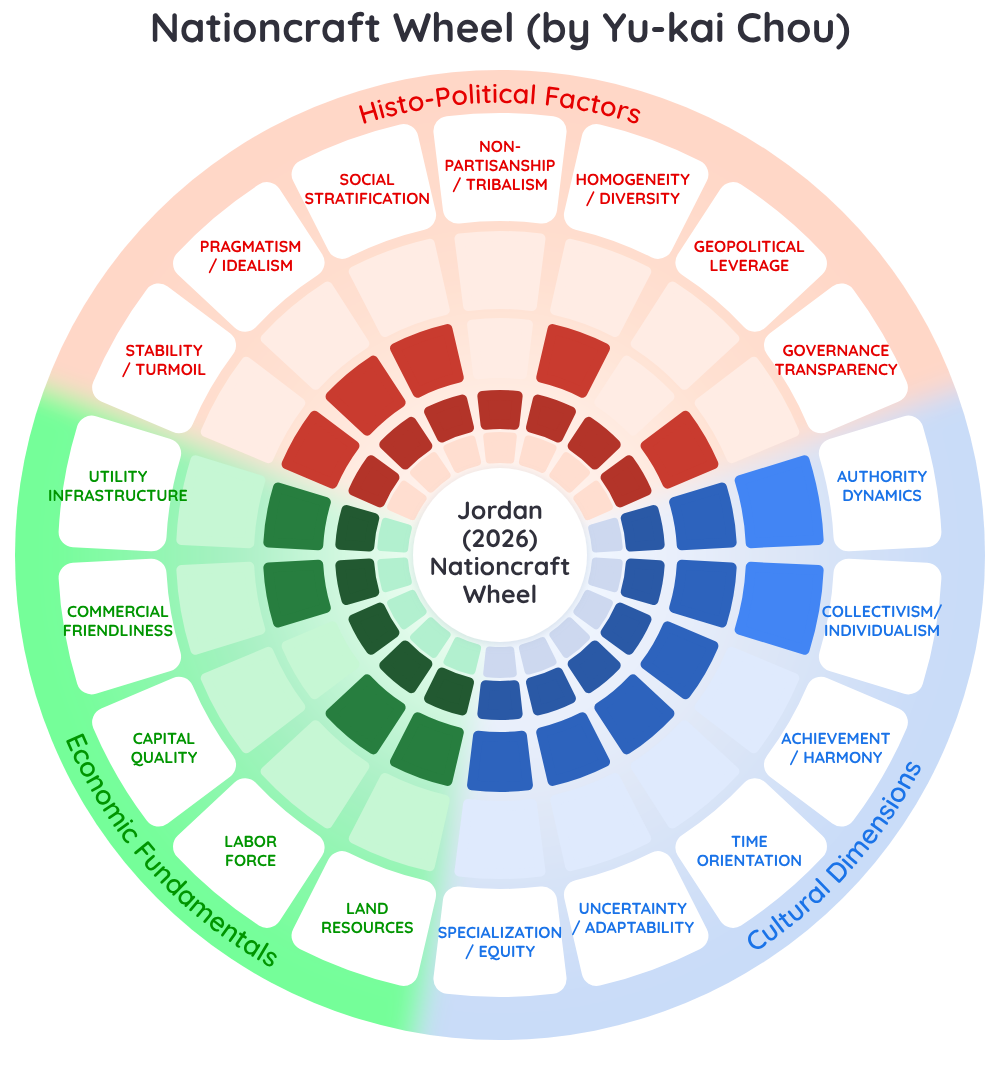

In the space of sixteen November days, Jordan collected the full package. On November 3, the IMF announced a staff-level agreement on the kingdom’s sixth review under its Extended Fund Facility and third under its Resilience and Sustainability Facility, unlocking roughly $294 million once the board signs off.[1]
On November 19, at the Jordan-EU Investment Conference on the Dead Sea shore, ministers signed a $6.6 billion agreement with the French infrastructure fund Meridiam to build the Aqaba-Amman Water Desalination and Conveyance Project, the largest infrastructure undertaking in the country’s history.[2]
The mission reported every quantitative performance criterion met, reserves of $27.5 billion, inflation near 2 percent, and a debt path the IMF itself calls credible. If passing reviews were development, Jordan would be a tiger.
Here is what the same institutions report in the same documents. Unemployment has been parked at just over 21 percent for years. Youth unemployment runs near 46 percent. Female labor force participation is 14.4 percent, among the lowest rates ever recorded in a middle-income country.[3][8] Jordan has now been under IMF arrangements almost continuously since 1989, and it passes nearly every review. The model student never graduates, because graduating was never what the arrangement was for.
This analysis names that configuration the Stability Rent Trap. Jordan’s core export is stability itself: a safe, moderate, cooperative state in the most dangerous neighborhood on earth, and the world pays rent for it in grants, concessional programs, and externally financed megaprojects. The rent keeps the kingdom solvent. It also removes the one thing every reform packet in the Nationcraft corpus depends on, which is a deadline. What follows reads Jordan’s 18 Nation Variables, shows how the rent flows through them, and tests nine historical reform playbooks against the configuration to find the three worth studying.
⚡ Speed Run Notes
- In sixteen November days Jordan banked an IMF pass worth ~$294M and a $6.6B externally financed water megaproject, while its own unemployment stayed over 21% and female labor participation sat at 14.4%.
- The Stability Rent Trap: Jordan’s real export is being stable in a dangerous neighborhood. Donors pay rent for that stability, and the rent quietly removes every deadline reform would need.
- The V-configuration: V1=9 and V2=8 absorb any shock, V12=2 means the location is monetized rather than wielded, and V16=3 plus V17=4 mean rent inflows never convert into private jobs.
- Jordan has been under IMF arrangements nearly continuously since 1989. Its own canon packet (SP-084) records the verdict: being indispensable keeps the regime alive; it doesn’t employ the population.
- Packet reading: study Morocco’s managed liberalization (SP-028), Bangladesh’s employment-first revolution (SP-025), and Costa Rica’s stability-to-services conversion (SP-031). Vision 2030 copying, shock therapy, and republic-by-decree all misfit.
Table of Contents
- Understanding Jordan’s Governance Landscape Through Nationcraft
- What Is the Nationcraft Framework?
- Why This Jordan Variables Analysis Matters
- The 18 Jordan Nation Variables
- The Stability Rent Trap
- Detailed Justifications: Reading Each Variable
- Six Reformer Playbooks Jordan Should Reject
- Three Playbooks Jordan’s Reformers Should Actually Study
- Strategic Implications
- Governance Strategy Recommendations
- Frequently Asked Questions
About Yu-kai Chou

Yu-kai Chou is a Human-Systems Architect & Behavioral Designer and the creator of the Nationcraft Framework — an 18-variable diagnostic for matching a country’s structural profile to the reform packets that have historically worked under similar conditions. He has consulted for governments in eight nations, including Ukraine, the United Kingdom, the Kingdom of Bahrain, Singapore, Taiwan, the Netherlands, Kazakhstan, and South Korea, and has worked directly with President Zelenskyy’s team on post-war reconstruction priorities for Ukraine.
Chou’s prior framework — the Octalysis Framework — has been applied by LEGO, Microsoft, Porsche, Coca-Cola, Salesforce, and MrBeast, impacting over 1.5 Billion Users. He has taught the methodology at Harvard, Stanford, Yale, Tesla, Google, BCG, and IDEO.
His work has been cited by Harvard, Stanford, MIT, Forbes, Wall Street Journal, Wired, US Department of Energy, NIST, NSF, NCBI, US Department of Education, ClinicalTrials.gov, and Google Scholar — with 3,700+ more academic publications. Explore his books here.

This Jordan analysis extends Chou’s advisory work across the region’s small, resource-light states — including the Kingdom of Bahrain, where converting a strategic position into a productive economy is the central reform question — and applies the Nationcraft Framework to the Arab world’s longest-running IMF relationship: a kingdom that has passed three decades of reviews while the variables that decide whether its people find work barely moved.
Understanding Jordan’s Governance Landscape Through Nationcraft
Jordan is the Arab world’s standing puzzle. It has no oil and almost no water, and it has absorbed refugee waves that would have broken most states three times over. And yet there has been no revolution, no civil war on its own soil, no default, and the same ruling house since 1946.
Most commentary explains this with personality, the survival artistry of King Hussein and the managed modernization of King Abdullah II. Nationcraft explains it with configuration. Jordan’s 18 Nation Variables describe a state built to absorb shocks and monetize its position, and that same configuration explains the thing the admiring commentary skips: why a kingdom this well run, this well funded, and this well reviewed still cannot employ its own young people.
The month just ended is the cleanest exhibit the corpus has ever offered. A sixth consecutive IMF review passed with every quantitative target met.[1] A $6.6 billion water project signed with external partners.[2] And an unemployment rate the IMF’s own staff report describes as stuck just over 21 percent, where it has sat through the entire program.[4] The kingdom is simultaneously the region’s best performer and its most instructive warning, and the two facts share one cause.
What Is the Nationcraft Framework?
The Nationcraft Framework diagnoses a nation the way a systems architect diagnoses a product: 18 Nation Variables (V1–V18) spanning cultural dimensions (V1–V6), histo-political factors (V7–V13), and economic fundamentals (V14–V18), each scored 1–9. The configuration, never the average, is what matters. A country with V1 (Authority Dynamics) at 9 and V13 (Governance Transparency) at 4 behaves nothing like a country with the reverse, even if their means are identical.
Against that diagnosis, Nationcraft holds a library of over 100 Success Packets and failure packets: historically documented reform programs, each recorded with the V-profile of the country at the moment the program began. Policy effectiveness is decided by context-fit rather than policy quality. The same playbook that transformed one configuration has wrecked others, which is why this series spends as much ink on the packets a country should reject as on the ones it should study. The method grew out of the same behavioral-design lineage as Octalysis applied to nation-building and public policy: motivation and friction, measured at the scale of a population.
Why This Jordan Variables Analysis Matters
Three reasons, in ascending order of reach.
First, Jordan matters in itself as a case: eleven million people, the Arab world’s longest continuous IMF relationship, and a water clock now measured in single-digit years of aquifer life. The decisions of the next thirty-six months, on water tariffs, on electricity cost recovery, on what the Economic Modernisation Vision actually executes, will decide whether the 2030s look like managed progress or managed decline.
Second, Jordan is the cleanest live specimen of a pattern the Nationcraft corpus keeps finding in different costumes: external income that rewards the existence of the state rather than the productivity of its people. Kuwait’s future-generations trap runs on oil rent. Qatar’s mediator’s mortgage runs on diplomatic positioning. Jordan runs on the purest version: the rent is stability itself, paid by donors who need the buffer state to hold. Reading Jordan teaches you to see the same mechanism wherever it hides.
Third, the timing makes the diagnosis unusually clean, because most countries only get analyzed in crisis. Jordan in November 2026 is being analyzed at the top of its game, every review passed, every ceremony attended, every ribbon cut, which is precisely when a trap configuration is hardest to see and most valuable to name.
The 18 Jordan Nation Variables
Scores are from the Nationcraft corpus’s 2026 Jordan record. The named paradox emerges from the interaction of V1, V2, V7, V12, V16, and V17, and the table is worth reading with that cluster in mind.
| Variable | Score | Reading |
|---|---|---|
| V1 Authority Dynamics | 9/9 | Hashemite monarchy; king appoints the prime minister, dissolved parliament in July 2024; managed pluralism under palace control |
| V2 Collectivism vs Individualism | 8/9 | Tribal confederations and extended-family networks organize politics, employment, and loyalty |
| V3 Achievement vs Harmony | 4/9 | Quiescence is rewarded over disruption; stability outranks ambition in the social bargain |
| V4 Time Orientation | 5/9 | Survival-mode planning punctuated by genuine long-horizon bets (a 2026–2029 modernization program, water infrastructure to 2030) |
| V5 Uncertainty & Adaptability | 6/9 | Absorbed Palestinian, Iraqi, and Syrian refugee waves without breaking; adaptation is a core competence |
| V6 Specialization vs Equity | 5/9 | Entrepreneurial pockets in Amman against a state- and military-employment gravity well |
| V7 Stability vs Turmoil | 6/9 | Hashemite continuity through every regional war since 1946; stability is the national product |
| V8 Pragmatism vs Idealism | 4/9 | Regime diplomacy is famously pragmatic; domestic reform practice is ritualized and slow |
| V9 Social Stratification | 6/9 | East Bank and Palestinian-origin communities track different economic lanes; tribal hierarchy accepted |
| V10 Non-Partisanship vs Tribalism | 3/9 | Parties weak; 2024 election turnout 32.25%, with tribal lists dominant and one organized party |
| V11 Homogeneity vs Diversity | 6/9 | Religiously homogeneous; national identity still negotiated across the origin divide |
| V12 Geopolitical Leverage | 2/9 | The position is priceless to others and therefore monetized as rent; Jordan collects a fee it does not set |
| V13 Governance Transparency | 4/9 | Cleaner than the region’s kleptocracies, but rent flows and state enterprises stay opaque |
| V14 Land Resources | 5/9 | No oil, world-tier water scarcity; phosphates, potash, and Dead Sea minerals carry the score |
| V15 Labor Force Quality | 6/9 | Educated regional talent exporter; chronically underemployed at home |
| V16 Capital Quality | 3/9 | Thin domestic capital markets, an aid-dependent budget, a small home market |
| V17 Commercial Friendliness | 4/9 | Adequate rather than magnetic; the IMF names weaker FDI among the standing risks |
| V18 Utility Infrastructure | 5/9 | Developed for the region; water is the existential gap at roughly 60 cubic meters per person per year |
The Stability Rent Trap
Every economy exports something. Saudi Arabia exports hydrocarbons, Bangladesh exports garments, the Philippines exports labor. Jordan’s largest export, measured by what actually balances the budget, is a condition: the continued existence of a stable, moderate, Western-aligned kingdom between Israel, Syria, Iraq, and Saudi Arabia.
That condition has paying buyers, and the receipts are public. Washington signed a memorandum of understanding in September 2022 committing roughly $10 billion in assistance across fiscal years 2023 to 2029, delivered in annual installments like the $845.1 million cash grant wired directly to the Treasury account in 2023.[5] The IMF runs a $1.3 billion Extended Fund Facility alongside a $700 million Resilience and Sustainability Facility.[6] Regional partners added another $200 million in budget grants this year.[4] And when the water crisis finally demanded an answer measured in billions, the answer arrived as a donor-backed public-private partnership, with $400 million in supplemental US grants already earmarked.[4]
Lay the November receipts in one ledger and the shape of the national business model is unmistakable.
| Date | Event | Value | What it pays for |
|---|---|---|---|
| Nov 3, 2026 | IMF staff-level agreement: 6th EFF review + 3rd RSF review, all quantitative performance criteria met[1] | ~$294M ($133M EFF + $161M RSF) | Budget support and climate-reform financing |
| Nov 19, 2026 | Aqaba-Amman Water Desalination & Conveyance agreement signed with Meridiam at the Jordan-EU Investment Conference[2] | $6.6B | 300 million m³ of water a year from 2030, about 40% of drinking-water demand |
| Since Jan 2024 | Extended Fund Facility (270% of quota), ~$733M drawn by December 2025[6] | $1.3B | Macro stability, debt path to ~80% of GDP by 2028 |
| Since 2024 | Resilience and Sustainability Facility (150% of quota)[6] | $700M | Water, electricity, and climate reform measures |
| FY2023–2029 | US memorandum of understanding, annual cash grants to the Treasury[5] | ~$10B expected | The general budget itself |
| 2026 | Additional budget grants from regional partners[4] | $200M (0.3% of GDP) | Deficit coverage |
None of this is corruption, and none of it is failure. Jordan earns the rent honestly, by being what its buyers need it to be, at real cost to itself. The trap sits one level deeper.
A state that lives on stability rent faces a motivational architecture unlike any normal economy. When reform succeeds, the rent continues. When reform stalls, the rent continues, and often increases, because a wobbling Jordan frightens its patrons into generosity. The downside case that forced Finland to rewire its economy in a decade, or South Korea to build export industries or starve, simply does not exist here. Jordan’s own canon packet in the Nationcraft corpus, SP-084 (Stability Without Oil, 1989–2020), records where three decades of that architecture landed: growth that decayed from 5 percent averages in the 1990s to 2.5 percent by the late 2010s, and a closing verdict worth quoting in full: “Being indispensable keeps the regime alive; it doesn’t employ the population.”
The November 2026 numbers are that verdict, still running. Growth around 3 percent in the first half of the year.[1] Unemployment just over 21 percent, youth unemployment near 46 percent, female participation at 14.4 percent.[3][8] The reviews pass because the rent makes passing them easy. The jobs never arrive because nothing in the structure requires them to.
Detailed Justifications: Reading Each Variable
Cultural cluster (V1–V6): a society built to absorb, not to accelerate
V1 Authority Dynamics sits at 9, the corpus ceiling shared with Egypt and Iraq. The king appoints and dismisses prime ministers (four days after the September 2024 election, Bisher Khasawneh resigned and the royal chief of staff Jafar Hassan was nominated to form a government[7]), dissolves parliament by decree, and sets the strategic direction every ministry executes. V2 Collectivism at 8 is the complementary load-bearing wall: tribal confederations and family networks deliver loyalty upward and distribute patronage downward, which is why the state has survived shocks that shattered its neighbors.
The cost of that wall shows in V3 Achievement vs Harmony at 4. The social bargain rewards quiescence. A public-sector or military job in exchange for political quiet has been the East Bank settlement since the founding, and it prices stability above ambition for exactly the young people the economy fails to employ. V4 Time Orientation at 5 captures a state that plans in survival increments but can sustain real long bets when the financing is external: the Economic Modernisation Vision’s 2026–2029 executive program, the 2030 water horizon.
V5 Uncertainty & Adaptability at 6 is the quiet superpower. A state that absorbed Palestinian, Iraqi, and Syrian refugee waves, each a double-digit percentage shock to its population, without institutional collapse has adaptation muscles most OECD members lack. V6 Specialization vs Equity at 5 splits the difference between Amman’s genuine entrepreneurial pockets and the state-employment gravity well that pulls talent away from them.
Histo-political cluster (V7–V13): stability as product, politics as ritual
V7 Stability vs Turmoil at 6 reads low until you notice the neighborhood discount: on its own soil, the kingdom has held through 1948, 1967, Black September, two Gulf wars, the Arab Spring, and the Syrian collapse next door. That continuity is the product the rent pays for. V8 Pragmatism at 4 records a split personality: the diplomacy is among the most pragmatic on earth (peace with Israel in 1994 against public opinion, balance with every bloc simultaneously), while domestic reform practice is ritualized, with the same committees reforming the same sectors across decades.
V9 Social Stratification at 6 and V11 Homogeneity at 6 encode the East Bank/Palestinian-origin divide: religiously homogeneous, nationally negotiated. V10 Non-Partisanship vs Tribalism at 3 is the variable the 2024 election measured precisely. Turnout was 32.25 percent; tribal and centrist lists took most of the 138 seats; the Islamic Action Front, with 31 seats, was the only organized program party in the chamber.[7] A parliament elected that way can absorb discontent, and that is its function. It cannot discipline a budget, and that is the point.
V12 Geopolitical Leverage at 2 looks like a data error until you read the corpus convention: Singapore scores 2, Kuwait 2, Morocco 2. The variable measures leverage a state can wield, terms it can set. Jordan’s position is enormously valuable, and almost all of that value is captured as rent offered by others on terms Jordan accepts. A buffer state does not threaten to stop buffering. The score is the paradox in miniature: the more indispensable the location, the less negotiating power the tenant of it holds. V13 Governance Transparency at 4 completes the cluster: cleaner than the region’s kleptocracies, yet the rent flows themselves, military budgets, state utilities, aid accounting, are precisely the least transparent corners of the state.
Economic cluster (V14–V18): everything is adequate, nothing compounds
V14 Land Resources at 5 is phosphates, potash, Dead Sea minerals, and sun, held down by the hardest water constraint in the corpus: roughly 60 cubic meters per person per year, against the 500 the UN labels absolute scarcity. V15 Labor Force Quality at 6 describes the sharpest contradiction. Jordan educates well and exports professionals across the Gulf; the IMF’s own framing is that structural reform must “address youth unemployment and low female labor force participation.”[6] The human capital exists. The home economy does not hire it.
V16 Capital Quality at 3 is why rent never compounds: thin capital markets, an aid-dependent budget, a small home market, and the National Electric Power Company still running operating losses projected at 1.2 percent of GDP in 2026 once war-related costs land.[4] V17 Commercial Friendliness at 4 matches the IMF’s named risk list: weaker foreign direct investment, higher trade and transport costs, lower tourism receipts, projected down 3.4 percent this year.[4] V18 Utility Infrastructure at 5 is decent regionally and existentially short on water, with the water authority’s consolidated losses at 0.4 percent of GDP and a cabinet-level financial sustainability roadmap due this very month.[4]
Read the three clusters together and the Stability Rent Trap stops being a metaphor and becomes a circuit. V1+V2 guarantee the shock absorption that makes the state a credible stability vendor. V12=2 converts the location into rent on the buyer’s terms. The rent flows into a V16=3/V17=4 economy that cannot transform it into private employment, so it pools in public payrolls and subsidies that V3=4 and V10=3 make politically untouchable. Unemployment stays at 21 percent, which keeps the state just fragile enough that no patron dares reduce the rent. The circuit closes on itself: every node is individually rational, and the loop they form is the trap.
Six Reformer Playbooks Jordan Should Reject
Jordan’s reform debate recycles a familiar menu. Tested against the V-configuration above, six of its most popular items misfit, some catastrophically. Each packet below is cited from the Nationcraft canon with the variables that break it.
1. The Vision 2030 packet (SP-037, Saudi Arabia 2016–present): command diversification you cannot afford
Amman policy circles have watched Riyadh’s giga-project decade with understandable envy, and the Economic Modernisation Vision borrows some of its vocabulary. The precondition gap is wide enough to sink the strategy. SP-037 runs on V14=10 oil wealth and a sovereign fund that can lose billions learning; the packet’s own recorded lesson is that it amounts to spending oil wealth to escape oil dependency. Jordan’s V14=5 and V16=3 mean there is no wealth to spend, only rent to reallocate, and rent comes with donor conditions attached. Saudi Arabia’s single-artery economy can buy transformation and still struggle to create private jobs; a copy of the strategy without the artery produces press conferences, not payrolls.
2. The shock therapy pattern (ET-004): the crisis never comes
Shock therapy’s signature requires V5≥7, V8≥8, and a post-collapse window in which the old system is fully discredited. Jordan scores V5=6 and V8=4, and, more fundamentally, the stability rent exists precisely to prevent the collapse that creates shock-therapy mandates. Every time Jordan approaches a cliff edge, 1989, 2011, 2018, a patron steps in, which is humane in the moment and paralytic across decades. The pattern’s counter-examples (Argentina’s repeated reversals without V8 depth) are warning enough; the deeper point is that a rent-cushioned state can never credibly tell its public that there is no alternative, because there always visibly is one. Venezuela’s reform-playbook analysis established the method this series uses: the packet that fits your crisis is useless if your configuration cannot host the crisis.
3. The monarchy-to-republic packet (SP-082, Nepal 1990–2015): changing the roof, keeping the house
A perennial exile fantasy holds that Jordan’s problem is the throne itself. SP-082 is the corpus’s controlled experiment: Nepal abolished its monarchy in 2008 after a peace process the packet genuinely credits, and then development stagnated anyway, because remittance dependency masked the absence of a productive economy. Nepal exports labor because it cannot employ it, the packet records, and Nepal’s clean-slate trap shows the same lesson from the 2026 angle. Swap “remittances” for “stability rent” and the transposition to Jordan is exact: regime form is not the binding constraint, the rent circuit is. Abolishing the monarchy would destroy the asset the rent is paid for while leaving V16=3 untouched.
4. The pre-war neoliberalization packet (FP-020, Syria 2000–2011): liberalization into connected hands
The darkest misfit, and the nearest neighbor. Bashar al-Assad’s first decade ran selective economic liberalization, private banks, free zones, while keeping politics sealed. The failure packet’s recorded insight: when transparency sits near the floor, market opening enriches the connected rather than the productive. Jordan’s V13=4 is better than Syria’s was, and that margin is the only thing standing between privatization and crony capture if liberalization accelerates without opening the books first. Syria’s hollow sovereignty analysis shows where that road ended. The sequencing lesson for Jordan is not “don’t liberalize”; it is that transparency reform must run ahead of asset transfers, never behind.
5. The Sisi stabilization packet (SP-065, Egypt 2013–2023): the garrison next door
Egypt offers Jordan the regional template for IMF-compliant authoritarian stabilization: pass the reviews, let the security establishment deepen its economic footprint, and call the combination reform. The packet’s arithmetic is unforgiving: a military-dominated economy cannot create jobs at population speed, and Egypt has stabilized without transforming, a holding pattern that can’t hold forever. Jordan already runs a softer version through its own security-employment bargain. Egypt’s garrison economy and this autumn’s Egypt IMF exit exam show both halves of the warning: the stabilization works, the society it stabilizes stays unemployed, and every review passed deepens the belief that passing reviews is the job.
6. The Special Period packet (SP-094, Cuba 1991–2020): endurance mistaken for strategy
When reformers despair, a fallback doctrine appears: hunker down, ration, survive on tourism and remittances, wait for the region to improve. SP-094 is the thirty-year record of that doctrine run to completion, and its verdict is the bleakest sentence in the corpus: regime survival and national development are different goals, and after three decades of adaptation Cuba is poorer in real terms than in 1989. Cuba’s doctrine trap reads the 2026 state of it. Jordan’s version would keep the rent, keep the reviews, keep the 21 percent, and discover in 2040 that endurance compounds nothing.
Three Playbooks Jordan’s Reformers Should Actually Study
The configuration is hard, and it is not hopeless. Three packets fit it well enough to repay serious study, each matched on the variables that usually break transplants.
SP-028: Hassan II’s managed liberalization (Morocco 1990–2010), the monarchy that opened without breaking
Morocco at 1990 is the closest precondition match in the library: V1=8 monarchy, V8=7, V14=5, structural-adjustment pressure, youth unemployment, a dangerous region. Hassan II ran managed liberalization, EU-anchored standards, an automotive export strategy, and reached 2010 with the throne intact and an export base that did not exist in 1990. The packet is honest about costs: democratic reform stayed limited, youth unemployment persisted above 25 percent, and the model creates a continuous job-creation requirement it never fully meets, which is exactly what Morocco’s two-speed kingdom diagnoses today. For Jordan the transferable core is sequencing: external anchor first (for Morocco the EU, for Jordan the EU association upgrade now visible at the Dead Sea conference), export niche second, and the palace spending political capital on execution rather than on announcement.
SP-025: the garment and microfinance revolution (Bangladesh 1980–2015), employment as the metric
Bangladesh in 1980 had less than Jordan has now: V15=3 labor, V16=2 capital, V12=2 leverage, a “basket case” label. The packet’s engine was ruthless focus on the one number that compounds, jobs, especially women’s jobs, through labor-intensive garment exports and microfinance that reached the unbanked at scale. The recorded transformation of women’s labor force participation is the packet’s crown jewel, and it is the precise inversion of Jordan’s 14.4 percent. Jordan already owns the half-built machinery: the QIZ zones that once shipped garments under US trade preference, the free trade agreements, the educated women its economy strands. Bangladesh’s seven-percent state shows the model’s 2026 stresses honestly. The lesson survives them: measure reform in female employment, not in reviews passed, and the rest of the machine reorients around the metric.
SP-031: demilitarization and eco-tourism (Costa Rica 1948–1990), converting safety into services
Costa Rica made one radical choice in 1948, abolishing its military, and invested the savings in education and health for four decades, buying Latin America’s most stable democracy and a services economy that attracted investment because of that stability. Jordan cannot copy the choice; its threats are real and its armed forces are part of what the rent buys. The transferable mechanism is subtler: Costa Rica converted safety itself into a tradable product, eco-tourism, education, later medical services and FDI, rather than renting the safety out and consuming the proceeds. Jordan sells stability wholesale to governments; the Costa Rica packet says retail it instead, to patients, students, tourists, and firms who will pay for the only country in its neighborhood where nothing explodes. Medical tourism, regional education, water technology off the back of the Aqaba-Amman build: each is a version of the same conversion, each already exists in embryo, and each creates private payrolls the wholesale rent never has.
| Packet | Country / years | Precondition fit | Verdict for Jordan |
|---|---|---|---|
| SP-037 Vision 2030 | Saudi Arabia 2016– | Requires V14=10 oil capital; Jordan V14=5, V16=3 | Reject: command diversification without the wealth to command |
| ET-004 Shock Therapy | Pattern (Poland 1990, Estonia 1991…) | Requires V8≥8 and a collapse window the rent prevents | Reject: the crisis mandate never forms |
| SP-082 Monarchy to Republic | Nepal 1990–2015 | Regime change without economic engine | Reject: changes the roof, keeps the circuit |
| FP-020 Pre-War Neoliberalization | Syria 2000–2011 | Liberalization at V13≈1 fed crony capture | Reject: Jordan’s V13=4 margin demands transparency-first sequencing |
| SP-065 Sisi Stabilization | Egypt 2013–2023 | IMF compliance plus security-economy expansion | Reject: stabilization without transformation, already half-adopted |
| SP-094 Special Period | Cuba 1991–2020 | Endurance as doctrine | Reject: survival is not development |
| SP-028 Hassan II Liberalization | Morocco 1990–2010 | V1=8 monarchy, V14=5, same pressures | Study: external anchor, export niche, palace-backed execution |
| SP-025 Garment & Microfinance | Bangladesh 1980–2015 | Built jobs from V15/V16 scores below Jordan’s | Study: female employment as the reform metric |
| SP-031 Demilitarization & Eco-Tourism | Costa Rica 1948–1990 | Converted stability into retail services | Study: sell safety retail, not wholesale |
Strategic Implications
For readers who track the region professionally, four implications fall out of the configuration.
The rent is getting more expensive to earn. The IMF’s risk assessment centers on the regional war and names lower tourism, costlier trade routes, weaker FDI, and energy volatility as the live transmission channels.[4] Jordan is being paid to stay stable in a neighborhood that keeps raising the difficulty, while the current account deficit widens toward 7.4 percent of GDP.[4] A business model whose costs rise while its price is set by the buyers is a business model with a shelf life.
The water project is the trap’s biggest test to date. The Aqaba-Amman Conveyance will lift 300 million cubic meters a year 1,100 meters uphill through 417 kilometers of pipe, and if delivered it moves per-capita availability from 60 to 110 cubic meters and household supply from one day a week to three.[2] Built as an accountable utility with published tariffs and cost recovery, it becomes the first piece of rent that compounds into capability. Built as another opaque rent conduit, it becomes NEPCO with pumps: the electricity company’s operating losses already cost more than a point of GDP in a bad year.[4]
The pension clock is the deadline the rent cannot cancel. Social Security Corporation reserves stand near 43 percent of GDP and, on the IMF’s arithmetic, are exhausted by 2048 without reform.[4] That is the one line in the program documents that behaves like a real constraint, because no patron can wire demographic solvency.
And the neighborhood comparisons are converging on the same lesson. Lebanon’s power-sharing trap shows what happens when a buffer state’s internal bargain finally eats its economy; Iraq’s two-armies problem shows rent flowing through a state that never consolidated a monopoly on force; Sri Lanka’s graduation cliff and Ghana’s imported discipline show program exits approaching for states that let the program substitute for the strategy. Jordan is better placed than any of them, and the direction of travel is the same.
Governance Strategy Recommendations
What would reform require, if Jordan’s reformers, in parliament, the professional associations, the universities, the diaspora, chose to run at the circuit rather than around it? Four moves, sequenced, each scored by who benefits.
| Phase | Move | Variables targeted | Who benefits |
|---|---|---|---|
| 1 | Publish the rent. One consolidated, public, annual ledger of every grant, concessional loan, deposit, and military-assistance flow, alongside NEPCO and water-authority accounts at line-item level | V13: 4→6 | Citizens and parliament, who can finally see what stability earns and where it goes |
| 2 | Make employment the published metric. Shift the Economic Modernisation Vision’s scoreboard from projects launched to private payrolls created, with female participation reported quarterly against the 14.4% baseline | V15, V17 | Job seekers, above all women, whose exclusion is the model’s largest waste |
| 3 | Run the water build in the open. Parliamentary ratification of tariffs, published cost-recovery milestones on the 2030 path, procurement disclosure on the $6.6B package | V18, V13, V16 | Households, who get three supply days a week as a verifiable promise rather than a ceremony |
| 4 | Widen the political market. Let the 2024 party-list track grow at the pace the electoral law already permits, so budgets face organized scrutiny between elections, whoever wins them | V10: 3→5 | Voters, whose 32% turnout is a measured verdict on a chamber that cannot say no |
Notice what the sequence refuses to do. Nothing here strengthens the state’s grip, and nothing requires the palace’s defeat. Every step opens a ledger, a labor market, a utility, or a ballot, which is the direction the fit packets all share: Morocco’s anchor was external standards, Bangladesh’s was employment, Costa Rica’s was services a free society could sell. Rent-funded stability bought Jordan time its neighbors never had. These four moves are what spending that time would look like.
Comparative Context
Within the Nationcraft corpus, Jordan’s nearest configurations illuminate by contrast. The small-state borrowed buffer comparison (Bahrain, Botswana, Mauritius) maps the family of states that survive on position and patronage, and Botswana’s escape from it. Kuwait shows rent with wealth attached; Qatar shows rent actively converted into diplomatic product; Ukraine’s escrowed recovery shows the opposite extreme, a state whose external financing is tied to existential performance rather than to quiet persistence. Jordan sits alone in the purity of its case: no oil, no escrow, no illusion. Just stability, sold by the year, to buyers who need it more than they need Jordan to flourish.
The Nationcraft Framework in Practice
A Nationcraft reading never ends at diagnosis; the framework exists to route decision-makers, and decision-watchers, to the packets their configuration can actually host. For Jordan the routing is concrete. Anyone negotiating the next review should hold the SP-028 sequencing against the program’s structural benchmarks. Anyone designing the water utility’s governance should read SP-031’s conversion logic before the tariff schedule is set. Anyone writing about the kingdom’s politics should test every proposal against one question the Stability Rent Trap makes mandatory: does this convert rent into capability, or does it spend capability to keep the rent?
The full method, variables, goals, and the packet library, lives at the Nationcraft Framework hub, and every published country reading sits in the Nation Variables Library, both linked throughout this analysis.
Closing
Jordan ends November 2026 with a passed review, a signed megaproject, and the same labor market it had a decade ago. Nothing in that sentence is contradictory, because it describes one system working exactly as configured, and the configuration now has a name. The kingdom that sells stability has bought itself more time than any state in its neighborhood. The only question the variables cannot answer is what it buys with the time.
Explore More Nationcraft Analyses
The Nation Variables Library holds every published country reading. For the threads pulled here, start with the IMF-cycle series: Egypt’s exit exam, Sri Lanka’s graduation cliff, Ghana’s imported discipline, and the rent family: Kuwait, Qatar, and the small-state buffer comparison.
Frequently Asked Questions
What is the Stability Rent Trap?
It is the configuration in which a state’s main external income rewards its continued stability rather than its productivity. Donors, lenders, and allies pay, in grants, concessional programs, and financed projects, for the state to remain safe and cooperative. The income keeps the state solvent while removing the deadline pressure that forces real structural reform, so reviews pass for decades while unemployment never moves. Jordan is the purest case of it in the corpus.
Why hasn’t Jordan graduated from IMF programs since 1989?
The short answer is that graduation was never load-bearing. Jordan has passed most reviews across successive arrangements, including the sixth EFF review agreed in November 2026 with every quantitative criterion met. But each program stabilizes rather than transforms: the rent cushion means the political system never has to accept the costs of converting a public-employment economy into a private-employment one, so each program ends where the next begins.
What did Jordan actually get in November 2026?
Two things in sixteen days: a staff-level agreement unlocking about $294 million ($133M under the EFF’s sixth review, $161M under the RSF’s third), and a signed $6.6 billion agreement with a Meridiam-led consortium for the Aqaba-Amman Water Desalination and Conveyance Project, designed to deliver 300 million cubic meters a year, around 40 percent of drinking-water demand, with pumping scheduled by the end of 2030.
Will the $6.6 billion desalination project fix Jordan’s water crisis?
It addresses the supply half of the problem. Per-capita availability would rise from about 60 to 110 cubic meters a year and weekly household supply from one day to three. The governance half is undecided: the water sector still loses around 0.4 percent of GDP a year, and whether the project becomes an accountable, cost-recovering utility or another opaque conduit depends on decisions, tariffs, disclosure, parliamentary oversight, being made now.
Which reform playbooks fit Jordan’s configuration?
Three from the Nationcraft canon: Morocco’s Hassan II managed liberalization (SP-028), the closest monarchy-under-pressure precedent; Bangladesh’s garment and microfinance revolution (SP-025), which made employment, especially women’s employment, the reform metric; and Costa Rica’s stability-to-services conversion (SP-031), which retailed safety as education, health, and tourism instead of renting it out wholesale. Vision 2030 imitation, shock therapy, republic-by-decree, Syrian-style crony liberalization, Egyptian-style garrison stabilization, and Cuban-style endurance all misfit the variables.
Related Reading
- The Nationcraft Framework: 18 Variables, 8 Goals, 100+ Proven Reform Packets
- Nationcraft Nation Variables Library
- Nationcraft Analysis: Egypt Exit Exam Trap 2026
- Nationcraft Analysis: Morocco Two-Speed Kingdom 2026
- Nationcraft Analysis: Qatar Mediator’s Mortgage 2026
- Nationcraft Analysis: Sri Lanka Graduation Cliff 2026
Footnotes
- Jordan News Agency (Petra), “Jordan, IMF reach staff-level agreement on sixth EFF review, third RSF review,” November 3, 2026: the ~$294 million total ($133M EFF, $161M RSF), the October 21–November 3 mission, all quantitative performance criteria met, H1 2026 growth of about 3 percent, inflation of 2.26 percent over the first three quarters, reserves of about $27.5 billion, and the commitment to bring public debt to around 80 percent of GDP by 2028. petra.gov.jo
- Jordan News Agency (Petra), “Jordan signs $6.6 billion water desalination, conveyance project agreement with Meridiam,” November 19, 2026: signing at the Jordan-EU Investment Conference witnessed by Prime Minister Jafar Hassan; 300 million m³/year (~40% of drinking-water demand); 417 km pipeline with a 1,100 m lift and 300 MW of solar; per-capita availability rising from 60 to 110 m³/year; weekly supply from one day to three; pumping by end-2030. petra.gov.jo
- International Monetary Fund, Jordan: Third Review Under the EFF, Country Report No. 25/155, July 2025: unemployment “remains high at 21 percent,” youth unemployment at 46 percent, female unemployment at 31 percent. imf.org
- International Monetary Fund, Jordan: Fifth Review Under the EFF and Second Review Under the RSF, Country Report No. 26/146, June 2026: “The EFF-supported program remains on track”; “Risks are mostly skewed to the downside, centered on the ongoing war”; net public debt 83.6% of GDP (2025) falling to 78.4% by 2029; NEPCO operating balance and 2026 war-related costs totaling 1.2% of GDP; water-sector losses of 0.4% of GDP (JD 172 million) with the financial-sustainability roadmap due November 2026; the Aqaba-Amman project’s $400 million in supplemental US grants; $200 million (0.3% of GDP) in additional regional budget grants; tourism receipts projected -3.4% in 2026; current account deficit widening to 7.4% of GDP; Social Security Corporation reserves of ~43% of GDP exhausted by 2048 without reform. imf.org
- Jordan Ministry of Planning and International Cooperation, “Jordan, US sign $845.1 million grant agreement to support Kingdom’s budget” (2023): the annual cash grant to the Public Treasury under the September 2022 memorandum of understanding covering fiscal years 2023–2029, with total expected US assistance of about $10 billion. mop.gov.jo
- International Monetary Fund, Press Release No. 25/423, “IMF Executive Board Completes the Fourth Review under the EFF and First Review under the RSF for Jordan,” December 12, 2025: EFF access of SDR 926.37 million (~$1.3 billion, 270% of quota) with ~$733 million purchased to date; RSF access of SDR 514.65 million (~$700 million, 150% of quota); unemployment of 21.4% in 2024; and the statement that accelerated structural reforms are “crucial to create a dynamic private sector, address youth unemployment and low female labor force participation.” imf.org
- “2024 Jordanian general election,” Wikipedia: September 10, 2024 vote for the 138-seat House of Representatives; Islamic Action Front 31 seats; turnout 32.25%; the July 25, 2024 dissolution; Bisher Khasawneh’s September 15 resignation and the nomination of royal chief of staff Jafar Hassan to form a government. wikipedia.org
- World Bank, Jordan country overview (accessed November 2026): female labor force participation at 14.4 percent; unemployment 21.4% in Q3 2025 (male 18%, female 33.9%); 2025 growth estimated at 2.8%, up from 2.6% in 2024. worldbank.org