

On 3 January 2026, United States forces entered Caracas and took Nicolás Maduro and his wife Cilia Flores to New York, where both now await a trial scheduled for 1 June 2027. It was the most dramatic single act of regime change in the Western Hemisphere in decades, and it produced an expectation that was almost universal: with the strongman gone, Venezuela’s transition could finally begin. Eleven months later, that expectation has met the country’s actual structure, and the structure is winning.
Consider what the raid did not change. Interim President Delcy Rodríguez, Maduro’s own vice president, governs through substantially the same state apparatus that existed on 2 January. The National Assembly is chaired by her brother. The security forces and the colectivos remain in place, and a UN fact-finding mission counts at least 19 officials it previously identified for gross human rights violations still sitting in, or reassigned to, key government positions. More than 390 political prisoners remained jailed as of August. And the one thing every transition requires, an election date, does not exist. Washington floats late 2027 or early 2028.
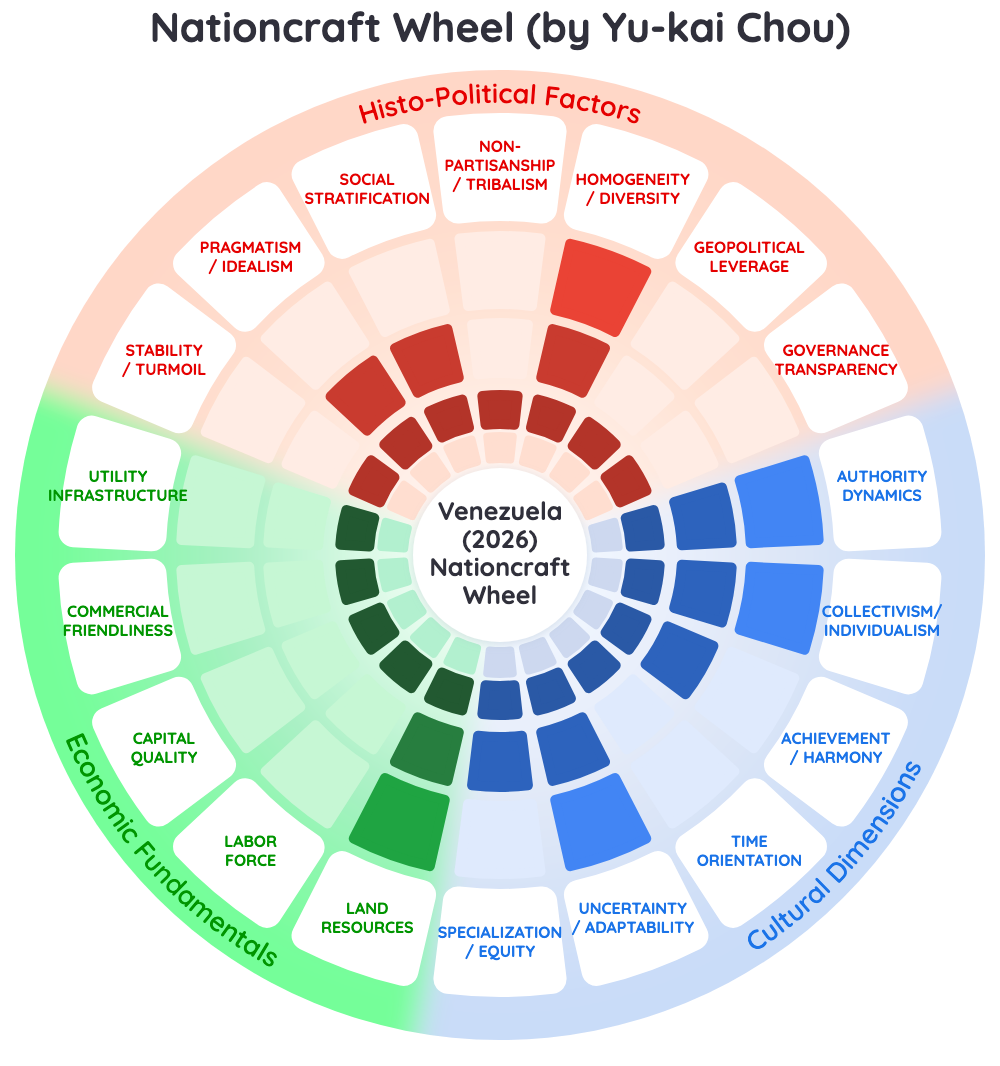
This is what I call the Decapitation Trap: when a nation’s crisis is diagnosed as one man, removing the man feels like solving the crisis, so the removal itself becomes the off-ramp that lets every structural variable survive. In Nationcraft terms, the 3 January operation changed the occupant of V1 (Authority Dynamics) while leaving the score itself at 7/9, and left V7 (Stability = 2), V10 (Tribalism = 2), V13 (Transparency = 2) and V16 (Capital = 1) almost exactly where they were. Seventeen of eighteen Nation Variables survived the raid intact.
My May 2026 Venezuela analysis asked which reform playbooks fit the country’s profile and found that eight of the standard options reject on contact. This second reading asks a harder question: what happens to a reform-ready diagnosis when the transition that should execute it is indefinitely deferred, and the stabilization that was supposed to fund it now runs through a US-controlled account? The answer is a case study in why the Nationcraft Framework scores configurations rather than rulers.
⚡ Speed Run Notes
- The 3 January 2026 operation removed V1’s occupant, not V1 itself. Venezuela’s Authority Dynamics (7/9), Stability (V7=2) and Tribalism (V10=2) read nearly the same in November as they did before the raid.
- No election date exists. Washington’s own officials point to late 2027 or early 2028, meaning the “political transition” phase of the three-step US plan is the one phase with no calendar.
- The 28 August oil agreement trades V14 access (Land = 9/9, roughly 65 billion barrels across 17 fields) for stabilization: a 35% US equity stake, board veto, and output purchase rights. Sovereignty became the collateral.
- Spain’s SP-017 pacted-transition packet is the best structural fit, but its load-bearing precondition, a credible election calendar that makes pacts worth keeping, is the one input Venezuela still lacks.
- The Decapitation Trap in one line: the ruler is the easiest variable to change and the least load-bearing one. Seventeen of eighteen Nation Variables survived the raid.
Table of Contents
- Understanding Venezuela’s Interrupted Transition Through Nationcraft
- What Is the Nationcraft Framework?
- Why This Venezuela Transition Analysis Matters
- What Venezuela Actually Looks Like in Numbers
- The Decapitation Trap: Removing the Man, Keeping the Machine
- Detailed Justifications: The Variables Eleven Months After the Raid
- Strategic Implications
- Best-Match Historical Packets
- Governance Strategy Recommendations
- Comparative Context
- The Nationcraft Framework in Practice
- Explore More Nationcraft Analyses
- Related Reading
- Footnotes
- Frequently Asked Questions
About Yu-kai Chou

Yu-kai Chou is a Human-Systems Architect & Behavioral Designer and the creator of the Nationcraft Framework — an 18-variable diagnostic for matching a country’s structural profile to the reform packets that have historically worked under similar conditions. He has consulted for governments in eight nations, including Ukraine, the United Kingdom, the Kingdom of Bahrain, Singapore, Taiwan, the Netherlands, Kazakhstan, and South Korea, and has worked directly with President Zelenskyy’s team on post-war reconstruction priorities for Ukraine.
Chou’s prior framework — the Octalysis Framework — has been applied by LEGO, Microsoft, Porsche, Coca-Cola, Salesforce, and MrBeast, impacting over 1.5 Billion Users. He has taught the methodology at Harvard, Stanford, Yale, Tesla, Google, BCG, and IDEO.
His work has been cited by Harvard, Stanford, MIT, Forbes, Wall Street Journal, Wired, US Department of Energy, NIST, NSF, NCBI, US Department of Education, ClinicalTrials.gov, and Google Scholar — with 3,700+ more academic publications. Explore his books here.

This second Venezuela reading applies the Nationcraft Framework to the hemisphere’s most consequential interrupted transition — testing the packet corpus’s hardest finding, that configurations outlive rulers, against a year of direct external intervention, and tracing which of the 18 variables will decide whether the promised 2027–2028 window becomes a genuine transition or a managed pause.
Understanding Venezuela’s Interrupted Transition Through Nationcraft
Most commentary on post-Maduro Venezuela sorts into two camps. One reads the year as vindication: oil licenses reopened, the central bank publishing data again, political prisoners released in the hundreds, investors returning to Caracas hotels. The other reads it as substitution: one externally dependent executive swapped for another, with the hemisphere’s largest proven oil reserves now partly governed from Washington. Both camps are reading outcomes. Nationcraft reads the configuration underneath, and the configuration explains why both camps keep being right at the same time.
The Nationcraft position is that policy effectiveness is decided by context-fit, not policy quality. A transition plan is a policy like any other, and the three-stage plan the US announced for Venezuela, stabilization, then economic recovery, then political transition, is being executed against an 18-variable profile that was shaped by twenty-five years of Bolivarian rule and a decade of collapse. The plan’s first two stages lean on Venezuela’s strongest variable, V14 (Land Resources = 9/9). Its third stage leans on its weakest cluster: V7 Stability at 2, V10 Non-Partisanship at 2, V13 Transparency at 2. That asymmetry, strong-variable stages executing on schedule while the weak-variable stage has no date at all, is the whole story of 2026, and this analysis will keep returning to it.
Eleven months in, the scoreboard reads like this: the stabilization phase is real but conditional, the recovery phase is contracted but contested, and the transition phase is a promise with no calendar. Nationcraft gives us the vocabulary to say why that ordering was predictable, and what it would take to break it.
What Is the Nationcraft Framework?
The Nationcraft Framework is my 18-variable diagnostic for matching a country’s structural profile to the reform packets that have historically worked under similar conditions. The variables split into three bands: Cultural (V1–V6: Authority Dynamics, Collectivism, Achievement, Time Orientation, Uncertainty Adaptability, Specialization), Histo-Political (V7–V13: Stability, Pragmatism, Stratification, Non-Partisanship, Homogeneity, Geopolitical Leverage, Transparency) and Economic Fundamentals (V14–V18: Land, Labor, Capital, Commercial Friendliness, Utility Infrastructure).
Each variable is scored 1–9, and the scores are never averaged into a single index, because configuration is strategy: a nation with V14=9 and V16=1 faces a categorically different problem from a nation where both sit at 5, even though the averages match. Against a country’s V-vector, Nationcraft matches more than a hundred historical Success Packets (SP) and Failure Packets (FP), each one a documented reform program with its own preconditions, sequencing and outcome trajectory. The question is never “is this a good policy?” It is “did this policy ever work in a country shaped like this one?”
That discipline matters most in exactly the situation Venezuela presents: a moment of apparent rupture, when every reform consultant in the hemisphere is shipping playbooks to Caracas, and the only filter available is structural fit.
Why This Venezuela Transition Analysis Matters
Venezuela in 2026 is the purest live test of a question the Nationcraft corpus keeps encountering in history: does removing the ruler change the nation? The corpus answer, built from cases like post-Gaddafi Libya (FP-002) and post-Soviet Russia (FP-016), is that leadership removal changes the occupant of V1 while every other variable persists, and that what happens next is decided by the variables, not the vacancy. Venezuela is running that experiment in real time, with the added twist that the removal was external, which means the legitimacy question that usually follows a palace coup is doubled by a sovereignty question.
The stakes are not abstract. Nearly 7.9 million people have left Venezuela since 2015, the largest displacement in the hemisphere’s modern history. The June 2026 earthquakes killed more than 6,500 people and added an estimated $19.6 billion in direct physical damage to a country whose public debt already stood near 180% of GDP. Poverty was measured at 86% in 2024. Whether the transition completes or stalls will decide whether the 2027–2028 window becomes a return corridor for the diaspora or one more cycle of exit. For readers tracking the region, the same structural lens applies to Colombia’s escape-clause politics next door, where much of that diaspora currently lives.
What Venezuela Actually Looks Like in Numbers
The table below is Venezuela’s current 18-variable Nationcraft profile. These scores are consistent with the May 2026 reading and the canonical corpus; the November re-score moved nothing major, and that stability is itself the headline. A year that contained a foreign military operation, a change of head of state, an amnesty law, two catastrophic earthquakes and a reopening of the oil sector moved almost nothing structural.
| Variable | Score (1–9) | November 2026 reading |
|---|---|---|
| V1 Authority Dynamics | 7 | Vertical, personalist-bureaucratic deference; occupant changed, structure intact under Rodríguez |
| V2 Collectivism | 7 | Clientelist and communal networks; colectivos still organized at barrio level |
| V3 Achievement vs Harmony | 6 | Status-seeking, entrepreneurial culture visible in diaspora success |
| V4 Time Orientation | 3 | Short-horizon survival economics after a decade of collapse |
| V5 Uncertainty Adaptability | 7 | Population hardened by hyperinflation, blackouts, dollarization; absorbed even the June earthquakes |
| V6 Specialization vs Equity | 4 | Mono-export skill base; professional class hollowed by emigration |
| V7 Stability vs Turmoil | 2 | Contested legitimacy, no election date, armed groups active |
| V8 Pragmatism vs Idealism | 4 | Ideological residue thick, but governance turning transactional (minor upward drift noted) |
| V9 Social Stratification | 6 | Connected class vs excluded majority; 86% poverty (2024) |
| V10 Non-Partisanship vs Tribalism | 2 | Chavista–opposition cleavage unresolved; amnesty has not depolarized |
| V11 Homogeneity | 7 | Linguistically and religiously homogeneous; cleavage is political, not ethnic |
| V12 Geopolitical Leverage | 3 | Latent reserve leverage real, but exercised leverage sits in Washington |
| V13 Governance Transparency | 2 | Central bank publishing again, yet oil proceeds flow to a US-controlled account outside the public budget |
| V14 Land Resources | 9 | World’s largest proven oil reserves, ~17% of the global total, plus gold, gas, coltan |
| V15 Labor Force Quality | 3 | Nearly 7.9 million people gone; labor participation down to 52% |
| V16 Capital Quality | 1 | Banking system destroyed; new inflows conditional and externally held |
| V17 Commercial Friendliness | 2 | Expropriation legacy intact; licenses open commerce for licensed actors only |
| V18 Utility Infrastructure | 2 | Chronic grid and water failure, worsened by earthquake damage |
Read the shape, not the average. Venezuela is a V14=9 nation wrapped in a V16=1 shell, with a political layer (V7, V10, V13 all at 2) that cannot convert resource wealth into state capacity that serves its people. The May analysis called this the configuration that rejects eight standard playbooks; this reading asks what it does to a transition.
The Decapitation Trap: Removing the Man, Keeping the Machine
Here is the paradox stated as a variable interaction. An external power can change the occupant of V1 in a single night, and on 3 January 2026 one did. But V1 Authority Dynamics does not measure who rules; it measures how authority moves through the society, and Venezuela’s 7/9 describes a quarter-century habit of vertical, personalist power that survives any particular person at the top. Meanwhile the variables that decide whether a transition can actually run are V7 (Stability = 2), V10 (Non-Partisanship = 2) and V13 (Transparency = 2), and no raid can touch those, because they live in institutions, habits and mutual distrust rather than in a palace.
The trap has three teeth. First, the removal satisfies the demand for change, draining urgency from the harder work: the US framing moved smoothly from “Maduro must go” to “Venezuela is not ready for elections,” with the second claim now doing the work the first one used to do. Second, the apparatus becomes the partner: because somebody must sign oil licenses and keep order during stabilization, the surviving structure becomes indispensable to the very powers that decapitated it, which is how a UN mission can find officials implicated in gross violations still holding key positions eleven months later. Third, sovereignty becomes the payment: with V16 at 1 and V13 at 2, no one will lend to or invest in the Venezuelan state on its own signature, so stabilization gets collateralized on the one strong variable, V14, through structures like the 28 August oil agreement, under which a new venture holding concessions over roughly 65 billion barrels granted a 35% equity stake to a US government office, board-composition control and output purchase rights.
The result is a country that is simultaneously more stable and less sovereign than it was a year ago, with a population that has yet to be asked its opinion of either. The Nationcraft reading is not that the trap was anyone’s plan. It is that given this V-vector, decapitation without a pacted, dated transition produces exactly this equilibrium, and the corpus has seen it before.
Detailed Justifications: The Variables Eleven Months After the Raid
V1, V2, V5 — the cultural base that absorbed the shock
V1 Authority Dynamics (7) explains the smoothest fact of the year: the succession. A vice president became interim president within 48 hours, the ministries kept functioning, and the system’s reflex was continuity, not fragmentation. V2 Collectivism (7) kept both the chavista base and the opposition organized as communities rather than atomized individuals, which is why the colectivos did not dissolve and why opposition networks survived years of repression. V5 Uncertainty Adaptability (7) is Venezuela’s quiet superpower: a population that normalized hyperinflation and blackouts absorbed a foreign military operation and two magnitude-7 earthquakes in the same year without state collapse. These three scores are why FP-002-style disintegration has not happened. They are also why the old machine runs so well without its driver.
V7 Stability (2) — the score that froze the calendar
Nothing in 2026 moved V7. The interim government rules without an electoral mandate; Maduro’s trial, scheduled for June 2027, keeps the old regime’s fate open; armed groups from colectivos to ELN fronts remain active; and the absence of an election date means every actor’s planning horizon ends at a question mark. The US position that conditions for free elections, an independent press, space for parties, a new electoral commission, do not yet exist is simultaneously a fair reading of V7 and V13 and a mechanism that keeps V7 at 2, because indefinite interim rule is itself instability. This is the recursion at the trap’s center: the variable that justifies deferring the transition is the variable the deferral preserves.
V10 Tribalism (2) and the amnesty that could not depolarize
The February amnesty law was the year’s most important institutional act, and its reception is a perfect V10 reading. Foro Penal verified 436 releases by late February and counted 391 political prisoners still jailed in August; the UN mission welcomed the releases while documenting at least 87 new politically motivated detentions after the raid. The opposition itself split along tribal lines: one faction entered negotiations with the government in August, while María Corina Machado and Edmundo González declined to participate. An amnesty in a V10=2 society is processed not as reconciliation but as a move in the ongoing war of factions. Brazil’s amnesty ballot shows the same variable operating one border south.
V13 Transparency (2) — new bookkeeping, old opacity
The year’s transparency gains are real: the central bank resumed publishing indicators in March after roughly a decade of silence, external auditors were hired, and in September authorities began unblocking censored websites, including 17 news portals. But the structural score holds at 2, for one decisive reason: the country’s dominant revenue stream now bypasses the public budget entirely, flowing into a US-controlled account under the March Treasury license. A state whose main income is visible to a foreign treasury but not to its own citizens has changed the audience of its opacity, not the fact of it. VE Sin Filtro’s register still listed 140 restricted domains, including 22 active news portals, as of late October.
V14 (9) vs V16 (1) — the inversion that priced the deal
Venezuela holds the world’s largest proven oil reserves and could not, in January 2026, borrow a dollar on its own signature: that is V14=9 colliding with V16=1 and V17=2. The 28 August agreement is what that collision prices out to. Rodríguez presented it as $209 billion in eventual revenue and roughly $19 per barrel to Venezuela; the White House factsheet presented it as majority control, a free 35% equity stake and a Monroe-doctrine revival. Both descriptions are accurate, which is the point: when your capital variable reads 1, your resource variable gets mortgaged on the counterparty’s terms. Analysts at multiple think tanks question whether the structure even complies with Venezuela’s constitution and its own January hydrocarbons reform, an objection that lands on V13 as much as on law. Kuwait’s future-generations dilemma shows the opposite corner of the same matrix, where strong V16 institutions let V14 wealth compound instead of becoming collateral.
V15 Labor (3) — the variable the transition cannot defer
Nearly 7.9 million Venezuelans live abroad, and labor participation at home has slid to 52%. Every month without a credible transition extends the diaspora’s wait-and-see, and the professionals a reconstruction needs, engineers for the grid, administrators for the courts, clinicians for a health system the earthquakes overloaded, are precisely the people with the least reason to return to an unscheduled future. V15 is where the Decapitation Trap compounds silently: the machine can run without its driver, but the country cannot rebuild without its people. Honduras’s remittance trap is the regional warning of what a permanent diaspora equilibrium looks like once it sets.
Strategic Implications
The scoreboard below separates what the year actually moved from what it left in place. This is the table that disciplines both optimism and despair.
| Dimension | January 2026 | November 2026 | Variable verdict |
|---|---|---|---|
| Head of state | Maduro | Rodríguez (interim, unelected) | V1 occupant changed; V1 score unchanged |
| Election calendar | None credible | None; US floats late 2027–2028 | V7 frozen at 2 |
| Political prisoners | Mass detentions, denied to exist | Hundreds released; ~391 still held (Aug); new detentions documented | V10 unchanged; repression paused, not dismantled |
| Oil production | ~1.1 million b/d (2025) | Recovering under US licenses; 25-year venture targeting 1.5m b/d | V14 monetizing; gains externally held |
| Macroeconomy | Triple-digit inflation; debt ~180% GDP | IMF country data projects +4.0% growth and ~390% inflation for 2026 | V16 still 1; stabilization without domestic capital formation |
| Data transparency | No official statistics | BCV publishing; external audit; oil proceeds off-budget | V13 still 2; opacity re-aimed, not removed |
| Sovereignty | Sanctioned pariah | Recognized, but oil, finance and the transition clock held abroad | V12 still 3; leverage latent, not exercised |
Three implications follow. First, stabilization is running ahead of legitimacy, and every month widens the gap: the deeper the economic architecture roots itself before an elected government exists, the more the eventual election becomes a referendum on arrangements the voters never authorized, the exact dynamic that makes think tanks doubt the oil deal’s survival across governments. Second, the reform window is real but unowned: prisoner releases, data publication and media unblocking are genuine openings, but each is revocable because none is anchored in a domestic institution with an electoral mandate. Third, the binding constraint has shifted from capacity to calendar: Venezuela now has more money, more recognition and more technical assistance than at any point in a decade, and no date. In the Nationcraft corpus, transitions that acquire resources before they acquire calendars tend to convert the resources into reasons for delay.
Best-Match Historical Packets
Nationcraft matches a nation’s V-vector against documented Success Packets (SP) and Failure Packets (FP). The May analysis ran this match for reform programs; this reading runs it for transitions. The table summarizes, and the subsections argue.
| Packet | Case | Verdict for Venezuela 2026 | Deciding variables |
|---|---|---|---|
| SP-017 Post-Franco Transition | Spain 1975–1986 | Study closely | V1 high, V10 low, V11 high; matches, but needs a dated calendar Venezuela lacks |
| SP-118 Estenssoro NEP / Decree 21060 | Bolivia 1985 | Still fits (held over from May) | Stabilization under weak institutions; V16=1 compatible |
| SP-034 Plano Real | Brazil 1994 | Still fits (held over from May) | Credibility-first stabilization; V5=7 supports |
| SP-051 Saakashvili Reform | Georgia 2004–2012 | Fit blocked: precondition missing | Requires an elected mandate; no election date exists |
| FP-002 Post-Gaddafi Collapse | Libya 2011– | The warning | Decapitation without pact; V2/V11 saved Venezuela so far |
| FP-016 Yeltsin Shock Therapy | Russia 1991–1999 | Reject | Externally blessed liberalization with V13=2 breeds insider capture |
| SP-005 Poland Shock Therapy | Poland 1990–2004 | Reject (reaffirmed) | Needed V13 and an EU anchor Venezuela lacks |
| SP-008 Park Chung-hee Industrialization | South Korea 1961–1979 | Reject | Authoritarian modernization misfit: V15=3, V16=1, and no developmental bureaucracy |
SP-017: Spain’s pacted transition is the blueprint, and its missing part is a date
Spain in 1975 is the corpus’s closest structural cousin to Venezuela in 2026: a personalist regime ending (V1 high), a society polarized by an unhealed civil conflict (V10 low), linguistic-religious homogeneity (V11 high), and European neighbors supplying the external anchor. The packet’s core moves, elite pact between regime soft-liners and opposition, amnesty as a mutual disarmament, elections within two years, constitution by broad agreement, map remarkably well onto Venezuela’s current pieces: the Figuera–Rodríguez negotiations, the February amnesty, the gold-reserves and judiciary agenda items from the August talks. What Spain had that Venezuela does not is the clock: Franco died in November 1975, the Political Reform Law passed in 1976, and elections came in June 1977. The calendar was the pact’s enforcement mechanism, because every faction could price the cost of defecting from a scheduled future. Venezuela has the pact’s furniture and no clock, which converts negotiation into an open-ended management arrangement. Readers of my Spain analysis will recognize how long the dividends of a well-executed pact can run, and the SP-017 lesson cuts both ways: the “forgetting pact” that enabled Spain’s peace deferred its reckoning for a generation.
SP-118 and SP-034: the stabilization pair still fits, but someone else is running it
The May analysis matched Venezuela to Bolivia’s 1985 Decree 21060 hyperinflation kill and Brazil’s Plano Real, both proofs that a V16=1 country can stop monetary chaos quickly when the program is credible. The November twist is that a version of this stabilization is happening, executed not by a mandated Venezuelan government but by Treasury licenses and a dollar channel: the IMF’s country data page lists 2026 projections of 4.0% real growth with average inflation near 390%, still brutal, but a fraction of the 600% annualized rate reported in February. The packets’ deeper lesson is being skipped, though. Estenssoro’s program worked because a Bolivian president spent domestic political capital on it and owned its costs, a dynamic my Bolivia analysis traces into the present. Imported stabilization builds no domestic constituency, and a stabilization without a constituency lasts exactly as long as the license that authorizes it. The same logic shadows Argentina’s anchor trap.
SP-051: the Georgia packet is blocked on its own first step
May’s third fit, the Saakashvili Reform Packet, remains the best template for what a post-transition Venezuelan government could do to V13 and V17: mass dismissal of corrupt services, radical deregulation, visible fast wins. But SP-051’s precondition is non-negotiable: Saakashvili held a crushing electoral mandate from the Rose Revolution before firing the first traffic cop. A packet that begins with “win an overwhelming election” cannot start in a country with no election date. The fit has not changed; the door to it has. That is the cleanest single measure of what the Decapitation Trap costs: it blocks the best packets at their first line.
FP-002 and the disintegration that did not happen — yet
Libya after 2011 is the corpus’s standing warning about externally assisted decapitation: remove the ruler, skip the pact, and watch the state dissolve into armed factions. Venezuela has avoided this outcome, and the V-vector says why: V2=7 and V11=7 give the society cohesion Libya’s tribal fragmentation (V11 low) never had, and the apparatus survived rather than shattered. But FP-002’s clock runs long. Libya’s collapse accelerated when interim arrangements lost legitimacy faster than they could schedule elections, and Venezuela’s armed-group inventory, colectivos, megabandas, ELN fronts along the Colombian border, is the raw material a legitimacy vacuum feeds. The variable to watch is V7: if interim rule normalizes past the point where factions stop believing in a scheduled future, the cohesion advantage decays.
FP-016 and SP-008: the two seductive rejects
Two packets will be pitched hard in Caracas and should be refused. The first is FP-016, Yeltsin-era shock therapy: rapid privatization under external blessing, in a V13=2 environment, which in Russia converted state assets into oligarchy within a decade. Venezuela’s version would be oilfield and mining concessions distributed while no elected government exists to contest them; the January hydrocarbons reform and March mining law have opened exactly that corridor, and the constitutional objections to the August deal show the capture risk is live. My China sequencing analysis sets out the corpus’s contrast case: Deng’s SP-003 worked because sequencing protected the system’s ability to correct errors, which is precisely what a 100-year concession forecloses. The second seductive reject is the Park Chung-hee Industrialization Packet, the fantasy that an unelected technocratic interim can simply develop the country first and democratize later. Park’s model ran on a disciplined developmental bureaucracy (V15 and V16 strong for its era) that Venezuela, with V15=3 and V16=1 after a decade of brain drain, cannot staff. An authoritarian modernization packet without the bureaucracy is just authoritarianism with a modernization press release. Iran’s resistance economy shows the end state of resource autocracy that mistakes survival for development.
Governance Strategy Recommendations
These recommendations are addressed to anyone reasoning about Venezuela’s transition: citizens, diaspora professionals, analysts, negotiators on both sides of the Figuera–Rodríguez table, and the external actors whose leverage currently sets the tempo. They are sequenced by the V-vector, and their common test is simple: each step must move power, information or money toward the Venezuelan population, because a transition that only upgrades the state’s machinery repeats the configuration that produced the collapse.
| Sequence | Move | Variables targeted | Packet precedent |
|---|---|---|---|
| 1 | A binding election date with an agreed electoral commission, set inside the current negotiation track | V7, V10 | SP-017 (Spain: Reform Law before anything else) |
| 2 | Full political prisoner release and amnesty completion, with state acknowledgment of violations | V10, V13 | SP-017 amnesty logic; UN mission’s stated gaps |
| 3 | Publish the oil accounts: proceeds, prices and the US-account flows reported in the public budget | V13, V16 | SP-106 (Norway) transparency floor, adapted |
| 4 | Time-limit and sunset-review all interim-era concessions, so an elected government inherits choices, not faits accomplis | V12, V17 | FP-016 avoidance; constitutional objections already filed |
| 5 | A diaspora return framework: credential recognition, property restitution, portable amnesty applications | V15 | Post-conflict recovery packets’ human-capital clauses |
| 6 | Post-election: run SP-051-style visible fast wins on services and petty corruption, with the mandate it requires | V13, V17 | SP-051 (Georgia), now unblocked |
The ordering is the argument. Steps 3 through 6 are the reforms everyone agrees on; step 1 is the reform that makes the others durable, and it is the only one with no current owner. Spain’s lesson is that the date is not the reward at the end of a transition; it is the mechanism that makes every other promise credible. A reader can test any proposal landing in Caracas against this sequence: if it deepens stabilization while leaving the calendar open, it extends the trap.
Comparative Context
Venezuela’s 2026 sits inside a regional pattern this series has been tracking all year. Peru’s iron-fist mandate shows a V7-weak democracy trading liberties for order through legal delegation; Venezuela shows the same trade executed by external force. Guatemala’s escape-valve trap and Honduras’s remittance dependence show what happens when emigration becomes the governance model’s pressure release, the path Venezuela’s V15=3 is already on. And Angola’s prosecution dividend is the closest analog for the next chapter: an oil state attempting renewal by prosecuting the old guard while the machinery that produced them runs on. The Maduro trial opening in June 2027 will put Venezuela in exactly that frame, with the added spectacle of the courtroom being in New York.
The deeper comparison is with Ukraine, the other nation whose reconstruction this series treats as a defining test of externally anchored recovery. There, as in Venezuela, the question is whether external resources build domestic institutions or substitute for them. The difference is that Ukraine’s escrowed recovery operates alongside an elected government fighting for its survival; Venezuela’s operates in place of one.
The Nationcraft Framework in Practice
This analysis has used the Nationcraft method end to end: score the 18 variables, name the paradox the configuration produces, match against the packet corpus, and sequence recommendations by structural fit rather than ideological preference. The Venezuela case shows the framework’s sharpest edge, which is what it refuses to do: it refuses to read a change of ruler as a change of nation. For the full methodology, start at the framework hub; the library below collects the other ninety-plus country readings.
Explore More Nationcraft Analyses
The complete collection of Nationcraft country analyses lives at the Nation Variables Library, including the regional siblings cited throughout this piece. If this is your first Nationcraft reading, pair this post with the May 2026 Venezuela playbook analysis for the reform-fit layer beneath today’s transition layer, then contrast with Ukraine’s escrowed recovery analysis for the democratic variant of externally anchored reconstruction.
Related Reading
- The Nationcraft Framework — the 18 variables, 8 goals and packet method behind this analysis
- Nationcraft Country Analyses Library — every published V-vector analysis
- Nationcraft Analysis: Guatemala Escape Valve Trap 2026: when emigration becomes the pressure release
- Nationcraft Analysis: Ukraine Escrowed Recovery 2026 — externally anchored reconstruction with an elected government
- Nationcraft Analysis: Argentina Anchor Trap 2026 — borrowed credibility and its expiry dates
- Nationcraft Analysis: USA Pendulum Trap 2026: the intervening power’s own V-vector after the 2026 midterms
Footnotes
- House of Commons Library, “Venezuela: What has happened since Maduro’s capture in January 2026?”, Research Briefing CBP-12211: commonslibrary.parliament.uk. Source for the 3 January operation, Rodríguez succession, amnesty law and prisoner figures, Figuera–Rodríguez negotiations, the 28 August oil agreement terms, earthquake tolls and the Maduro trial schedule.
- EUAA, “1.8. Aftermath of US intervention”, Venezuela: Country Focus, July 2026: euaa.europa.eu. Source for intervention aftermath and interim-government developments.
- EUAA, “1.2. Economy”, Venezuela: Country Focus, July 2026: euaa.europa.eu. Source for reserve share (~17%), production (~1.1 million b/d by 2025), General License 52 and the US-controlled account, inflation series, 86% poverty (OVF 2024) and 52% labor participation.
- UNHCR, “Venezuela situation”: unhcr.org. Source for the nearly 7.9 million displaced figure.
- IMF, “República Bolivariana de Venezuela: Country Data”: imf.org. Source for 2026 projections (+4.0% real GDP, 387.4% inflation) and population (26.9 million).
Frequently Asked Questions
What is the Decapitation Trap in the Nationcraft Framework?
The Decapitation Trap is the pattern in which removing a nation’s ruler substitutes for changing the nation’s structure. Because the removal satisfies the demand for change, the surviving apparatus becomes the indispensable partner of the powers that removed the ruler, and the structural variables that caused the crisis (in Venezuela’s case V7=2, V10=2, V13=2, V16=1) persist untouched. The ruler is the easiest variable to change and the least load-bearing one.
Who governs Venezuela after Maduro’s capture?
Delcy Rodríguez, Maduro’s former vice president, has served as interim president since early January 2026. The United States recognized her government and restored diplomatic relations in March 2026. She governs without an electoral mandate, through substantially the pre-raid state apparatus, with her brother Jorge Rodríguez chairing the National Assembly. Nicolás Maduro is detained in New York awaiting a trial scheduled to begin on 1 June 2027.
Why has removing Maduro not transformed Venezuela?
Because the Nationcraft variables that constrain Venezuela live in institutions and habits, not in one office. Authority Dynamics (V1=7) reproduced the same vertical governance under a new occupant; Stability (V7=2) persists because no election date exists; Tribalism (V10=2) survives because the chavista-opposition cleavage is unresolved; and Capital (V16=1) keeps the state dependent on externally controlled financing. The corpus pattern from Libya (FP-002) and Russia (FP-016) predicts exactly this: leadership removal without structural sequencing preserves the configuration.
Which reform packets fit Venezuela in 2026?
Spain’s Post-Franco pacted transition (SP-017) is the closest structural fit for the political problem, and the Estenssoro (SP-118) and Plano Real (SP-034) stabilization packets still fit the monetary problem, as they did in the May 2026 analysis. Georgia’s Saakashvili packet (SP-051) remains a fit on paper but is blocked because its first precondition, an elected government with a strong mandate, does not yet exist. Shock-therapy privatization (FP-016) and authoritarian-modernization models (SP-008) reject on Venezuela’s V-vector.
When will Venezuela hold elections?
No election date has been set as of late November 2026. US officials have indicated elections could occur in late 2027 or early 2028, conditioned on an independent press, space for political parties and a new electoral commission. This analysis argues the open calendar is itself the central risk: every other reform of 2026 remains revocable until an elected government can anchor it.