

Iran has spent four decades building an economy whose single design goal is surviving a siege. In September 2026 that design is passing its hardest test, and the test results are the problem.
The state has absorbed a war that killed its Supreme Leader, a naval blockade that cut its oil exports by roughly ninety percent, inflation near seventy percent, and a currency that has lost more than half its value in a year. It is still standing, and still refusing terms.
Call this the Resistance Economy Trap: the machinery a state builds to make siege survivable is the same machinery that makes siege permanent. Because the system can always endure one more year, it never has to choose an exit, and the population pays the spread between enduring and living.
Tehran’s own vocabulary concedes the design. “Resistance economy” has been official doctrine since 2014, a deliberate architecture of self-sufficiency, sanction-proofing and hardship absorption.
This analysis reads that architecture through the 18 Nationcraft variables, audits what four months of blockade did to each one, and then runs Iran’s profile against the historical reform packets. The short version: every packet that fits begins at the one variable the doctrine forbids from moving.
⚡ Speed Run Notes
- Iran built an economy whose design goal is surviving siege. It works: the state absorbed war, blockade and near-70% inflation. The success is the trap, since an economy that always endures never has to choose an exit.
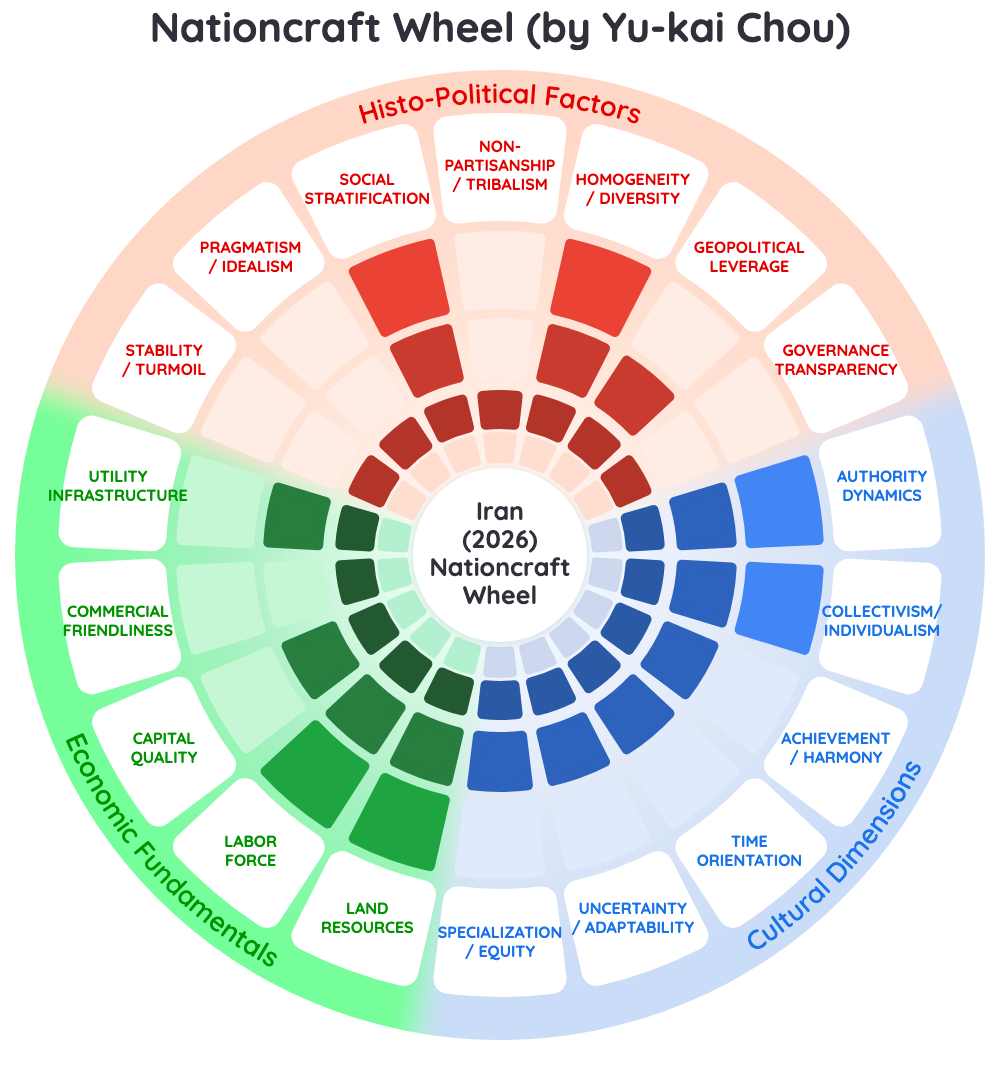
- The V-vector shows capacity without conversion: V1=10 authority, V2=9 collectivism and V14=8 resources against V8=2 pragmatism, V13=2 transparency and V17=3 commercial friendliness. The machine endures; it cannot grow.
- Crude loadings fell from ~2 million barrels a day in March to ~220,000-255,000 in August under the US naval blockade. Iran’s answer is keeping Hormuz closed, spending its last V12 leverage to hold the siege in place.
- Cuba’s Special Period (SP-094) is the packet Iran is running without naming it: survival through rationing, remittances and repression. Cuba proves the packet can run for 30 years and deliver zero development.
- Every packet that fits Iran’s profile, from Vietnam’s Đổi Mới to Uzbekistan’s pivot to Spain’s pacted transition, began when doctrine stopped being the ruling credential. That variable is V8, and Iran’s sits at 2.
- The population pays the difference: 69.9% inflation, a rial past 2.2 million per dollar, pensioners and oil workers protesting, and a brain drain that compounds every other variable it touches.
Table of Contents
- Understanding Iran’s Governance Landscape Through Nationcraft
- What Is the Nationcraft Framework?
- Why This Iran Analysis Matters
- The 18 Iran Nation Variables
- The Resistance Economy Trap
- The Siege Ledger: What Changed Since May
- Detailed Justifications: Reading the Iran V-Vector
- Best-Match Historical Packets
- Governance Strategy Recommendations
- Strategic Implications
- Frequently Asked Questions
About Yu-kai Chou

Yu-kai Chou is a Human-Systems Architect & Behavioral Designer and the creator of the Nationcraft Framework — an 18-variable diagnostic for matching a country’s structural profile to the reform packets that have historically worked under similar conditions. He has consulted for governments in eight nations, including Ukraine, the United Kingdom, the Kingdom of Bahrain, Singapore, Taiwan, the Netherlands, Kazakhstan, and South Korea, and has worked directly with President Zelenskyy’s team on post-war reconstruction priorities for Ukraine.
Chou’s prior framework — the Octalysis Framework — has been applied by LEGO, Microsoft, Porsche, Coca-Cola, Salesforce, and MrBeast, impacting over 1.5 Billion Users. He has taught the methodology at Harvard, Stanford, Yale, Tesla, Google, BCG, and IDEO.
His work has been cited by Harvard, Stanford, MIT, Forbes, Wall Street Journal, Wired, US Department of Energy, NIST, NSF, NCBI, US Department of Education, ClinicalTrials.gov, and Google Scholar — with 3,700+ more academic publications. Explore his books here.

This is the second Nationcraft reading of Iran in 2026. The May analysis mapped the Coercion Spiral before the blockade closed; this one reads the same configuration under full siege, informed by Chou’s advisory work with governments under external pressure, including Ukraine’s wartime reconstruction planning, where endurance and recovery proved to be different design problems.
Understanding Iran’s Governance Landscape Through Nationcraft
Iran in September 2026 is governed by a system that survived the assassination of its own head of state. Supreme Leader Ali Khamenei was killed in a joint US-Israeli strike on 28 February 2026, the opening day of the current war, and the Assembly of Experts announced his son Mojtaba Khamenei as successor by a “decisive vote” on 8 March.[1]
A dynastic handover under bombardment, completed in nine days, is what a V1 Authority Dynamics score of 10 out of 10 looks like in practice, and it anchors everything else in this reading.
Below the apex, the same September produced a different picture. Oil workers protested at Pars Oil and Gas platforms and in Assaluyeh over pay, taxes and benefits on 7 September, and Social Security pensioners have demonstrated in multiple cities as the rial slid past 2.2 million per dollar.[2]
The leadership itself is split on what to do. President Masoud Pezeshkian said on 1 September that Iran would return to the June ceasefire if Washington returned to its commitments,[3] while security chief Mohsen Rezaei’s stated conditions for ending the war include “the release of our frozen funds and an end to the naval blockade.”[5]
The Nationcraft variable set was built for states in exactly this condition: centralized, stressed and divided about their own exits. What it measures is execution capacity, so the reading that follows concerns what this configuration can and cannot do rather than how to judge it.
What Is the Nationcraft Framework?
The Nationcraft Framework scores a country on 18 variables across three clusters: cultural (V1-V6), histo-political (V7-V13) and economic (V14-V18). Each variable is scored for how it affects policy execution, and the configuration is read as a whole rather than averaged.
The framework’s core claim is that policy effectiveness is decided by context-fit, not policy quality. A reform that transformed one country fails in another when the preconditions differ, which is why Nationcraft matches nations to historical Success Packets: documented reform programs with known starting conditions, sequencing and outcomes.
Nationcraft grew out of the same behavioral-design lineage as the Octalysis Framework, extended from products to polities. The longer methodological bridge is covered in how Octalysis applies to nation-building and public policy.
For Iran, the framework’s main use is separating what the siege changed from what the siege merely revealed.
Why This Iran Analysis Matters
Nationcraft last read Iran in May 2026, as the Coercion Spiral: a state that could no longer govern by delivering results and so governed by force, burning the legitimacy it ran on. That reading was made weeks after the assassination, while a Pakistan-mediated ceasefire was failing.
Four months later the configuration has been stress-tested by a full blockade, and the results answer a question the May analysis could only pose. We now know what the resistance economy does under maximum pressure: it holds, and it hollows.
The stakes reach well past Iran. During UN General Assembly week, President Trump said on 22 September that he believes the US will reach a deal with Iran to end the conflict by the upcoming midterm elections, if not before, after what he called a productive meeting between his envoys and Iranian counterparts.[4]
Whatever happens at the negotiating table, someone will eventually face the question this analysis is really about: what would it take for this configuration to produce prosperity instead of endurance? The sections below work out the structural answer for the reformers, analysts and Iranian readers who will need it.
The 18 Iran Nation Variables
The table below shows Iran’s 2026 V-vector. Scores are held consistent with the May analysis, which corrected V7 Stability from 4 to 3 after the assassination; the September sanity check found zero major drifts and three documented minor down-pressures (V12, V16, V18).
| Variable | Score | 2026 reading |
|---|---|---|
| V1 Authority Dynamics | 10 | Supreme Leader system completed a dynastic succession under bombardment; IRGC command intact |
| V2 Collectivism | 9 | Deep family and network solidarity carrying households through near-70% inflation |
| V3 Achievement vs Harmony | 4 | Status routed through loyalty channels rather than open achievement |
| V4 Time Orientation | 6 | Civilizational long-horizon identity; regime planning horizon compressed by war |
| V5 Uncertainty Adaptability | 6 | Four decades of sanctions adaptation, institutionalized as the resistance economy |
| V6 Specialization vs Equity | 6 | Strong engineering and medical pipelines; allocation distorted by loyalty screening |
| V7 Stability vs Turmoil | 3 | Active war, blockade, labor and pensioner protests; no civil war, no territorial loss |
| V8 Pragmatism vs Idealism | 2 | Revolutionary doctrine vetoes off-ramps; Hormuz closure held on ideological conditions |
| V9 Social Stratification | 7 | Insider bonyad/IRGC economy against wage earners; war widened the gap |
| V10 Non-Partisanship | 2 | Negotiation faction against security faction, split visible in September reporting |
| V11 Homogeneity | 7 | Persian-majority center with Kurdish, Baloch, Azeri and Arab peripheries |
| V12 Geopolitical Leverage | 6 | Leverage now spent through the Hormuz closure; exports collapsed under blockade |
| V13 Governance Transparency | 2 | Opaque bonyad and IRGC ledgers; wartime information control |
| V14 Land Resources | 8 | World-class hydrocarbons and minerals; endowment intact, monetization severed |
| V15 Labor Force Quality | 7 | Educated, entrepreneurial population; war-accelerated brain drain |
| V16 Capital Quality | 4 | Rial past 2.2M per dollar, ~70% inflation, trade finance severed |
| V17 Commercial Friendliness | 3 | Sanctions, expropriation risk and loyalty-gated licensing |
| V18 Utility Infrastructure | 4 | War-damaged refining and energy, recurring blackouts; grid functioning |
Read as a shape rather than a list, the vector splits into two hands. The endurance hand: V1=10, V2=9, V5=6, V11=7, V14=8, V15=7. The conversion hand: V8=2, V10=2, V13=2, V16=4, V17=3, V18=4.
Everything a state needs to absorb punishment scores high. Everything a state needs to turn capacity into prosperity scores near the floor.
The Resistance Economy Trap
Iran’s endurance hand makes collapse unlikely, and its conversion hand makes success impossible. Siege is the one state the system can sustain indefinitely, so that is where it settles.
In most countries, economic pain of this magnitude forces a decision. GDP contracted 10.1% year-on-year in the first quarter of the Persian year, inflation reached 69.9% in early September, and official unemployment hit 9.1% in spring.[5]
Iran’s configuration absorbs that pain instead. V1=10 means no institution can force the decision upward, and V2=9 means families and networks quietly subsidize what the state no longer provides. Forty years of workaround habits, the substance of the V5=6 score, keep goods moving through gray channels.
The result is a state that experiences catastrophe as discomfort. And a state that experiences catastrophe as discomfort has no internal deadline, which is why the June ceasefire could lapse into an open-ended blockade without producing a settlement.
The pattern has siblings in the Nationcraft corpus. Cuba’s Doctrine Trap shows a V1=10, V8=2 state surviving the loss of its superpower patron for three decades without developing; the North Korea analysis shows the terminal version, where survival architecture became the entire state.
What makes Iran’s case distinct is the quality of what is being wasted. Cuba endured with modest resources; North Korea endured with almost none; Iran is enduring on top of V14=8 hydrocarbons and a V15=7 educated labor force, the endowment of a regional economic power, running at siege idle.
The Siege Ledger: What Changed Since May
The May analysis was written under sanctions and an unstable ceasefire. Since then the coercion became physical: the 17 June memorandum traded a ceasefire and a 60-day negotiating framework for suspended blockade enforcement and oil-export waivers, strikes resumed in early July, and the memorandum expired in mid-August with the blockade back in force.[6]
| Indicator | Pre-war / early 2026 | September 2026 |
|---|---|---|
| Crude loadings | ~2 million bpd (March) | ~220,000-255,000 bpd (August) |
| 12-month average inflation | ~40-45% (2025 range) | 69.9% (early September) |
| Quarterly GDP | Low single-digit growth (2024) | -10.1% y/y (21 Mar – 20 Jun 2026) |
| Rial per USD (market) | ~1 million (Sept 2025) | >2.2 million (early Sept 2026) |
| Strait of Hormuz | Open | Closed or restricted by Iran, conditions unmet |
| Ceasefire status | 17 June MoU, 60-day framework | Expired mid-August; Qatar and Pakistan mediating a restart |
Two entries in that ledger are choices rather than damage. Iran is holding Hormuz closed as its condition-setting card, and it is declining to re-enter the ceasefire on offered terms; both are V8=2 behaviors, doctrine converting leverage into siege duration rather than into settlement value.[3]
Russia’s fortress economy offers the nearest comparison. Russia built financial buffers to outlast pressure on a V1=10 frame and found the garrison consuming the fortress; Iran is running the same experiment with thinner buffers, a poorer population and a hotter war.
The China dimension adds a clock. With Iranian barrels mostly stranded, China faces higher prices and narrowing supply options, which means Iran’s one reliable customer now has active reasons to want this resolved, on anyone’s terms.[7]
Detailed Justifications: Reading the Iran V-Vector
Cultural cluster (V1-V6): the endurance engine
V1 Authority Dynamics sits at 10, the scale’s ceiling, and 2026 provided the proof twice. The system executed a wartime dynastic succession in roughly a week, and it has since enforced an economically ruinous Hormuz policy against visible elite dissent.
V2 Collectivism at 9 is the population-side shock absorber. Iranian households survive 69.9% inflation the way they survived the 2018-2025 sanctions cycles: pooled incomes, family housing, diaspora remittances, informal credit.
The state’s remaining mobilization runs on Core Drive 1 (CD1): Epic Meaning & Calling, the sacralized resistance narrative, backed by Core Drive 8 (CD8): Loss & Avoidance, the fear that any concession unravels the revolution. That motivational mix explains a pattern in the protest record: loss-framing holds people who still have something to protect, which is why the December wave began among bazaar shopkeepers watching the currency destroy their stock, and why pensioners whose fixed incomes inflation has already taken are the ones back in the street now.
V3 at 4 and V6 at 6 describe a talent system that trains well and allocates badly. Iran produces engineers and physicians at regional-power rates, then filters advancement through loyalty, which converts V15 quality into emigration files.
V4 at 6 and V5 at 6 complete the endurance engine. A civilization that thinks in centuries can rationalize a lost decade, and an economy that has improvised around sanctions since 1979 treats every new restriction as a routing problem rather than a verdict.
Histo-political cluster (V7-V13): the conversion blockage
V7 Stability holds at 3, the corrected May value. The war is real and the protests are real, but the apparatus functions, territory is controlled, and the succession is settled; 3 marks a state under severe stress, short of fragmentation.
V8 Pragmatism vs Idealism at 2 decided the June memorandum’s fate. The memorandum offered a tested exit, with a ceasefire, blockade suspension, oil waivers and a reconstruction package on the table; doctrine-priced conditions kept it from converting, and the blockade returned.
V10 at 2 records that even the apex is factionalized. Pezeshkian and Ghalibaf publicly favor a negotiated return while security officials set conditions that foreclose it, and under V1=10 that argument resolves wherever the Leader’s office says it resolves.
V13 Transparency at 2 explains who profits from endurance. The bonyad foundations and IRGC-linked conglomerates that run sanction-era logistics operate on closed ledgers, which means the siege’s rents are allocated in the dark while its costs are distributed in daylight.
V9 at 7, V11 at 7 and V12 at 6 round out the cluster. Stratification is widening as insiders arbitrage scarcity, the ethnic peripheries carry disproportionate repression, and geopolitical leverage is being spent through the strait rather than banked.
Economic cluster (V14-V18): a regional power at siege idle
V14 Land Resources holds at 8, and the waste concentrates here. The hydrocarbon endowment did not shrink; the loadings did, from around 2 million barrels a day to a few hundred thousand, with 29 tankers carrying 36 million barrels reported trapped in the Strait of Hormuz.[5]
V15 Labor Force Quality at 7 is the other wasted asset, and unlike geology it depreciates. Every month of war economy converts more of Iran’s educated class into the kind of diaspora Ukraine is counting on to come back, except Iran’s configuration gives its diaspora no return trigger.
V16 Capital Quality at 4 is generous by the day. A currency that halved in a year, plus a US Treasury campaign launched in late August to sever Iran’s remaining financial and commercial connections, adds up to an economy that can transact but cannot finance.[2]
V17 Commercial Friendliness at 3 predates the war and will outlast it, because its binding constraints are internal: expropriation risk, loyalty-gated licensing, and competition from subsidized insider firms. V18 at 4 records energy and grid infrastructure taking war damage on top of decades of underinvestment, with fuel shortages now visible at the pump.
Best-Match Historical Packets
Nationcraft matches a country’s configuration against documented Success Packets and failure packets. Iran’s own history contributes the diagnostic anchor: FP-017, the Khomeini Islamic Revolution Packet (1979-1989), in which cultural transformation and legal enforcement scores undermined economic management and human capital retention, producing a lost decade.
The 2026 vector is FP-017’s configuration matured for four decades: the same idealism-over-pragmatism ranking, now with V1 consolidated at 10 and the improvisational V5 institutionalized. That inheritance decides which packets fit.
| Packet | Country / era | Verdict for Iran’s configuration | Deciding variables |
|---|---|---|---|
| SP-094 Special Period Survival | Cuba 1991+ | Reject as destination — it is the current trajectory | V8, V13, V17 |
| FP-018 Juche Total Isolation | North Korea 1953-1994 | Reject — the terminus of the resistance road | V16, V17, V18 |
| SP-003 Deng Open Reform | China 1978-2000 | Reject — pragmatism precondition absent | V8, V17 |
| SP-013 Atatürk Reforms | Turkey 1923-1938 | Reject — required V8=8 and a founding rupture | V8, V1 composition |
| SP-037 Vision 2030 | Saudi Arabia 2016+ | Reject — requires capital-market and alliance access | V12, V16, V17 |
| SP-044 Nazarbayev Resource Management | Kazakhstan 1991+ | Reject — multi-vector diplomacy unavailable at V8=2 | V8, V12 |
| SP-065 Sisi Stabilization | Egypt 2013+ | Reject — external financing absent, and a capacity trap anyway | V12, V16 |
| FP-016 Yeltsin Shock Therapy | Russia 1991-1999 | Reject — institutions-first warning for any rupture scenario | V13, V17 |
| SP-018 Đổi Mới | Vietnam 1986-2010 | Study — closest economic starting point | V8 shift required |
| SP-045 Karimov-Mirziyoyev Transition | Uzbekistan 2016+ | Study — succession-pivot mechanics | V1 high, V13 low match |
| SP-017 Post-Franco Transition | Spain 1975-1986 | Study — pacted exit from ideological authoritarianism | V8, V10 mechanics |
Five siege playbooks Iran’s configuration should not be measured against
SP-094, Cuba’s Special Period, needs no adoption because Iran is already running it: rationing psychology, remittance dependence, tourism-and-gray-trade dollars, repression at the margins. The packet’s recorded outcome is the warning, since Cuba survived a 35% GDP collapse and then spent thirty years not developing, with social indicators maintained and mass emigration as the release valve.
The trap logic transfers exactly. Survival packets stabilize the crisis and then stabilize the stagnation, because the same machinery that absorbs shock also absorbs the pressure that would force change.
FP-018, North Korea’s Juche isolation, is where the road ends if the blockade becomes permanent and Iran adapts to it rather than out of it. Kim Il-sung’s configuration scored control at the ceiling and adaptation near the floor, and when external subsidies vanished the economy collapsed with no alternative mechanisms available.
Iran is not there; its V5=6 improvisational capacity and V15=7 labor force are assets North Korea never had. The packet’s value is showing what those assets erode toward under enough years of siege.
FP-016, Yeltsin’s shock therapy, guards the other flank. If Iran’s system ever ruptures rather than reforms, the 1990s Russia record shows what liberalization without institutions does at V13=2: asset stripping, oligarch capture, and a backlash that eventually rebuilt the fortress. The lesson for any post-siege scenario is institutions first, then speed.
SP-065, Sisi’s stabilization, fails on financing and on principle. Egypt’s model ran on Gulf deposits, IMF programs and US military aid, none of which exist for Iran; and its recorded outcome, a military economy crowding out the private sector while mega-projects absorb scarce capital, is Egypt’s garrison economy, a capacity trap wearing a stabilization label.
SP-037, Vision 2030, fails on access. Saudi Arabia’s transformation spends V12=9 leverage and open capital markets that Iran forfeited; as the Saudi Single Artery analysis notes, even with those advantages the diversification math is hard. Without them the packet stops being runnable and becomes a brochure.
Three reform-era playbooks that fail on the same missing variable
Iranian technocrats cite SP-003, Deng’s opening, more than any other packet, and their configuration fits it least. Deng inherited V1=10 and party discipline, which Iran matches, but he also inherited an ideology already discredited by its own catastrophe, with Mao dead and the Gang of Four purged; the doctrine had stopped being the ruling credential before the first Special Economic Zone opened.
Iran’s 2026 succession produced the opposite: an heir whose entire claim is doctrinal continuity. The China analysis shows what the Deng lineage looks like today; its starting condition is the one Iran’s succession just foreclosed.
SP-013, Atatürk’s refoundation, required V8=8 pragmatism, war-hero legitimacy, and a state built on the rubble of the old order’s collapse. Iran’s clerical state is the continuity, and no figure inside it holds rupture legitimacy; the packet describes a different geometry entirely.
SP-044, Nazarbayev’s resource management, ran on multi-vector diplomacy: balancing Russia, China and the West to extract maximum value from each. The Kazakhstan analysis traces what that bought and what it cost; the entry requirement is treating all three vectors as legitimate partners, which is a V8 posture Iran’s doctrine rules out.
SP-018 Đổi Mới: the closest economic starting point on the board
Vietnam in 1986 scored below Iran today on nearly every economic variable: V16=1, V17=2, V18=2, hyperinflation past 700%, famine conditions in provinces. Within a generation it became a manufacturing power, which is why the packet matters for anyone thinking about what Iran’s endowment could support.
Read the preconditions before the policies. Đổi Mới began when the party’s pragmatists concluded the Soviet model had exhausted itself, a V8 shift from roughly Iran’s current level to 7, and it compounded only after normalization with the United States, the wartime enemy, unlocked trade and investment.
The sequencing matters as much as the direction: agriculture and household production first, so food security and visible household gains built public buy-in before heavier reforms arrived. The Vietnam analysis covers where that model stands in 2026.
For an Iranian reader the packet’s message is double-edged. The endowment is sufficient, the diaspora capital exists, the labor force is better than Vietnam’s was; and none of it activates until doctrine yields the veto, because every step in the packet, from foreign investment law to normalization, is a pragmatism transaction.
SP-045 Uzbekistan: what a succession pivot looks like when it happens
Uzbekistan under Karimov was Central Asia’s most closed state: V1=9, V13=3, a frozen economy, forced labor in the flagship export. His death in 2016 produced Mirziyoyev, an insider who pivoted, and the packet documents the opening moves: currency unification that killed the black-market rate, visa liberalization, forced-labor abolition verified by the ILO, borders opened with every neighbor.
The structural rhyme runs close: same high-V1 system, same opaque V13, same insider-succession moment. Iran’s Assembly of Experts had its Mirziyoyev opportunity in March 2026 and selected for continuity instead.
The packet still earns its study slot, for two reasons. It proves a system this closed can open fast without collapsing, and its first moves form a checklist that requires no regime change to be legible: a unified exchange rate and audited public ledgers are reforms whose beneficiaries are savers, wage earners and small firms.
Its recorded limits matter equally. Uzbekistan’s political opening lagged its economic one and the authoritarian reflex resurfaced, a reminder that succession pivots begin reform windows rather than complete them.
SP-017 Post-Franco Spain: the pacted exit from ideological authoritarianism
Spain 1975 sits closest to Iran in deep time: an ideological authoritarian system four decades old, an economy developed enough to know better, a society exhausted by repression, and a succession moment. The packet’s mechanics are the Moncloa Pacts, legalizing the opposition including the regime’s demonized enemy, and a constitution that traded amnesty for participation.
Two Spanish preconditions map onto Iran better than any East Asian case. The transition was run by insiders, with Suárez a former Franco minister, so it required defectors from the system rather than its destruction; and the demonstration effect of democratic neighbors gave every faction a visible alternative future, the role a normalized region could one day play for Iran.
The missing precondition is again V8, at Spain’s 7 against Iran’s 2, plus an anchor. Spain had the European Community as its external gravity; Iran’s equivalent would have to be built out of sanctions relief, diaspora reconnection and regional reintegration, which is why the packet is filed under study rather than fit.
Filed beside it as the standing warning: the Venezuela analysis, where another V8=2 petrostate demonstrated that doctrine plus oil can destroy an economy faster than any blockade.
Governance Strategy Recommendations
Nationcraft writes recommendations for whoever would reform the nation, and for the readers evaluating whether reform is real. What follows is the packet-derived sequence for Iran’s configuration, addressed to that reader, with the population as the beneficiary of every step.
The sequence exists because the study packets agree on an ordering: legitimacy-cheap economic opening first, institutional transparency second, political settlement running throughout. Each step below opens the system, and each is measurable from outside.
| Phase | Reform move | Packet source | Who benefits, observably |
|---|---|---|---|
| 0 | End the war footing: ceasefire re-entry, de-escalation of the strait, release of detained protesters | Precondition in all three study packets | Households exit mobilization economics; families of the detained |
| 1 | Unify the exchange rate and end multi-rate arbitrage | SP-045 opening move | Savers and wage earners; kills an insider rent at the source |
| 2 | Publish bonyad and para-statal ledgers; audit siege-era procurement | SP-045 / FP-016 institutions-first lesson | Taxpayers; converts V13=2 toward accountability |
| 3 | License household and small private enterprise ahead of heavy industry | SP-018 agriculture-first sequencing | Small firms and provinces, visible gains before elite bargains |
| 4 | Pacted political inclusion: legalize excluded factions, amnesty framework, negotiated rules | SP-017 Moncloa mechanics | The excluded majority; converts V10=2 fragmentation into bargained pluralism |
| 5 | Normalization sequencing with sanctions relief tied to verified openings | SP-018 US-normalization lesson | Diaspora reconnection; return triggers for V15 |
The test each phase must pass is beneficiary-shaped. A reform whose measurable output is that ordinary Iranians keep more of their wages, see more of the ledgers, or face fewer gatekeepers is real; a reform whose measurable output is that the apparatus taxes, monitors or coordinates more efficiently is the siege upgrading itself.
That test is not hypothetical. Iran’s own reform-branded episodes, from subsidy reallocations to anti-smuggling drives, have repeatedly resolved into revenue capture for the para-statal economy, which is why phase 2’s open ledgers precede any capacity-touching reform in this sequence.
Strategic Implications
For readers of the region, the first implication is that collapse forecasts and imminent-deal forecasts are both misreading the configuration. A V1=10, V2=9, V5=6 state outlasts both forecasts; it endures, and its decision points arrive on succession clocks and doctrine shifts rather than economic pain thresholds.
Second, the blockade is testing a design margin, and the design is holding at a price the designers do not pay. Watching V16 and V18 tells you about the population’s trajectory; watching V8 tells you about the state’s, and V8 has not moved.
Third, the succession that looked like an ending answered the wrong question. The March installation settled who holds the office and left open what the office will eventually have to concede, and the Uzbek and Spanish records both show insider systems producing their pivots one succession later than observers expected.
Fourth, for the diaspora and the analysts who advise on eventual reconstruction, the packet math says preparation beats prediction. Vietnam’s opening compounded because overseas capital and expertise were ready when the doctrine yielded; an Iranian opening, whenever it comes, will reward the same readiness.
What This Means Practically for Iran Reform
Practically, the resistance economy has one exit, and it runs through V8. The Vietnamese, Uzbek and Spanish packets each started from the same event, doctrine losing its veto over results, and no packet in the corpus shows a V8=2 state developing its way out of siege with doctrine intact.
That is why the reform sequence above starts with war termination and price truth rather than grand bargains. Those steps are legible to a stressed system as survival moves, they deliver their first gains to households rather than factions, and they build the domestic constituencies that make the later phases politically possible.
It is also why the most important indicators are boring ones. A unified rial rate, a published bonyad ledger, a licensing regime a shopkeeper can pass without a loyalty file: these are the tells that endurance is converting into development, and their absence is the tell that another year of siege is being priced in.
The people in this story have already voted on the configuration, in December and January, at documented human cost.[8] A reform sequence worth the name is one that makes their next vote survivable.
Comparative Context
Within the Nationcraft lattice, Iran now anchors a siege-configuration cluster. Russia runs the fortress variant with deeper reserves, Cuba the survival variant with smaller stakes, North Korea the terminal variant, and Egypt the garrison variant funded by allies rather than resisted by them.
The sharper contrasts sit on the reform side. The Singapore analysis shows what V8=8 pragmatism compounds into when paired with high authority, and Vietnam shows the same arithmetic starting from post-war rubble.
What sets Iran apart in the cluster is endowment density: no other siege-configuration state combines V14=8 resources with a V15=7 labor force. The trap costs more here than anywhere else in the corpus because there is more to waste.
The Nationcraft Framework in Practice
Iran’s scores work as a constraint map, and the map says endurance is what this configuration produces until V8, V10 and V13 move. That is the Nationcraft reading of configuration as strategy applied to a siege state.
Deng’s playbook, Atatürk’s playbook and Vision 2030 all worked for the configurations that ran them, and all of them break against Iran’s. That gap between policy quality and context fit is why Nationcraft matches packets rather than prescribing best practices.
The Venezuela reform-window analysis and the war-economy readings of Russia and Ukraine apply these same 18 variables to opposite configurations, and reading them beside this one shows the verdicts moving with the configurations rather than with the method.
Explore More Nationcraft Analyses
The nearest siblings to this analysis are the May Iran reading, the Russia fortress-economy and Cuba doctrine analyses linked above, and the reform-side contrasts of Vietnam, Singapore and Kazakhstan. Each applies the same 18 variables to a different configuration.
The full set of country analyses, with each nation’s variable wheel, lives in the library linked under Related Reading below.
Closing
Iran’s resistance economy is a real achievement of a grim kind: few states could absorb 2026’s blows and remain coherent. The Nationcraft read is that the achievement carries the trap inside it, and that the exit runs through a different credential for choosing rather than through a better siege.
Somewhere in Iran’s future is a morning when a unified exchange rate is announced and a ledger is published, and the question will be whether the configuration behind it has actually moved. The 18 variables are how you check.
Frequently Asked Questions
What is the Resistance Economy Trap?
It is the Nationcraft paradox named in this analysis: the machinery Iran built to survive sanctions and siege, maximum authority, deep collectivism, institutionalized workaround capacity, is the same machinery that makes siege permanent. Because the state can always endure another year, it never has to choose an exit, and the population absorbs the gap between surviving and prospering.
Why doesn’t the Deng or China playbook work for Iran?
SP-003 required an ideology already discredited by its own catastrophe before reform began; Mao was dead and the doctrine had lost its veto. Iran’s 2026 succession installed doctrinal continuity at V8=2, so the packet’s entry condition, pragmatism outranking idealism, is absent even though the V1=10 authority matches.
What would real reform in Iran require?
The packet-derived sequence runs: end the war footing, unify the exchange rate, publish the bonyad and para-statal ledgers, license small enterprise first, then pacted political inclusion and normalization tied to verified openings. The test for every step is whether its measurable beneficiary is the population rather than the apparatus.
How does the Nationcraft Framework score Iran in 2026?
Iran scores V1=10 authority, V2=9 collectivism, V14=8 resources and V15=7 labor quality against V8=2 pragmatism, V10=2 non-partisanship, V13=2 transparency, V17=3 commercial friendliness, with V7=3 stability under active war. The September 2026 sanity check held all 18 scores with zero major drifts against the May baseline.
What changed between the May 2026 Iran analysis and this one?
May’s Coercion Spiral read a post-assassination state governing by force under an unstable ceasefire. Since then the June memorandum expired without a settlement, the blockade tightened, oil loadings fell to roughly a tenth of pre-war levels, inflation reached 69.9%, and labor and pensioner protests spread, so this analysis reads the same configuration under full siege.
Is Iran’s economy collapsing?
Contracting severely, with GDP down 10.1% year-on-year in the spring quarter, but not collapsing in the state-failure sense. The configuration absorbs shock through family networks, gray-channel trade and rationed hardship, which is exactly the trap: it converts what would elsewhere be a decision-forcing crisis into survivable decline.
Related Reading
- The Nationcraft Framework: the 18 variables, 8 goals and packet method behind this analysis
- Nationcraft Country Analyses Library: every published nation reading with its variable wheel
- Nationcraft Analysis: Iraq Rentier Trap 2026: the neighboring configuration where Iranian influence meets rentier politics
- Nationcraft Analysis: Turkey Strongman Discount 2026: the regional contrast, Atatürk’s inheritance under strongman economics
- Nationcraft Analysis: Eritrea Permanent Siege 2026: the small-state version of siege as a governing system
- Nationcraft Analysis: Guatemala Escape Valve Trap 2026: the newest analysis in the library
Footnotes
- Al Jazeera, “Who is Mojtaba Khamenei, Iran’s new supreme leader amid war?”, 8 March 2026, aljazeera.com
- Iran International, oil-industry protest reporting, 7 September 2026, iranintl.com
- Fortune, Iran ceasefire and Strait of Hormuz coverage, 1 September 2026, fortune.com
- The Times of Israel, liveblog, 22 September 2026, timesofisrael.com
- Al Jazeera, “How oil, gas losses have shrunk Iran’s GDP by 10 percent during war,” 21 September 2026 (Statistical Center of Iran data), aljazeera.com
- Al Jazeera, “Strait of Hormuz: What has happened since the US-Iran MoU on June 17?”, 9 July 2026, aljazeera.com
- Al Jazeera, “China faces oil challenge as prices soar and supply options narrow,” 17 September 2026, aljazeera.com
- Al Jazeera, “At least 3,117 people killed during Iran protests, state media reports,” 21 January 2026, aljazeera.com; Middle East Monitor, “Rights group names 4,219 killed in Iran protests,” 18 September 2026, middleeastmonitor.com; Human Rights Watch, “Iran: Authorities’ Renewed Cycle of Protest Bloodshed,” 8 January 2026, hrw.org