

In the week of October 19, 2026, the Finnish Defence Forces confirmed a procurement nobody in Europe would have predicted five years ago: roughly one million anti-personnel landmines, produced domestically, for around 100 million euros, with the stockpile targeted for 2028.[1][2]
The order is legal because Finland walked out of the Ottawa Mine Ban Treaty, the disarmament agreement it once championed, with the withdrawal process set in motion in 2025 and the exit taking effect in January 2026.[3] The country that spent three decades teaching the world how to demine is now tooling its own factories to mine its own forests.
Three weeks before that announcement, Statistics Finland published a quieter number: general government debt reached 259.6 billion euros in the second quarter of 2026, which is 90.3 percent of GDP, up 13.6 billion euros in a single year.[4] Unemployment is forecast at 10.3 percent for 2026. Growth in 2025 came in at 0.8 percent.[5]
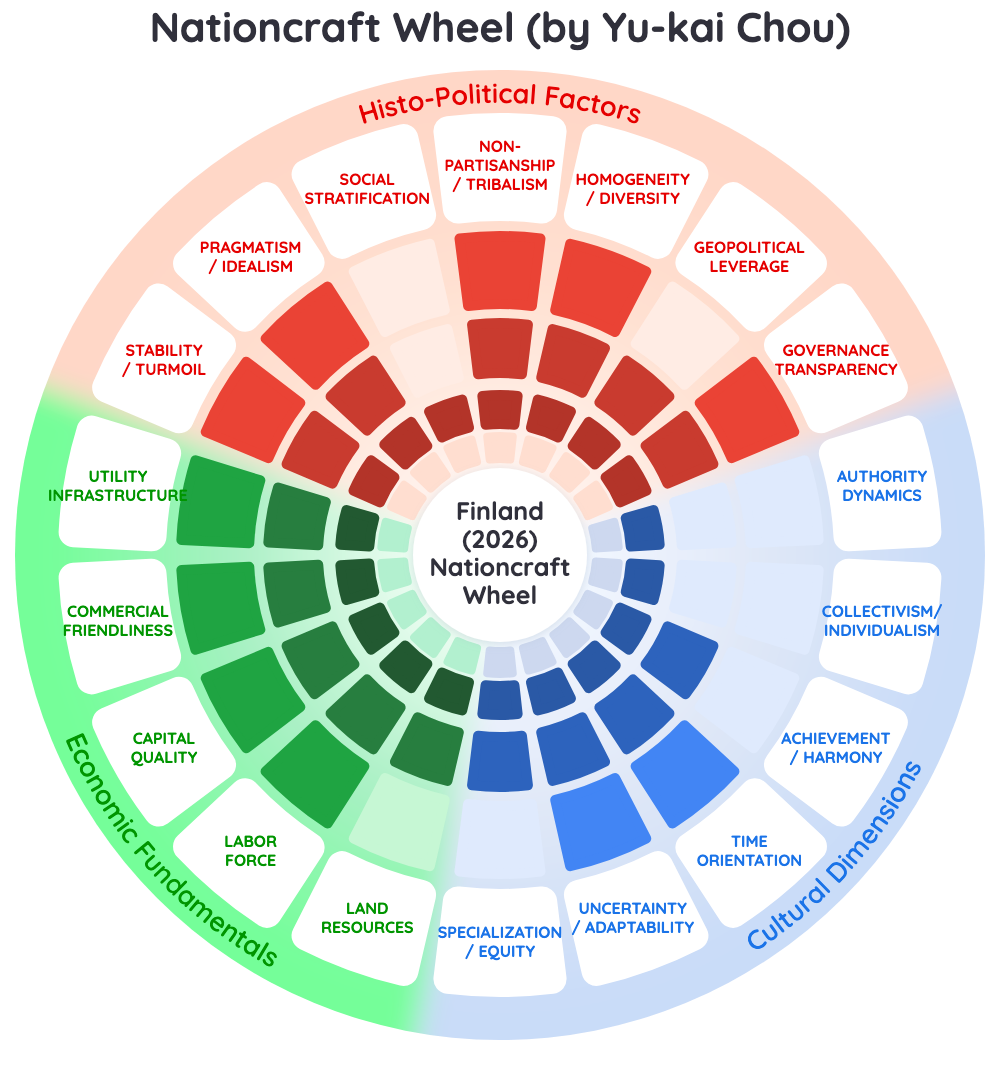
Hold those two announcements side by side and you are looking at the most instructive governance experiment in Europe right now. A society carrying one of the strongest preparedness clusters in the Nationcraft corpus (V4=8 planning horizon, V7=9 stability, V10=9 cross-party trust, V13=10 transparency) is financing an open-ended deterrence bill from an economy that has barely grown since 2008, on a fiscal base that just crossed 90 percent debt-to-GDP.
I call this configuration the Deterrence Mortgage. Finland is buying tomorrow’s security on credit drawn against the same welfare model the deterrence exists to protect. This analysis reads the October 2026 moment through the Nationcraft lens: what the 18 Nation Variables actually say, why six celebrated reform playbooks would fail against this profile, and why the playbook Finland should study hardest is the one it already ran once, in 1991, when the last eastern shock and the last fiscal crisis arrived together.
⚡ Speed Run Notes
- Finland ordered ~1 million domestic anti-personnel mines (~€100M) in October 2026 after exiting the Ottawa Treaty in January, while debt hit 90.3% of GDP and unemployment headed past 10%.
- The Nationcraft read: one of Europe’s strongest preparedness clusters (V4=8, V7=9, V10=9, V13=10) is being financed by one of its weakest growth stories. The Deterrence Mortgage is paid monthly, from a flat income.
- Finland already solved a worse version of this in 1991–2000: the SP-110 packet grew R&D to 3.5% of GDP during austerity instead of cutting it. The corpus says that counter-cyclical move is repeatable.
- Six famous playbooks fail Finland’s preconditions: Thatcher, Rogernomics, Park, Vision 2030, Bukele, and the Norway fund. Each needs a variable Finland lacks or breaks one Finland cannot spare.
- The variable to watch is V16 Capital Quality. Deterrence can be borrowed for a while; a welfare state’s collateral has to be earned by growth, and 0.8% growth does not service a 90% mortgage.
Table of Contents
- Understanding Finland’s Governance Landscape Through Nationcraft
- What Is the Nationcraft Framework?
- Why This Finland Variables Analysis Matters Now
- What Finland Actually Looks Like in Numbers
- The 18 Finland Nation Variables
- The Deterrence Mortgage: Finland’s Named Paradox
- Detailed Justifications: Reading Each Variable
- Six Reformer Playbooks Finland’s Renewal Should Reject
- Three Reformer Playbooks Worth Studying Instead
- Governance Strategy Recommendations
- Strategic Implications
- Comparative Context
- The Nationcraft Framework in Practice
- Explore More Nationcraft Analyses
- Frequently Asked Questions
About Yu-kai Chou

Yu-kai Chou is a Human-Systems Architect & Behavioral Designer and the creator of the Nationcraft Framework — an 18-variable diagnostic for matching a country’s structural profile to the reform packets that have historically worked under similar conditions. He has consulted for governments in eight nations, including Ukraine, the United Kingdom, the Kingdom of Bahrain, Singapore, Taiwan, the Netherlands, Kazakhstan, and South Korea, and has worked directly with President Zelenskyy’s team on post-war reconstruction priorities for Ukraine.
Chou’s prior framework — the Octalysis Framework — has been applied by LEGO, Microsoft, Porsche, Coca-Cola, Salesforce, and MrBeast, impacting over 1.5 Billion Users. He has taught the methodology at Harvard, Stanford, Yale, Tesla, Google, BCG, and IDEO.
His work has been cited by Harvard, Stanford, MIT, Forbes, Wall Street Journal, Wired, US Department of Energy, NIST, NSF, NCBI, US Department of Education, ClinicalTrials.gov, and Google Scholar — with 3,700+ more academic publications. Explore his books here.

I have advised governments including Ukraine, the UK, Bahrain, Singapore, Taiwan, the Netherlands, Kazakhstan, and South Korea, and several of those engagements turned on the same question Finland now faces: how a small, open, high-trust state pays for security without starving the system that makes it worth securing. Finland is the cleanest live test of that question anywhere in the corpus, which is why this analysis reads its October 2026 procurement news against its fiscal ledger rather than against its headlines.
Understanding Finland’s Governance Landscape Through Nationcraft
Finland enters the Nationcraft corpus with one of its most enviable configurations. V13 (Governance Transparency) reads 10, the ceiling of the scale, and no other variable in the profile falls below 3.
There is no authority concentration to diagnose here. V1 (Authority Dynamics) sits at 3: a four-party coalition under Prime Minister Petteri Orpo governs until the April 2027 election, courts rule against the state routinely, and no single office can move the system alone.[5]
That is precisely what makes Finland interesting. Most countries in this series are studies in what a state lacks. Finland is a study in what a state can lose, and how quietly it can happen while every headline is about something else.
The pressure arrives from two directions at once. From the east: a 1,340-kilometer border with Russia, closed to ordinary crossings since late 2023 over instrumentalized migration, monitored for hybrid interference, and now slated for a million-mine defensive stockpile.[1][6] From the inside: an economy that produced 0.8 percent growth in 2025, a deficit forecast at 4.2 percent of GDP for 2026, and a debt ratio that crossed 90 percent while nobody was holding a press conference about it.[4][5]
I examined a related configuration in Sweden’s Trust Overdraft Trap, where a Nordic model spends social trust faster than it regenerates. Finland’s version is fiscal rather than social: the trust is intact, and the invoice is denominated in euros.
What Is the Nationcraft Framework?
The Nationcraft Framework treats a nation the way a systems designer treats any motivational system: diagnose the configuration first, prescribe second.
It scores every nation on 18 Nation Variables across three groups. Cultural variables (V1–V6) capture how people relate to authority, to each other, and to time. Histo-political variables (V7–V13) capture stability, pragmatism, stratification, partisan trust, diversity, external leverage, and transparency. Economic variables (V14–V18) capture land, labor, capital, commercial friendliness, and infrastructure.
The Nationcraft thesis is that policy effectiveness is decided by context-fit rather than policy quality. The same fiscal consolidation that rebuilt Sweden in 1994 wrecked other economies that tried it, because the receiving configuration differed.
The framework grew out of behavioral design. I spent two decades studying why people do what they do, and the extension of Octalysis to nation-building and public policy follows the same logic at population scale: motivation is designed, and nations are the largest motivational systems humans build.
Against this corpus of 147 country profiles, 139 historical Success Packets, and 35 recurring patterns, Finland’s October 2026 moment can be measured rather than merely narrated.
Why This Finland Variables Analysis Matters Now
Three sets of publications landed within three weeks of each other this autumn, and together they frame the moment.
On October 8, Statistics Finland released preliminary national accounts showing 2025 growth of 0.8 percent and a 2025 deficit of 3.8 percent of GDP, after reporting on September 30 that general government debt had reached 90.3 percent of GDP in the second quarter.[4][7]
On October 2, the Ministry of Finance published its autumn forecast: growth of 1.6 percent in 2026, inflation back to 2.0 percent, unemployment rising to 10.3 percent, and a deficit widening to 4.2 percent.[5] The Bank of Finland’s June forecast was darker still, with 0.7 percent growth and debt reaching 91.9 percent of GDP.[8]
Then, in the week of October 19, the Defence Forces confirmed the plan to acquire roughly one million domestically produced anti-personnel mines by 2028, the first such program since Finland’s Ottawa Treaty exit took effect in January.[1][2][3]
Each story was covered separately. Nationcraft insists on reading them as one story, because they are one ledger. A deterrence posture is a recurring liability, and the only question that matters across the next ten years is which asset services it.
Poland faces a cousin of this question with a very different political configuration, which I analyzed in Poland’s Liberum Veto Trap: Europe’s fastest rearmament riding on institutions that veto each other. Finland’s institutions agree with each other. Its constraint is arithmetic.
What Finland Actually Looks Like in Numbers
The security pivot is real and so is the stagnation. Here is the October 2026 scoreboard with sources.
| Indicator | Reading | As of | Source |
|---|---|---|---|
| Real GDP growth, 2025 | 0.8% (preliminary) | Oct 8, 2026 | [7] |
| Real GDP growth, 2026 forecast | 1.6% (Ministry of Finance); 0.7% (Bank of Finland, June) | Oct 2 / Jun 2026 | [5][8] |
| Inflation | 0.3% in 2025; 2.0% forecast for 2026 | Oct 2, 2026 | [5] |
| Unemployment | 9.7% in 2025; 10.3% forecast for 2026 | Oct 2, 2026 | [5] |
| General government debt | €259.6 billion (90.3% of GDP), up €13.6B year-on-year | Q2 2026 | [4] |
| Fiscal deficit | 3.8% of GDP in 2025; 4.2% forecast for 2026 | Oct 2026 | [5][7] |
| Anti-personnel mine order | ~1 million units, ~€100M, domestic production, stockpile by 2028 | Oct 19–20, 2026 | [1][2] |
| Treaty posture | Ottawa Mine Ban Treaty exit effective January 2026 | Jan 2026 | [3] |
| Air force recapitalization | 64 F-35A fighters on order from the United States | ongoing | [8] |
| NATO membership | Member since April 4, 2023; the alliance’s longest border with Russia | current | [6] |
Read the bottom four rows against the top six. The bottom rows are commitments that extend past 2035. The top rows are the income statement that has to carry them.
Nationcraft treats the gap between those two groups as the dependent variable. The eighteen readings below are the independent ones.
The 18 Finland Nation Variables
These scores come from the Nationcraft corpus, cross-checked this month against Statistics Finland, the Ministry of Finance autumn forecast, the Bank of Finland outlook, and the standard transparency and freedom indices. Scores run 1–10 and measure ease of governance under each dimension, never moral worth.
| Variable | Score | October 2026 reading |
|---|---|---|
| V1 Authority Dynamics | 3 | Consensus coalition democracy; power dispersed across parties, courts, and agencies |
| V2 Collectivism vs Individualism | 3 | Individualist society resting on exceptional interpersonal trust |
| V3 Achievement vs Harmony | 6 | Quiet achievement culture; engineering pride over status display |
| V4 Time Orientation | 8 | Total-defense planning measured in decades; pensions pre-funded; shelters built across generations |
| V5 Uncertainty & Adaptability | 8 | Executed the NATO pivot in under a year; absorbed full energy decoupling from Russia |
| V6 Specialization vs Equity | 6 | Deep forestry, machinery, and ICT clusters on an egalitarian base |
| V7 Stability vs Turmoil | 9 | Institutional stability intact; the 2024 strike wave stayed inside the rules |
| V8 Pragmatism vs Idealism | 8 | Dropped eight decades of non-alignment in one spring when the facts changed |
| V9 Social Stratification | 3 | Among the lowest inequality readings in the OECD |
| V10 Non-Partisanship vs Tribalism | 9 | Cross-bloc consensus machinery still functions; strained at the margin by the union conflict |
| V11 Homogeneity vs Diversity | 8 | Still among Europe’s most homogeneous societies; immigration rising from a low base |
| V12 Geopolitical Leverage | 4 | NATO’s longest Russia border makes Finland strategically vital and strategically exposed at once |
| V13 Governance Transparency | 10 | Perennial top of the corruption-perception and press-freedom tables; the corpus ceiling |
| V14 Land Resources | 6 | Forests, minerals, and hydro; no hydrocarbon rent to lean on |
| V15 Labor Force Quality | 7 | Highly educated workforce; aging and a PISA slide erode the edge at the margin |
| V16 Capital Quality | 9 | Deep pension funds, sound banks, strong credit standing, now carrying 90.3% debt-to-GDP |
| V17 Commercial Friendliness | 9 | Top-tier business environment; pristine rule of law |
| V18 Utility Infrastructure | 9 | Olkiluoto 3 online; Nordic grid integration; near-universal broadband |
Summed naively, this is one of the strongest profiles in the corpus. Nationcraft never sums naively, because configuration is strategy, and the configuration contains exactly one weakness that every other strength now has to pay for.
The Deterrence Mortgage: Finland’s Named Paradox
Every Nationcraft analysis names the specific variable interaction that defines the country’s trap. Finland’s is the Deterrence Mortgage, and it runs through five variables.
Start with the preparedness cluster. V4=8 means Finland plans in decades: it kept conscription when the rest of Western Europe abandoned it, pre-funded its pensions, and maintained a civil-defense shelter network sized for most of the population through fifty years in which none of it was fashionable. V7=9 and V10=9 mean the political system can sustain a policy across governments without relitigating it. V13=10 means the public can see what it is paying for.
That cluster is why Finland’s security pivot has been so fast and so coherent. NATO accession, border closure, F-35 procurement, treaty exit, mine production: each step was debated, decided, and executed without a constitutional crisis or a legitimacy fight.[3][6] In Germany’s Consensus Machine Trap I showed how consensus can become the obstacle to rearmament. Finland is the control case, where the same consensus machinery became the accelerant.
Now look at what finances it. V16=9 reflects excellent capital institutions. The stock those institutions manage, though, is deteriorating. Debt crossed 90 percent of GDP in mid-2026, rising 13.6 billion euros in a year.[4] The deficit is forecast to widen, not close.[5] Growth has averaged close to zero in real per-capita terms since 2008, when Nokia’s handset empire and the old paper economy peaked together.
Here is the mortgage structure. Deterrence is a liability with no maturity date: mines must be replaced, jets must be flown, a 1,340-kilometer border must be watched forever. The collateral is the welfare model itself: the education, health, and social insurance systems that produce V9=3, V13=10, and the social trust that makes total defense possible. The willingness of reservists to serve is anchored in the belief that the state is worth defending.
A mortgage is not a trap while income grows. Finland’s income does not grow. 0.8 percent in 2025, perhaps 1.6 percent in 2026, with unemployment forecast above 10 percent.[5][7] Each year the deterrence bill is paid by borrowing against the collateral rather than from earnings, and each year the collateral quietly thins: an aging workforce (V15=7 and drifting), a youth cohort watching taxes rise, services tighten, and jobs stall.
The paradox, stated once: the variables that make Finland uniquely able to sustain deterrence are funded by the one variable the deterrence spending is eroding. V4, V7, V10, and V13 write the mortgage. V16 services it. Nothing in the current configuration pays it down.
Finland has been here before. That matters more than anything else in this analysis, and it is where the packet matching below ends up.
Detailed Justifications: Reading Each Variable
Cultural variables (V1–V6): the trust machine
V1 Authority Dynamics = 3. Finnish authority is procedural, distributed, and reversible. The Orpo coalition pushed contested labor and benefit reforms through in 2024 against the largest strike wave in decades, and the fight stayed entirely inside parliament, courts, and collective bargaining.[5] No emergency powers, no court-packing, no referendum theater.
V2 Collectivism vs Individualism = 3. Finns are individualists who cooperate through institutions rather than through kin networks. This is the inverse of the configurations I analyzed across the Gulf and South Asia, where V2 runs high and institutions compete with family loyalty.
V3 Achievement vs Harmony = 6 captures a culture that competes hard in engineering, education, and sport while disliking display. V6 Specialization vs Equity = 6 reflects world-class clusters (forestry machinery, telecom equipment, icebreakers, gaming) sitting on a deliberately flat wage structure.
V4 Time Orientation = 8 is the signature Finnish score. The shelter network, the conscription system, the pension pre-funding, and the national emergency stockpiles were all maintained for decades without an imminent threat to justify them. When the threat returned in 2022, the infrastructure of patience was already built.
V5 Uncertainty & Adaptability = 8 earned its reading in 2022–2023: NATO application within three months of the invasion, membership by April 2023, and a full energy decoupling from Russia absorbed without blackouts.[6]
Histo-political variables (V7–V13): the ceiling scores
V7 Stability vs Turmoil = 9. Nothing institutional has wobbled: elections proceed, coalitions form, courts rule. The sanity check this month logged one caveat: a two-year run of political strikes and unemployment past 10 percent are stability costs, even when absorbed lawfully.
V8 Pragmatism vs Idealism = 8. The same country that wrote humanitarian disarmament into its identity reversed course on mines within three years of the Ukraine invasion, on explicit battlefield evidence.[1][3] Whatever one thinks of the decision, it is the behavior of a state that prices doctrine against facts.
V9 Social Stratification = 3 and V11 Homogeneity vs Diversity = 8 continue to reinforce each other: a flat, cohesive society where free-riding is socially expensive. V10 Non-Partisanship vs Tribalism = 9 is the score under the most pressure: the government-union conflict and a harder-edged populist bloc in cabinet strain the consensus reflex. Yet cross-party agreement on security policy remains total, which is the Nationcraft definition of the score.
V12 Geopolitical Leverage = 4 is the quiet low score. Finland gained alliance protection in 2023 and simultaneously became NATO’s longest land frontier with Russia, a position that consumes leverage as fast as it confers importance.[6] A country whose border is the alliance’s tripwire does not get to choose its own agenda.
V13 Governance Transparency = 10 is the corpus ceiling, and it earns its keep: this is the variable that makes the Deterrence Mortgage survivable at all, for reasons the recommendations section will make explicit.
Economic variables (V14–V18): a strong engine at idle
V14 Land Resources = 6: forests that built the first Finnish economy, promising battery-mineral deposits, and no hydrocarbons. There is no rent to hide behind, which the rejected-playbooks section below turns from a weakness into a filter.
V15 Labor Force Quality = 7: still among the best-educated workforces on earth, with two erosions at the margin: the demographic pyramid narrowing at working age, and a decade-long slide in the PISA scores that once defined the brand.
V16 Capital Quality = 9: deep pension capital, sound banks, and uninterrupted market access. The score measures institutions rather than balances, and the balances are the problem: 90.3 percent debt-to-GDP and a 4.2 percent deficit mean the institutions are now financing consumption and deterrence rather than investment.[4][5]
V17 Commercial Friendliness = 9 and V18 Utility Infrastructure = 9 round out an economy with no structural excuse. Starting a business is easy, contracts are enforced, electricity is clean and increasingly abundant with Olkiluoto 3 online, and connectivity is near-universal. The engine itself gives Finland no structural excuse, which sharpens the question of why it has idled since 2008.
Six Reformer Playbooks Finland’s Renewal Should Reject
The Nationcraft corpus holds 139 Success Packets: documented reform programs with their historical preconditions scored on the same 18 variables. Matching Finland’s 2026 profile against them rules out the famous options first.
1. The Thatcher packet (SP-102, United Kingdom 1979–1990)
The obvious temptation for a stagnant, heavily unionized economy with double-digit unemployment. The preconditions do not transfer. Thatcher’s program ran on confrontation: it required a crisis mandate born of the Winter of Discontent, 27 percent inflation within living memory, and an electorate willing to break the unions as institutions (SP-102).
Finland’s inflation is 2 percent, its crisis is slow rather than acute, and its unions co-manage unemployment insurance and wage formation inside the V10=9 consensus machinery. A confrontation strategy would not merely fail; it would spend the cross-party trust that holds the entire defense consensus together. The 2024 strikes were the free sample of that cost.
2. Rogernomics (SP-108, New Zealand 1984–1993)
New Zealand’s overnight liberalization is the template reformers reach for when gradualism feels exhausting. Its precondition was an acute currency crisis (reserves nearly exhausted, a forced 20 percent devaluation) that suspended normal politics and licensed shock (SP-108).
Finland has no such license. V7=9 and euro membership mean there is no emergency window, and a V4=8 society punishes manufactured urgency. Running shock therapy without a shock would simply vandalize institutions that still work.
3. The Park Chung-hee packet (SP-008, South Korea 1961–1979)
Directed industrialization under concentrated authority: V1=9, V2=9, V3=9 in the packet’s benchmark reading, a population that accepted command and sacrifice (SP-008). Finland reads V1=3 and V2=3. There is no command channel to industrialize through, and building one would destroy the V13=10 transparency that is Finland’s actual comparative advantage. The packet is unrunnable here, and that is to Finland’s credit.
4. Vision 2030 (SP-037, Saudi Arabia 2016– )
The megaproject transformation model requires two things Finland lacks: an absolute executive (the packet benchmarks V1=10) and a hydrocarbon rent to spend down while the new economy gestates (SP-037). Finland’s V14=6 offers no rent, and its V1=3 offers no executive who could commit a generation of spending by decree. Megaproject politics inside a consensus democracy tends to deliver compromise monuments instead of new economies.
5. The Bukele packet (SP-064, El Salvador 2019– )
Included because its logic is spreading through European politics: trade institutional checks for visible, rapid results. The packet’s precondition was institutional collapse: courts and parties so discredited (V1=8 concentration riding on their ruins) that the population preferred results to process (SP-064).
Finland’s institutions are the most trusted in Europe. V13=10 means there is nothing to trade: every check surrendered would be a real loss priced in real trust, purchased for results a functioning system could have delivered anyway. This packet is what the Deterrence Mortgage forecloses into if renewal fails and a decade of stagnation curdles politics. It belongs on the rejection list as a warning, not an option.
6. The Norway fund packet (SP-106, Norway 1990–2010)
The nearest neighbor and the most misleading model. Norway’s packet solved the problem of too much money: sterilize petroleum revenue in an offshore fund under consensus rules, with the packet benchmarking V1=4 and V2=8, recognizably Nordic (SP-106). Finland can copy the governance but has nothing to put in the vault, because V14=6 yields no rent. Without a revenue torrent, a sovereign fund is an org chart waiting for deposits, so the Finnish version of Norwegian discipline has to run through the expenditure side — which is a different packet entirely, the one Sweden wrote.
Three Reformer Playbooks Worth Studying Instead
The packets that fit Finland’s configuration are less famous and more Nordic. One of them is Finnish.
| Packet | Country / years | Precondition match to Finland 2026 | What it delivered |
|---|---|---|---|
| SP-110 Post-Soviet Nokia Miracle | Finland 1991–2000 | Eastern shock + banking crisis + fiscal squeeze on the same consensus V-vector | GDP fell 13% in 1990–93 and unemployment hit 20%; a decade later Finland was a knowledge economy with R&D at 3.5% of GDP |
| SP-109 Banking Crisis & Fiscal Consolidation | Sweden 1990–1996 | Consensus polity (V1=4, V2=8 at benchmark) consolidating ~11% deficits without breaking the model | Growth restored by 1996; the fiscal framework that followed became the Nordic standard |
| SP-113 Flexicurity Labor Market | Denmark 1994–2005 | 12% unemployment in a high-trust, union-dense welfare state; Finland’s 2026 labor problem almost exactly | Unemployment to 5% by 1999 and 4.8% by 2005, with security preserved through activation |
SP-110: the packet Finland already owns
In 1991 the Soviet collapse erased a quarter of Finland’s export trade, a banking crisis forced emergency restructuring, GDP fell 13 percent over three years, and unemployment went from 3 to 20 percent (SP-110). The configuration that absorbed that blow (consensus authority, long time horizon, high transparency) is the same one reading V4=8, V10=9, V13=10 today.
The move that made SP-110 canonical was counter-cyclical and counter-intuitive: while consolidating everything else, the state raised R&D spending toward 3.5 percent of GDP, the OECD’s highest, kept education funding intact through the worst of the austerity, deregulated telecoms early, and anchored the whole program to EU accession in 1995. The packet’s recorded lesson is explicit: a small open economy can pivot from a dependent trade structure to a knowledge economy within a decade, but only by protecting investment in people and research during the crisis, the opposite of reflexive austerity.
The 2026 rhyme is uncomfortably precise. Another eastern rupture, another fiscal squeeze, another decade demanding a new engine. The difference is that in 1991 Finland had no choice but renewal, while in 2026 the mortgage can be serviced quietly for years before the collateral visibly fails. SP-110 is the proof that this specific V-vector can grow its way out. The paradox is that the proof removes the urgency.
SP-109: Sweden’s expenditure-side discipline
Sweden’s 1990s crisis was the harder version of Finland’s 2026 position: a deficit reaching 11 percent of GDP, three insolvent banks, and a failed currency defense that peaked at a 500 percent marginal interest rate (SP-109). The repair ran through the expenditure side under cross-party rules: transparent bank resolution, multi-year consolidation, and a fiscal framework both blocs honored after the crisis passed.
The precondition that made it work was the willingness of a high-solidarity society (the packet benchmarks V2=8) to accept shared sacrifice when the accounting was honest and the burden visibly fair. Finland holds the same cards, with better transparency. What SP-109 adds to SP-110 is the fiscal architecture: consolidation survives elections only when it is rule-bound rather than government-bound.
SP-113: Denmark’s answer to 10 percent unemployment
Denmark in 1993 had 12 percent unemployment inside a generous, passive welfare system (SP-113). Flexicurity rebuilt it as a triangle: easy hiring and firing, strong income security, and mandatory activation. Unemployment fell to 5 percent by 1999. The packet’s implementation notes read like a Finnish manual: union co-management preserved buy-in, gradual tightening replaced shock, and the framing of rights paired with duties made activation politically durable.
Finland’s 2024–2026 labor reforms moved in this direction through confrontation rather than co-management, and the strike wave was the price. SP-113’s lesson is that the same destination was reachable with the unions inside the room: slower on paper, faster in practice, because nothing had to be defended against repeal.
Governance Strategy Recommendations
Nationcraft recommendations are addressed to the general reader studying how this configuration renews itself, and they follow from the packet evidence rather than from preference. For Finland’s profile, reform means one thing: growing the engine that services the mortgage, in the open, without spending the trust that makes the whole system work.
| Priority | Move | Packet basis | Variables engaged |
|---|---|---|---|
| 1 | Publish the full, consolidated cost of the security pivot (procurement, border, readiness) as a single auditable line the public can track year over year | SP-109’s honest-accounting precondition | V13=10 put to work; protects V10=9 |
| 2 | Protect R&D and education spending through the coming consolidation, explicitly and by rule, as the 1990s governments did | SP-110’s counter-cyclical core | V15, V16, V4 |
| 3 | Rebuild labor-market reform on co-management terms: activation with the unions inside the design, not across a picket line | SP-113 implementation tactics | V10, V15, V7 |
| 4 | Widen the working-age base: labor participation, retention of graduates, and skilled immigration priced honestly to a V11=8 society | SP-110’s human-capital floor; PB-12 | V15, V11 |
| 5 | Bind consolidation to a cross-bloc fiscal rule with an explicit debt anchor, so the path survives the 2027 election whatever its result | SP-109’s framework legacy | V16, V10, V4 |
Note what is absent. Nothing above makes the state’s security apparatus stronger, because that is not the gap. Finland’s deterrence is credible today. What is not yet credible is the thirty-year financing plan behind it, and every row in that table is about the civilian engine (research, skills, workers, and honest accounts) whose beneficiaries are the people paying for the mines.
The measurable outcomes that would mark success are civilian ones: growth above 2 percent, unemployment back under 7, the debt ratio bending below 90, PISA scores recovering, and net graduate retention turning positive. A reform decade that delivers those numbers pays the mortgage. One that delivers only hardware does not.
Strategic Implications
For students of reform sequencing, Finland is the rare case where the binding constraint is neither legitimacy nor capability but compounding arithmetic. The configuration can decide, execute, and sustain; what it has not done since 2008 is grow.
For EU and alliance watchers, the implication is uncomfortable: frontline deterrence in Europe’s north is being financed by deficit spending in a stagnant economy, and the political premise that welfare and defense never compete will be tested in public, in Finnish, within this parliament or the next.
For investors and policy professionals, the signal variable is V16. Watch the spread between Finland’s institutional quality and its fiscal trajectory. A V13=10 country will publish its own deterioration in exquisite detail, which means the data to act on will never be the problem. The will to act on it is the entire game.
For reform students comparing configurations: contrast this with Russia’s Fortress Economy Trap across the border, where a state finances its posture by consuming its future through inflation and capital controls, hidden from its own public. Finland’s version of the same arithmetic runs in daylight, and daylight is where every workable repair starts. Only one side of that border has it.
Comparative Context
Finland’s closest corpus siblings each miss its situation in an instructive way.
Sweden shares the model and the transparency, and its 1990s packet (SP-109) is directly loadable; what Sweden lacks is the 1,340-kilometer border, so its consolidation never had to compete with a standing deterrence bill. Its current strains are the subject of the Sweden analysis linked above.
The Netherlands shows the other Nordic-adjacent failure mode: an engine so strong it masks structural rot, analyzed in the Second Dutch Disease. Finland has the opposite problem: structure without momentum.
Ukraine is the reason the mortgage exists, and its own V-vector (forged collectivism, collapsed capital) is the subject of Ukraine’s Escrowed Recovery Trap. Finland is, in effect, pre-paying to avoid ever holding Ukraine’s 2022 hand.
And the cautionary endpoint of security-first governance sits in the corpus as Eritrea’s Permanent Siege Trap: a state that let mobilization become the economy. Finland is nowhere near it, and the distance is measured precisely by V13, a 10 against a 1, which is why transparency is the variable this analysis keeps returning to.
The Nationcraft Framework in Practice
This analysis demonstrates the core Nationcraft method: diagnose the 18-variable configuration, name the paradox the variables produce, then filter 139 historical packets by precondition fit rather than by fame.
Finland’s reading rejects six celebrated playbooks because each requires a variable Finland lacks (a crisis mandate, a command channel, a rent) or breaks one Finland cannot spare (V10 consensus, V13 transparency). It elevates three Nordic packets because their preconditions (consensus authority, high trust, honest accounts) are Finland’s exact endowment.
The deeper Nationcraft point is that Finland’s hardest problem is motivational, which is why a behavioral framework has standing here at all. A population will accept a decade of renewal effort when the stakes are legible and the accounting is honest; it will not accept quiet decline on autopilot. Making the mortgage visible is a motivation design problem, and motivation design at population scale is exactly the job the Nationcraft lens was built for.
Explore the full methodology at the Nationcraft Framework hub linked throughout this piece, including the 18 variables, the 8 national goals, and the packet library this analysis draws from. For how a city-state turned its own V-vector into fifty years of compounding, the companion piece on Singapore’s LKY packet stress test shows the method applied to a success story, and the Small-State Borrowed Buffer comparison shows it applied to three states that, like Finland, survive on configuration rather than mass.
Explore More Nationcraft Analyses
The full Nationcraft country analyses library holds every published V-vector, wheel, and named paradox in one place.
Readers tracking Europe’s security repricing should pair this analysis with the Poland and Germany readings linked above, and with Israel’s Startup Nation Trap, the corpus’s standing example of a small state that made permanent security pressure compatible with a compounding economy, which is the exact equation Finland now has to solve on Nordic terms.
Closing
Finland has earned the benefit of every doubt. It is the best-governed stagnant economy on earth, and its security pivot has been executed with a competence most of its allies can only study.
The Nationcraft ledger simply insists on the whole balance sheet: a deterrence liability with no end date is now secured against a welfare model whose income has been flat for a generation. The 1991 generation faced the same double bind with fewer resources and answered with the most successful renewal packet in the Nordic corpus. The 2026 generation holds a better hand and a weaker sense of emergency. The mines will be delivered by 2028. The variable worth watching matures later, and it is not stored in a bunker.
Frequently Asked Questions
What is the Deterrence Mortgage paradox?
It is the configuration in which the variables that make a nation able to sustain long-term deterrence (planning horizon, stability, consensus, transparency) are financed by borrowing against the welfare model those variables depend on. Finland in 2026 is the live case: an open-ended security bill serviced from a 90.3 percent debt ratio and 0.8 percent growth.
Why did Finland leave the Ottawa Mine Ban Treaty?
Finland’s government and parliament concluded, citing Russia’s extensive use of mines in Ukraine and the demands of defending a 1,340-kilometer border, that anti-personnel mines were again militarily necessary. The withdrawal took effect in January 2026, and in October 2026 the Defence Forces confirmed plans to procure roughly one million domestically produced mines by 2028.
Is Finland’s economy actually in crisis?
No, and that is the trap’s defining feature. Finland retains top-tier credit standing, deep pension capital (V16=9), and a world-class business environment (V17=9). The problem is a slow one: growth of 0.8 percent in 2025, unemployment forecast at 10.3 percent, and debt rising 13.6 billion euros in a year. Nothing is collapsing, so nothing forces the renewal the arithmetic requires.
Which reform playbooks actually fit Finland’s Nationcraft profile?
Finland’s own 1991–2000 packet (SP-110), Sweden’s 1990s fiscal consolidation (SP-109), and Denmark’s flexicurity labor reform (SP-113). All three operated on consensus-governed, high-trust Nordic configurations like Finland’s V-vector. The celebrated alternatives, from Thatcher (SP-102) and Rogernomics (SP-108) to Park (SP-008), Vision 2030 (SP-037), Bukele (SP-064), and the Norway fund (SP-106), each require preconditions Finland lacks or would break variables Finland cannot spare.
What would prove Finland is paying down the Deterrence Mortgage rather than just servicing it?
Civilian numbers moving together: growth sustained above 2 percent, unemployment under 7 percent, the debt ratio bending back below 90, R&D and education spending protected through consolidation, and young-graduate retention turning positive. Those series would show the engine growing faster than the liability: the SP-110 outcome repeating under 2020s conditions.
Related Reading
- The Nationcraft Framework: 18 Variables, 8 Goals, 100+ Proven Reform Packets
- Nationcraft Nation Variables Library
- Nationcraft Analysis: Pakistan Borrower’s Gavel 2026
- Nationcraft Analysis: Czech Republic Firm State Trap 2026
- Nationcraft Analysis: Kuwait Future Generations Trap 2026
Footnotes
- Al Jazeera, “Finland seeking one million land mines as it eyes Russian threat,” October 19, 2026. aljazeera.com
- Militarnyi, “Finland to Purchase One Million Domestic Anti-Personnel Mines for €100 Million,” October 2026. militarnyi.com
- Kyiv Post, “Finland to Invest in Anti-Personnel Mines After Ottawa Convention Withdrawal,” October 2026. kyivpost.com
- Statistics Finland, “General government debt by quarter” (Q2 2026: EUR 259.6 billion, 90.3% of GDP, +EUR 13.6 billion year-on-year), September 30, 2026. stat.fi
- Ministry of Finance, Finland, Economic Survey, Autumn 2026 (growth 1.6% and inflation 2.0% forecast for 2026; unemployment 9.7% in 2025 rising to 10.3% in 2026; general government deficit 4.2% of GDP in 2026), October 2, 2026, as compiled with Statistics Finland releases in the State Treasury investor presentation, October 2026. valtiokonttori.fi (PDF)
- NATO, “Relations with Finland” (membership April 4, 2023), accessed October 2026. nato.int
- Statistics Finland, preliminary national accounts 2025 (GDP +0.8%; general government deficit 3.8% of GDP), October 8, 2026. stat.fi
- Bank of Finland, economic forecast, June 2026 (GDP growth 0.7% in 2026; unemployment 10.4%; general government debt 91.9% of GDP; the F-35 and defense-investment context). suomenpankki.fi (PDF)